Kafka Consumer Group Rebalancing: Coordinated vs. Incremental Cooperative Deep Dive

Introduction
Apache Kafka has become the de facto standard for building high-throughput, fault-tolerant, and scalable real-time data pipelines and stream processing applications. At the heart of Kafka's ability to distribute message consumption lies the concept of Consumer Groups and their intricate mechanism for assigning partitions to consumers: Rebalancing.
While consumer groups provide parallelism and fault tolerance, the rebalancing process itself can introduce latency and impact application availability. Traditionally, Kafka has relied on a "stop-the-world" approach to rebalancing. However, with the introduction of Incremental Cooperative Rebalancing, a more graceful and efficient mechanism emerged, significantly improving the operational characteristics of Kafka consumer applications.
This article will take a deep dive into Kafka consumer group rebalancing, comparing the traditional Coordinated (Eager) approach with the modern Incremental Cooperative strategy. We'll explore their inner workings, practical implications, configuration, best practices, and common pitfalls, equipping you with the knowledge to build more resilient and performant Kafka applications.
Prerequisites
To get the most out of this guide, you should have a basic understanding of:
- Apache Kafka Fundamentals: Concepts like topics, partitions, brokers, producers, and consumers.
- Consumer Groups: How multiple consumers can subscribe to a topic and process messages in parallel.
- Java or Python Basics: Code examples will primarily use Java, with some conceptual discussion applicable to other client libraries.
Understanding Kafka Consumer Groups
A Kafka consumer group is a set of consumers that jointly consume messages from one or more topics. Each consumer within a group is assigned a subset of the partitions from the subscribed topics, ensuring that each partition is consumed by only one consumer in that group at any given time. This design provides both scalability (by adding more consumers) and fault tolerance (if a consumer fails, its partitions are reassigned).
When a consumer group is formed, or when its membership changes, Kafka needs a mechanism to determine which consumer instance owns which partition. This mechanism is called rebalancing.
The Challenge of Rebalancing
Rebalancing is a critical operation, but it comes with challenges:
- Service Interruption: During a rebalance, consumers stop processing messages, revoke their assigned partitions, and then get new assignments. This pause, even if brief, can lead to increased end-to-end latency and reduced throughput.
- Resource Overhead: Revoking and reassigning partitions can involve committing offsets, closing underlying network connections, and re-initializing state, incurring CPU and network overhead.
- State Management: For stateful stream processing applications (like those built with Kafka Streams), rebalancing can trigger expensive state store re-initialization or migration.
- Rebalance Storms: Frequent rebalances due to misconfiguration or unstable environments can lead to a "rebalance storm," where the group spends more time rebalancing than processing messages.
Understanding how different rebalancing strategies address these challenges is key to optimizing your Kafka applications.
Coordinated Rebalancing (Eager Protocol)
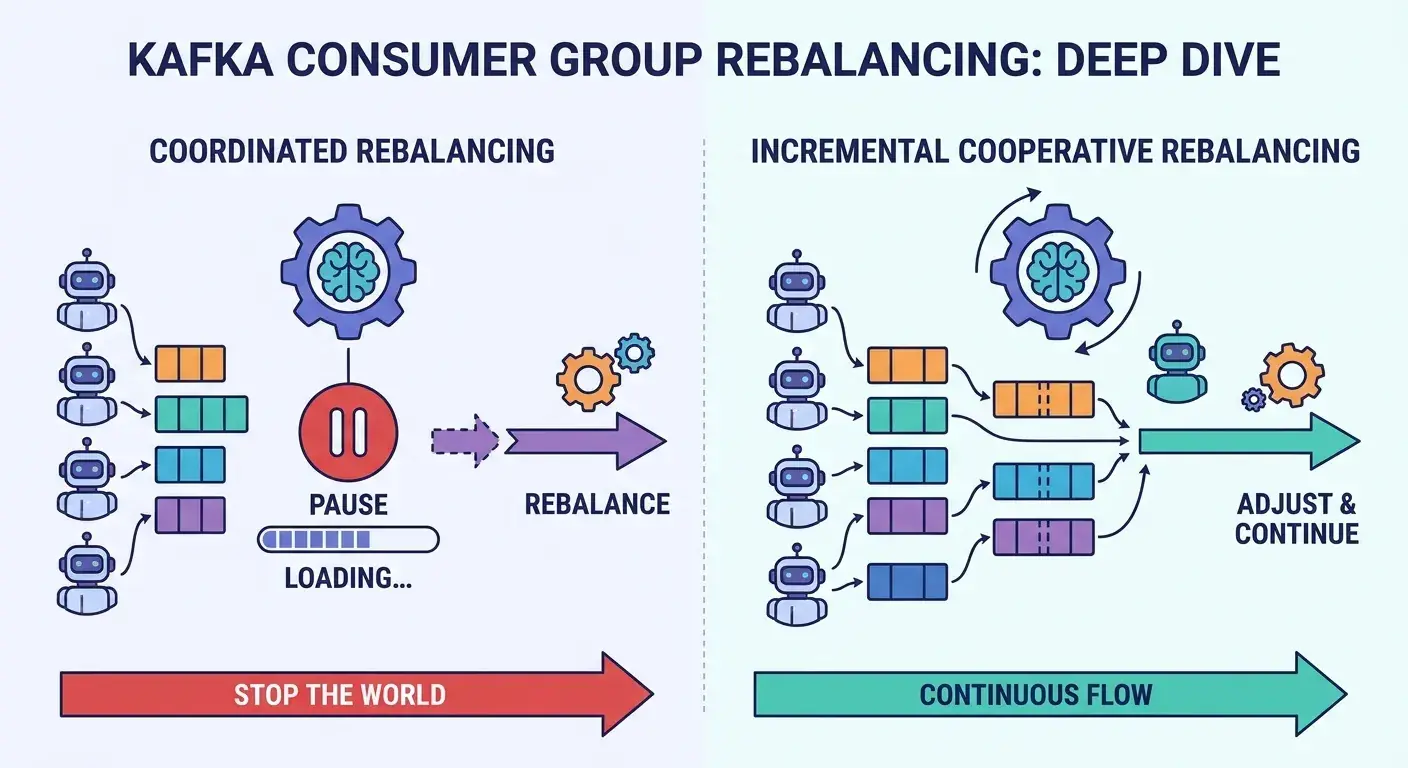
Historically, Kafka consumer groups primarily used what's now known as Coordinated Rebalancing, often referred to as the Eager Protocol. This strategy is characterized by its "stop-the-world" nature.
How it Works:
- Detection: A rebalance is triggered when a consumer joins the group, leaves the group (gracefully or due to a crash), or when a subscribed topic's partition count changes.
- Revocation: Upon detecting a rebalance, the group coordinator (a Kafka broker) instructs all active consumers in the group to revoke all their currently assigned partitions. Consumers must commit any pending offsets before revocation.
- Joining: All consumers then send a
JoinGrouprequest to the group coordinator. - Assignment: The group leader (one of the consumers elected by the coordinator) proposes a new partition assignment strategy (e.g.,
RangeAssignor,RoundRobinAssignor). The coordinator approves and distributes this assignment to all consumers. - Synchronization: Consumers receive their new assignments via a
SyncGrouprequest and begin fetching messages from their newly assigned partitions.
Drawbacks:
- Full Stop: All consumers stop processing messages simultaneously, even if only one consumer joined or left. This leads to a period of complete unavailability for the consumer group.
- Higher Latency: The time taken for all consumers to revoke, join, and synchronize can be significant, especially with many partitions or consumers.
- Resource Waste: Unnecessary revocation and re-assignment for consumers whose partition assignments haven't actually changed.
When it's Still Used:
While largely superseded by cooperative rebalancing for most modern applications, the Eager protocol is still the default for older Kafka client versions (0.10.2 and earlier) or when explicitly configured using assignors like RangeAssignor or RoundRobinAssignor (which are inherently eager).
Incremental Cooperative Rebalancing (Sticky Assignor)
To address the limitations of the Eager protocol, Kafka introduced Incremental Cooperative Rebalancing with KIP-429. This strategy aims to minimize service interruption by allowing consumers to retain as many of their existing partition assignments as possible during a rebalance.
How it Works:
Cooperative rebalancing typically uses the CooperativeStickyAssignor (or StickyAssignor in older versions with cooperative semantics). It operates in two phases:
- Phase 1: Revocation and Partial Assignment (First Rebalance)
- When a rebalance is triggered, the group coordinator informs consumers. Instead of revoking all partitions, consumers only revoke partitions that must be re-assigned (e.g., partitions that need to move to a new consumer or a consumer that is leaving).
- Consumers then send
JoinGrouprequests. The group leader proposes a new assignment, ensuring that partitions are only revoked if absolutely necessary. - Consumers receive their partial new assignments. They continue processing messages from partitions they still own.
- Phase 2: Full Assignment (Second Rebalance, if needed)
- After the initial partial assignment, the group might still be in an unbalanced state. A second rebalance is immediately triggered.
- During this second phase, the remaining unassigned partitions are distributed among the consumers, and consumers that temporarily held partitions during the first phase might give them up.
- The goal is to reach a final, stable, and balanced assignment with minimal disruption.
Key Concepts:
CooperativeStickyAssignor: This is the assignor that implements the cooperative protocol. It prioritizes keeping existing assignments stable and distributes partitions incrementally.- Minimal Disruption: Only partitions that need to change ownership are revoked. Consumers continue processing messages from partitions they retain.
- Two-Phase Process: A single logical rebalance might involve two actual rebalance cycles (JoinGroup/SyncGroup) to achieve the final balanced state. This is a crucial distinction from the eager protocol.
The CooperativeStickyAssignor vs. Other Assignors:
RangeAssignor: Assigns contiguous ranges of partitions to consumers. Can lead to uneven distribution if partition counts aren't multiples of consumer counts. Eager protocol.RoundRobinAssignor: Assigns partitions in a round-robin fashion across consumers. Better load distribution thanRangeAssignorbut still eager.StickyAssignor(legacy non-cooperative): An improvement overRangeandRoundRobinby trying to keep assignments stable. However, when a rebalance does occur, it still uses an eager (stop-the-world) approach.CooperativeStickyAssignor: The recommended assignor for modern Kafka applications. It combines the benefits of sticky assignments with the incremental, cooperative rebalancing protocol.
Implementing Incremental Cooperative Rebalancing
To enable cooperative rebalancing, you need to configure your Kafka consumers to use the CooperativeStickyAssignor.
Java Consumer Configuration Example:
import org.apache.kafka.clients.consumer.ConsumerConfig;
import org.apache.kafka.clients.consumer.KafkaConsumer;
import org.apache.kafka.common.serialization.StringDeserializer;
import java.util.Collections;
import java.util.Properties;

public class CooperativeConsumer {

    public static void main(String[] args) {
        Properties props = new Properties();
        props.put(ConsumerConfig.BOOTSTRAP_SERVERS_CONFIG, "localhost:9092");
        props.put(ConsumerConfig.GROUP_ID_CONFIG, "my-cooperative-group");
        props.put(ConsumerConfig.KEY_DESERIALIZER_CLASS_CONFIG, StringDeserializer.class.getName());
        props.put(ConsumerConfig.CONSUMER_CLIENT_ID_CONFIG, "coop-consumer-client-1");
        props.put(ConsumerConfig.VALUE_DESERIALIZER_CLASS_CONFIG, StringDeserializer.class.getName());
        // *** Crucial for Cooperative Rebalancing ***
        props.put(ConsumerConfig.PARTITION_ASSIGNMENT_STRATEGY_CONFIG,
                  "org.apache.kafka.clients.consumer.CooperativeStickyAssignor");

        // Other important settings for stability
        props.put(ConsumerConfig.SESSION_TIMEOUT_MS_CONFIG, "10000"); // Default is 10s
        props.put(ConsumerConfig.HEARTBEAT_INTERVAL_MS_CONFIG, "3000"); // Default is 3s (1/3 of session timeout)
        props.put(ConsumerConfig.MAX_POLL_INTERVAL_MS_CONFIG, "300000"); // Default is 5 min

        try (KafkaConsumer<String, String> consumer = new KafkaConsumer<>(props)) {
            consumer.subscribe(Collections.singletonList("my-topic"));
            System.out.println("Subscribed to topic 'my-topic' with CooperativeStickyAssignor.");
            // Consumer loop to poll for records
            while (true) {
                // Consumer records and process them
            }
        }
    }
}
Python Consumer Configuration Example (using kafka-python library):
from kafka import KafkaConsumer
from kafka.coordinator.assignors.sticky import CooperativeStickyAssignor
import json

consumer = KafkaConsumer(
    'my-topic',
    group_id='my-cooperative-group',
    bootstrap_servers=['localhost:9092'],
    client_id='coop-consumer-client-py-1',
    # *** Crucial for Cooperative Rebalancing ***
    partition_assignment_strategy=[CooperativeStickyAssignor],
    # Other important settings for stability
    session_timeout_ms=10000,
    heartbeat_interval_ms=3000,
    max_poll_interval_ms=300000,
    auto_offset_reset='earliest',
    enable_auto_commit=True,
    value_deserializer=lambda m: json.loads(m.decode('utf-8'))
)

print("Subscribed to topic 'my-topic' with CooperativeStickyAssignor.")

for message in consumer:
    print(f"Received message: {message.value}")

# The consumer will close automatically when the script exits
Deep Dive into the Rebalancing Process
Regardless of the strategy, the rebalancing process involves the interaction between the Kafka consumer client and the Group Coordinator (a Kafka broker responsible for managing consumer group state).
Steps Common to Both Protocols:
- JoinGroup: When a consumer starts or a rebalance is triggered, it sends a
JoinGrouprequest to the Group Coordinator. The coordinator registers the consumer and assigns amember.id. - Leader Election: One consumer in the group is elected as the "group leader." This leader is responsible for proposing the partition assignments.
- SyncGroup: The group leader sends its proposed assignment to the Group Coordinator via a
SyncGrouprequest. The coordinator then distributes this assignment to all other consumers in the group. - Partition Assignment: Each consumer receives its new partition assignments and starts fetching messages from them.
Distinctions in Action:
- Eager Protocol: The
JoinGroupandSyncGrouprequests essentially define a single, atomic operation where all partitions are revoked, and then new assignments are made for the entire group. - Cooperative Protocol: The process is more nuanced. The first
JoinGroup/SyncGroupcycle allows consumers to retain partitions they already own and that aren't being moved. Only partitions that must be revoked are handled. A subsequentJoinGroup/SyncGroupcycle then distributes the remaining unassigned partitions. This two-phase approach is key to its incremental nature.
Best Practices for Consumer Group Rebalancing
Optimizing rebalancing is crucial for stable Kafka applications. Here are key best practices:
1. Configure CooperativeStickyAssignor
Always use org.apache.kafka.clients.consumer.CooperativeStickyAssignor for modern Kafka clients to leverage incremental rebalancing and minimize downtime.
2. Tune session.timeout.ms and heartbeat.interval.ms
session.timeout.ms: The maximum time the coordinator will wait for a consumer to send a heartbeat before considering it dead and triggering a rebalance. Default is 10 seconds. Too low can cause spurious rebalances; too high delays detection of actual failures.heartbeat.interval.ms: The frequency at which the consumer sends heartbeats to the coordinator. Default is 3 seconds. It must be less thansession.timeout.ms(typically 1/3).
Adjust these based on your network stability and desired failure detection speed. For example, in highly stable environments, you might increase session.timeout.ms to 30 seconds (and heartbeat.interval.ms to 10 seconds) to tolerate transient network glitches.
3. Manage max.poll.interval.ms
max.poll.interval.ms: The maximum time between calls topoll(). If a consumer doesn't callpoll()within this interval, the coordinator considers it dead and triggers a rebalance. Default is 5 minutes.
Set this higher than your maximum expected message processing time. If your processing is slow, a consumer might exceed this timeout, leading to unnecessary rebalances. If your processing is truly slow, consider increasing this value or offloading processing to another thread/service.
4. Implement Static Group Membership (group.instance.id)
For stateful applications or those that want to avoid rebalances during planned restarts, use group.instance.id. This assigns a persistent identifier to a consumer instance. If a consumer with a static group.instance.id leaves the group (e.g., for a graceful shutdown or planned restart) and rejoins within session.timeout.ms, Kafka will attempt to reassign the exact same partitions back to it without triggering a full rebalance for the entire group. This is incredibly powerful for minimizing disruption.
// Example with static group membership
props.put(ConsumerConfig.GROUP_ID_CONFIG, "my-static-group");
props.put(ConsumerConfig.GROUP_INSTANCE_ID_CONFIG, "my-app-instance-1"); // Unique ID per instance
5. Graceful Shutdowns
Always ensure your consumers shut down gracefully by calling consumer.close(). This informs the group coordinator that the consumer is leaving, allowing for a quicker and cleaner rebalance, preventing session.timeout.ms delays.
6. Monitor Rebalances
Use Kafka's JMX metrics or client-side callbacks (ConsumerRebalanceListener) to monitor rebalance events. Track metrics like rebalance-total, rebalance-latency-avg, and assigned-partitions. High rebalance rates indicate instability.
import org.apache.kafka.clients.consumer.ConsumerRebalanceListener;
import org.apache.kafka.common.TopicPartition;
import java.util.Collection;

public class MyRebalanceListener implements ConsumerRebalanceListener {
    @Override
    public void onPartitionsRevoked(Collection<TopicPartition> partitions) {
        System.out.println("Partitions revoked: " + partitions);
        // Commit offsets here if using manual commits
        // Save processing state if needed
    }

    @Override
    public void onPartitionsAssigned(Collection<TopicPartition> partitions) {
        System.out.println("Partitions assigned: " + partitions);
        // Restore processing state if needed
        // Seek to appropriate offsets
    }
}

// In your consumer code:
// consumer.subscribe(Collections.singletonList("my-topic"), new MyRebalanceListener());
7. Idempotent Processing
Design your consumers for idempotent processing. Since rebalances can cause a consumer to process some messages twice (if offsets are committed before processing completes, or if a consumer takes over a partition whose offsets were not yet committed by the previous owner), your downstream systems should be able to handle duplicate messages without adverse effects.
8. Partition Count Considerations
While not directly a rebalancing strategy, consider the number of partitions. Too many partitions can increase rebalance time and overhead due to more assignments to manage. Too few can limit parallelism. A good rule of thumb is 1-3 partitions per consumer instance, giving room for scaling up or down.
Common Pitfalls and Troubleshooting
Even with cooperative rebalancing, issues can arise. Here's how to identify and address common pitfalls:
1. Frequent Rebalances ("Rebalance Storms")
- Cause: Too low
session.timeout.ms,max.poll.interval.msbeing exceeded, unstable network, or frequent consumer restarts/crashes. - Troubleshooting: Check consumer logs for
Group coordinator xxx is unavailable or invalid, will try again.orheartbeat expired. Reviewsession.timeout.ms,heartbeat.interval.ms, andmax.poll.interval.mssettings. Ensure sufficient resources for consumers (CPU, memory) to avoid crashes. Use static group membership for planned restarts.
2. Slow Consumer Processing
- Cause: If message processing takes longer than
max.poll.interval.ms, the consumer will be kicked out of the group, triggering a rebalance. - Troubleshooting: Increase
max.poll.interval.msif processing is inherently slow (but be aware this increases the time to detect a dead consumer). Consider offloading heavy processing to separate threads or services, ensuringpoll()is called regularly. Optimize your message processing logic.
3. Incorrect Offset Committing
- Cause: Committing offsets too frequently or too infrequently, or at the wrong time (e.g., before processing is complete).
- Troubleshooting: If
enable.auto.commitistrue, ensureauto.commit.interval.msis suitable. For manual commits, ensureconsumer.commitSync()orconsumer.commitAsync()are called reliably, especially withinonPartitionsRevokedto prevent data loss or reprocessing.
4. Network Latency and Instability
- Cause: High network latency between consumers and brokers, or transient network drops, can cause heartbeats to be missed, leading to rebalances.
- Troubleshooting: Ensure consumers are deployed in the same data center/region as Kafka brokers. Monitor network health. Increase
session.timeout.msto be more tolerant of transient network issues.
Real-World Use Cases
Cooperative rebalancing significantly benefits various Kafka-driven architectures:
- Stream Processing Applications (e.g., Kafka Streams, Flink): These applications are often stateful. Cooperative rebalancing minimizes the cost of state migration and re-initialization, leading to faster recovery and less processing downtime during scaling events or failures.
- Microservices Event Consumption: In microservice architectures, services often consume events from Kafka. Cooperative rebalancing ensures that scaling up or down consumer instances for a service (e.g., via Kubernetes HPA) causes minimal disruption to event processing, maintaining high availability.
- Data Ingestion Pipelines: For pipelines ingesting data into data lakes or databases, continuous and uninterrupted flow is crucial. Cooperative rebalancing reduces the pauses associated with consumer group changes, ensuring data is ingested with lower latency and higher reliability.
- Real-time Analytics Dashboards: Applications that power real-time dashboards benefit from cooperative rebalancing by having their data pipelines remain active and responsive even when consumer instances are added or removed for maintenance or scaling.
Conclusion
Kafka consumer group rebalancing is a fundamental mechanism for achieving scalability and fault tolerance in distributed stream processing. While the traditional Coordinated (Eager) rebalancing protocol served its purpose, its "stop-the-world" nature introduced significant operational overhead and latency.
Incremental Cooperative Rebalancing, primarily implemented through the CooperativeStickyAssignor, represents a major advancement. By allowing consumers to retain existing partition assignments during a rebalance and performing reassignments in a phased manner, it dramatically reduces service interruption and improves the overall resilience and performance of Kafka consumer applications.
Adopting cooperative rebalancing, coupled with careful configuration of timeout parameters, static group membership, and robust monitoring, is essential for any modern, high-performance Kafka deployment. By understanding these concepts and applying the best practices outlined, you can build more stable, efficient, and user-friendly stream processing solutions that truly harness the power of Apache Kafka.
Enjoyed this deep dive? Buy me a coffee!
Every article on CodeWithYoha is 100% free, independent, and sponsor-free. If this guide saved you hours of debugging or helped you architect better software, consider supporting future guides with a coffee ($5, $10, or any amount of your choice).
Written by
CodewithYohaFull-Stack Software Engineer with 7+ years of experience in Java, Spring Boot, and cloud architecture across AWS, Azure, and GCP. Writing production-grade engineering patterns for developers who ship real software.