
Mastering the Saga Pattern for Distributed Transactions in Spring Boot

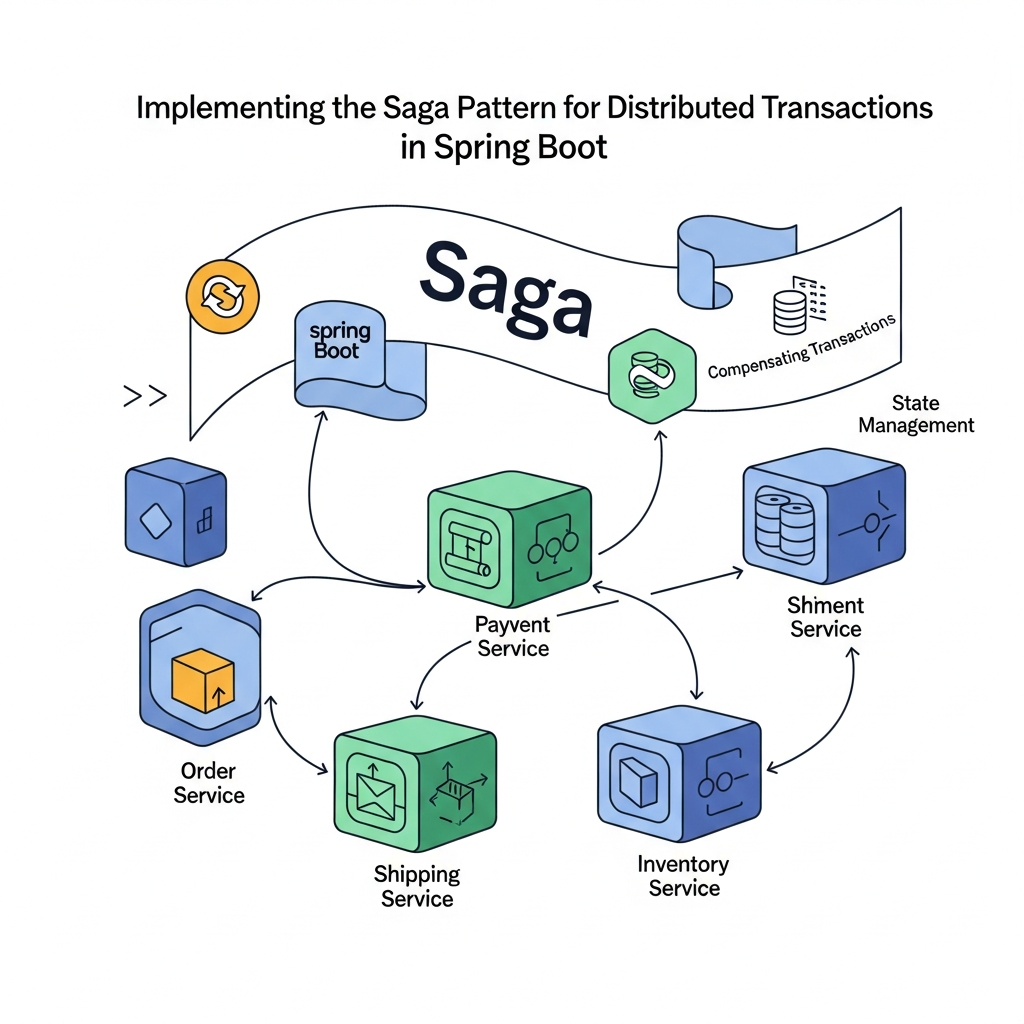
Introduction
In the world of microservices, applications are broken down into smaller, independent services that communicate with each other. While this architecture offers numerous benefits like scalability, resilience, and independent deployment, it introduces significant challenges, especially when dealing with transactions that span across multiple services. Unlike monolithic applications where a single database transaction (ACID properties: Atomicity, Consistency, Isolation, Durability) can ensure data integrity, distributed systems cannot rely on a global two-phase commit (2PC) protocol due to its blocking nature and performance overheads.
This is where the Saga Pattern comes into play. The Saga Pattern is a powerful architectural pattern designed to manage distributed transactions in a way that maintains data consistency across multiple services, even in the face of failures. It achieves eventual consistency by breaking down a large transaction into a sequence of smaller, local transactions, each managed by a single service. If any local transaction fails, the Saga executes a series of compensating transactions to undo the changes made by preceding successful transactions, thus ensuring data integrity.
This comprehensive guide will delve deep into the Saga Pattern, exploring its two main implementation styles – Choreography and Orchestration – and providing practical, detailed examples using Spring Boot and Apache Kafka. By the end of this article, you will have a solid understanding of how to design, implement, and manage distributed transactions effectively in your microservices architecture.
Prerequisites
To get the most out of this guide, you should have:
- Java 17+: Familiarity with Java programming language.
- Spring Boot: Basic understanding of building applications with Spring Boot.
- Maven/Gradle: Knowledge of build tools.
- Microservices Concepts: Awareness of microservices architecture principles.
- Apache Kafka: Basic understanding of Kafka topics, producers, and consumers (though we'll cover its use here).
- Docker/Docker Compose: For easily setting up Kafka and databases locally.
Understanding Distributed Transactions and the Need for Saga
Before diving into the Saga Pattern, let's briefly revisit why distributed transactions are so challenging. In a monolithic application, if an order creation involves updating the Orders table, Inventory table, and Payments table, a single transaction.begin(), commit(), or rollback() operation ensures atomicity. All or nothing.
In a microservices world, these operations might be handled by separate services: an Order Service, an Inventory Service, and a Payment Service, each with its own database. If the Order Service successfully creates an order, but the Payment Service fails to process the payment, how do we ensure the Order Service's change is undone or compensated for? This is the core problem of distributed transactions.
Traditional 2PC protocols are often avoided in microservices due to:
- Blocking: Participants hold resources until all commit or rollback, reducing concurrency.
- Performance Overhead: High network latency and coordination costs.
- Single Point of Failure: The transaction coordinator can be a bottleneck or SPOF.
Instead, microservices often embrace BASE principles (Basically Available, Soft State, Eventually Consistent) over strict ACID. The Saga Pattern aligns perfectly with BASE, ensuring eventual consistency through a series of local, independent transactions.
What is the Saga Pattern?
A Saga is a sequence of local transactions where each transaction updates data within a single service and publishes an event. The next transaction in the sequence is triggered by the event from the previous transaction. If a local transaction fails, the Saga executes a series of compensating transactions that undo the changes made by the preceding successful local transactions.
Key characteristics:
- Local Transactions: Each step in a saga is a standard ACID transaction within a single service's database.
- Event-Driven: Communication between services typically happens via asynchronous events.
- Compensation: A mechanism to reverse previously completed steps if a later step fails.
- Eventual Consistency: The overall system state will eventually become consistent, but might be inconsistent during the saga's execution.
Types of Saga Implementations
The Saga Pattern can be implemented in two primary ways:
Choreography-based Saga
In a choreography-based saga, each service involved in the saga participates by publishing events and reacting to events published by other services. There is no central orchestrator; instead, services coordinate directly by subscribing to and publishing domain events. Each service decides its next action based on the events it consumes.
Pros:
- Decoupled Services: Services are highly decoupled, as they only need to know about the events they produce and consume, not the entire saga flow.
- Simple for Small Sagas: Easier to implement for sagas involving a few steps.
- No Single Point of Failure: No central orchestrator means no single point of failure within the saga coordination.
Cons:
- Hard to Monitor: The overall flow of the saga can be difficult to track and monitor, as the logic is distributed across multiple services.
- Circular Dependencies: Can lead to complex event chains and potential circular dependencies if not designed carefully.
- Complex Compensation: Implementing compensation can become complex as each service needs to understand when and how to compensate for its actions.
Orchestration-based Saga
In an orchestration-based saga, a dedicated Saga Orchestrator service is responsible for coordinating the entire saga. The orchestrator sends commands to participant services, telling them what local transaction to execute. Participant services then perform their local transaction and reply to the orchestrator with an event indicating success or failure. The orchestrator then decides the next step based on these replies, including initiating compensation if needed.
Pros:
- Clear Flow: The saga's logic is centralized and clearly defined within the orchestrator, making it easier to understand, monitor, and debug.
- Easier Compensation: Compensation logic is managed by the orchestrator, simplifying its implementation.
- Less Coupling: Participant services are less coupled to each other; they only interact with the orchestrator.
Cons:
- Orchestrator Complexity: The orchestrator can become complex, especially for long-running or intricate sagas.
- Single Point of Failure/Bottleneck: The orchestrator itself can become a single point of failure or a performance bottleneck if not designed for high availability and scalability.
- Potential Centralization: If not carefully designed, the orchestrator can turn into a mini-monolith.
Designing a Saga: A Practical Example (Order Fulfillment)
Let's consider a common e-commerce scenario: Order Fulfillment. When a customer places an order, several actions need to happen across different services:
- Order Service: Creates the order.
- Inventory Service: Deducts items from stock.
- Payment Service: Processes the payment.
If any of these steps fail, the entire transaction should be rolled back (compensated).
Saga Steps and Compensations:
-
Step 1: Create Order
- Action: Order Service saves the order in
PENDINGstatus. - Compensation:
Cancel Order(updates order status toCANCELLED, potentially refunds customer if payment was processed).
- Action: Order Service saves the order in
-
Step 2: Deduct Inventory
- Action: Inventory Service reserves/deducts items.
- Compensation:
Restore Inventory(adds items back to stock).
-
Step 3: Process Payment
- Action: Payment Service processes the customer's payment.
- Compensation:
Refund Payment(initiates a refund to the customer).
This sequence of actions, with defined compensation steps, forms our saga.
Implementing Choreography Saga in Spring Boot with Kafka
For choreography, we'll use Apache Kafka as our event bus. Each service will listen to specific events and publish new ones, driving the saga forward.
1. Event Definitions
First, let's define our events. These are simple POJOs that will be serialized to and deserialized from Kafka messages.
// common-dtos module (or shared library)

public enum OrderStatus { PENDING, APPROVED, REJECTED, CANCELLED }
public enum InventoryStatus { PENDING, DEDUCTED, REJECTED, RESTORED }
public enum PaymentStatus { PENDING, PROCESSED, REJECTED, REFUNDED }

// Events for choreography

public record OrderCreatedEvent(String orderId, String productId, int quantity, double price, String customerId) {}
public record OrderRejectedEvent(String orderId, String reason) {}
public record OrderApprovedEvent(String orderId) {}
public record OrderCancelledEvent(String orderId, String reason) {}

public record InventoryDeductionRequestEvent(String orderId, String productId, int quantity) {}
public record InventoryDeductedEvent(String orderId) {}
public record InventoryDeductionFailedEvent(String orderId, String reason) {}
public record InventoryRestoredEvent(String orderId) {}

public record PaymentRequestEvent(String orderId, double amount, String customerId) {}
public record PaymentProcessedEvent(String orderId) {}
public record PaymentFailedEvent(String orderId, String reason) {}
public record PaymentRefundedEvent(String orderId) {}
2. Kafka Configuration
Each service will need Kafka producer and consumer configurations. We'll use Spring for Kafka.
// In each service's application.yml
spring:
  kafka:
    bootstrap-servers: localhost:9092
    producer:
      key-serializer: org.apache.kafka.common.serialization.StringSerializer
      value-serializer: org.springframework.kafka.support.serializer.JsonSerializer
    consumer:
      group-id: ${spring.application.name}
      key-deserializer: org.apache.kafka.common.serialization.StringDeserializer
      value-deserializer: org.springframework.kafka.support.serializer.JsonDeserializer
      properties:
        spring.json.trusted.packages: "*"

// KafkaConfig.java in each service
@Configuration
public class KafkaConfig {

    @Bean
    public NewTopic orderCreatedTopic() {
        return TopicBuilder.name("order-created-events").partitions(1).replicas(1).build();
    }

    @Bean
    public NewTopic inventoryDeductedTopic() {
        return TopicBuilder.name("inventory-deducted-events").partitions(1).replicas(1).build();
    }

    // ... define other topics as needed

    @Bean
    public ConcurrentKafkaListenerContainerFactory<String, Object> kafkaListenerContainerFactory(
            ConcurrentKafkaListenerContainerFactoryConfigurer configurer,
            ConsumerFactory<String, Object> kafkaConsumerFactory) {
        ConcurrentKafkaListenerContainerFactory<String, Object> factory = new ConcurrentKafkaListenerContainerFactory<>();
        configurer.configure(factory, kafkaConsumerFactory);
        return factory;
    }
}
3. Service Implementations
Order Service
Initiates the saga and handles its own local transactions and compensations.
@Service
@RequiredArgsConstructor
public class OrderService {
    private final KafkaTemplate<String, Object> kafkaTemplate;
    private final OrderRepository orderRepository; // Assume JPA repository

    @Transactional
    public Order createOrder(String productId, int quantity, double price, String customerId) {
        Order order = new Order();
        order.setOrderId(UUID.randomUUID().toString());
        order.setProductId(productId);
        order.setQuantity(quantity);
        order.setPrice(price);
        order.setCustomerId(customerId);
        order.setStatus(OrderStatus.PENDING);
        orderRepository.save(order);

        // Publish event to initiate inventory deduction
        kafkaTemplate.send("inventory-deduction-requests", new InventoryDeductionRequestEvent(
                order.getOrderId(), productId, quantity));
        return order;
    }

    @Transactional
    public void cancelOrder(String orderId, String reason) {
        Order order = orderRepository.findByOrderId(orderId)
                .orElseThrow(() -> new RuntimeException("Order not found"));
        order.setStatus(OrderStatus.CANCELLED);
        order.setReason(reason);
        orderRepository.save(order);
        kafkaTemplate.send("order-cancelled-events", new OrderCancelledEvent(orderId, reason));
        System.out.println("Order " + orderId + " cancelled. Reason: " + reason);
    }

    @KafkaListener(topics = "inventory-deducted-events", groupId = "order-service")
    public void handleInventoryDeducted(InventoryDeductedEvent event) {
        Order order = orderRepository.findByOrderId(event.orderId())
                .orElseThrow(() -> new RuntimeException("Order not found"));
        // Inventory deducted, now request payment
        kafkaTemplate.send("payment-requests", new PaymentRequestEvent(
                order.getOrderId(), order.getPrice(), order.getCustomerId()));
        System.out.println("Order " + event.orderId() + ": Inventory deducted, requesting payment.");
    }

    @KafkaListener(topics = "inventory-deduction-failed-events", groupId = "order-service")
    public void handleInventoryDeductionFailed(InventoryDeductionFailedEvent event) {
        cancelOrder(event.orderId(), event.reason());
        System.out.println("Order " + event.orderId() + ": Inventory deduction failed, cancelling order.");
    }

    @KafkaListener(topics = "payment-processed-events", groupId = "order-service")
    @Transactional
    public void handlePaymentProcessed(PaymentProcessedEvent event) {
        Order order = orderRepository.findByOrderId(event.orderId())
                .orElseThrow(() -> new RuntimeException("Order not found"));
        order.setStatus(OrderStatus.APPROVED);
        orderRepository.save(order);
        kafkaTemplate.send("order-approved-events", new OrderApprovedEvent(event.orderId()));
        System.out.println("Order " + event.orderId() + ": Payment processed, order approved.");
    }

    @KafkaListener(topics = "payment-failed-events", groupId = "order-service")
    public void handlePaymentFailed(PaymentFailedEvent event) {
        // Payment failed, compensation needed: restore inventory, then cancel order
        kafkaTemplate.send("inventory-restoration-requests", new InventoryDeductionRequestEvent(
                event.orderId(), null, 0)); // productId and quantity not needed for restoration here
        cancelOrder(event.orderId(), event.reason());
        System.out.println("Order " + event.orderId() + ": Payment failed, initiating compensation.");
    }
}
Inventory Service
Listens for inventory deduction requests and publishes its outcome.
@Service
@RequiredArgsConstructor
public class InventoryService {
    private final KafkaTemplate<String, Object> kafkaTemplate;
    private final InventoryRepository inventoryRepository; // Assume JPA repository

    @KafkaListener(topics = "inventory-deduction-requests", groupId = "inventory-service")
    @Transactional
    public void handleInventoryDeductionRequest(InventoryDeductionRequestEvent event) {
        try {
            Inventory inventory = inventoryRepository.findByProductId(event.productId())
                    .orElseThrow(() -> new RuntimeException("Product not found"));
            if (inventory.getAvailableStock() < event.quantity()) {
                throw new RuntimeException("Insufficient stock");
            }
            inventory.setAvailableStock(inventory.getAvailableStock() - event.quantity());
            inventoryRepository.save(inventory);

            kafkaTemplate.send("inventory-deducted-events", new InventoryDeductedEvent(event.orderId()));
            System.out.println("Inventory for order " + event.orderId() + " deducted.");
        } catch (Exception e) {
            kafkaTemplate.send("inventory-deduction-failed-events", new InventoryDeductionFailedEvent(
                    event.orderId(), e.getMessage()));
            System.err.println("Inventory deduction failed for order " + event.orderId() + ": " + e.getMessage());
        }
    }

    @KafkaListener(topics = "inventory-restoration-requests", groupId = "inventory-service")
    @Transactional
    public void handleInventoryRestorationRequest(InventoryDeductionRequestEvent event) {
        // In a real scenario, you'd need to store the original deduction amount per order
        // For simplicity, let's assume we can restore based on a 'known' quantity or fetch from a saga log.
        // Here, we'll just log and send a success event.
        System.out.println("Restoring inventory for order " + event.orderId());

        // Example: If we stored the original quantity with the orderId in a separate table
        // OrderInventoryLink link = orderInventoryLinkRepository.findByOrderId(event.orderId());
        // Inventory inventory = inventoryRepository.findByProductId(link.getProductId());
        // inventory.setAvailableStock(inventory.getAvailableStock() + link.getQuantity());
        // inventoryRepository.save(inventory);

        kafkaTemplate.send("inventory-restored-events", new InventoryRestoredEvent(event.orderId()));
        System.out.println("Inventory for order " + event.orderId() + " restored.");
    }
}
Payment Service
Processes payments and handles refunds.
@Service
@RequiredArgsConstructor
public class PaymentService {
    private final KafkaTemplate<String, Object> kafkaTemplate;
    private final PaymentRepository paymentRepository; // Assume JPA repository

    @KafkaListener(topics = "payment-requests", groupId = "payment-service")
    @Transactional
    public void handlePaymentRequest(PaymentRequestEvent event) {
        try {
            // Simulate payment processing logic
            if (event.amount() > 1000) {
                throw new RuntimeException("Payment amount too high (simulated failure)");
            }
            Payment payment = new Payment();
            payment.setOrderId(event.orderId());
            payment.setAmount(event.amount());
            payment.setCustomerId(event.customerId());
            payment.setStatus(PaymentStatus.PROCESSED);
            paymentRepository.save(payment);

            kafkaTemplate.send("payment-processed-events", new PaymentProcessedEvent(event.orderId()));
            System.out.println("Payment for order " + event.orderId() + " processed.");
        } catch (Exception e) {
            kafkaTemplate.send("payment-failed-events", new PaymentFailedEvent(
                    event.orderId(), e.getMessage()));
            System.err.println("Payment failed for order " + event.orderId() + ": " + e.getMessage());
        }
    }

    @KafkaListener(topics = "payment-refund-requests", groupId = "payment-service")
    @Transactional
    public void handlePaymentRefundRequest(PaymentRequestEvent event) {
        // Simulate refund logic
        Payment payment = paymentRepository.findByOrderId(event.orderId())
                .orElseThrow(() -> new RuntimeException("Payment not found for refund"));
        payment.setStatus(PaymentStatus.REFUNDED);
        paymentRepository.save(payment);

        kafkaTemplate.send("payment-refunded-events", new PaymentRefundedEvent(event.orderId()));
        System.out.println("Payment for order " + event.orderId() + " refunded.");
    }
}
This choreography example demonstrates how services react to events to progress the saga. If the Payment Service fails, it publishes PaymentFailedEvent, which the Order Service consumes. The Order Service then initiates compensation by requesting inventory restoration and canceling the order.
Implementing Orchestration Saga in Spring Boot
For orchestration, we'll introduce a dedicated Saga Orchestrator Service. This service will manage the state of the saga and issue commands to participant services, listening for their responses.
Instead of a full-blown workflow engine, we can implement a lightweight orchestrator using Spring's ApplicationEvent system for internal state management and Kafka for inter-service communication.
1. Events and Commands (Orchestration Specific)
We'll use Command objects to tell services what to do and Reply events for services to report back.
// common-dtos module

// Commands sent by orchestrator
public record DeductInventoryCommand(String orderId, String productId, int quantity) {}
public record ProcessPaymentCommand(String orderId, double amount, String customerId) {}
public record CancelOrderCommand(String orderId, String reason) {}
public record RestoreInventoryCommand(String orderId) {}
public record RefundPaymentCommand(String orderId) {}

// Replies from services to orchestrator
public record InventoryDeductedReply(String orderId) {}
public record InventoryDeductionFailedReply(String orderId, String reason) {}
public record PaymentProcessedReply(String orderId) {}
public record PaymentFailedReply(String orderId, String reason) {}
2. Saga Orchestrator Service
The orchestrator will maintain the state of each saga instance (e.g., using a database table for SagaStatus).
// Saga Orchestrator Service

@Service
@RequiredArgsConstructor
public class OrderSagaOrchestrator {
    private final KafkaTemplate<String, Object> kafkaTemplate;
    private final SagaLogRepository sagaLogRepository; // To store saga state

    // Initial step: Order creation event triggers the saga
    @KafkaListener(topics = "order-created-events", groupId = "saga-orchestrator")
    @Transactional
    public void handleOrderCreated(OrderCreatedEvent event) {
        SagaLog sagaLog = new SagaLog(event.orderId(), SagaStatus.IN_PROGRESS, "OrderCreated");
        sagaLogRepository.save(sagaLog);

        // Command Inventory Service to deduct inventory
        kafkaTemplate.send("inventory-commands", new DeductInventoryCommand(
                event.orderId(), event.productId(), event.quantity()));
        System.out.println("Saga " + event.orderId() + ": Order created, requesting inventory deduction.");
    }

    // Step 2: Inventory Service replies
    @KafkaListener(topics = "inventory-replies", groupId = "saga-orchestrator")
    @Transactional
    public void handleInventoryReply(Object reply) {
        if (reply instanceof InventoryDeductedReply deductedReply) {
            SagaLog sagaLog = sagaLogRepository.findBySagaId(deductedReply.orderId())
                    .orElseThrow(() -> new RuntimeException("Saga log not found"));
            sagaLog.setCurrentStep("InventoryDeducted");
            sagaLogRepository.save(sagaLog);

            // Command Payment Service to process payment
            // In a real app, fetch order details to get amount/customer ID
            kafkaTemplate.send("payment-commands", new ProcessPaymentCommand(
                    deductedReply.orderId(), 100.0, "customer123"));
            System.out.println("Saga " + deductedReply.orderId() + ": Inventory deducted, requesting payment.");

        } else if (reply instanceof InventoryDeductionFailedReply failedReply) {
            SagaLog sagaLog = sagaLogRepository.findBySagaId(failedReply.orderId())
                    .orElseThrow(() -> new RuntimeException("Saga log not found"));
            sagaLog.setStatus(SagaStatus.FAILED);
            sagaLog.setCurrentStep("InventoryDeductionFailed");
            sagaLogRepository.save(sagaLog);

            // Compensation: Cancel Order in Order Service
            kafkaTemplate.send("order-commands", new CancelOrderCommand(
                    failedReply.orderId(), failedReply.reason()));
            System.out.println("Saga " + failedReply.orderId() + ": Inventory deduction failed, cancelling order.");
        }
    }

    // Step 3: Payment Service replies
    @KafkaListener(topics = "payment-replies", groupId = "saga-orchestrator")
    @Transactional
    public void handlePaymentReply(Object reply) {
        if (reply instanceof PaymentProcessedReply processedReply) {
            SagaLog sagaLog = sagaLogRepository.findBySagaId(processedReply.orderId())
                    .orElseThrow(() -> new RuntimeException("Saga log not found"));
            sagaLog.setCurrentStep("PaymentProcessed");
            sagaLog.setStatus(SagaStatus.COMPLETED);
            sagaLogRepository.save(sagaLog);

            // Saga completed successfully
            kafkaTemplate.send("order-commands", new OrderApprovedEvent(processedReply.orderId()));
            System.out.println("Saga " + processedReply.orderId() + ": Payment processed, saga completed.");

        } else if (reply instanceof PaymentFailedReply failedReply) {
            SagaLog sagaLog = sagaLogRepository.findBySagaId(failedReply.orderId())
                    .orElseThrow(() -> new RuntimeException("Saga log not found"));
            sagaLog.setStatus(SagaStatus.FAILED);
            sagaLog.setCurrentStep("PaymentFailed");
            sagaLogRepository.save(sagaLog);

            // Compensation: Restore Inventory, then Cancel Order
            kafkaTemplate.send("inventory-commands", new RestoreInventoryCommand(failedReply.orderId()));
            kafkaTemplate.send("order-commands", new CancelOrderCommand(
                    failedReply.orderId(), failedReply.reason()));
            System.out.println("Saga " + failedReply.orderId() + ": Payment failed, initiating compensation.");
        }
    }

    // Listen for compensation completion events (optional, for tracking complex sagas)
    @KafkaListener(topics = "inventory-restored-events", groupId = "saga-orchestrator")
    public void handleInventoryRestored(InventoryRestoredEvent event) {
        System.out.println("Saga " + event.orderId() + ": Inventory restored as part of compensation.");
        // Potentially update saga log or trigger next compensation step if any
    }

    @KafkaListener(topics = "order-cancelled-events", groupId = "saga-orchestrator")
    public void handleOrderCancelled(OrderCancelledEvent event) {
        System.out.println("Saga " + event.orderId() + ": Order cancelled as part of compensation.");
        // Mark saga as completed (compensated)
        SagaLog sagaLog = sagaLogRepository.findBySagaId(event.orderId())
                .orElseThrow(() -> new RuntimeException("Saga log not found"));
        sagaLog.setStatus(SagaStatus.COMPENSATED);
        sagaLogRepository.save(sagaLog);
    }
}
3. Participant Services (Orchestration)
Participant services now listen for commands and send replies.
// Inventory Service (simplified for orchestration)
@Service
@RequiredArgsConstructor
public class InventoryService {
    private final KafkaTemplate<String, Object> kafkaTemplate;
    private final InventoryRepository inventoryRepository;

    @KafkaListener(topics = "inventory-commands", groupId = "inventory-service")
    @Transactional
    public void handleCommand(Object command) {
        if (command instanceof DeductInventoryCommand deductCommand) {
            try {
                // ... deduction logic ...
                kafkaTemplate.send("inventory-replies", new InventoryDeductedReply(deductCommand.orderId()));
            } catch (Exception e) {
                kafkaTemplate.send("inventory-replies", new InventoryDeductionFailedReply(
                        deductCommand.orderId(), e.getMessage()));
            }
        } else if (command instanceof RestoreInventoryCommand restoreCommand) {
            // ... restoration logic ...
            kafkaTemplate.send("inventory-restored-events", new InventoryRestoredEvent(restoreCommand.orderId()));
        }
    }
}

// Payment Service (simplified for orchestration)
@Service
@RequiredArgsConstructor
public class PaymentService {
    private final KafkaTemplate<String, Object> kafkaTemplate;
    private final PaymentRepository paymentRepository;

    @KafkaListener(topics = "payment-commands", groupId = "payment-service")
    @Transactional
    public void handleCommand(Object command) {
        if (command instanceof ProcessPaymentCommand processCommand) {
            try {
                // ... payment logic ...
                kafkaTemplate.send("payment-replies", new PaymentProcessedReply(processCommand.orderId()));
            } catch (Exception e) {
                kafkaTemplate.send("payment-replies", new PaymentFailedReply(
                        processCommand.orderId(), e.getMessage()));
            }
        } else if (command instanceof RefundPaymentCommand refundCommand) {
            // ... refund logic ...
            kafkaTemplate.send("payment-refunded-events", new PaymentRefundedEvent(refundCommand.orderId()));
        }
    }
}

// Order Service (simplified for orchestration, only handles initial creation and cancellation command)
@Service
@RequiredArgsConstructor
public class OrderService {
    private final KafkaTemplate<String, Object> kafkaTemplate;
    private final OrderRepository orderRepository;

    @Transactional
    public Order createOrder(String productId, int quantity, double price, String customerId) {
        // ... create order in PENDING status ...
        // Publish initial event for orchestrator
        kafkaTemplate.send("order-created-events", new OrderCreatedEvent(
                order.getOrderId(), productId, quantity, price, customerId));
        return order;
    }

    @KafkaListener(topics = "order-commands", groupId = "order-service")
    @Transactional
    public void handleCommand(Object command) {
        if (command instanceof CancelOrderCommand cancelCommand) {
            // ... cancel order logic ...
            kafkaTemplate.send("order-cancelled-events", new OrderCancelledEvent(cancelCommand.orderId(), cancelCommand.reason()));
        } else if (command instanceof OrderApprovedEvent approvedEvent) {
            // ... approve order logic ...
            System.out.println("Order " + approvedEvent.orderId() + " approved by orchestrator.");
        }
    }
}
This orchestration example shows a central service dictating the flow and handling compensation logic based on replies.
Idempotency and Concurrency in Sagas
In a distributed system, messages can be duplicated or processed multiple times due to network issues, retries, or consumer rebalancing. This makes idempotency crucial for all saga steps and compensation actions. An idempotent operation produces the same result regardless of how many times it's executed.
Techniques for Idempotency:
- Unique Message IDs: Include a unique message ID (e.g., UUID) in every command/event. Services can store processed message IDs and ignore duplicates.
- Business Key Checks: For operations like
deductInventory, check if the inventory for a specificorderIdhas already been deducted. If so, ignore the duplicate request. - Conditional Updates: Use
UPDATE ... WHERE ... AND version = XorINSERT ... IF NOT EXISTSqueries. - Event Sourcing: If using event sourcing, each event is applied once, and the state is derived from the sequence of events.
Concurrency: Sagas, by nature, are asynchronous. Ensure that local transactions within each service handle concurrent access to their local data correctly (e.g., using database transactions, optimistic locking).
Error Handling and Compensation Logic
Robust error handling is the backbone of any reliable saga implementation. Every local transaction in a saga must have a corresponding compensation transaction.
Key considerations:
- Failure Detection: Services must promptly detect failures (e.g., database constraints violated, external API call failed) and publish appropriate failure events/replies.
- Compensation Logic: Design compensation transactions to be as robust and idempotent as the forward steps. They should be able to reverse partial changes.
- Retry Mechanisms: For transient failures, services should implement retry logic (e.g., Spring Retry, Kafka's built-in retry mechanisms, or custom back-off strategies). Use dead-letter queues (DLQs) for messages that repeatedly fail processing.
- Timeouts: Implement timeouts for saga steps to prevent a saga from hanging indefinitely if a service fails to respond.
- Human Intervention: For critical failures that cannot be automatically compensated, escalate to human intervention (e.g., alert a support team).
Monitoring and Observability for Sagas
Sagas, especially choreography-based ones, can be difficult to observe due to their distributed nature. Proper monitoring is essential.
- Distributed Tracing: Use tools like Spring Cloud Sleuth/OpenTelemetry with Zipkin or Jaeger to trace requests across multiple services. This allows you to visualize the entire flow of a saga, identifying bottlenecks or failures.
- Centralized Logging: Aggregate logs from all services into a central system (e.g., ELK stack, Splunk). Ensure logs include correlation IDs (e.g., saga ID, trace ID) to link related log entries.
- Metrics and Dashboards: Collect metrics (e.g., saga completion rates, failure rates, latency per step) using Prometheus and visualize them with Grafana. Define alerts for critical saga failures.
- Saga Log: For orchestration, the orchestrator's state log (e.g.,
SagaLogtable) is a crucial monitoring tool. For choreography, consider a dedicated "saga monitor" service that subscribes to all relevant events and reconstructs the saga's state. - Business Transaction Monitoring: Track the business outcomes of sagas (e.g., number of successful orders, failed orders, compensated orders) to understand the system's overall health from a business perspective.
Best Practices for Saga Implementation
- Keep Sagas Short and Simple: The more steps a saga has, the more complex it becomes to manage, monitor, and compensate. Aim for the minimum necessary steps.
- Design Robust Compensation: Every step must have a well-defined, idempotent compensation action. Test compensation paths rigorously.
- Idempotent Operations: Ensure all local transactions and compensation transactions are idempotent to handle duplicate messages gracefully.
- Asynchronous Communication: Use asynchronous messaging (like Kafka) for inter-service communication to avoid blocking calls and improve resilience.
- Dedicated Saga Log (Orchestration): The orchestrator should persist the saga's state to a database. This ensures the orchestrator can recover and continue a saga after a crash.
- Correlation IDs: Pass a unique
sagaIdorcorrelationIdthrough all events and commands to link related operations across services. - Test Thoroughly: Test all success paths, all failure paths, and all compensation paths. Simulate network partitions and service failures.
- Use a Transaction Outbox Pattern: When publishing events from a service that performs a local transaction, use the Transaction Outbox Pattern to ensure atomicity between the local database commit and the event publication to Kafka.
Common Pitfalls to Avoid
- Ignoring Idempotency: Leads to incorrect state when messages are reprocessed.
- Incomplete Compensation Logic: Failing to account for all possible failure scenarios or not fully reversing effects can leave the system in an inconsistent state.
- Over-engineering Simple Transactions: Not every distributed operation requires a full saga. For simpler cases, consider simpler patterns or even just retries with eventual consistency.
- Tight Coupling in Choreography: If services become too aware of each other's internal logic or rely on the specific order of many events, choreography can become brittle.
- Orchestrator as a Monolith: An orchestrator that becomes too large, complex, and tightly coupled to participant services can negate the benefits of microservices. Keep it focused on coordination.
- Lack of Observability: Without proper logging, tracing, and monitoring, debugging sagas in production becomes a nightmare.
- No Dead Letter Queue (DLQ): Messages that repeatedly fail processing can block consumers. DLQs provide a mechanism to isolate these messages for manual inspection.
Conclusion
The Saga Pattern is an indispensable tool for building resilient and eventually consistent distributed systems in a microservices architecture. While it adds complexity compared to traditional ACID transactions, its benefits in terms of scalability, fault tolerance, and decoupling are crucial for modern applications.
By understanding the differences between choreography and orchestration, designing robust compensation logic, ensuring idempotency, and implementing comprehensive monitoring, you can effectively leverage the Saga Pattern in your Spring Boot applications. Remember that choosing the right saga implementation style depends on the complexity of your business process and the level of control and visibility you require. Embrace eventual consistency, and design for failure, and your distributed transactions will be much more robust.
Start experimenting with these patterns in your Spring Boot projects to build truly resilient microservices.
Written by
CodewithYohaFull-Stack Software Engineer with 7+ years of experience in Java, Spring Boot, and cloud architecture across AWS, Azure, and GCP. Writing production-grade engineering patterns for developers who ship real software.