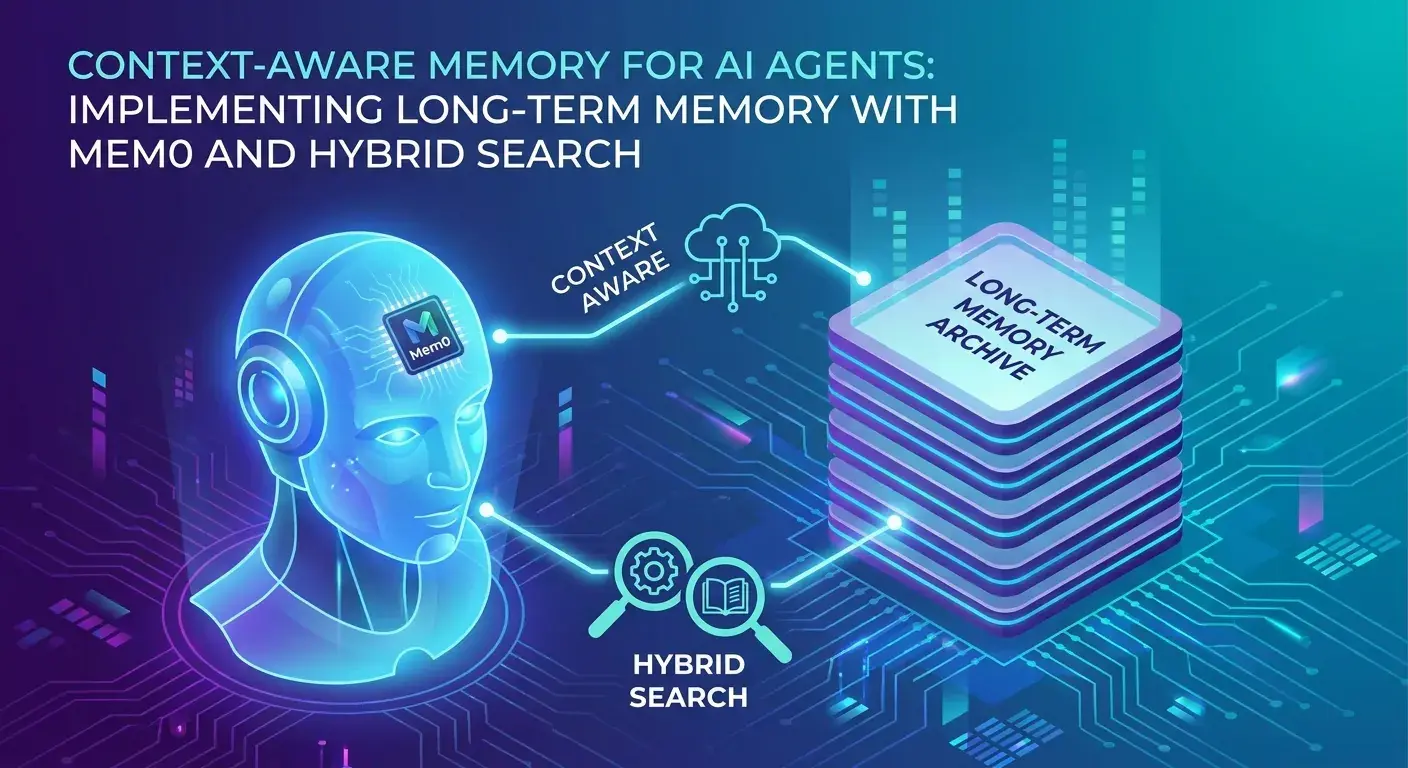
Unlock AI Agent Potential: Context-Aware Long-Term Memory with Mem0 & Hybrid Search

Introduction
In the rapidly evolving landscape of Artificial Intelligence, Large Language Models (LLMs) have demonstrated astonishing capabilities in understanding and generating human-like text. However, even the most advanced LLMs face a fundamental limitation: their "memory." This isn't memory in the human sense of recalling past experiences over a lifetime, but rather a restricted "context window" – a finite amount of information they can process at any given time. Once a conversation or task exceeds this window, the LLM "forgets" prior interactions, leading to disjointed, repetitive, or unhelpful responses.
For AI agents to truly become intelligent, proactive, and personalized assistants, they need more than just a short-term context window. They require context-aware long-term memory: the ability to store, recall, and reason over vast amounts of past experiences, facts, and preferences, intelligently retrieving only the most relevant information at precisely the right moment. This is where specialized memory layers become indispensable.
This comprehensive guide will dive deep into implementing context-aware long-term memory for your AI agents using Mem0, an open-source memory layer designed for AI, coupled with the power of hybrid search. We'll explore how Mem0 allows agents to transcend the limitations of their context window, enabling richer, more continuous, and genuinely intelligent interactions.
Prerequisites
To follow along with this guide, you'll need:
- Python 3.8+: The code examples are written in Python.
- Basic understanding of LLMs: Familiarity with concepts like context windows, embeddings, and prompt engineering.
mem0library: We'll install this shortly.- An API key for an embedding model/LLM: While Mem0 handles embeddings internally, for certain advanced configurations or direct LLM integration, you might need access to services like OpenAI, Cohere, or local models.
The Challenge of AI Agent Memory
Modern LLMs are stateless by design. Each prompt is processed independently, with no inherent memory of previous interactions beyond what is explicitly passed within the current context window. This architecture presents several significant challenges for building sophisticated AI agents:
Limited Context Window
LLMs have a fixed token limit for their input and output. While this limit is growing (e.g., 128k tokens), it's still insufficient for recalling an entire user history, a vast knowledge base, or complex project details over extended periods. Passing the entire history for every turn is computationally expensive and quickly hits the token limit.
Lack of Persistence
When an LLM session ends, all context is lost. There's no built-in mechanism for an agent to remember user preferences, past decisions, or learned information across sessions or even across different interactions within the same session after a certain point.
Inability to Learn and Adapt
Without persistent memory, agents cannot learn from feedback, adapt their behavior, or build a personalized model of the user or environment. This severely limits their utility in dynamic, long-running applications.
The Need for "Forgetting" (and Remembering)
Humans don't remember everything perfectly; we filter, prioritize, and sometimes forget. An effective AI memory system needs to intelligently retrieve only the most relevant information, rather than simply dumping everything. This is where "context-awareness" becomes critical.
Introducing Context-Aware Memory
Context-aware memory refers to an AI agent's ability to store and retrieve information in a way that is highly relevant to its current task, conversation, or environment. It goes beyond simple keyword matching or even basic semantic search by considering various contextual cues, such as:
- Current User Query/Goal: What is the user asking right now?
- Conversation History: What has been discussed recently in this session?
- Agent's Internal State/Goals: What is the agent trying to achieve?
- Metadata: Who is the user? What project are we discussing? What date is it?
- Temporal Relevance: Is this memory recent and therefore more likely to be important?
By leveraging context-aware memory, AI agents can:
- Maintain Coherence: Remember previous turns in a conversation, avoiding repetition.
- Personalize Interactions: Recall user preferences, habits, and past interactions to offer tailored responses.
- Perform Complex Tasks: Break down multi-step tasks, remembering intermediate results and goals.
- Learn and Evolve: Store new facts, insights, and user feedback over time, improving their performance.
- Reduce Hallucinations: Ground responses in factual, retrieved information, minimizing fabricated content.
Mem0: An Overview
Mem0 is an open-source memory layer specifically designed to provide AI agents with robust, context-aware long-term memory. It acts as an external brain, allowing agents to store and retrieve information efficiently without overwhelming their LLM's context window. Mem0 abstracts away the complexities of vector databases, embedding models, and retrieval strategies, offering a simple yet powerful API.
Key features of Mem0 include:
- Flexible Data Storage: Stores both unstructured text and structured metadata.
- Intelligent Retrieval: Employs advanced retrieval mechanisms, including vector (semantic) search and hybrid search, to find the most relevant memories.
- Session Management: Helps maintain conversational context across turns.
- Easy Integration: Designed to be easily integrated into existing agent frameworks.
- Extensible Backend: Supports various underlying vector stores and embedding models.
By using Mem0, developers can focus on agent logic while Mem0 handles the intricacies of memory management, ensuring that agents always have access to the most pertinent information.
Setting Up Mem0
Getting started with Mem0 is straightforward. First, you need to install the library. Mem0 relies on an embedding model for vector search. By default, it uses sentence-transformers models locally, but you can configure it to use cloud-based models like OpenAI or Cohere.
Let's install Mem0:
pip install mem0Once installed, you can initialize a Mem0 instance. For simplicity, we'll start with the default in-memory setup, which is great for local development and testing. For persistent storage, you'd configure it with a backend like ChromaDB, Pinecone, etc.
from mem0 import Mem0

# Initialize Mem0 with default settings (uses a local in-memory store by default)
# For persistent storage, you might configure it like:
# mem0 = Mem0(vector_store_config={"provider": "chroma", "config": {"path": "./chroma_db"}})
mem0 = Mem0()

print("Mem0 initialized successfully!")
This initializes an instance of Mem0 ready to store and retrieve memories. If you want to use a specific embedding model or vector store, you would pass configurations during initialization. For this guide, the default setup is sufficient to demonstrate core functionalities.
Storing Information in Mem0 (Episodic Memory)
Mem0 allows you to store various types of information, which can be thought of as an agent's "experiences" or "facts." These are typically short pieces of text, but can also be more structured. The mem0.add() method is your primary interface for storing memories.
Each memory consists of data (the actual information) and optional metadata (structured key-value pairs that describe the data). Metadata is crucial for effective retrieval and filtering.
Let's add some example memories:
from mem0 import Mem0

mem0 = Mem0()

# Add a simple, unstructured fact
mem0.add("The capital of France is Paris.")

# Add a memory with rich metadata for better context and filtering
mem0.add(
    data="I had a conversation with John about project Alpha's upcoming deadline. He seemed stressed.",
    metadata={
        "user": "current_user",
        "person": "John",
        "topic": "project_alpha",
        "date": "2023-10-27",
        "sentiment": "stressed"
    }
)

# Another memory, perhaps a user preference
mem0.add(
    data="My favorite programming language is Python, especially for AI development.",
    metadata={"user": "current_user", "category": "preferences", "language": "Python"}
)

# A memory about a past agent action
mem0.add(
    data="I recommended a highly-rated Italian restaurant for dinner last night.",
    metadata={
        "user": "current_user",
        "category": "recommendation",
        "cuisine": "Italian",
        "date": "2023-11-01"
    }
)

print("Information added to Mem0 successfully.")
Notice how metadata provides additional context without being part of the main data field. This allows Mem0 to filter and prioritize memories more effectively during retrieval.
Retrieval Strategies: Vector Search
Vector search, also known as semantic search, is a cornerstone of modern AI memory systems. It works by converting text (both the stored memories and your query) into numerical representations called embeddings. These embeddings are high-dimensional vectors where texts with similar meanings are located closer together in the vector space.
When you perform a vector search, Mem0 takes your query, converts it into an embedding, and then finds the stored memories whose embeddings are most "similar" (closest) to the query's embedding. This allows for conceptual understanding, meaning you can retrieve relevant information even if the exact keywords aren't present.
Mem0's get() method performs vector search by default:
# Assuming Mem0 is initialized and data added from previous steps
# mem0 = Mem0()
# mem0.add(...)

query = "What is the capital of France?"
retrieved_memories = mem0.get(query, limit=1)
print(f"\nVector Search Result for '{query}':")
for mem in retrieved_memories:
    print(f"- {mem.data} (Score: {mem.score:.2f})")

query_preferences = "What are my coding preferences?"
retrieved_preferences = mem0.get(query_preferences, limit=1)
print(f"\nVector Search Result for '{query_preferences}':")
for mem in retrieved_preferences:
    print(f"- {mem.data} (Score: {mem.score:.2f})")

query_past_dinner = "Did I eat anything good recently?"
retrieved_dinner = mem0.get(query_past_dinner, limit=1)
print(f"\nVector Search Result for '{query_past_dinner}':")
for mem in retrieved_dinner:
    print(f"- {mem.data} (Score: {mem.score:.2f})")
In these examples, Mem0 successfully retrieves the semantically relevant memories, even if the query doesn't use the exact words (e.g., "coding preferences" matches "programming language"). The score indicates the similarity of the retrieved memory to the query.
The Power of Keyword Matching
While vector search excels at semantic understanding, it has limitations. For instance, if you're looking for a very specific entity, an ID, a name, or an exact phrase, vector search might sometimes retrieve conceptually similar but factually incorrect information. This is where traditional keyword matching still holds immense value.
Keyword matching (often implemented with techniques like TF-IDF or BM25) is precise. It's excellent for:
- Exact Matches: Finding a specific product code, a person's full name, or a date.
- Filtering: Narrowing down results based on explicit criteria (e.g., "all emails from John").
- Specific Entity Retrieval: When you need to be absolutely sure about a particular term.
The challenge is that keyword search lacks semantic understanding. A query for "car" won't typically find documents mentioning "automobile" unless both words are present. This is why combining it with vector search is so powerful.
Mem0's get() method doesn't expose a separate keyword_search parameter directly, as its core design is to provide an intelligent, unified retrieval mechanism. However, the power of keyword-like precision can be achieved through two primary mechanisms within Mem0:
- Metadata Filtering: By adding descriptive
metadatato your memories, you can filter results based on exact keyword matches within those metadata fields. This acts as a highly precise keyword filter. - Hybrid Search (Implicit): As we'll discuss next, Mem0's underlying retrieval often combines semantic and keyword signals to provide a more robust result, giving you the best of both worlds without needing to explicitly choose.
Let's demonstrate metadata filtering, which provides a precise way to narrow down search results:
# Assuming Mem0 is initialized and data added
# mem0 = Mem0()
# mem0.add(...)

# Retrieve memories about 'project_alpha' specifically
query_filtered = "Tell me about project deadlines."
retrieved_filtered = mem0.get(
    query=query_filtered,
    metadata={"topic": "project_alpha"},
    limit=1
)
print(f"\nFiltered Search Result for '{query_filtered}' (topic: project_alpha):")
for mem in retrieved_filtered:
    print(f"- {mem.data} (Score: {mem.score:.2f}, Metadata: {mem.metadata})")

# Retrieve memories about recommendations made by the agent
query_agent_action = "What did I recommend to the user?"
retrieved_agent_action = mem0.get(
    query=query_agent_action,
    metadata={"speaker": "agent", "category": "recommendation"},
    limit=1
)
print(f"\nFiltered Search Result for '{query_agent_action}' (agent recommendations):")
for mem in retrieved_agent_action:
    print(f"- {mem.data} (Score: {mem.score:.2f}, Metadata: {mem.metadata})")
This shows how metadata can serve as a powerful, precise filtering mechanism, mimicking some aspects of keyword search while still benefiting from semantic understanding on the data field.
Hybrid Search for Context-Awareness
Hybrid search is the intelligent combination of vector (semantic) search and keyword matching. It aims to leverage the strengths of both approaches while mitigating their weaknesses. The goal is to achieve both high recall (finding all relevant items, even if not an exact match) and high precision (ensuring the retrieved items are truly relevant).
Mem0's get() method, especially when backed by modern vector stores, often implicitly performs a form of hybrid retrieval. It combines semantic similarity (from embeddings) with keyword relevance (from term frequency, inverse document frequency, or other lexical signals) to produce a ranked list of memories that are both conceptually similar and lexically aligned with the query.
Why Hybrid Search is Powerful:
- Robustness: Handles a wider variety of queries, from vague conceptual questions to highly specific factual lookups.
- Improved Relevance: Prevents "semantic drift" (where vector search retrieves conceptually similar but factually incorrect items) and improves recall for exact matches.
- Better User Experience: Agents provide more accurate and contextually appropriate information.
Consider a scenario where you've stored a memory about "Project Falcon's budget report from Q3." A pure vector search for "financials for Falcon" would likely find it. But a query like "Show me the Q3 report for Project Falcon" benefits immensely from the keyword components, ensuring the exact report is prioritized.
Mem0's API simplifies this by providing a single get() method that intelligently handles the underlying complexity. You just provide the query, and Mem0 works to find the best match:
# Assuming Mem0 is initialized and data added
# mem0 = Mem0()
# mem0.add(...)

query = "What did I discuss with John about the Alpha project deadline?"
retrieved_hybrid = mem0.get(query, limit=2)
print(f"\nHybrid Search Result for '{query}':")
for mem in retrieved_hybrid:
    print(f"- {mem.data} (Score: {mem.score:.2f}, Metadata: {mem.metadata})")

query_specific = "My favorite language is Python. Why?"
retrieved_specific = mem0.get(query_specific, limit=1)
print(f"\nHybrid Search Result for '{query_specific}':")
for mem in retrieved_specific:
    print(f"- {mem.data} (Score: {mem.score:.2f})\n")

query_restaurant = "Where did I get Italian food last night?"
retrieved_restaurant = mem0.get(query_restaurant, limit=1)
print(f"Hybrid Search Result for '{query_restaurant}':")
for mem in retrieved_restaurant:
    print(f"- {mem.data} (Score: {mem.score:.2f}, Metadata: {mem.metadata})\n")
In the above examples, Mem0's get() method implicitly employs its best retrieval strategy, often a hybrid approach, to match both the semantic intent and specific keywords from your query to the stored memories and their metadata. This ensures highly accurate and context-aware retrieval.
Advanced Memory Management with Mem0 (Sessions & Context)
For AI agents operating in continuous conversations or over extended periods, managing the flow of interaction is crucial. Mem0 provides features to help maintain state and context within a session.
Sessions
A "session" in Mem0 represents a continuous interaction, typically a conversation with a user. By assigning a session_id to your add() and get() calls, Mem0 can prioritize memories from the current session, ensuring conversational continuity. This is vital for maintaining the thread of a discussion and recalling recent interactions.
Explicit Context
Sometimes, you might have very specific, short-term information that is relevant only for the current retrieval operation but shouldn't be permanently stored or necessarily retrieved from long-term memory. Mem0 allows you to pass explicit context to the get() method. This context is used to bias the retrieval towards memories related to the provided short-term information.
from mem0 import Mem0
import uuid

mem0 = Mem0()

# Simulate starting a new session with a unique ID
session_id = str(uuid.uuid4())
print(f"Starting new session: {session_id}")

# Add memories within this specific session
mem0.add("User mentioned they prefer coffee over tea.", session_id=session_id)
mem0.add("The user asked about the weather forecast for tomorrow.", session_id=session_id)
mem0.add(
    data="I recommended a café downtown for good coffee.",
    metadata={
        "agent_action": "recommendation",
        "item": "café"
    },
    session_id=session_id
)

# Retrieve memories specific to the current session (prioritizes session memories)
print(f"\nMemories from session {session_id} (query: 'drink preferences'):")
session_memories = mem0.get(
    query="What did the user say about drinks?",
    session_id=session_id,
    limit=2
)
for mem in session_memories:
    print(f"- {mem.data} (Score: {mem.score:.2f})")

# Demonstrating explicit context for a query
# This provides additional context *just for this retrieval*, without storing it permanently.
query_with_context = "Given the user's preference, what should I suggest for a morning beverage?"
retrieved_with_context = mem0.get(
    query=query_with_context,
    context=["The user prefers coffee.", "It is currently morning.", "I want to suggest a drink."],
    session_id=session_id, # Still relevant to the session
    limit=1
)
print(f"\nRetrieval with explicit context for '{query_with_context}':")
for mem in retrieved_with_context:
    print(f"- {mem.data} (Score: {mem.score:.2f}, Metadata: {mem.metadata})")
Using session_id is crucial for building stateful, conversational agents. The context parameter offers fine-grained control for influencing retrieval for a single query, providing a powerful way to inject immediate, transient relevance signals.
Building an AI Agent with Mem0 for Long-Term Memory
Let's put it all together and see how Mem0 integrates into a simplified AI agent loop. A typical agent loop involves:
- Perceive: Receive user input.
- Store: Add user input (and agent's response) to long-term memory.
- Retrieve: Fetch relevant long-term memories based on the current context.
- Reason/Act: Use retrieved memories and current input to generate a response (via an LLM).
- Respond: Deliver the response to the user.
from mem0 import Mem0
import uuid
# In a real application, you would integrate with an actual LLM client (e.g., OpenAI, Anthropic)
# For this example, we'll use a placeholder function for LLM interaction.

class SimpleAgent:
    def __init__(self, name, mem0_instance):
        self.name = name
        self.mem0 = mem0_instance
        self.session_id = str(uuid.uuid4()) # Unique ID for this agent's session
        print(f"Agent {self.name} initialized with session: {self.session_id}")

    def _call_llm(self, prompt, temperature=0.7):
        # This is a placeholder for your actual LLM API call.
        # In a real scenario, you'd use openai.ChatCompletion.create or similar.
        print(f"\n--- LLM Prompt (simulated) ---\n{prompt}\n--- End Prompt ---")

        # Simulate LLM response based on keywords from the prompt
        if "coffee" in prompt.lower() and "recommend" in prompt.lower():
            return "Ah yes, I remember you prefer coffee! Did you enjoy the café I recommended earlier?"
        elif "weather" in prompt.lower():
            return "I recall you asked about the weather. I'll check the forecast for tomorrow for you."
        elif "Quantum Leap" in prompt:
            return "Quantum Leap sounds like an intriguing project! I've noted down the name. What's the main goal?"
        else:
            return f"That's an interesting point. Let me think about that. I've noted your input for future reference."

    def perceive_and_respond(self, user_input):
        print(f"\n[{self.name} perceives]: \"{user_input}\" ")

        # 1. Store the user's input as an episodic memory
        self.mem0.add(user_input, session_id=self.session_id, metadata={"speaker": "user"})

        # 2. Retrieve relevant long-term memories based on current input and session history
        # Mem0's get() uses hybrid search to find the most relevant memories
        relevant_memories = self.mem0.get(
            query=user_input, # The user's input is the query for relevant past memories
            session_id=self.session_id, # Prioritize memories from this session
            limit=3 # Retrieve up to 3 most relevant memories
        )

        # Format retrieved memories to be included in the LLM's prompt
        memory_context = ""
        if relevant_memories:
            memory_context = "Here are some relevant past memories that might help:\n"
            for i, mem in enumerate(relevant_memories):
                memory_context += f"- Memory {i+1}: {mem.data}\n"
        else:
            memory_context = "No highly relevant past memories found.\n"

        # 3. Construct the prompt for the LLM
        prompt = (
            f"You are {self.name}, a helpful and context-aware assistant. "
            f"Your goal is to provide useful and personalized responses.\n\n"
            f"{memory_context}\n"
            f"Current conversation:\n"
            f"User: {user_input}\n"
            f"Agent: "
        )

        # 4. Get response from the LLM (simulated)
        agent_response = self._call_llm(prompt)

        # 5. Store the agent's response as an episodic memory
        self.mem0.add(agent_response, session_id=self.session_id, metadata={"speaker": "agent"})

        return agent_response

# Initialize Mem0
mem0_instance = Mem0()

# Create an agent instance
my_agent = SimpleAgent("ContextBot", mem0_instance)

# Simulate interactions
print(f"Agent Response: {my_agent.perceive_and_respond('I really enjoy a good cup of coffee in the morning.')}")
print(f"Agent Response: {my_agent.perceive_and_respond('What was that café you recommended last time?')}")
print(f"Agent Response: {my_agent.perceive_and_respond('Also, I'm starting a new project called 'Quantum Leap'.')}")
print(f"Agent Response: {my_agent.perceive_and_respond('Tell me more about Quantum Leap.')}")
print(f"Agent Response: {my_agent.perceive_and_respond('I need to remember to buy coffee beans for tomorrow.')}")
This example showcases the core loop: user input is stored, relevant memories are retrieved (using Mem0's hybrid search), these memories are injected into the LLM's prompt, and the agent's response is also stored. This creates a continuous, context-aware interaction.
Real-World Use Cases
Context-aware long-term memory powered by Mem0 and hybrid search opens up a plethora of possibilities for advanced AI agents:
- Personalized Customer Support: An agent can remember a customer's entire history, past issues, preferences, and previous interactions, leading to faster, more accurate, and less frustrating support experiences.
- Intelligent Personal Assistants: Imagine an assistant that truly knows your habits, schedule, preferences (e.g., "You usually go for a run around this time, should I check the weather?"), and long-term goals. It can proactively offer relevant information or take actions.
- Research and Knowledge Management Agents: Agents can build an evolving knowledge base, remembering documents they've processed, insights they've extracted, and questions they've answered. They can summarize complex topics over time or track research progress.
- Interactive Storytelling and Gaming NPCs: Non-player characters (NPCs) could remember player actions, dialogue choices, and relationships, leading to dynamic, personalized narratives and a more immersive gaming experience.
- Coding Assistants: An agent could remember your project's architecture, past code snippets you found useful, and specific design patterns you prefer, providing highly relevant suggestions.
Best Practices for Mem0 and Hybrid Search
To maximize the effectiveness of your context-aware memory system:
- Structured Metadata is Key: Always strive to add meaningful
metadatato your memories. This allows for precise filtering and helps Mem0 (and your agent's logic) prioritize relevant information. Think aboutuser_id,topic,date,sentiment,source,category,speaker, etc. - Granularity of Memories: Store atomic, digestible pieces of information. Avoid dumping entire documents as a single memory. Break down complex information into smaller, self-contained facts or episodes. This improves retrieval quality and reduces noise.
- Craft Clear Queries: The quality of your
querytomem0.get()directly impacts retrieval. Make your queries concise, specific, and reflective of the current context or user intent. - Leverage Sessions: Always use
session_idfor conversational agents. This ensures that Mem0 prioritizes memories from the ongoing conversation, providing crucial short-to-medium term context. - Iterative Refinement: Monitor the quality of retrieved memories. If retrieval isn't optimal, consider refining your data (
addstrategy), your queries (getstrategy), or your metadata structure. - Consider Memory Pruning/Summarization: For very long-running agents, memory can accumulate. While Mem0 manages storage, your agent might benefit from periodically summarizing older, less critical memories or even implementing a "forgetting" mechanism for truly irrelevant data to keep the memory base lean and relevant.
- Secure Sensitive Data: Be mindful of what sensitive information you store in Mem0. Implement appropriate security measures and access controls, especially if using a persistent vector store.
Common Pitfalls
Even with powerful tools like Mem0, certain anti-patterns can hinder your agent's memory capabilities:
- "Garbage In, Garbage Out": Storing poorly structured, irrelevant, or overly verbose data will lead to poor retrieval. If the raw memories are not good, no search strategy can fix it.
- Ignoring Metadata: Failing to use metadata effectively is a missed opportunity for precise filtering and contextualization. It's like having a library without a catalog system.
- Over-reliance on a Single Search Type: Assuming either pure semantic or pure keyword search is sufficient. The power lies in their combination (hybrid search), which Mem0 aims to provide.
- Memory Bloat: Indiscriminately adding every piece of information can lead to a noisy memory space, making it harder to retrieve truly relevant data. Quality over quantity.
- Lack of Context in Queries: Submitting generic queries to Mem0 without considering the current conversation or agent's goals will yield less relevant results.
- Not Managing Session Context: Treating every interaction as a fresh start, neglecting
session_id, will result in a forgetful and frustrating agent experience.
Conclusion
The journey towards truly intelligent AI agents hinges on their ability to remember, learn, and adapt. The traditional limitations of LLM context windows necessitate the integration of sophisticated long-term memory systems. Mem0, with its intuitive API and powerful hybrid search capabilities, provides an elegant solution for building context-aware memory into your AI agents.
By understanding the principles of episodic memory, leveraging vector and keyword search through Mem0's hybrid approach, and applying best practices for data storage and retrieval, you can empower your AI agents to move beyond simple stateless interactions. Start building agents that remember, understand, and engage in a way that feels genuinely intelligent and personalized. The future of AI agents is contextual, and Mem0 is a significant step in making that future a reality.
Begin experimenting with Mem0 today and unlock the full potential of your AI agents to remember, learn, and truly interact with the world around them.
Written by
CodewithYohaFull-Stack Software Engineer with 7+ years of experience in Java, Spring Boot, and cloud architecture across AWS, Azure, and GCP. Writing production-grade engineering patterns for developers who ship real software.