
Multimodal AI in Practice: Building Intelligent Apps That See, Hear, and Understand

Introduction
In an increasingly interconnected world, human communication is inherently multimodal. We don't just speak; we convey meaning through facial expressions, body language, tone of voice, and the context of our surroundings. Traditional Artificial Intelligence, while powerful, often operates within the confines of a single modality – be it text, images, or audio. This siloed approach limits AI's ability to grasp the full richness of human experience and the complexities of the real world.
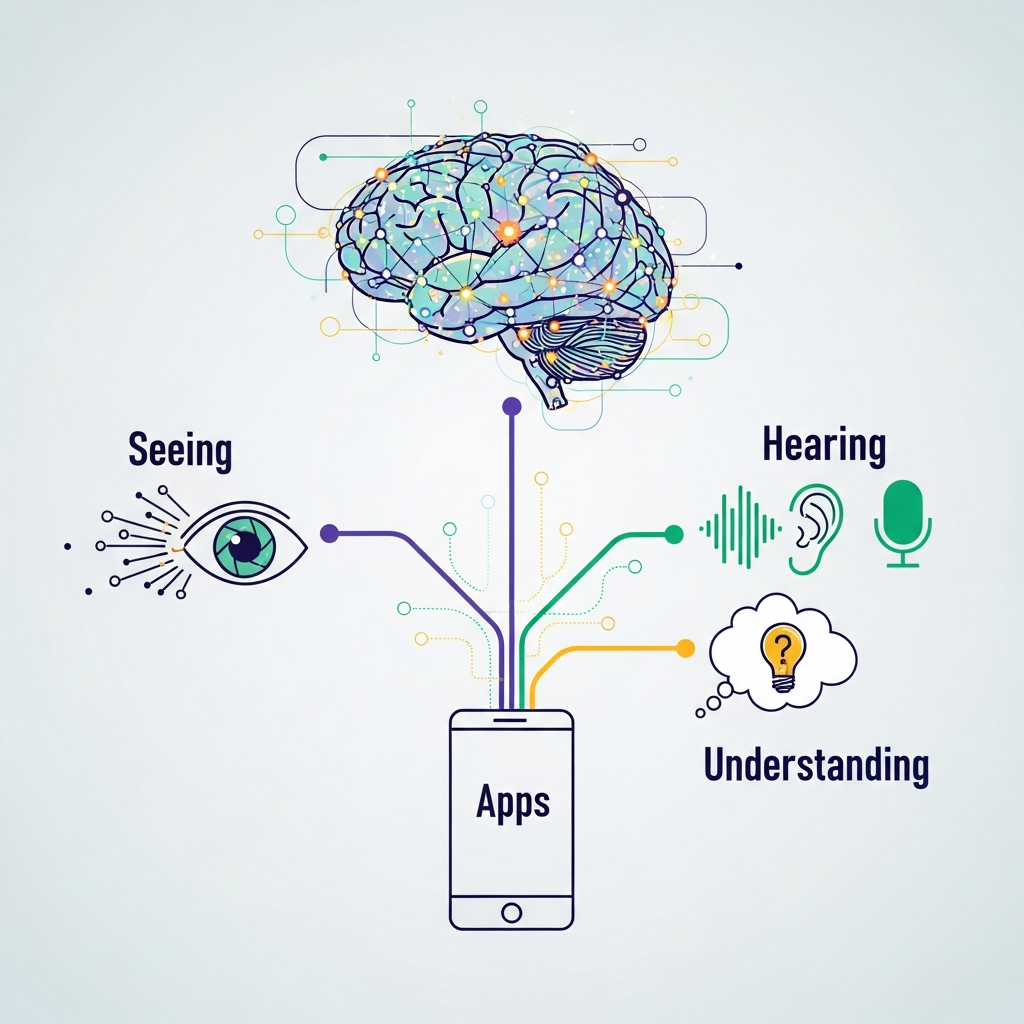
Enter Multimodal AI: a paradigm shift that aims to bridge these sensory gaps. By enabling AI systems to process and interpret information from multiple input modalities simultaneously, we can build applications that perceive, understand, and interact with the world in a much more human-like, robust, and nuanced way. Imagine an AI that can not only transcribe your words but also understand your sentiment from your tone and facial cues, or an autonomous vehicle that processes visual data alongside lidar and radar to make safer decisions.
This comprehensive guide will take you on a journey into the practical aspects of building Multimodal AI applications. We'll explore the foundational concepts, dive into architectural patterns, provide concrete code examples, and discuss best practices and common pitfalls. By the end, you'll have a solid understanding of how to construct intelligent systems that can truly see, hear, and understand.
Prerequisites
To get the most out of this article, a basic understanding of the following concepts will be beneficial:
- Machine Learning and Deep Learning Fundamentals: Familiarity with neural networks, training, and evaluation.
- Python Programming: Our code examples will be in Python.
- Deep Learning Frameworks: Exposure to TensorFlow or PyTorch is helpful, though specific implementations will be simplified.
- Basic Concepts of Computer Vision, Natural Language Processing, and Speech Recognition: Understanding the core tasks and techniques within these fields.
1. What is Multimodal AI?
Multimodal AI refers to AI systems designed to process and relate information from multiple distinct modalities. A modality is essentially a channel through which information is conveyed, such as text, images, audio, video, sensor data, or even physiological signals. The goal is to integrate these different forms of data to achieve a more comprehensive and accurate understanding than would be possible with any single modality alone.
Why is it powerful?
- Richer Context: Combining modalities provides a richer, more holistic view of a situation, leading to better decision-making.
- Robustness: If one modality is noisy or ambiguous, other modalities can compensate, making the system more resilient.
- Human-like Understanding: Humans naturally integrate information from all senses. Multimodal AI moves closer to this cognitive ability.
- Solving Complex Problems: Many real-world problems inherently require understanding across different data types (e.g., autonomous driving, human-computer interaction).
Examples:
- Image Captioning: Describing the content of an image in natural language.
- Visual Question Answering (VQA): Answering questions about an image.
- Multimodal Sentiment Analysis: Determining sentiment from spoken words, vocal tone, and facial expressions.
- Video Summarization: Generating a textual summary of a video's content.
2. The Architecture of Multimodal Systems
Building a multimodal AI system typically involves several key architectural components, primarily focusing on how to encode individual modalities and then how to fuse their representations.
Modality-Specific Encoders
Each modality (image, text, audio) requires a specialized encoder capable of extracting meaningful features from its raw data. These encoders transform the raw input into a fixed-size vector representation, often called an embedding or latent representation.
- Vision Encoders: Convolutional Neural Networks (CNNs) like ResNet, VGG, or more recently, Vision Transformers (ViT) are used to process images and extract visual features.
- Audio Encoders: Recurrent Neural Networks (RNNs), Convolutional Neural Networks (CNNs), or Transformer-based models (e.g., Wav2Vec 2.0, HuBERT) are common for processing audio signals, often after converting them into spectrograms.
- Text Encoders: Transformer-based models like BERT, RoBERTa, or GPT variants are highly effective at generating contextualized embeddings for textual data.
Fusion Techniques
Once individual modality embeddings are generated, the crucial step is to combine them. This fusion can happen at different stages:
- Early Fusion: Concatenating raw data from different modalities before feeding it into a single model. This is often challenging due to differing data formats, sampling rates, and scales.
- Intermediate (Feature-Level) Fusion: The most common approach. Individual encoders process their respective modalities, and their resulting feature vectors (embeddings) are then concatenated, added, or multiplied and fed into a joint model.
- Late (Decision-Level) Fusion: Each modality is processed by a separate, independent model, and their individual predictions are combined at the final decision stage (e.g., averaging probabilities, voting).
Cross-Modal Attention and Unified Representations
More advanced architectures often employ attention mechanisms to allow different modalities to 'attend' to relevant parts of other modalities. For example, in VQA, the text question might attend to specific regions of an image. The ultimate goal is often to create a unified multimodal representation where information from all modalities is semantically aligned in a shared latent space.
3. Key Modalities and Their Encoders
Understanding how each modality is processed individually is fundamental before attempting to combine them.
Vision Encoders (Images/Video)
For still images, CNNs remain a strong baseline. For sequences (video), often 3D CNNs or a combination of 2D CNNs for spatial features and RNNs/Transformers for temporal features are used.
import tensorflow as tf
from tensorflow.keras.applications import ResNet50
from tensorflow.keras.layers import Input, GlobalAveragePooling2D, Dense
from tensorflow.keras.models import Model

def build_image_encoder(input_shape=(224, 224, 3), embedding_dim=512):
    # Load a pre-trained ResNet50 model, excluding the top classification layer
    base_model = ResNet50(weights='imagenet', include_top=False, input_shape=input_shape)
    base_model.trainable = False # Freeze base model for feature extraction

    # Add custom layers to get desired embedding dimension
    x = base_model.output
    x = GlobalAveragePooling2D()(x) # Reduce spatial dimensions
    x = Dense(embedding_dim, activation='relu')(x) # Project to embedding_dim

    model = Model(inputs=base_model.input, outputs=x)
    return model

# Example usage:
# image_encoder = build_image_encoder()
# image_encoder.summary()
Audio Encoders (Speech/Sound)
Raw audio signals are typically converted into a spectrogram (a visual representation of frequency over time) or Mel-frequency cepstral coefficients (MFCCs). These representations can then be fed into CNNs, RNNs (like LSTMs or GRUs), or specialized Transformer architectures.
import tensorflow as tf
from tensorflow.keras.layers import Input, Conv1D, GlobalAveragePooling1D, Dense, Bidirectional, LSTM
from tensorflow.keras.models import Model

def build_audio_encoder(input_shape=(128, 64), embedding_dim=512):
    # input_shape: (timesteps, features) e.g., (spectrogram_width, num_mel_bands)
    input_audio = Input(shape=input_shape)

    # Example: CNN + LSTM for audio feature extraction
    x = Conv1D(filters=64, kernel_size=3, activation='relu', padding='same')(input_audio)
    x = Conv1D(filters=128, kernel_size=3, activation='relu', padding='same')(x)
    x = Bidirectional(LSTM(128, return_sequences=True))(x)
    x = Bidirectional(LSTM(128))(x) # Output sequence of features
    x = Dense(embedding_dim, activation='relu')(x) # Project to embedding_dim

    model = Model(inputs=input_audio, outputs=x)
    return model

# Example usage:
# audio_encoder = build_audio_encoder()
# audio_encoder.summary()
Text Encoders (Natural Language)
Transformer-based models like BERT, RoBERTa, or even smaller, task-specific Transformers are the go-to for text. They produce rich contextual embeddings for words or sentences.
from transformers import AutoTokenizer, TFAutoModel
import tensorflow as tf

def build_text_encoder(model_name='bert-base-uncased', max_length=128, embedding_dim=768):
    tokenizer = AutoTokenizer.from_pretrained(model_name)
    transformer_model = TFAutoModel.from_pretrained(model_name)
    transformer_model.trainable = False # Freeze for feature extraction

    input_ids = tf.keras.layers.Input(shape=(max_length,), dtype=tf.int32, name='input_ids')
    attention_mask = tf.keras.layers.Input(shape=(max_length,), dtype=tf.int32, name='attention_mask')

    outputs = transformer_model(input_ids, attention_mask=attention_mask)
    # CLS token output is typically used as sentence embedding
    cls_output = outputs.last_hidden_state[:, 0, :]

    # If embedding_dim is different from BERT's default (768), add a projection layer
    if embedding_dim != 768:
        cls_output = tf.keras.layers.Dense(embedding_dim, activation='relu')(cls_output)

    model = tf.keras.models.Model(inputs=[input_ids, attention_mask], outputs=cls_output)
    return model, tokenizer

# Example usage:
# text_encoder, tokenizer = build_text_encoder(embedding_dim=512)
# text_encoder.summary()
4. Fusion Strategies for Multimodal Data
Once you have embeddings from each modality, the next step is to combine them effectively. The choice of fusion strategy heavily depends on the task and the nature of your data.
Intermediate (Feature-Level) Fusion
This is the most common and often most effective method. Embeddings from different modalities are concatenated or combined element-wise (e.g., addition, multiplication) and then passed through subsequent layers of a neural network to learn joint representations.
import tensorflow as tf
from tensorflow.keras.layers import Concatenate, Dense
from tensorflow.keras.models import Model

# Assuming you have image_encoder, audio_encoder, text_encoder from previous steps
# All encoders should output embeddings of the same dimension for easy concatenation
embedding_dim = 512

image_encoder = build_image_encoder(embedding_dim=embedding_dim)
audio_encoder = build_audio_encoder(embedding_dim=embedding_dim)
text_encoder, _ = build_text_encoder(embedding_dim=embedding_dim)

# Define inputs for the full multimodal model
image_input = tf.keras.layers.Input(shape=(224, 224, 3), name='image_input')
audio_input = tf.keras.layers.Input(shape=(128, 64), name='audio_input')
text_input_ids = tf.keras.layers.Input(shape=(128,), dtype=tf.int32, name='text_input_ids')
text_attention_mask = tf.keras.layers.Input(shape=(128,), dtype=tf.int32, name='text_attention_mask')

# Get embeddings from each encoder
image_embedding = image_encoder(image_input)
audio_embedding = audio_encoder(audio_input)
text_embedding = text_encoder([text_input_ids, text_attention_mask])

# Concatenate the embeddings
fused_embedding = Concatenate()([image_embedding, audio_embedding, text_embedding])

# Add a final classification layer (example for a classification task)
output = Dense(128, activation='relu')(fused_embedding)
output = Dense(10, activation='softmax')(output) # Example: 10 classes

multimodal_model = Model(inputs=[
    image_input, audio_input, text_input_ids, text_attention_mask
], outputs=output)

multimodal_model.summary()
Late (Decision-Level) Fusion
In this approach, each modality is processed by a separate, independent model, and their individual predictions are combined at the very end. This is simpler to implement and debug but might miss crucial cross-modal interactions at the feature level.
# Pseudocode for Late Fusion
# image_model = build_image_model_for_task()
# audio_model = build_audio_model_for_task()
# text_model = build_text_model_for_task()

# image_prediction = image_model(image_data)
# audio_prediction = audio_model(audio_data)
# text_prediction = text_model(text_data)

# Combine predictions (e.g., average probabilities for classification)
# final_prediction = (image_prediction + audio_prediction + text_prediction) / 3
Advanced Fusion: Cross-Modal Attention
For more complex interactions, cross-modal attention mechanisms allow different modalities to query and attend to relevant information from other modalities. This is common in models like Visual Question Answering (VQA) where the text question guides attention over image regions.
5. Practical Use Case 1: Image Captioning
Image captioning is a classic multimodal task where an AI system generates a natural language description for a given image. It combines computer vision (to understand the image) and natural language processing (to generate the text).
Architecture
Typically, an image captioning model consists of:
- Image Encoder: A CNN (e.g., ResNet, Inception) extracts visual features from the image.
- Text Decoder: A Recurrent Neural Network (RNN) like an LSTM or a Transformer decoder generates the caption word by word, conditioned on the image features and previously generated words.
Data
Datasets like MS COCO (Microsoft Common Objects in Context) are widely used, providing images paired with multiple human-annotated captions.
# Simplified Keras-like pseudocode for Image Captioning
import tensorflow as tf
from tensorflow.keras.layers import Input, Dense, Embedding, LSTM, TimeDistributed
from tensorflow.keras.models import Model

# Assume image_encoder from before, outputting (embedding_dim) vector
image_encoder = build_image_encoder(embedding_dim=512)

# Text Decoder part
vocabulary_size = 10000 # Example size
max_caption_length = 50 # Max words in a caption

# Input for image features
image_features_input = Input(shape=(512,), name='image_features_input')

# Input for text sequence (tokenized caption)
text_input = Input(shape=(max_caption_length,), name='text_input')

# Embedding layer for text tokens
text_embedding_layer = Embedding(vocabulary_size, 256, mask_zero=True)(text_input)

# LSTM layer to process text sequence, conditioned on image features
# The image features are fed to the initial state of the LSTM
# A more complex setup might use attention between image features and LSTM outputs
lstm_output = LSTM(512, return_sequences=True)(
    text_embedding_layer, initial_state=[image_features_input, image_features_input]
)

# TimeDistributed Dense layer for word prediction at each time step
output_caption = TimeDistributed(Dense(vocabulary_size, activation='softmax'))(lstm_output)

# Build the decoder model for training
caption_decoder = Model(inputs=[image_features_input, text_input], outputs=output_caption)

# Full image captioning model (conceptual)
# image_input = Input(shape=(224, 224, 3), name='image_input')
# encoded_image = image_encoder(image_input)
# final_caption_model = Model(inputs=[image_input, text_input], outputs=caption_decoder([encoded_image, text_input]))

# During inference, you'd feed the image, then iteratively predict the next word
# based on the image features and previously predicted words.
6. Practical Use Case 2: Multimodal Sentiment Analysis
Traditional sentiment analysis relies solely on text. However, human sentiment is expressed through multiple channels: words, tone of voice, and facial expressions. Multimodal sentiment analysis combines these to achieve a more accurate and robust understanding.
Architecture
- Text Encoder: BERT or similar for spoken words (after ASR).
- Audio Encoder: CNNs/RNNs on spectrograms for vocal emotion (pitch, intensity, rhythm).
- Vision Encoder: CNNs on video frames for facial expressions (e.g., detecting happiness, sadness, anger).
- Fusion Layer: Concatenate the embeddings from all three encoders and feed them into a final classification layer.
Data
Datasets like IEMOCAP (Interactive Emotional Dyadic Motion Capture) or CMU-MOSI (Multimodal Opinion Sentiment and Emotion Intensity) provide video recordings with synchronized audio, video, and text transcripts, along with sentiment labels.
# Conceptual code for Multimodal Sentiment Analysis (Intermediate Fusion)
import tensorflow as tf
from tensorflow.keras.layers import Input, Concatenate, Dense
from tensorflow.keras.models import Model

embedding_dim = 256 # Example embedding dimension for all modalities

# Assume you have these pre-trained/defined encoders
text_encoder, _ = build_text_encoder(embedding_dim=embedding_dim) # For transcribed speech
audio_encoder = build_audio_encoder(embedding_dim=embedding_dim) # For vocal tone/emotion
video_frame_encoder = build_image_encoder(embedding_dim=embedding_dim) # For facial expressions

# Define inputs
text_input_ids = Input(shape=(128,), dtype=tf.int32, name='text_input_ids')
text_attention_mask = Input(shape=(128,), dtype=tf.int32, name='text_attention_mask')
audio_input = Input(shape=(128, 64), name='audio_input')
# For simplicity, assume video input is a single 'representative' frame or aggregated features
video_input = Input(shape=(224, 224, 3), name='video_input')

# Get embeddings
text_embedding = text_encoder([text_input_ids, text_attention_mask])
audio_embedding = audio_encoder(audio_input)
video_embedding = video_frame_encoder(video_input)

# Fuse embeddings
fused_features = Concatenate()([text_embedding, audio_embedding, video_embedding])

# Classification head for sentiment (e.g., positive, neutral, negative)
output = Dense(128, activation='relu')(fused_features)
output = Dense(3, activation='softmax')(output) # 3 classes for sentiment

sentiment_model = Model(inputs=[
    text_input_ids, text_attention_mask, audio_input, video_input
], outputs=output)

sentiment_model.summary()
7. Practical Use Case 3: Visual Question Answering (VQA)
VQA systems take an image and a natural language question about that image as input, then output a natural language answer. This task requires deep understanding of both visual content and linguistic queries, and their interplay.
Architecture
- Image Encoder: Extracts visual features from the image.
- Question Encoder: Extracts semantic features from the question.
- Fusion Mechanism: A crucial component that combines the image and question features. This often involves attention mechanisms where the question guides the model to focus on relevant parts of the image, or vice-versa.
- Answer Decoder/Classifier: Predicts the answer, which could be a single word (classification) or a short phrase (generation).
Data
Datasets like VQA v2.0 provide images, questions about those images, and corresponding answers, often with multiple human annotations for robustness.
# Conceptual Keras-like code for VQA
import tensorflow as tf
from tensorflow.keras.layers import Input, Dense, Concatenate, Multiply
from tensorflow.keras.models import Model

embedding_dim = 512

# Encoders (re-use from previous examples)
image_encoder = build_image_encoder(embedding_dim=embedding_dim)
question_encoder, _ = build_text_encoder(embedding_dim=embedding_dim) # Use text encoder for questions

# Define inputs
image_input = Input(shape=(224, 224, 3), name='image_input')
question_input_ids = Input(shape=(128,), dtype=tf.int32, name='question_input_ids')
question_attention_mask = Input(shape=(128,), dtype=tf.int32, name='question_attention_mask')

# Get embeddings
image_embedding = image_encoder(image_input)
question_embedding = question_encoder([question_input_ids, question_attention_mask])

# Simple Fusion (e.g., element-wise multiplication followed by concatenation)
# More advanced VQA models use complex attention mechanisms here.
# For simplicity, let's use a Hadamard product (element-wise multiplication)
# to capture interaction, then concatenate.
interaction_features = Multiply()([image_embedding, question_embedding])
fused_features = Concatenate()([image_embedding, question_embedding, interaction_features])

# Answer prediction head (e.g., a classifier for common answers)
num_possible_answers = 3000 # Example: top N most frequent answers in dataset
output = Dense(1024, activation='relu')(fused_features)
output = Dense(num_possible_answers, activation='softmax')(output) # Predict one of the top N answers

vqa_model = Model(inputs=[
    image_input, question_input_ids, question_attention_mask
], outputs=output)

vqa_model.summary()
8. Emerging Trends: Large Multimodal Models (LMMs)
The field of Multimodal AI is rapidly evolving with the advent of Large Multimodal Models (LMMs). Inspired by the success of Large Language Models (LLMs), LMMs are pre-trained on vast datasets containing diverse modalities, enabling them to perform a wide range of tasks with remarkable zero-shot and few-shot capabilities.
Key examples include:
- CLIP (Contrastive Language-Image Pre-training) by OpenAI: Learns to associate images with text by training on millions of image-text pairs. It can perform zero-shot image classification and image-to-text retrieval.
- DALL-E, Midjourney, Stable Diffusion: Generative models that take text as input and generate corresponding images, demonstrating powerful cross-modal generation capabilities.
- GPT-4V (GPT-4 with Vision) and Google Gemini: These models integrate visual understanding directly into powerful language models, allowing for conversational interactions about images, visual reasoning, and complex multimodal understanding.
These LMMs often leverage massive Transformer architectures and contrastive learning objectives to align embeddings from different modalities into a shared semantic space. This allows them to understand relationships between modalities even for concepts they haven't seen explicitly paired during training.
9. Best Practices for Multimodal AI Development
Developing robust multimodal applications comes with its own set of challenges and best practices:
Data Collection and Annotation: The Cornerstone
- High-Quality, Synchronized Data: Ensure all modalities are properly aligned in time and context. Poor synchronization can lead to misleading features.
- Diverse Datasets: Collect data that represents the variety of real-world scenarios your application will encounter.
- Thorough Annotation: Accurate and consistent labeling across modalities is critical for supervised learning. Consider using multiple annotators for consensus.
Handling Missing Modalities
Real-world scenarios often involve missing data (e.g., no audio in a silent video, blurry images). Strategies include:
- Imputation: Filling in missing features with zeros, averages, or generated data.
- Modality Dropout: Randomly dropping modalities during training to make the model robust to missing inputs at inference time.
- Masking: Using a mask token or flag to indicate which modalities are present.
- Designing for Robustness: Architectures that can degrade gracefully or leverage available modalities when others are absent.
Alignment and Synchronization
- Temporal Alignment: For video and audio, precise time synchronization is essential. Tools like
ffmpegor specialized libraries can help. - Semantic Alignment: Ensure that the features extracted from different modalities are semantically comparable, often achieved through shared embedding spaces or contrastive learning.
Evaluation Metrics
- Task-Specific Metrics: Use standard metrics relevant to your specific task (e.g., BLEU/ROUGE for captioning, F1-score for classification, accuracy for VQA).
- Multimodal Performance: Evaluate whether the multimodal approach truly outperforms single-modality baselines.
Transfer Learning
- Pre-trained Encoders: Always start with pre-trained encoders for each modality (e.g., ImageNet pre-trained CNNs, BERT for text, Wav2Vec for audio). Fine-tuning these greatly reduces training time and data requirements.
- Pre-trained LMMs: Leverage powerful LMMs like CLIP or GPT-4V through fine-tuning or prompt engineering for downstream tasks.
10. Common Pitfalls and Challenges
Despite its potential, Multimodal AI presents several challenges:
Data Sparsity and Imbalance
- Challenge: Obtaining large, high-quality, and perfectly synchronized multimodal datasets is extremely difficult and expensive. Imbalances between modalities (e.g., many images but few corresponding captions) are common.
- Mitigation: Data augmentation, synthetic data generation, transfer learning, and robust handling of missing modalities.
Computational Cost
- Challenge: Processing multiple high-dimensional modalities (especially video) and combining their features requires significant computational resources for both training and inference.
- Mitigation: Model quantization, pruning, distillation, efficient architectures, and leveraging cloud-based GPU infrastructure.
Modality Gap
- Challenge: Different modalities have inherently different statistical properties and semantic structures (e.g., images are continuous, text is discrete). Aligning them into a coherent joint representation can be challenging.
- Mitigation: Sophisticated fusion techniques (attention, transformers), contrastive learning, and shared embedding spaces.
Interpretability and Explainability
- Challenge: Understanding why a multimodal model made a particular decision is even harder than with unimodal models, as the decision relies on interactions between multiple complex feature sets.
- Mitigation: Attention visualization, saliency maps across modalities, and developing new explainable AI (XAI) techniques tailored for multimodal systems.
Bias in Data and Models
- Challenge: Biases present in individual modality datasets can be amplified when combined. For example, if an image dataset primarily features one demographic performing a certain activity, and a text dataset contains similar biases, the multimodal model might perpetuate harmful stereotypes.
- Mitigation: Careful data curation, bias detection tools, debiasing techniques, and ensuring diverse and representative training data.
Conclusion
Multimodal AI is not just a research frontier; it's a practical necessity for building truly intelligent applications that can understand and interact with the complex, multifaceted world we live in. By integrating information from vision, audio, text, and other modalities, we move closer to creating AI systems that exhibit human-like perception, reasoning, and communication.
We've covered the fundamental architectures, explored practical use cases like image captioning, multimodal sentiment analysis, and visual question answering, and discussed critical best practices and common pitfalls. The rapid advancements in Large Multimodal Models (LMMs) like GPT-4V and Gemini signal a future where these capabilities become even more accessible and powerful.
As you embark on your journey to build multimodal applications, remember the importance of high-quality, synchronized data, judicious choice of fusion strategies, and a keen awareness of the computational and ethical challenges. The ability to build apps that can truly see, hear, and understand will unlock unprecedented opportunities across industries, from enhanced human-computer interaction and assistive technologies to more robust autonomous systems and creative content generation. The future of AI is undeniably multimodal, and the tools and knowledge to shape it are now within your grasp.
Written by
CodewithYohaFull-Stack Software Engineer with 7+ years of experience in Java, Spring Boot, and cloud architecture across AWS, Azure, and GCP. Writing production-grade engineering patterns for developers who ship real software.