
AI Code Review Automation: Integrating LLMs into Pull Request Workflows

Introduction
Code reviews are the cornerstone of high-quality software development. They catch bugs, ensure adherence to standards, foster knowledge sharing, and ultimately lead to more robust and maintainable codebases. However, traditional manual code reviews can be slow, inconsistent, and prone to human error or fatigue. As projects scale and development teams grow, the bottleneck of manual reviews becomes increasingly apparent.
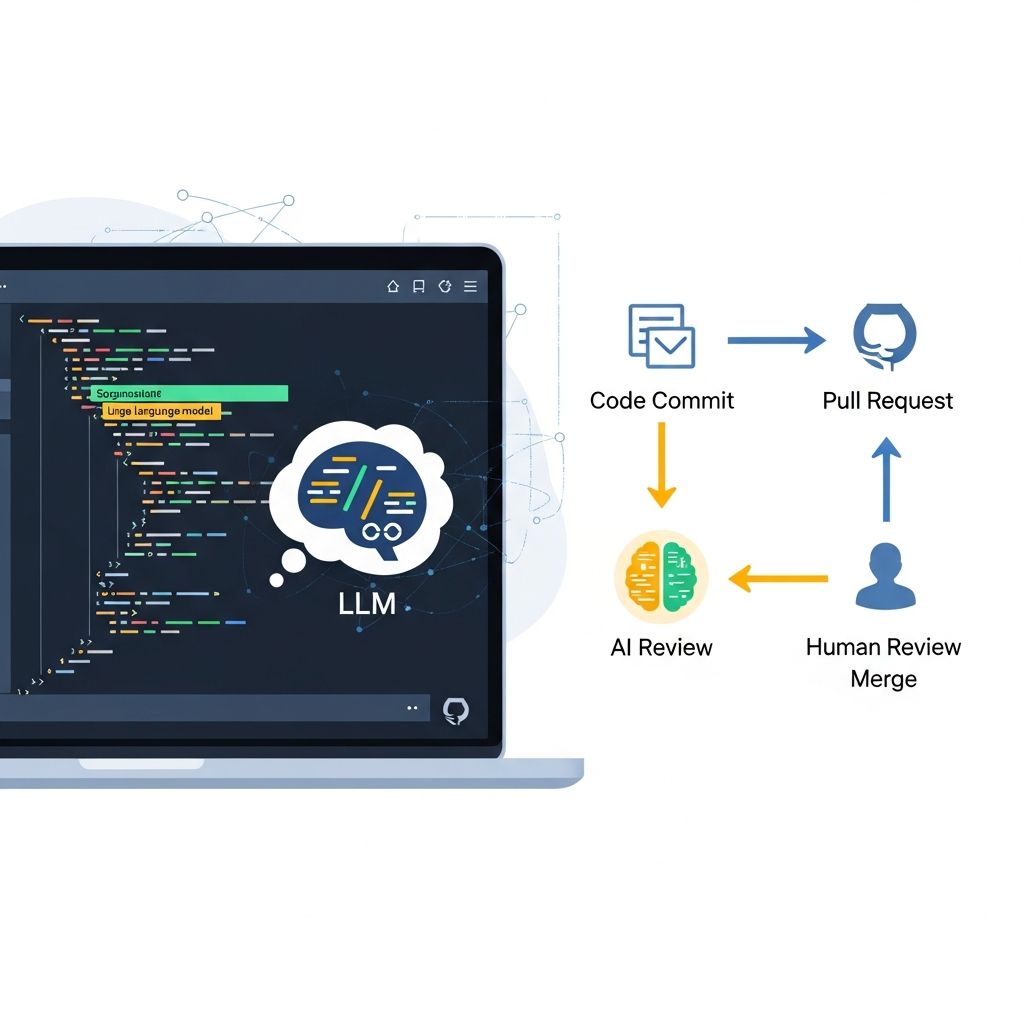
Enter Large Language Models (LLMs). With their unprecedented ability to understand, generate, and reason about human language (and by extension, programming languages), LLMs offer a revolutionary path to automate and enhance the code review process. Imagine a system that can provide instant, intelligent feedback on every pull request, identifying potential bugs, suggesting style improvements, flagging security vulnerabilities, and even proposing performance optimizations, all before a human reviewer even looks at the code.
This comprehensive guide will walk you through the "how" and "why" of integrating LLMs into your pull request (PR) workflows. We'll explore the architecture, practical implementation, best practices, and common pitfalls to help you leverage AI for faster, more consistent, and higher-quality code reviews.
Prerequisites
To get the most out of this guide, you should have:
- A basic understanding of Git and pull request workflows (e.g., GitHub, GitLab).
- Familiarity with webhooks and API interactions.
- Intermediate Python programming skills.
- An API key for an LLM provider (e.g., OpenAI, Anthropic, Google Gemini).
The Evolution of Code Review: From Manual to AI-Powered
Code review has evolved significantly over the decades:
- Manual Review (Human-centric): The traditional approach where developers manually inspect code changes. While invaluable for complex logic and architectural discussions, it's slow, subjective, and resource-intensive.
- Static Analysis Tools: Tools like Linters (ESLint, Pylint), SAST (Static Application Security Testing) tools (SonarQube, Bandit), and formatters (Prettier, Black) automate the detection of common errors, style violations, and security flaws. They are fast and consistent but often lack contextual understanding and cannot reason about complex logic.
- Dynamic Analysis Tools: Tools that analyze code during execution (e.g., unit tests, integration tests, performance profilers). Essential for verifying runtime behavior but not directly part of the pre-merge review process.
- LLM-Powered Code Review: The next frontier. LLMs combine the speed and consistency of static analysis with a degree of contextual understanding and reasoning ability approaching that of a human. They can analyze code changes, suggest improvements, explain complex concepts, and even refactor code snippets, offering a dynamic and intelligent layer to the review process.
Why LLMs for Code Review? Unlocking Key Benefits
Integrating LLMs into your PR workflow offers several compelling advantages:
- Speed and Efficiency: LLMs can review code almost instantly, drastically reducing the time spent waiting for initial feedback. This accelerates the development cycle and allows human reviewers to focus on higher-level architectural concerns.
- Consistency: Unlike human reviewers who might have varying standards or moods, an LLM, given the same prompt and context, will provide consistent feedback, ensuring uniform code quality across the codebase.
- Early Bug Detection: LLMs can identify potential bugs, logic errors, and anti-patterns early in the development process, preventing them from propagating further down the pipeline.
- Improved Code Quality: By consistently enforcing style guides, suggesting best practices, and flagging potential issues, LLMs contribute to a higher overall code quality.
- Enhanced Security: LLMs can be prompted to specifically look for common security vulnerabilities (e.g., SQL injection, XSS, insecure deserialization) and suggest remediation.
- Knowledge Transfer and Learning: The explanations provided by LLMs can serve as a learning tool for junior developers, helping them understand best practices and common pitfalls.
- Reduced Reviewer Fatigue: By offloading the initial pass and identifying obvious issues, LLMs free up human reviewers to concentrate on more complex, nuanced aspects of the code.
Understanding LLM Capabilities in Code Review
While powerful, it's important to understand what LLMs excel at and where their limitations lie in the context of code review.
What LLMs CAN Do:
- Syntax and Style Checks: Enforce coding standards (e.g., PEP8 for Python, ESLint rules for JavaScript).
- Potential Bug Detection: Identify common logical errors, off-by-one errors, unhandled exceptions, resource leaks (e.g., unclosed files).
- Suggesting Best Practices: Propose more idiomatic code, better data structures, or cleaner algorithms.
- Security Vulnerability Spotting: Detect common OWASP Top 10 vulnerabilities based on code patterns.
- Performance Optimizations: Suggest areas where code could be more efficient.
- Readability and Maintainability: Provide feedback on code clarity, naming conventions, and modularity.
- Explaining Code: Help understand complex sections or the intent behind changes.
- Refactoring Suggestions: Propose minor refactorings for improved structure.
What LLMs CANNOT (Yet) Do Reliably:
- Deep Architectural Understanding: They struggle with understanding the entire system's architecture, business logic, or long-term design implications.
- Complex Contextual Reasoning: While they have a "context window," understanding how a change impacts a vast, distributed system is beyond their current capabilities.
- Guaranteed Correctness: LLMs can "hallucinate" or provide plausible but incorrect suggestions. Human oversight is always critical.
- Debugging Runtime Issues: They cannot execute code or understand dynamic behavior directly.
- Non-Code Artifacts: They don't understand design documents, user stories, or requirements beyond what's explicitly provided in the prompt.
Architectural Overview of an LLM-Powered Code Review System
An LLM-powered code review system typically involves several key components:
- Version Control System (VCS) Webhook: GitHub, GitLab, or Bitbucket provide webhooks that trigger an event (e.g.,
pull_requestopened,pull_requestsynchronized) whenever a PR activity occurs. - Webhook Receiver/Orchestrator: A server-side application (e.g., Flask, FastAPI, AWS Lambda) that listens for these webhooks. It extracts relevant information like the PR ID, repository details, and the code diff.
- Diff Extraction and Preparation: The orchestrator fetches the actual code changes (the diff) associated with the PR. This diff is crucial input for the LLM.
- LLM API Interaction: The prepared diff, along with carefully crafted prompts, is sent to an LLM provider's API (e.g., OpenAI's GPT-4, Anthropic's Claude, Google's Gemini).
- Feedback Generation: The LLM processes the input and generates review comments or a summary.
- Feedback Posting: The orchestrator uses the VCS API (e.g., GitHub API) to post the LLM's generated feedback directly as PR comments, either as a single summary or as line-by-line suggestions.
- Configuration and Rules Engine (Optional but Recommended): A system to define custom rules, ignored files/directories, and specific review focuses (e.g., only security review for certain repos).
Designing the Prompt for Effective Code Review
Prompt engineering is the most critical aspect of building an effective LLM code review system. The quality of the feedback directly depends on the clarity, specificity, and completeness of your prompts.
General Principles for Prompt Design:
- Role-Playing: Assign a persona to the LLM (e.g., "You are an experienced Senior Software Engineer specializing in Python and security...").
- Clear Instructions: Be explicit about what you want the LLM to do and what format you expect the output in.
- Context Provision: Provide the code diff, surrounding code (if possible), file path, and any relevant project guidelines.
- Constraints: Specify what not to do, e.g., "Do not provide trivial suggestions" or "Focus only on security aspects."
- Output Format: Request a structured output, e.g., Markdown list, JSON, or specific comment format.
- Iterative Refinement: Experiment with prompts and observe the output to continuously improve them.
Example: General Code Review Prompt
Let's assume we're reviewing a Python file. The prompt should instruct the LLM on its role and desired output.
import os

def create_general_review_prompt(diff_content, file_path, project_tech_stack="Python, FastAPI, PostgreSQL"):
    return f"""
    You are an expert Senior Software Engineer specializing in {project_tech_stack}.
    Your task is to perform a comprehensive code review on the provided diff for the file '{file_path}'.

    Focus on the following aspects:
    1.  **Potential Bugs**: Identify any logical errors, edge cases, or runtime issues.
    2.  **Code Style & Readability**: Check for adherence to common style guides (e.g., PEP8 for Python), clarity, and maintainability.
    3.  **Security Vulnerabilities**: Flag any potential security risks (e.g., injection flaws, insecure configurations).
    4.  **Performance Improvements**: Suggest areas where the code could be made more efficient.
    5.  **Best Practices**: Recommend idiomatic patterns, proper error handling, and robust design principles.
    6.  **Testability**: Comment on how easy or difficult the changed code would be to test.

    Provide your feedback as a Markdown list, with each item clearly stating the issue, its location (line number if possible), and a concise suggestion for improvement. If no issues are found in a category, state 'No issues found.'

    Here is the code diff for '{file_path}':
    \`\`\`diff
    {diff_content}
    \`\`\`

    Begin your review:
    """

# Example usage (diff_content would come from your Git system)
# diff = """
# --- a/app.py
# +++ b/app.py
# @@ -1,5 +1,7 @@
#  import os
# +import json
#
#  def process_data(data):
# -    return data.upper()
# +    if not isinstance(data, str):
# +        raise ValueError("Input must be a string")
# +    return data.strip().upper()
# """
# print(create_general_review_prompt(diff, "app.py"))
Example: Security-Focused Review Prompt
For specific concerns, you can create targeted prompts.
def create_security_review_prompt(diff_content, file_path, project_tech_stack="Python, FastAPI"):
    return f"""
    You are a highly experienced Security Engineer specializing in {project_tech_stack} applications.
    Your task is to perform a security-focused code review on the provided diff for the file '{file_path}'.

    Specifically, look for:
    1.  **Injection Vulnerabilities**: SQL injection, Command injection, XSS.
    2.  **Insecure Deserialization**: Risks associated with deserializing untrusted data.
    3.  **Broken Authentication/Authorization**: Weaknesses in session management, access control.
    4.  **Sensitive Data Exposure**: Hardcoded credentials, improper logging of sensitive info.
    5.  **Insecure Configurations**: Default credentials, unnecessary services.
    6.  **Dependency Vulnerabilities**: Outdated or known vulnerable libraries (if applicable from the diff).
    7.  **Input Validation Issues**: Lack of proper sanitization or validation.

    Provide your feedback as a Markdown list. For each identified vulnerability, state the type, its location (line number if possible), a brief explanation of the risk, and a clear recommendation for remediation. If no security issues are found, state 'No security issues found.'

    Here is the code diff for '{file_path}':
    \`\`\`diff
    {diff_content}
    \`\`\`

    Begin your security review:
    """

# Example usage
# diff = """
# --- a/auth.py
# +++ b/auth.py
# @@ -5,7 +5,9 @@
#  from flask import request, jsonify
#
#  @app.route('/login', methods=['POST'])
#  def login():
# -    username = request.form['username']
# -    password = request.form['password']
# -    # Insecure query, vulnerable to SQL Injection
# -    user = db.query(f"SELECT * FROM users WHERE username='{username}' AND password='{password}'")
# +    username = request.form.get('username')
# +    password = request.form.get('password')
# +    if not username or not password:
# +        return jsonify({"message": "Missing credentials"}), 400
# +    # Using parameterized query to prevent SQL Injection
# +    user = db.execute("SELECT * FROM users WHERE username=? AND password=?", (username, password)).fetchone()
#      if user:
#          return jsonify({"message": "Login successful"})
# """
# print(create_security_review_prompt(diff, "auth.py"))
Integrating with GitHub/GitLab Webhooks: A Practical Example
This section demonstrates how to set up a basic webhook receiver using Python with Flask, extract the diff, call an LLM API, and post comments back to a GitHub Pull Request.
1. Set up a Flask Webhook Receiver
First, you need a server to listen for GitHub webhook events. This example uses Flask. You'll need to expose this server to the internet (e.g., using ngrok for local testing or deploying to a cloud service).
# app.py
import os
import json
import requests
from flask import Flask, request, jsonify
from dotenv import load_dotenv

load_dotenv() # Load environment variables from .env file

app = Flask(__name__)

GITHUB_TOKEN = os.getenv("GITHUB_TOKEN") # Your GitHub Personal Access Token
OPENAI_API_KEY = os.getenv("OPENAI_API_KEY") # Your OpenAI API Key
WEBHOOK_SECRET = os.getenv("WEBHOOK_SECRET") # GitHub webhook secret for verification

if not GITHUB_TOKEN or not OPENAI_API_KEY or not WEBHOOK_SECRET:
    raise ValueError("Missing required environment variables (GITHUB_TOKEN, OPENAI_API_KEY, WEBHOOK_SECRET)")

# --- LLM Interaction Function ---
def call_llm_for_review(diff_content, file_path, project_tech_stack="Python, Flask"):
    try:
        prompt = create_general_review_prompt(diff_content, file_path, project_tech_stack)
        headers = {
            "Authorization": f"Bearer {OPENAI_API_KEY}",
            "Content-Type": "application/json"
        }
        payload = {
            "model": "gpt-4o", # Or 'gpt-3.5-turbo', 'claude-3-opus-20240229', etc.
            "messages": [{"role": "user", "content": prompt}],
            "max_tokens": 1500,
            "temperature": 0.5
        }
        response = requests.post("https://api.openai.com/v1/chat/completions", headers=headers, json=payload)
        response.raise_for_status()
        review_comment = response.json()["choices"][0]["message"]["content"]
        return review_comment
    except requests.exceptions.RequestException as e:
        print(f"Error calling LLM API: {e}")
        return """I encountered an error while trying to review your code.
        Please check the LLM service status or API key configuration.
        """
    except Exception as e:
        print(f"An unexpected error occurred during LLM call: {e}")
        return """An unexpected error occurred during the AI review process.
        """

# --- GitHub API Interaction Function ---
def post_pr_comment(repo_full_name, pull_number, comment_body):
    url = f"https://api.github.com/repos/{repo_full_name}/issues/{pull_number}/comments"
    headers = {
        "Authorization": f"token {GITHUB_TOKEN}",
        "Accept": "application/vnd.github.v3+json"
    }
    payload = {"body": comment_body}
    response = requests.post(url, headers=headers, json=payload)
    response.raise_for_status()
    print(f"Posted comment to PR #{pull_number}")

def get_pr_diff(repo_full_name, pull_number):
    url = f"https://api.github.com/repos/{repo_full_name}/pulls/{pull_number}.diff"
    headers = {
        "Authorization": f"token {GITHUB_TOKEN}",
        "Accept": "application/vnd.github.v3.diff"
    }
    response = requests.get(url, headers=headers)
    response.raise_for_status()
    return response.text

# --- Webhook Endpoint ---
@app.route('/webhook', methods=['POST'])
def github_webhook():
    if request.headers.get('X-GitHub-Event') == 'ping':
        return jsonify({"msg": "pong"})

    # Verify webhook secret (important for security)
    # This is a simplified check; for production, use hmac.compare_digest
    if request.headers.get('X-Hub-Signature-256'):
        # Implement actual signature verification for production
        # For simplicity, we'll skip full verification here, but it's CRITICAL for security
        pass # Placeholder for signature verification

    event = request.headers.get('X-GitHub-Event')
    payload = request.get_json()

    if event == 'pull_request' and payload['action'] in ['opened', 'synchronize']:
        pull_request = payload['pull_request']
        repo_full_name = payload['repository']['full_name']
        pull_number = pull_request['number']
        head_sha = pull_request['head']['sha']

        print(f"Received PR event for {repo_full_name} PR #{pull_number} (SHA: {head_sha})")

        try:
            # 1. Get the diff
            diff_content = get_pr_diff(repo_full_name, pull_number)

            # Extract changed file paths from the diff (basic parsing)
            # This is a simplified approach; a robust parser would be better.
            changed_files = []
            for line in diff_content.split('\n'):
                if line.startswith('--- a/') and not line.startswith('--- a/dev/null'):
                    changed_files.append(line[6:].split(' ')[0])

            # For simplicity, let's just review the whole diff for now.
            # In a real system, you might iterate through files or apply smarter diff parsing.
            file_path_for_llm = changed_files[0] if changed_files else "unknown_file"

            # 2. Call LLM for review
            llm_review_comment = call_llm_for_review(diff_content, file_path_for_llm)

            # 3. Post comment back to GitHub PR
            if llm_review_comment:
                post_pr_comment(repo_full_name, pull_number,
                                f"## 🤖 AI Code Review Results\n\n{llm_review_comment}\n\n---
*Disclaimer: This review was generated by an AI and may contain inaccuracies. Human review is still essential.*")

        except requests.exceptions.HTTPError as e:
            print(f"GitHub API error: {e.response.status_code} - {e.response.text}")
        except Exception as e:
            print(f"Error processing PR webhook: {e}")

    return jsonify({"status": "success"}), 200

# Include the prompt functions defined earlier
# (create_general_review_prompt, create_security_review_prompt)
# For brevity, they are not repeated here but would be in the same file or imported.

# ... (Paste create_general_review_prompt and create_security_review_prompt here) ...
# I'll include the general prompt function here to make the example self-contained.

def create_general_review_prompt(diff_content, file_path, project_tech_stack="Python, Flask"):
    return f"""
    You are an expert Senior Software Engineer specializing in {project_tech_stack}.
    Your task is to perform a comprehensive code review on the provided diff for the file '{file_path}'.

    Focus on the following aspects:
    1.  **Potential Bugs**: Identify any logical errors, edge cases, or runtime issues.
    2.  **Code Style & Readability**: Check for adherence to common style guides (e.g., PEP8 for Python), clarity, and maintainability.
    3.  **Security Vulnerabilities**: Flag any potential security risks (e.g., injection flaws, insecure configurations).
    4.  **Performance Improvements**: Suggest areas where the code could be made more efficient.
    5.  **Best Practices**: Recommend idiomatic patterns, proper error handling, and robust design principles.
    6.  **Testability**: Comment on how easy or difficult the changed code would be to test.

    Provide your feedback as a Markdown list, with each item clearly stating the issue, its location (line number if possible), and a concise suggestion for improvement. If no issues are found in a category, state 'No issues found.'

    Here is the code diff for '{file_path}':
    \`\`\`diff
    {diff_content}
    \`\`\`

    Begin your review:
    """


if __name__ == '__main__':
    app.run(debug=True, port=5000)
2. Environment Variables (.env file)
Create a .env file in the same directory:
GITHUB_TOKEN="YOUR_GITHUB_PERSONAL_ACCESS_TOKEN"
OPENAI_API_KEY="YOUR_OPENAI_API_KEY"
WEBHOOK_SECRET="YOUR_GITHUB_WEBHOOK_SECRET"
- GITHUB_TOKEN: Generate a Personal Access Token with
reposcope (for private repos) orpublic_reposcope (for public repos) andwrite:discussionorpull_requestspermissions to allow posting comments. - OPENAI_API_KEY: Get this from your OpenAI dashboard.
- WEBHOOK_SECRET: A secret string you define, which GitHub uses to sign the webhook payloads. This helps verify that the request is genuinely from GitHub. (Note: The example's verification is simplified; use
hmac.compare_digestin production).
3. Configure GitHub Webhook
- Go to your GitHub repository's
Settings->Webhooks->Add webhook. - Payload URL: Point this to your exposed Flask app (e.g.,
https://your-ngrok-url/webhookor your deployed endpoint). - Content type:
application/json. - Secret: Enter the
WEBHOOK_SECRETyou defined in your.envfile. - Which events would you like to trigger this webhook?: Select
Just the push eventandPull requests. - Click
Add webhook.
Now, every time a PR is opened or updated in your repository, GitHub will send a POST request to your Flask app, triggering the AI review process.
Handling Different Review Scenarios
An effective LLM-powered review system should be adaptable to various scenarios:
- New Code vs. Refactoring: The prompt can be adjusted. For new code, focus on architecture and completeness. For refactoring, emphasize correctness, performance, and ensuring no regressions.
- Specific Languages/Frameworks: Tailor your prompts to the technology stack. Mentioning "Python, Django, Celery" in the prompt helps the LLM apply relevant best practices.
- Contextual Awareness: Beyond just the diff, providing relevant project-specific documentation, architectural guidelines, or even previous PR comments can significantly improve the LLM's understanding and quality of feedback. This often requires fetching more data from your VCS and potentially storing project-specific knowledge bases.
- Large Diffs: LLMs have context window limits. For very large PRs, consider breaking down the review by file, or even by hunk within a file. You might also need to summarize parts of the diff before sending it to the LLM.
Best Practices for LLM-Automated Code Review
To maximize the benefits and mitigate risks, follow these best practices:
- Start Small and Iterate: Don't try to automate everything at once. Begin with simple checks (e.g., style, basic bug patterns) and gradually expand the LLM's scope as you gain confidence.
- Human-in-the-Loop is Essential: LLMs are powerful tools, but they are not infallible. Always treat AI-generated feedback as suggestions rather than definitive truths. Human reviewers should always have the final say.
- Clear Guidelines and Expectations: Communicate to your team what the AI reviewer will check and what its limitations are. This helps manage expectations and fosters trust.
- Fine-tuning and Customization: For highly specific project guidelines or domain-specific code, consider fine-tuning a smaller LLM or using Retrieval Augmented Generation (RAG) to provide project-specific context from your documentation.
- Monitor and Evaluate: Regularly review the quality of the LLM's feedback. Collect metrics on how often its suggestions are accepted, rejected, or lead to further discussion. Use this data to refine prompts and configurations.
- Security Considerations: Ensure your LLM API calls are authenticated and secure. Be mindful of sending sensitive code or proprietary information to third-party LLM providers if not explicitly allowed by your organization's policies. Consider self-hosted or private LLMs for highly sensitive data.
- Rate Limiting and Cost Management: LLM API calls incur costs. Implement rate limiting and monitor usage to stay within budget. Optimize prompts to be concise and provide only necessary context.
- Graceful Degradation: Design your system to function even if the LLM API is unavailable or returns an error. The PR process should not halt because the AI reviewer is down.
Common Pitfalls and How to Avoid Them
Implementing LLM-powered code review isn't without its challenges:
- Over-reliance and Blind Trust: The biggest pitfall. Developers might blindly accept AI suggestions without understanding them, leading to the introduction of new bugs or suboptimal code. Avoid by emphasizing human oversight.
- Hallucinations and Incorrect Suggestions: LLMs can generate plausible but incorrect code or advice. This is a known limitation. Mitigate by detailed prompts, human review, and clear disclaimers.
- Context Window Limitations: Large PRs or diffs might exceed the LLM's token limit, leading to incomplete reviews. Address by splitting reviews by file/hunk, summarizing diffs, or using models with larger context windows.
- Lack of Project Context: An LLM doesn't inherently know your project's specific conventions, architectural patterns, or historical decisions. Overcome by feeding relevant project documentation, configuration files, or previous code examples into the prompt or using RAG.
- Security Vulnerabilities in LLM Output: LLMs can sometimes generate code snippets that contain security flaws. If these are blindly applied, they introduce new risks. Always review AI-generated code suggestions for security, just as you would any other code.
- Noise and Trivial Suggestions: Overly verbose or nitpicky feedback can annoy developers and diminish the value of the review. Refine prompts to focus on high-impact issues and filter out low-priority suggestions.
- Cost Overruns: Frequent or extensive LLM API calls can become expensive. Monitor usage, optimize prompts for token efficiency, and consider caching mechanisms for common code patterns.
Advanced Techniques and Future Trends
As LLMs evolve, so too will their application in code review:
- Custom Models and Fine-tuning: Training or fine-tuning LLMs on your organization's specific codebase and coding standards can significantly improve the relevance and accuracy of feedback.
- Integration with Static Analysis Tools: Combining LLM insights with traditional static analysis (SAST, Linters) can create a more powerful and comprehensive review system, where LLMs provide context and reasoning for issues flagged by static tools.
- Self-Correction Loops: An advanced system could use an LLM to not only identify issues but also to propose fixes, apply them, and then use another LLM to review its own generated fix, creating a self-improving cycle.
- Automated Test Generation: Based on code changes, an LLM could suggest or even generate unit tests to cover new functionality or edge cases identified during the review.
- Personalized Reviews: Tailoring feedback based on a developer's experience level or historical performance (e.g., more detailed explanations for junior developers, focusing on specific areas for senior developers).
- AI-Driven Refactoring: Beyond suggestions, LLMs could be used to semi-automate refactoring tasks, proposing and executing changes with human approval.
Conclusion
AI code review automation with LLMs is not about replacing human developers or reviewers; it's about augmenting their capabilities, making the review process faster, more consistent, and ultimately more effective. By offloading repetitive and time-consuming checks to AI, human reviewers can focus their invaluable expertise on architectural decisions, complex logic, and mentoring.
Integrating LLMs into your pull request workflow requires careful planning, meticulous prompt engineering, and a commitment to continuous improvement. While challenges like hallucinations and context limitations exist, embracing a "human-in-the-loop" approach, coupled with robust monitoring and iterative refinement, will unlock a new era of efficiency and quality in software development. The future of code review is collaborative, intelligent, and increasingly automated, with LLMs playing a pivotal role in shaping how we build and maintain software.
Written by
CodewithYohaFull-Stack Software Engineer with 7+ years of experience in Java, Spring Boot, and cloud architecture across AWS, Azure, and GCP. Writing production-grade engineering patterns for developers who ship real software.