Generative AI in DevOps: Automating Configs, Scripts, and IaC Templates

Introduction
The landscape of software development and operations is in constant flux, driven by the relentless pursuit of speed, reliability, and efficiency. DevOps methodologies have emerged as a cornerstone for achieving these goals, emphasizing collaboration, continuous integration, and continuous delivery. Yet, even with sophisticated CI/CD pipelines and infrastructure as Code (IaC) practices, the manual effort involved in crafting configurations, writing bespoke scripts, and maintaining complex infrastructure templates remains a significant bottleneck and a source of human error.
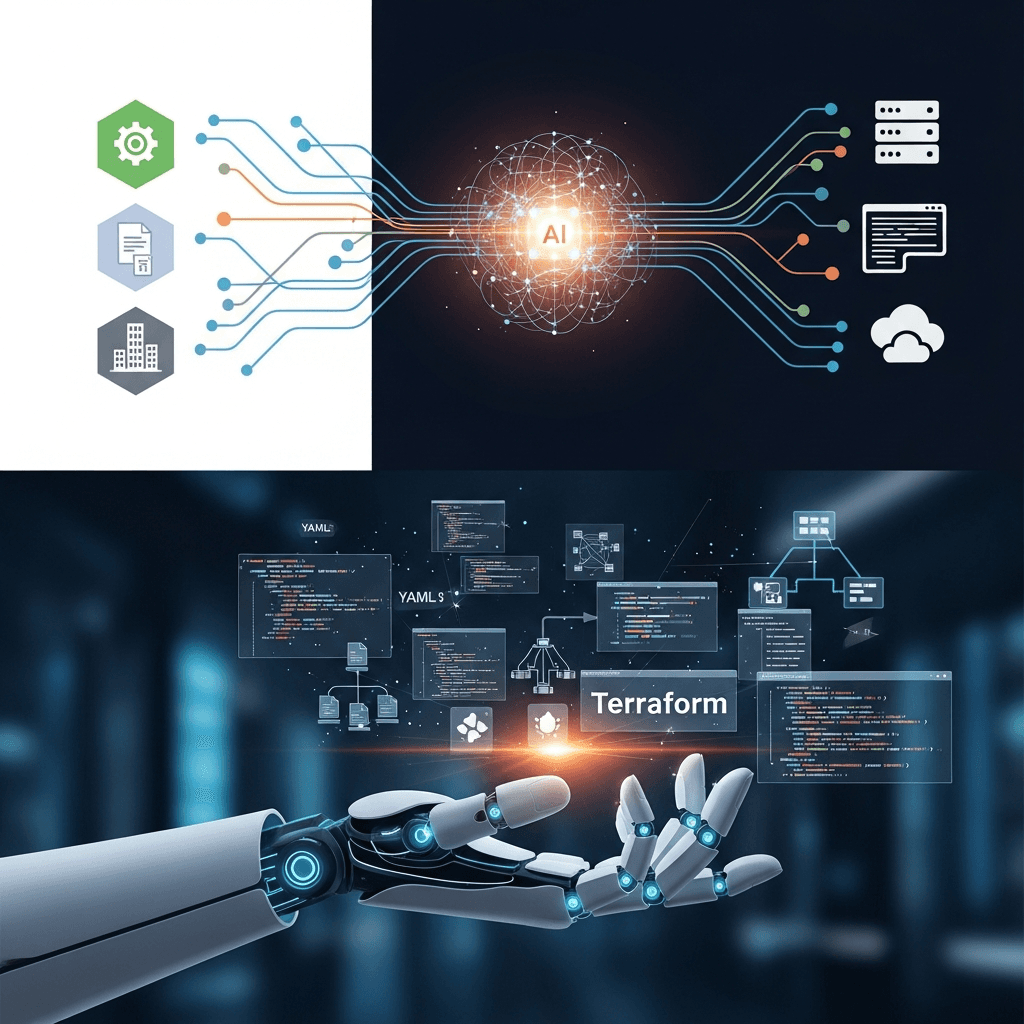
Enter Generative AI. Once a futuristic concept, large language models (LLMs) and other generative AI techniques are now powerful, accessible tools capable of understanding natural language prompts and generating high-quality code, text, and data. This revolutionary technology stands poised to transform DevOps by automating some of its most tedious and error-prone tasks, ushering in an era of hyper-automation.
This comprehensive guide explores how Generative AI can be leveraged within DevOps to automate the creation and management of configuration files, operational scripts, and infrastructure templates. We'll delve into the practical applications, best practices, common pitfalls, and the transformative potential of integrating AI into your DevOps workflows.
Prerequisites
To fully grasp the concepts discussed in this article, a basic understanding of the following is recommended:
- DevOps Fundamentals: Concepts like CI/CD, IaC, configuration management, and monitoring.
- Cloud Computing: Familiarity with major cloud providers (AWS, Azure, GCP) and their services.
- Scripting: Basic knowledge of languages like Python, Bash, or PowerShell.
- AI/ML Concepts: A general understanding of what Generative AI and Large Language Models (LLMs) are, and how they function at a high level.
The DevOps Landscape and Its Challenges
DevOps aims to shorten the systems development life cycle and provide continuous delivery with high software quality. While it has brought immense benefits, certain challenges persist:
- Configuration Drift: Maintaining consistent configurations across diverse environments (development, staging, production) is complex and prone to manual errors.
- Scripting Fatigue: Developers and operations teams spend considerable time writing, debugging, and maintaining custom scripts for automation tasks, data processing, and system administration.
- IaC Complexity: While IaC (e.g., Terraform, CloudFormation, Ansible) is powerful, writing and maintaining complex templates for intricate infrastructure setups requires deep domain knowledge and meticulous attention to detail.
- Knowledge Silos: The expertise required to manage specific systems or write specialized scripts often resides with a few individuals, creating bottlenecks.
- Repetitive Tasks: Many tasks, though critical, are repetitive and consume valuable engineering time that could be spent on innovation.
These challenges highlight a significant opportunity for automation, especially in areas requiring pattern recognition, context understanding, and code generation – precisely where Generative AI excels.
What is Generative AI? A Primer for DevOps
Generative AI refers to a class of artificial intelligence models capable of generating new content, rather than just classifying or predicting existing data. At its core, Generative AI for DevOps primarily leverages Large Language Models (LLMs).
How LLMs Work:
LLMs are neural networks trained on vast amounts of text data, enabling them to understand, summarize, translate, and generate human-like text. When applied to DevOps, this means they can:
- Understand Natural Language Prompts: You can describe what you want in plain English.
- Generate Code: Create configurations (YAML, JSON), scripts (Python, Bash), and IaC templates (Terraform, CloudFormation).
- Translate: Convert between different programming languages or configuration formats.
- Summarize: Explain complex code or system logs.
- Refactor/Optimize: Suggest improvements to existing code or configurations.
The key is their ability to learn patterns and relationships from their training data, allowing them to produce coherent and contextually relevant outputs, including executable code.
Bridging the Gap: Generative AI's Role in DevOps Automation
Generative AI isn't about replacing human engineers; it's about augmenting their capabilities and accelerating workflows. Its role in DevOps automation can be categorized into several key areas:
- Code Generation: From natural language descriptions, generate boilerplate code, scripts, or configuration files.
- Code Completion and Suggestion: Assist engineers by suggesting code snippets, function calls, or configuration parameters in real-time.
- Code Explanation and Documentation: Automatically generate comments, documentation, or explanations for existing code.
- Code Translation and Refactoring: Convert code between languages or refactor existing code for better performance or readability.
- Troubleshooting and Debugging: Analyze logs, error messages, and suggest potential fixes or diagnostic steps.
By handling the initial draft, repetitive patterns, or even complex translations, Generative AI frees up engineers to focus on higher-level design, architectural decisions, and critical problem-solving.
Automating Configuration Files with Generative AI
Configuration files are the backbone of any application or infrastructure. They define how services run, how applications connect, and how systems behave. Manually writing these files, especially for complex systems like Kubernetes or cloud services, is time-consuming and error-prone. Generative AI can dramatically simplify this.
Use Cases:
- Kubernetes Manifests: Generating
Deployment,Service,Ingress, orConfigMapYAML files. - Application Configuration: Creating
application.properties(Spring Boot),.envfiles, or JSON configuration for microservices. - Cloud Service Configurations: Generating JSON policies for AWS IAM, Azure RBAC roles, or Google Cloud firewall rules.
How it Works:
Provide the AI with a natural language description of the desired configuration. The AI leverages its training on countless configuration examples to generate a syntactically correct and semantically relevant output.
Code Example: Generating a Kubernetes Deployment YAML
Let's say you need a Kubernetes Deployment for a simple Nginx application. Instead of remembering all the YAML syntax, you can prompt an AI:
"""Generate a Kubernetes Deployment YAML for an Nginx application. It should have 3 replicas, expose port 80, and use the 'nginx:latest' image. Name the deployment 'nginx-web-app'."""
Generative AI output (with human review and potential edits):
apiVersion: apps/v1
kind: Deployment
metadata:
  name: nginx-web-app
  labels:
    app: nginx
spec:
  replicas: 3
  selector:
    matchLabels:
      app: nginx
  template:
    metadata:
      labels:
        app: nginx
    spec:
      containers:
      - name: nginx
        image: nginx:latest
        ports:
        - containerPort: 80
This significantly reduces the initial boilerplate writing and allows engineers to focus on customizing specific parameters rather than syntax.
Script Generation and Optimization
Scripts are vital for automating operational tasks, data processing, system health checks, and CI/CD pipeline steps. Writing efficient and robust scripts can be challenging, especially for those less familiar with specific scripting languages or APIs.
Use Cases:
- Cloud API Interaction: Python scripts to manage cloud resources (e.g., creating S3 buckets, starting/stopping EC2 instances, listing Azure Blob containers).
- System Administration: Bash scripts for log parsing, file management, user administration, or service restarts.
- CI/CD Pipeline Steps: Generating Groovy scripts for Jenkinsfiles or YAML steps for GitHub Actions/GitLab CI.
- Data Transformation: Python scripts for processing and transforming data before ingestion into a database.
How it Works:
Describe the desired script functionality in natural language, specifying the language, inputs, and expected outputs. The AI can generate the script, often including comments and basic error handling.
Code Example: Generating a Python Script to List AWS S3 Buckets
"""Write a Python script using boto3 to list all S3 buckets in an AWS account. Include error handling for AWS credentials or connection issues."""
Generative AI output:
import boto3
from botocore.exceptions import ClientError, NoCredentialsError

def list_s3_buckets():
    """Lists all S3 buckets in the AWS account.
    Handles potential credential or connection errors.
    """
    print("Attempting to list S3 buckets...")
    try:
        # Initialize S3 client
        s3 = boto3.client('s3')

        # List buckets
        response = s3.list_buckets()

        if 'Buckets' in response:
            print("S3 Buckets:")
            for bucket in response['Buckets']:
                print(f"  - {bucket['Name']}")
        else:
            print("No S3 buckets found.")

    except NoCredentialsError:
        print("Error: AWS credentials not found or configured. Please configure your AWS credentials.")
    except ClientError as e:
        error_code = e.response.get("Error", {}).get("Code")
        if error_code == 'AccessDenied':
            print("Error: Access denied. Ensure your AWS user has permissions to list S3 buckets.")
        else:
            print(f"An AWS client error occurred: {e}")
    except Exception as e:
        print(f"An unexpected error occurred: {e}")

if __name__ == "__main__":
    list_s3_buckets()
This script provides a solid starting point, saving the engineer from looking up boto3 documentation and basic error handling patterns.
Infrastructure as Code (IaC) Template Generation
IaC tools like Terraform, AWS CloudFormation, and Azure Resource Manager (ARM) templates define infrastructure declaratively. While powerful, writing these templates for complex environments can be verbose and require deep knowledge of resource types and interdependencies. Generative AI can accelerate this process significantly.
Use Cases:
- Terraform Modules: Generating
.tffiles for common resources (VPC, EC2, S3, RDS, Kubernetes clusters). - CloudFormation Stacks: Creating
YAMLorJSONtemplates for complete application environments. - Ansible Playbooks: Generating
YAMLplaybooks for configuration management tasks.
How it Works:
Describe the desired infrastructure in natural language, specifying cloud provider, resource types, and their attributes. The AI can generate the corresponding IaC template, often inferring dependencies.
Code Example: Generating a Terraform Configuration for an AWS S3 Bucket
"""Generate a Terraform configuration for an AWS S3 bucket. The bucket name should be 'my-unique-app-data-bucket', and it should have public access blocked. Enable versioning on the bucket."""
Generative AI output:
# main.tf

resource "aws_s3_bucket" "app_data_bucket" {
  bucket = "my-unique-app-data-bucket"
  # Note: S3 bucket names must be globally unique.
  # Consider using a random suffix or organization prefix for production.

  tags = {
    Name        = "ApplicationDataBucket"
    Environment = "Development"
  }
}

resource "aws_s3_bucket_versioning" "app_data_bucket_versioning" {
  bucket = aws_s3_bucket.app_data_bucket.id
  versioning_configuration {
    status = "Enabled"
  }
}

resource "aws_s3_bucket_public_access_block" "app_data_bucket_public_access_block" {
  bucket = aws_s3_bucket.app_data_bucket.id

  block_public_acls       = true
  block_public_policy     = true
  ignore_public_acls      = true
  restrict_public_buckets = true
}

# output.tf (Optional, but good practice to show generated outputs)

output "s3_bucket_id" {
  description = "The ID of the S3 bucket."
  value       = aws_s3_bucket.app_data_bucket.id
}

output "s3_bucket_arn" {
  description = "The ARN of the S3 bucket."
  value       = aws_s3_bucket.app_data_bucket.arn
}
This example demonstrates how AI can generate not just the basic resource, but also related configurations like versioning and public access blocks, adhering to best practices.
Advanced Use Cases: Observability, Security, and Self-Healing
Generative AI's capabilities extend beyond basic code generation, offering significant potential in more complex DevOps domains.
- Observability Dashboard Generation: Automatically generate Grafana dashboards (JSON definitions) or Prometheus alert rules based on service metrics and desired thresholds described in natural language.
- Security Policy Creation: Craft IAM policies, network security group rules, or Kubernetes Network Policies by defining access requirements and resource permissions.
- Runbook and Incident Response Automation: Generate runbook steps, diagnostic commands, or even scripts for automated remediation actions based on incident descriptions or error logs.
- Test Data Generation: Create realistic, synthetic test data for performance testing or database seeding, ensuring privacy and covering edge cases.
- Root Cause Analysis: Analyze logs, metrics, and tracing data from multiple sources to suggest potential root causes for incidents.
Best Practices for Integrating Generative AI in DevOps
Integrating Generative AI requires careful planning to maximize benefits and mitigate risks.
- Human-in-the-Loop (HIL): Always treat AI-generated code as a first draft. Human review, testing, and approval are critical before deployment to production. AI is an assistant, not a replacement.
- Start Small and Iterate: Begin with low-risk, well-defined tasks like generating boilerplate configurations or simple scripts. Gradually expand to more complex scenarios as your team gains experience and confidence.
- Fine-tuning and Domain-Specific Models: Generic LLMs are powerful, but fine-tuning them with your organization's specific codebases, coding standards, and common patterns will significantly improve the relevance and quality of generated output.
- Version Control Everything: Treat AI-generated configurations, scripts, and IaC templates like any other code. Store them in Git, implement pull requests, and maintain a clear history of changes.
- Security by Design: Be mindful of sensitive information in prompts. Avoid feeding confidential data into public models. Sanitize inputs and ensure generated code doesn't introduce new vulnerabilities (e.g., insecure defaults, prompt injection risks).
- Establish Clear Guardrails: Define policies for what types of code can be generated, what level of review is required, and how to handle potential errors or hallucinations.
- Leverage Feedback Loops: Implement mechanisms to provide feedback to the AI model (or its maintainers) on the quality and correctness of its output. This iterative improvement is crucial.
- Educate Your Team: Provide training on how to effectively prompt AI models, understand their limitations, and integrate them safely into existing workflows.
Common Pitfalls and Limitations
While Generative AI offers immense potential, it's not a silver bullet. Awareness of its limitations is crucial for successful adoption.
- Hallucinations and Inaccurate Code: LLMs can generate plausible-sounding but factually incorrect or non-functional code. This is why human review is non-negotiable.
- Security Vulnerabilities: Generated code might contain security flaws, outdated libraries, or insecure patterns if the training data included such examples or if the prompt was ambiguous. Thorough security scanning is essential.
- Lack of Context and Nuance: General-purpose models might struggle with highly specific, proprietary, or deeply nested architectural contexts without proper fine-tuning or extensive prompt engineering.
- Over-Reliance and Skill Erosion: Excessive reliance on AI for basic tasks could potentially lead to a decline in fundamental scripting or IaC skills among engineers. It's important to maintain a balance.
- Cost and Resource Consumption: Running large-scale generative AI models, especially custom-trained ones, can be computationally intensive and costly, particularly for high-volume usage.
- Bias in Training Data: If the training data contains biases, the generated output might reflect those biases, leading to non-optimal or unfair solutions.
- Intellectual Property and Licensing Concerns: When using public models, there can be questions around the ownership and licensing of generated code, especially if it resembles existing copyrighted material.
- Prompt Engineering Complexity: Getting the AI to produce exactly what you want often requires precise and iterative prompt engineering, which itself is a skill.
Tools and Platforms Supporting Generative AI in DevOps
The ecosystem for Generative AI in DevOps is rapidly expanding. Here are some key categories and examples:
- General-Purpose LLM APIs: These provide the underlying models that can be integrated into custom DevOps tools.
- OpenAI API (GPT-3.5, GPT-4): Widely used for text and code generation.
- Google Cloud Vertex AI (Gemini, Codey): Offers managed services for building and deploying AI applications, including code generation models.
- Azure OpenAI Service: Provides access to OpenAI models within the Azure environment, with enterprise-grade security and compliance features.
- Code-Specific AI Assistants: Tools designed specifically to assist developers with coding tasks.
- GitHub Copilot: Integrates directly into IDEs to provide real-time code suggestions, complete functions, and generate entire files.
- Amazon CodeWhisperer: Similar to Copilot, offering AI-powered code suggestions for various languages and AWS SDKs.
- Open-Source Models and Platforms: For those who prefer more control or wish to fine-tune models locally.
- Hugging Face: A hub for pre-trained models (e.g., CodeLlama, StarCoder) and tools for building, training, and deploying NLP models.
- Local LLM Frameworks: Tools like
OllamaorLM Studioallow running open-source LLMs on local hardware for privacy-sensitive or offline use cases.
- Specialized DevOps Tools (Emerging): Many existing DevOps platforms are beginning to integrate generative AI capabilities directly into their offerings for specific tasks.
Conclusion
Generative AI is not merely an incremental improvement; it represents a paradigm shift in how we approach automation in DevOps. By empowering engineers to generate configurations, scripts, and infrastructure templates with natural language, it promises to significantly reduce manual toil, accelerate development cycles, and enhance the overall reliability of systems.
However, the true power of Generative AI in DevOps lies in its application as an intelligent assistant, augmenting human capabilities rather than replacing them. The future of DevOps will be characterized by a symbiotic relationship between human expertise and AI-driven automation, where engineers leverage AI for repetitive tasks, allowing them to focus on innovation, complex problem-solving, and strategic initiatives. Embracing this technology with a clear understanding of its potential, best practices, and limitations will be key to unlocking a new era of efficiency and resilience in our digital infrastructure.
Written by
CodewithYohaFull-Stack Software Engineer with 7+ years of experience in Java, Spring Boot, and cloud architecture across AWS, Azure, and GCP. Writing production-grade engineering patterns for developers who ship real software.