
AI Engineering Fundamentals: Prompting, Fine-tuning, and Model Evaluation

Introduction
The landscape of Artificial Intelligence is evolving at an unprecedented pace. While foundational research in machine learning and deep learning continues to push the boundaries of what's possible, the real-world impact of AI hinges on a critical discipline: AI Engineering. It's the art and science of taking cutting-edge AI models from research labs and transforming them into robust, scalable, reliable, and ethical production systems.
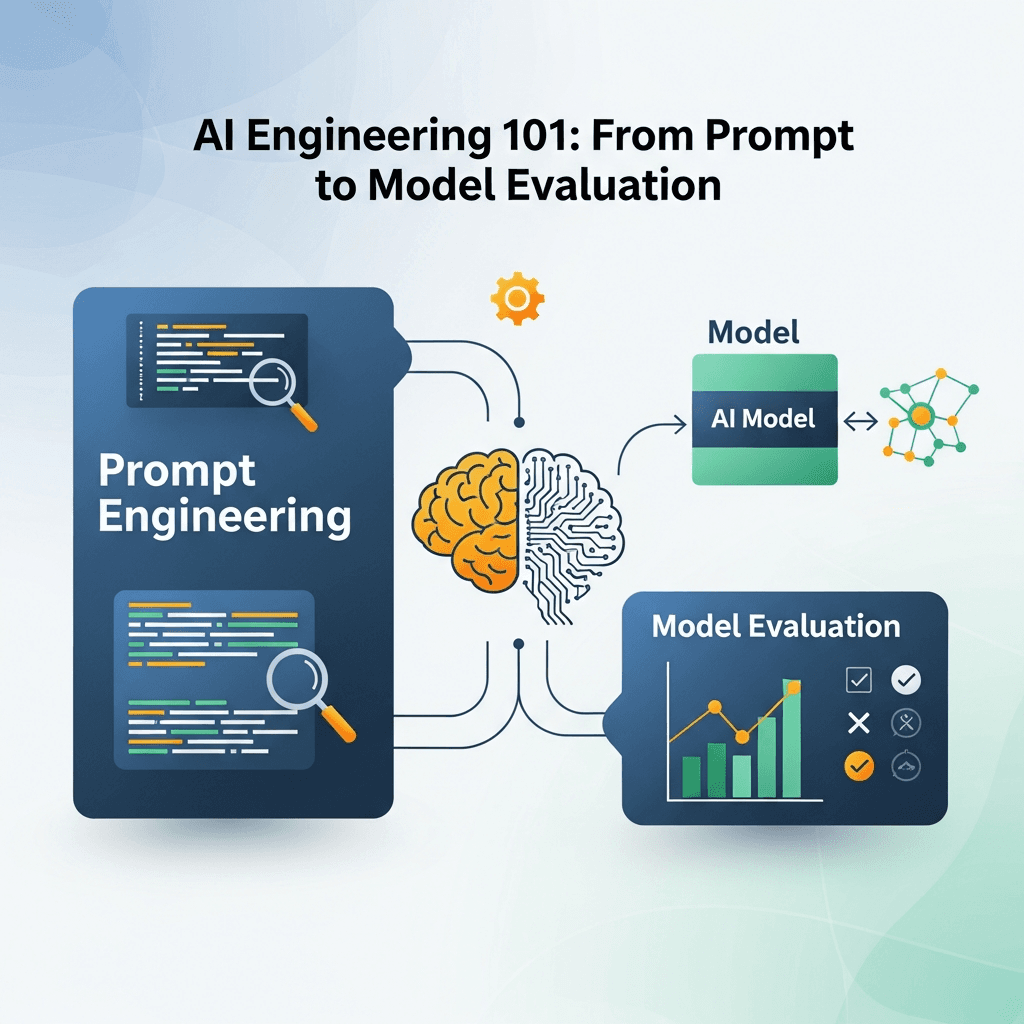
This comprehensive guide, "AI Engineering 101," will take you on a journey from the very first interaction with an AI model – crafting effective prompts – through advanced techniques like fine-tuning, and culminate in the crucial process of rigorously evaluating your AI solutions. Whether you're a data scientist looking to deploy your models, a software engineer integrating AI, or an aspiring AI practitioner, understanding these core principles is essential for building impactful AI products.
Prerequisites
To get the most out of this guide, a basic understanding of:
- Python programming: Most AI and ML frameworks are Python-based.
- Machine Learning concepts: Familiarity with terms like training, inference, datasets, and model types.
- Command-line basics: For interacting with development environments and cloud services.
What is AI Engineering?
AI Engineering is the multidisciplinary field that focuses on the practical application, deployment, and maintenance of AI systems in real-world scenarios. It bridges the gap between theoretical machine learning research and scalable, production-ready software. Unlike pure data science or machine learning research, AI Engineering emphasizes:
- Scalability: Ensuring AI systems can handle increasing loads and data volumes.
- Reliability: Building robust systems that perform consistently and predictably.
- Maintainability: Designing systems that are easy to update, debug, and monitor.
- Cost-effectiveness: Optimizing resource usage for training and inference.
- Ethical considerations: Addressing bias, fairness, transparency, and privacy.
- Integration: Seamlessly embedding AI components into larger software architectures.
It encompasses elements of MLOps, software engineering, data engineering, and responsible AI practices.
The Core of Interaction: Prompt Engineering
With the rise of Large Language Models (LLMs) and other generative AI, prompt engineering has emerged as a critical skill. Prompt engineering is the art and science of crafting effective inputs (prompts) to guide an AI model to produce desired outputs. It's about communicating with the AI in a way that maximizes its utility and minimizes undesirable behaviors.
Why is it so important?
- Unlocks potential: A well-crafted prompt can unlock capabilities of a pre-trained model you didn't know existed.
- Cost-effective: Often, prompt engineering can achieve significant improvements without expensive model retraining or fine-tuning.
- Flexibility: Allows for rapid iteration and adaptation to new tasks or requirements.
- Reduces hallucination/bias: Strategic prompting can steer models towards more factual or unbiased responses.
Basic Prompting Techniques
Understanding fundamental prompting patterns is your first step to becoming an AI engineer.
Zero-shot Prompting
This is the simplest form, where you directly ask the model to perform a task without any examples.
# Example: Zero-shot Prompting
import os
from openai import OpenAI

# Ensure you have your API key set as an environment variable (e.g., OPENAI_API_KEY)
client = OpenAI(api_key=os.environ.get("OPENAI_API_KEY"))

def zero_shot_prompt(text):
    response = client.chat.completions.create(
        model="gpt-3.5-turbo",
        messages=[
            {"role": "user", "content": f"Summarize the following text: {text}"}
        ]
    )
    return response.choices[0].message.content

article = "Artificial intelligence (AI) is intelligence demonstrated by machines, unlike the natural intelligence displayed by humans and animals. Leading AI textbooks define the field as the study of 'intelligent agents': any device that perceives its environment and takes actions that maximize its chance of successfully achieving its goals. Colloquially, the term 'artificial intelligence' is often used to describe machines (or computers) that mimic 'cognitive' functions that humans associate with the human mind, such as 'learning' and 'problem-solving'."
summary = zero_shot_prompt(article)
print(f"Zero-shot Summary:\n{summary}")
Few-shot Prompting
By providing a few examples of input-output pairs, you can guide the model to follow a specific format or style.
# Example: Few-shot Prompting
def few_shot_prompt(text_to_classify):
    response = client.chat.completions.create(
        model="gpt-3.5-turbo",
        messages=[
            {"role": "system", "content": "You are a sentiment analyzer."},
            {"role": "user", "content": "Text: I love this product. Sentiment: Positive"},
            {"role": "user", "content": "Text: This movie was terrible. Sentiment: Negative"},
            {"role": "user", "content": "Text: It's an okay experience. Sentiment: Neutral"},
            {"role": "user", "content": f"Text: {text_to_classify}. Sentiment:"}
        ]
    )
    return response.choices[0].message.content

sentiment = few_shot_prompt("The service was incredibly slow today.")
print(f"Few-shot Sentiment:\n{sentiment}")
Chain-of-Thought (CoT) Prompting
CoT prompts encourage the model to break down complex problems into intermediate steps, significantly improving performance on reasoning tasks. This is often achieved by adding "Let's think step by step." or similar phrases.
# Example: Chain-of-Thought Prompting
def cot_prompt(question):
    response = client.chat.completions.create(
        model="gpt-3.5-turbo",
        messages=[
            {"role": "user", "content": f"Question: {question}\nLet's think step by step."}
        ]
    )
    return response.choices[0].message.content

math_question = "If a baker has 24 cookies and bakes 36 more, and then sells half of them, how many cookies does the baker have left?"
answer = cot_prompt(math_question)
print(f"CoT Answer:\n{answer}")
Advanced Prompt Engineering Strategies
Moving beyond basic techniques, advanced strategies enable more sophisticated AI applications.
Retrieval Augmented Generation (RAG)
RAG combines the power of LLMs with external knowledge bases. Instead of relying solely on the model's pre-trained knowledge (which can be outdated or prone to hallucination), RAG first retrieves relevant information from a trusted source and then uses that information to inform the LLM's response.
How it works:
- Query: User asks a question.
- Retrieve: The system searches an external database (e.g., vector database, document store) for relevant documents/chunks based on the query.
- Augment: The retrieved context is added to the user's prompt.
- Generate: The LLM generates a response using both the original query and the augmented context.
# Example: Conceptual RAG Flow (simplified)
def rag_process(user_query, knowledge_base_docs):
    # Step 1: Simulate retrieval from a knowledge base
    # In a real system, this would involve embedding user_query and searching a vector DB
    retrieved_context = []
    for doc in knowledge_base_docs:
        if user_query.lower() in doc.lower(): # Simple keyword match for demo
            retrieved_context.append(doc)

    if not retrieved_context:
        retrieved_context.append("No specific context found, relying on general knowledge.")

    context_str = "\n".join(retrieved_context)

    # Step 2: Augment the prompt with retrieved context
    augmented_prompt = f"Based on the following information:\n{context_str}\n\nAnswer the question: {user_query}"

    # Step 3: Send augmented prompt to LLM (conceptual)
    print(f"\n--- Sending to LLM with Augmented Prompt ---")
    print(augmented_prompt)
    # Simulate LLM response
    llm_response = f"(LLM response based on context and query: '{user_query}')"
    return llm_response

knowledge_base = [
    "The capital of France is Paris.",
    "Eiffel Tower is located in Paris.",
    "The Louvre Museum is a famous landmark in Paris."
]

query = "What is the capital of France and what famous landmarks are there?"
rag_output = rag_process(query, knowledge_base)
print(f"\nRAG Output: {rag_output}")
Self-Consistency
This technique involves prompting the LLM multiple times with the same question, often using CoT, and then taking the majority vote or most consistent answer among the generated responses. It helps to improve reliability for complex reasoning tasks.
Tool Use / Function Calling
Modern LLMs can be prompted to use external tools or call specific functions. This allows them to interact with APIs, perform calculations, access real-time data, or execute code. For example, an LLM could be prompted to: "Find the current weather in London" and it would then call a get_weather(location) function.
Prompt Chaining
Complex tasks can be broken down into a series of smaller, simpler prompts, where the output of one prompt becomes the input for the next. This creates a pipeline of AI interactions, managing complexity and improving accuracy.
Beyond Prompts: Fine-tuning and Adaptation
While prompt engineering is powerful, there are scenarios where it's insufficient. When you need the model to learn new knowledge, adopt a very specific style, or significantly reduce hallucination for a niche domain, fine-tuning becomes essential.
Fine-tuning involves taking a pre-trained base model and training it further on a smaller, task-specific dataset. This process updates a subset or all of the model's weights, adapting it to your specific requirements.
When to Fine-tune:
- Domain-specific language: Your domain uses jargon or phrasing not well-represented in the base model's training data.
- Specific style/tone: You need the model to consistently generate text in a particular voice or brand.
- Reducing hallucination: For factual tasks where accuracy is paramount, fine-tuning can ground the model more firmly in your data.
- New capabilities: Teaching the model to perform a new type of task not explicitly covered by the base model (e.g., custom entity extraction).
- Cost/Latency optimization: Smaller, fine-tuned models can sometimes be more efficient than large general-purpose models for specific tasks.
Parameter-Efficient Fine-Tuning (PEFT)
Full fine-tuning of large models is computationally expensive and requires significant data. PEFT methods like LoRA (Low-Rank Adaptation) address this by only updating a small fraction of the model's parameters, making fine-tuning more accessible and efficient.
# Example: Conceptual LoRA Fine-tuning Setup (using Hugging Face PEFT library concepts)
# This code block is illustrative and requires a full ML setup to run.

# from transformers import AutoModelForCausalLM, AutoTokenizer
# from peft import LoraConfig, get_peft_model, TaskType
# from datasets import Dataset

# def setup_lora_fine_tuning(model_name="gpt2", custom_data_path="./my_custom_data.json"):
#     # 1. Load a pre-trained base model and tokenizer
#     model = AutoModelForCausalLM.from_pretrained(model_name)
#     tokenizer = AutoTokenizer.from_pretrained(model_name)
#     tokenizer.pad_token = tokenizer.eos_token # Set padding token for GPT-like models

#     # 2. Define LoRA configuration
#     lora_config = LoraConfig(
#         r=8, # LoRA attention dimension
#         lora_alpha=16, # Alpha parameter for LoRA scaling
#         target_modules=["q_proj", "v_proj"], # Modules to apply LoRA to
#         lora_dropout=0.05,
#         bias="none",
#         task_type=TaskType.CAUSAL_LM # Or TaskType.SEQ_CLS, etc.
#     )

#     # 3. Get PEFT model
#     model = get_peft_model(model, lora_config)
#     model.print_trainable_parameters() # Shows how few parameters are trainable

#     # 4. Prepare your custom dataset (conceptual)
#     # This would typically involve loading a JSON or CSV, tokenizing, and formatting.
#     # For demonstration, let's assume `Dataset.from_json(custom_data_path)` is used.
#     # Example data format: {"text": "[Instruction] [Input] [Output]"}

#     # training_args = TrainingArguments(
#     #     output_dir="./lora_results",
#     #     num_train_epochs=3,
#     #     per_device_train_batch_size=4,
#     #     learning_rate=2e-4,
#     #     logging_dir="./lora_logs",
#     #     logging_steps=10,
#     # )

#     # trainer = SFTTrainer(
#     #     model=model,
#     #     tokenizer=tokenizer,
#     #     train_dataset=your_tokenized_dataset,
#     #     dataset_text_field="text",
#     #     args=training_args,
#     #     peft_config=lora_config,
#     # )

#     # trainer.train()
#     print("LoRA setup complete. Model is ready for training with a custom dataset.")
#     return model, tokenizer

# # To run this, you would need to install transformers, peft, and datasets libraries.
# # For illustration, we'll just print a message:
print("Conceptual LoRA fine-tuning setup. Actual execution requires specific libraries and data.")
print("LoRA allows efficient adaptation of large models by training only a small set of new parameters.")
The AI Engineering Workflow
Building AI products involves a structured workflow, often iterative and cyclical:
- Problem Definition & Data Strategy: Clearly define the business problem, identify data sources, and plan for data collection and annotation.
- Data Collection & Preparation: Gather relevant data, clean it, transform it, and split it into training, validation, and test sets. This includes data for prompt engineering (examples) and fine-tuning.
- Model Selection & Development: Choose appropriate base models (e.g., GPT-4, Llama 3, custom models). Implement prompt engineering techniques or fine-tune the model on your prepared data.
- Evaluation & Iteration: Rigorously evaluate model performance using defined metrics. Based on results, iterate on prompts, data, or fine-tuning strategies.
- Deployment: Integrate the trained/prompt-engineered model into a production environment. This often involves containerization (Docker), API endpoints, and cloud infrastructure (AWS, Azure, GCP).
- Monitoring & Maintenance: Continuously monitor model performance, data drift, and potential biases in production. Implement feedback loops for continuous improvement.
- Version Control: Crucial for prompts, data, models, and code. Tools like Git, DVC, MLflow.
Model Evaluation Fundamentals
Deployment without robust evaluation is like flying blind. Model evaluation is the systematic process of assessing the performance, reliability, and ethical implications of an AI model. It helps answer questions like:
- Is the model accurate enough for its intended purpose?
- Is it fair across different user groups?
- Does it handle edge cases well?
- How does it compare to previous versions or alternative models?
Key Principles:
- Objective Metrics: Use quantitative metrics (accuracy, precision, recall, F1, MSE, etc.) relevant to the task.
- Holdout Sets: Always evaluate on unseen data (test set) to ensure generalization.
- Human-in-the-Loop: For qualitative tasks, human judgment is often indispensable.
- Domain Expertise: Involve domain experts to define relevant evaluation criteria.
Evaluating Generative Models (LLMs)
Evaluating generative models, especially LLMs, presents unique challenges due to their open-ended nature. There's often no single "correct" answer, and human judgment plays a significant role.
Automated Metrics:
- Perplexity: Measures how well a probability model predicts a sample. Lower perplexity generally indicates a better model, but it's not always directly correlated with human quality judgment.
- ROUGE (Recall-Oriented Understudy for Gisting Evaluation): Commonly used for summarization tasks. It compares an automatically produced summary against human-generated reference summaries by counting overlapping units (n-grams, word sequences).
- BLEU (Bilingual Evaluation Understudy): Originally for machine translation, it assesses the similarity between a generated text and a set of reference texts. It counts matching n-grams, penalizing short outputs.
- BERTScore: A more advanced metric that leverages pre-trained BERT embeddings to calculate semantic similarity between candidate and reference sentences, addressing some limitations of n-gram based metrics.
# Example: Calculating ROUGE and BLEU scores (conceptual, using 'evaluate' library)
# Requires: pip install evaluate rouge_score sacrebleu

import evaluate

# Sample data
predictions = [
    "The cat sat on the mat.",
    "The quick brown fox jumps over the lazy dog."
]
references = [
    ["The cat was sitting on the mat.", "A cat sat on the mat."], # Multiple references for flexibility
    ["A quick brown fox jumps over the lazy dog."]
]

# ROUGE evaluation
rouge = evaluate.load("rouge")
rouge_results = rouge.compute(predictions=predictions, references=references)
print(f"\nROUGE Scores: {rouge_results}")

# BLEU evaluation
bleu = evaluate.load("bleu")
bleu_results = bleu.compute(predictions=predictions, references=references)
print(f"\nBLEU Score: {bleu_results}")

# BERTScore (conceptual, requires model download)
# bertscore = evaluate.load("bertscore")
# bertscore_results = bertscore.compute(predictions=predictions, references=references, lang="en")
# print(f"\nBERTScore: {bertscore_results}")
print("BERTScore computation skipped for brevity, but it provides semantic similarity.")
Human-in-the-Loop Evaluation:
For generative tasks, human evaluation is often the gold standard. Methods include:
- Preference Ranking: Humans rate which of two or more model outputs is better.
- Side-by-Side Comparison: Humans compare a model's output to a ground truth or another model's output.
- Likert Scale Rating: Humans rate outputs on dimensions like coherence, fluency, relevance, and factual correctness.
- A/B Testing: Deploying different model versions or prompt strategies to a subset of users and measuring real-world engagement or conversion metrics.
Safety and Bias Evaluation:
- Red-teaming: Proactively probing models with adversarial prompts to uncover vulnerabilities, biases, or harmful outputs.
- Fairness Metrics: Analyzing model performance across different demographic groups to detect and mitigate bias.
Best Practices in AI Engineering
Adopting these practices ensures robust, ethical, and maintainable AI systems:
- MLOps for Automation: Implement CI/CD pipelines for models, automated testing, deployment, and monitoring. Tools like MLflow, Kubeflow, or cloud-specific MLOps platforms.
- Version Control Everything: Not just code, but also data (DVC), models, prompts, and evaluation metrics. Traceability is key.
- Observability and Monitoring: Implement comprehensive logging, tracing, and monitoring for AI systems in production. Track input distributions, output quality, latency, and resource usage. Detect data drift and model decay early.
- Ethical AI by Design: Integrate fairness, accountability, and transparency (FAT) principles from the outset. Conduct bias audits, privacy impact assessments, and ensure explainability where possible.
- Iterative Development: AI development is rarely linear. Embrace rapid prototyping, continuous feedback, and agile methodologies.
- Robust Experiment Tracking: Keep detailed records of experiments, including model versions, hyperparameters, data splits, and evaluation results. This is crucial for reproducibility and debugging.
- Cost Management: Optimize inference costs by choosing appropriate model sizes, batching requests, and leveraging efficient hardware.
- Clear Documentation: Document your prompts, fine-tuning datasets, model cards, evaluation methodologies, and deployment procedures. This is vital for team collaboration and future maintenance.
Common Pitfalls and How to Avoid Them
Even experienced practitioners can fall into these traps:
- Over-reliance on Prompt Engineering: While powerful, prompts have limits. Don't avoid fine-tuning when the task truly demands deeper model adaptation or domain-specific knowledge. Prompt engineering is not a silver bullet for every problem.
- Lack of Robust Evaluation: Deploying models without thorough, multi-faceted evaluation (including human review for generative tasks) leads to poor user experiences, reputational damage, and potentially harmful outcomes. Always define success metrics before deployment.
- Ignoring Data Quality: "Garbage in, garbage out" applies to both training data and prompt examples. Poorly labeled, biased, or irrelevant data will cripple your AI system, regardless of model sophistication.
- Data Drift and Model Decay: Real-world data changes over time. A model trained on past data may lose efficacy. Implement continuous monitoring and retraining strategies to combat data drift and model decay.
- Security Vulnerabilities: Prompt injection attacks can manipulate LLMs to ignore safety instructions or reveal sensitive information. Implement input validation, output filtering, and robust security measures.
- Ethical Blind Spots: Failing to consider bias, fairness, privacy, and potential misuse from the start can lead to models that perpetuate societal inequalities or cause harm. Engage diverse stakeholders in the design and evaluation process.
- Underestimating Infrastructure Needs: Deploying and scaling AI models, especially LLMs, requires significant computational resources and robust MLOps infrastructure. Plan for this early.
Real-World Use Cases
AI Engineering principles are applied across a vast array of industries and applications:
- Customer Support Automation: Building intelligent chatbots and virtual assistants that can understand customer queries, retrieve relevant information (RAG), and provide human-like responses, reducing support load.
- Content Creation & Curation: Generating marketing copy, blog posts, product descriptions, or summarizing long documents. Fine-tuning for brand voice and evaluating for originality and factual accuracy are key.
- Code Generation & Assistance: Integrating AI into IDEs to auto-complete code, suggest improvements, generate unit tests, or explain complex functions. Evaluation focuses on correctness, efficiency, and security.
- Personalized Recommendations: Enhancing e-commerce, streaming services, and social media platforms with AI-driven recommendation engines that adapt to user preferences and behavior.
- Healthcare: Assisting medical professionals with clinical note summarization, diagnostic aids, or drug discovery. Rigorous evaluation for accuracy and safety is paramount.
- Financial Services: Fraud detection, risk assessment, and personalized financial advice. Models are evaluated for accuracy, fairness, and compliance.
Conclusion
AI Engineering is the indispensable bridge transforming raw AI potential into tangible, real-world value. From the nuanced art of prompt engineering, which allows us to coax desired behaviors from powerful models, to the disciplined science of fine-tuning for specialized tasks, and finally to the critical rigor of model evaluation, every step is vital.
As AI technology continues to advance, the demand for skilled AI engineers who can build, deploy, and maintain these intelligent systems responsibly will only grow. Embrace continuous learning, experiment with new techniques, and always prioritize ethical considerations. The future of AI is not just about building smarter models, but building them smarter in production.
Start experimenting with the code examples, explore open-source LLMs and frameworks, and contribute to building the next generation of intelligent applications. Your journey into AI Engineering has just begun!
Written by
CodewithYohaFull-Stack Software Engineer with 7+ years of experience in Java, Spring Boot, and cloud architecture across AWS, Azure, and GCP. Writing production-grade engineering patterns for developers who ship real software.