Introduction: The Serverless Data Revolution Continues
By 2026, the serverless paradigm has fundamentally reshaped how developers build and deploy applications. While serverless compute functions like AWS Lambda, Azure Functions, and Google Cloud Functions have become commonplace, the database layer has historically presented a greater challenge. Traditional relational databases, with their persistent connections and fixed infrastructure, often felt like an awkward fit for the ephemeral, auto-scaling nature of serverless compute.
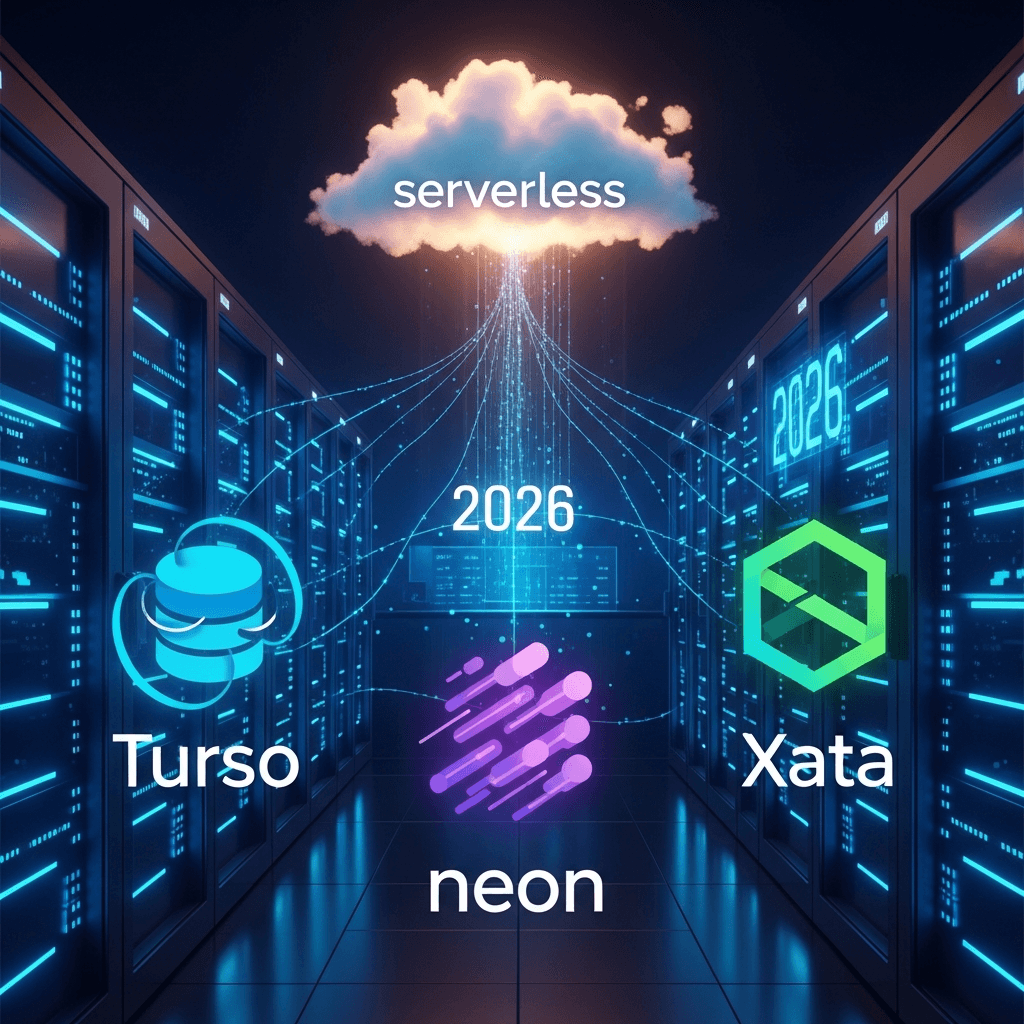
However, a new generation of serverless databases has emerged, specifically designed to complement and empower serverless architectures. These databases offer unparalleled scalability, pay-per-use pricing, and drastically simplified operations, allowing developers to focus on application logic rather than infrastructure management. In this comprehensive guide, we'll delve into the state of serverless databases in 2026, focusing on three prominent players that are defining the landscape: Turso, Neon, and Xata. We'll explore their unique architectures, core features, real-world use cases, and best practices for leveraging them in your modern applications.
The Serverless Database Paradigm Shift: Why Now?
The shift towards serverless databases isn't just a trend; it's a response to the evolving demands of modern application development. In 2026, developers expect:
- Instant Scalability: Databases should effortlessly scale up or down based on demand, handling sudden traffic spikes without manual intervention.
- Cost Efficiency: A true pay-per-use model, eliminating the need to provision for peak capacity and paying only for actual consumption.
- Operational Simplicity: Managed services that abstract away patching, backups, and high availability, freeing up engineering resources.
- Developer Experience: Tools and APIs that integrate seamlessly into modern development workflows, supporting popular languages and frameworks.
- Global Distribution: The ability to serve users worldwide with low latency by placing data closer to the edge.
Turso, Neon, and Xata each address these needs with distinct approaches, catering to different facets of the serverless ecosystem.
Turso: Edge-first SQLite for Global Applications
Turso represents a fascinating evolution of SQLite, bringing its simplicity and embeddability to the distributed, serverless world. By 2026, Turso has matured into a robust, edge-first database solution built on libSQL (a fork of SQLite). Its core value proposition is to provide a low-latency, globally distributed database that feels as easy to use as a local SQLite file.
Turso's Architecture and Key Features
Turso leverages a unique architecture where your primary database instance lives in a central region, and read-replica instances can be spun up at the edge, close to your users. Writes are typically routed to the primary, while reads benefit from extremely low latency from the nearest replica. This eventually consistent model is perfect for read-heavy, globally distributed applications.
- libSQL Core: Built on a modern, open-source fork of SQLite, offering battle-tested reliability with modern enhancements.
- Global Replication: Effortless creation of read replicas across multiple geographic regions.
- Embedded Capabilities: The ability to embed a Turso client directly into edge functions (e.g., Cloudflare Workers, Vercel Edge Functions), providing direct, low-latency access to data.
- HTTP API & Client Libraries: Access your data via a standard HTTP API or dedicated client libraries for various languages.
Turso Use Cases
- Edge Functions and APIs: Ideal for backend services deployed on edge platforms where data needs to be close to the user.
- IoT and Device Data: Collecting and serving data from distributed devices where low-latency reads are critical.
- Personalized User Data: Storing user preferences, session data, or cached content that benefits from edge proximity.
- Content Delivery Networks (CDNs) for Dynamic Data: Enhancing static CDNs with dynamic content fetched from the nearest Turso replica.
Practical Code Example: Connecting to Turso (TypeScript)
import { createClient } from '@libsql/client'; // Turso's official client library

async function getProducts() {
  // Ensure your Turso database URL and token are set as environment variables
  const client = createClient({
    url: process.env.TURSO_DATABASE_URL || '',
    authToken: process.env.TURSO_AUTH_TOKEN || '',
  });

  try {
    const rs = await client.execute("SELECT id, name, price FROM products WHERE category = 'electronics'");
    console.log('Fetched products:', rs.rows);
    return rs.rows;
  } catch (error) {
    console.error('Error fetching products from Turso:', error);
    throw error;
  }
}

// Example usage within an edge function (e.g., Cloudflare Worker)
export default {
  async fetch(request: Request) {
    if (request.url.includes('/api/products')) {
      try {
        const products = await getProducts();
        return new Response(JSON.stringify(products), { headers: { 'Content-Type': 'application/json' } });
      } catch (e) {
        return new Response('Internal Server Error', { status: 500 });
      }
    }
    return new Response('Not Found', { status: 404 });
  },
};
Neon: Serverless PostgreSQL for Modern Workloads
Neon has established itself as a leading serverless PostgreSQL provider by 2026, offering a truly modern take on the beloved relational database. It re-architects PostgreSQL for the cloud-native era, separating compute and storage to enable instant scaling, branching, and a compelling pay-as-you-go model.
Neon's Architecture and Key Features
Neon's innovative architecture detaches the PostgreSQL compute engine from its storage. Data is stored in a highly available, distributed storage layer, while compute nodes can be spun up, scaled, and even suspended independently. This allows for near-instantaneous provisioning and scaling.
- Compute/Storage Separation: The cornerstone of its serverless capabilities, enabling rapid scaling and cost efficiency.
- Instant Scaling & Suspend: Compute scales to zero when idle, and can burst to handle massive loads in milliseconds.
- Branching: Git-like branching for your database. Create isolated copies of your database for development, testing, or feature branches without affecting production data.
- PostgreSQL Compatibility: Full compatibility with standard PostgreSQL tools, drivers, and extensions, ensuring easy migration and familiarity.
- Low-Cost Development: Free tier and usage-based pricing make it highly attractive for startups and small projects.
Neon Use Cases
- Full-Stack Web Applications: Ideal for SaaS platforms, e-commerce, and content management systems requiring a robust, scalable relational database.
- APIs and Microservices: Provides a reliable data store for backend services that experience variable loads.
- Data Analytics and Reporting: Leveraging PostgreSQL's analytical capabilities with the flexibility of serverless scaling.
- CI/CD Pipelines: Database branching simplifies testing and deployment workflows, allowing each branch to have its own isolated database.
Practical Code Example: Connecting to Neon with Prisma (Node.js)
import { PrismaClient } from '@prisma/client';

const prisma = new PrismaClient();

async function getUsers() {
  try {
    // Ensure DATABASE_URL environment variable points to your Neon connection string
    const users = await prisma.user.findMany({
      where: { isActive: true },
      select: { id: true, email: true, name: true },
    });
    console.log('Active users:', users);
    return users;
  } catch (error) {
    console.error('Error fetching users from Neon:', error);
    throw error;
  } finally {
    await prisma.$disconnect();
  }
}

// Example usage
getUsers()
  .then(() => console.log('Finished fetching users.'))
  .catch((e) => console.error('Application error:', e));

// To use branching for a feature, you might update your DATABASE_URL in a test environment
// e.g., DATABASE_URL="postgresql://user:pass@ep-random-branch-id.us-east-2.aws.neon.tech/dbname?sslmode=require"
Xata: Developer-first Data Platform with PostgreSQL at Core
Xata isn't just a serverless database; it's a comprehensive data platform designed from the ground up for developers. By 2026, Xata offers a tightly integrated suite of features that combine the familiarity of a relational database (PostgreSQL) with advanced capabilities like search, analytics, and robust APIs, all wrapped in an exceptional developer experience.
Xata's Architecture and Key Features
Xata leverages PostgreSQL as its core relational engine but augments it with dedicated search and analytics engines. This multi-engine approach allows it to offer powerful features through a unified API and SDK, abstracting away the complexity of managing separate services.
- PostgreSQL-based Core: Provides relational integrity and familiarity, supporting standard SQL operations.
- Built-in Search Engine: Integrated full-text search capabilities, often powered by Elasticsearch or similar technologies, accessible via the same API.
- Integrated Analytics Engine: Enables powerful aggregation and reporting directly on your data, without needing to export to separate data warehouses.
- Type-Safe SDKs: Excellent developer experience with auto-generated, type-safe SDKs for various languages (e.g., TypeScript, Python).
- Data APIs: Every table automatically gets a REST API, simplifying integration with frontends and other services.
- Branching and Environments: Similar to Neon, Xata offers database branching for isolated development and testing.
Xata Use Cases
- Full-Stack Applications with Search: Ideal for applications requiring robust search functionality alongside structured data (e.g., e-commerce product catalogs, job boards, documentation sites).
- Internal Tools and Dashboards: Rapidly build applications with data-rich UIs and analytical views.
- Content Management Systems: Storing content, metadata, and providing powerful search for articles, users, and categories.
- Prototyping and Rapid Development: Its developer-first approach allows for extremely fast iteration from idea to production.
Practical Code Example: Using Xata SDK for CRUD and Search (TypeScript)
import { XataClient } from './xata'; // Auto-generated Xata client based on your schema

const xata = new XataClient({
  databaseURL: process.env.XATA_DATABASE_URL,
  branch: process.env.XATA_BRANCH || 'main',
  apiKey: process.env.XATA_API_KEY,
});

async function managePosts() {
  // Create a new post
  const newPost = await xata.db.posts.create({
    title: 'State of Serverless DBs in 2026',
    content: 'A deep dive into Turso, Neon, and Xata...',
    author: 'John Doe',
    tags: ['serverless', 'database', 'tech'],
    published: true,
  });
  console.log('Created post:', newPost);

  // Search for posts containing 'serverless'
  const searchResults = await xata.db.posts.search('serverless', {
    fuzziness: 1, // Allow for minor typos
    target: ['title', 'content'], // Search in title and content fields
  });
  console.log('Search results for "serverless":', searchResults.records);

  // Update a post
  if (newPost.id) {
    const updatedPost = await xata.db.posts.update(newPost.id, {
      content: 'Updated content with more details...',
    });
    console.log('Updated post:', updatedPost);
  }

  // Fetch all published posts
  const publishedPosts = await xata.db.posts.filter({ published: true }).getMany();
  console.log('Published posts:', publishedPosts);
}

// Example usage
managePosts()
  .then(() => console.log('Xata operations complete.'))
  .catch((e) => console.error('Xata error:', e));
Key Differentiators and Overlap in 2026
While all three platforms champion the serverless database ethos, their strengths lie in different areas:
- Data Model & Core Engine: Turso leans into the simplicity and embeddability of SQLite (
libSQL), making it ideal for edge and highly distributed read-heavy workloads. Neon and Xata both build on the robustness and feature richness of PostgreSQL, catering to more traditional relational needs with serverless scaling. - Target Audience & Use Cases: Turso is the choice for extreme edge deployments, IoT, and applications where data locality and minimal latency are paramount. Neon is the go-to for general-purpose serverless PostgreSQL, offering a drop-in replacement for traditional Postgres with cloud-native benefits. Xata targets full-stack developers building applications that require not just a database, but also integrated search and analytics capabilities, prioritizing developer experience.
- Feature Set: Neon excels in pure PostgreSQL serverless scaling and branching. Turso's strength is its global distribution and embedded nature. Xata differentiates with its built-in search, analytics, and a comprehensive SDK that abstracts away multi-engine complexity.
- Ecosystem Integration: All three integrate well with serverless compute platforms. Turso has a strong affinity for edge runtimes (e.g., Cloudflare Workers, Vercel Edge). Neon integrates seamlessly with ORMs like Prisma and any PostgreSQL client. Xata's SDK provides a high-level abstraction, making it easy to use with frameworks like Next.js, Remix, and SvelteKit.
Real-world Use Cases in 2026: A Hybrid Approach
In 2026, it's common to see these serverless databases used in concert, leveraging their individual strengths within a larger architecture:
1. Global E-commerce Platform
- Turso: Store product catalog data, user preferences, and session information at the edge for lightning-fast reads and personalized experiences. Price lookups and stock checks for nearby warehouses could also leverage Turso.
- Neon: Handle critical transaction data (orders, payments, user accounts) requiring strong consistency and full PostgreSQL features. Use branching for A/B testing new checkout flows.
- Xata: Power the product search functionality, internal analytics dashboards for sales trends, and content management for blog posts and marketing materials.
2. SaaS Application Backend
- Neon: The primary database for core application data, user profiles, and operational metrics, benefiting from instant scaling and reliability.
- Xata: Implement a powerful search for user-generated content, provide integrated analytics for feature usage, and manage internal knowledge bases.
- Turso: For highly localized features, such as real-time notifications based on geographic proximity or caching user-specific, frequently accessed data at the edge.
3. Event-driven Architectures
Serverless databases fit perfectly into event-driven patterns. For instance, an event stream (e.g., Kafka, AWS Kinesis) could feed data into Neon for primary storage, trigger edge functions that update Turso replicas for fast reads, and push data into Xata for indexing and analytics.
Performance and Scalability Considerations
While serverless databases offer impressive scalability, understanding their nuances is key:
- Connection Management: Serverless functions are often short-lived. Efficient connection pooling (e.g., using PgBouncer for Neon, or built-in pooling for Turso/Xata clients) is crucial to avoid exhausting database connections.
- Cold Starts: While less of an issue for the database itself (as the underlying infrastructure is always running or quickly brought up), the first connection from a cold serverless function might incur a slight delay. Design applications to minimize this impact.
- Latency in Distributed Systems: Turso's edge replicas drastically reduce read latency for global users, but writes typically still route to a primary region. Applications must be designed with eventual consistency in mind for some data types. Neon and Xata, while highly distributed internally, generally present a single, consistent view to the application from a regional endpoint.
- Query Optimization: Serverless doesn't negate the need for efficient queries, proper indexing, and good schema design. These fundamentals remain critical for performance.
Best Practices for Serverless Database Adoption
- Choose the Right Tool: Evaluate your core requirements: global distribution and edge reads (Turso), pure serverless PostgreSQL (Neon), or a developer-first platform with search/analytics (Xata).
- Schema Design: Plan your schema carefully. For Turso, consider the implications of eventual consistency for globally replicated data. For Neon and Xata, leverage PostgreSQL's robust features, but avoid overly complex queries that could strain a serverless compute unit.
- Connection Pooling: Always use connection pooling for serverless functions to manage database connections efficiently and prevent connection storms.
- Environment Variables & Secrets Management: Store database credentials and connection strings securely using environment variables or dedicated secret management services (e.g., AWS Secrets Manager, Vercel Environment Variables).
- Observability: Integrate with monitoring and logging tools. All three platforms provide dashboards, but integrating with external APM tools (e.g., Datadog, New Relic) gives a holistic view of your serverless application.
- Leverage Branching: Use database branching (Neon, Xata) for every feature, development, and staging environment to ensure isolated, safe testing without impacting production.
- Data Migration Strategies: Plan for schema changes and data migrations. Tools like Flyway or Liquibase work well with Neon and Xata. For Turso, simpler migrations might be handled programmatically or via its CLI.
- Understand Pricing Models: Familiarize yourself with the pay-per-use models. Optimize queries and connection usage to control costs effectively.
Common Pitfalls to Avoid
- Ignoring Database Fundamentals: Serverless databases don't magically solve bad schema design or unoptimized queries. Performance tuning is still essential.
- Over-reliance on "Serverless Magic": While managed, you still need to understand the underlying architecture, especially for distributed systems like Turso's replicas.
- Lack of Connection Pooling: This is a major cause of performance issues and connection limits being hit in serverless applications.
- Neglecting Data Residency: For applications with strict data residency requirements, ensure your chosen database and its replicas/regions comply.
- Not Using Branching: Skipping database branching for development and testing can lead to data corruption or difficult debugging.
- Insecure Credential Management: Hardcoding database credentials or exposing them publicly is a critical security vulnerability.
- Vendor Lock-in Concerns: While convenient, be aware of the level of abstraction provided. Xata, for instance, offers a highly integrated experience, which might make migration more involved than a pure PostgreSQL solution like Neon.
The Future Outlook: Beyond 2026
The serverless database landscape is rapidly evolving. Beyond 2026, we can expect:
- Increased Convergence: Features like integrated search, analytics, and global distribution will become more standard across all offerings.
- Smarter Query Optimization: AI and machine learning will play a greater role in optimizing queries, indexing, and data distribution automatically.
- Even Deeper Integrations: Tighter integration with serverless compute platforms, CI/CD pipelines, and development frameworks.
- New Data Models: Exploration of serverless options for graph databases, time-series databases, and other specialized data stores.
- Enhanced Local Development: Even better local development experiences that mirror the cloud environment more accurately.
Conclusion
By 2026, Turso, Neon, and Xata represent the vanguard of serverless database innovation. Each offers a compelling vision for how data should be managed in the cloud-native era, abstracting away operational complexities and empowering developers with incredible scalability and flexibility. Whether you prioritize edge performance with Turso, pure serverless PostgreSQL power with Neon, or a holistic developer platform with Xata, the choice ultimately depends on your application's unique requirements.
Embracing these technologies means stepping into a future where your database scales effortlessly, costs are optimized, and your focus remains squarely on building innovative applications that delight your users. The serverless data revolution isn't just coming; it's already here, and these platforms are leading the charge.

Written by
CodewithYohaFull-Stack Software Engineer with 7+ years of experience in Java, Spring Boot, and cloud architecture across AWS, Azure, and GCP. Writing production-grade engineering patterns for developers who ship real software.