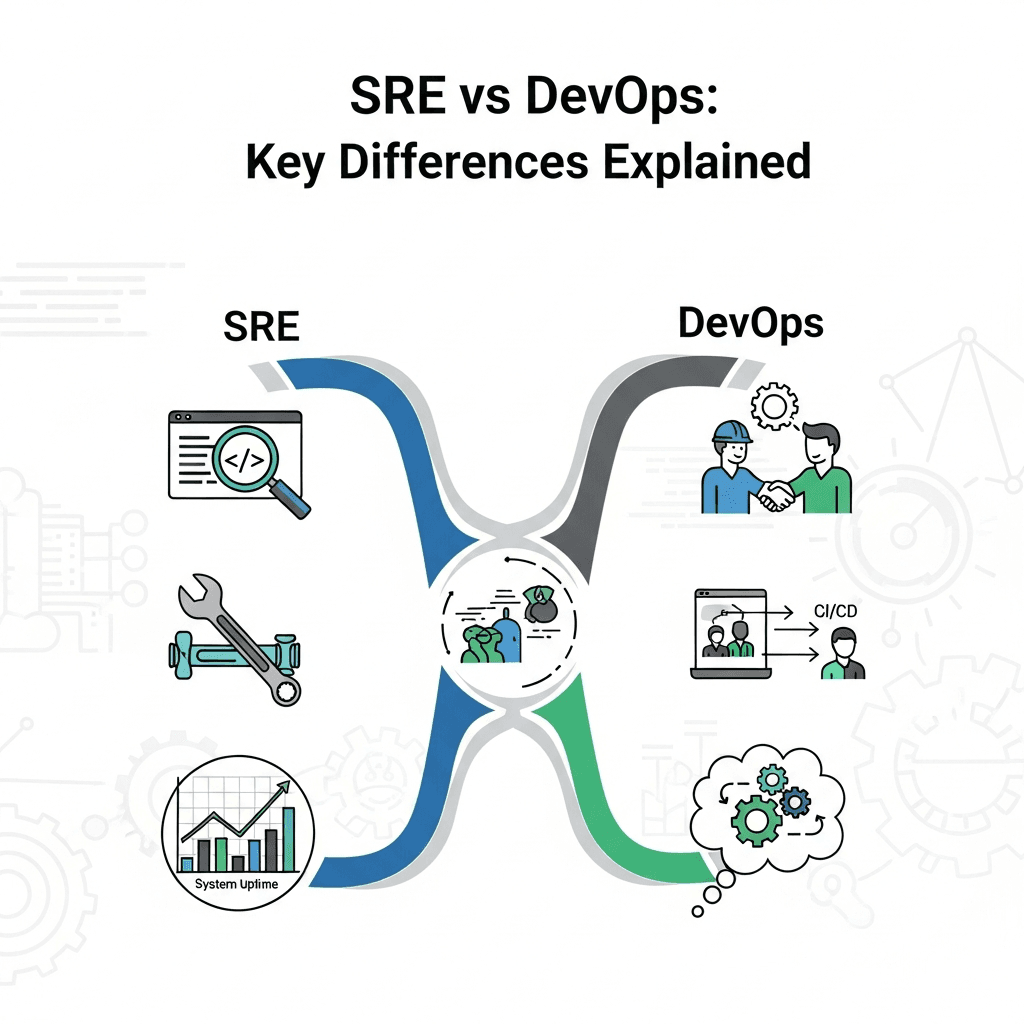
Introduction: Demystifying the DevOps and SRE Relationship
In the rapidly evolving landscape of software development and operations, two terms frequently surface: DevOps and Site Reliability Engineering (SRE). Often used interchangeably or seen as competing methodologies, they share a common goal: to deliver high-quality software rapidly and reliably. However, their approaches, philosophical underpinnings, and practical implementations differ significantly. Understanding these distinctions is crucial for organizations looking to optimize their development lifecycle, enhance operational stability, and foster a culture of continuous improvement.
This comprehensive guide will unravel the complexities of DevOps and SRE, detailing their origins, core philosophies, practices, and tooling. We'll explore how they diverge, where they converge, and ultimately, how they can be leveraged together to achieve operational excellence. By the end, you'll have a clear understanding of each discipline and how to strategically apply them within your organization.
Prerequisites
To fully grasp the concepts discussed, a basic understanding of software development lifecycles, continuous integration/continuous delivery (CI/CD), and general IT operations is beneficial.
1. The Genesis of DevOps: Culture, Collaboration, Automation
DevOps emerged in the late 2000s as a response to the traditional silos between development (Dev) and operations (Ops) teams. These silos often led to slow deployments, communication breakdowns, and blame games. DevOps isn't a technology or a job title; it's a cultural and professional movement that advocates for better collaboration and communication between developers and operations professionals throughout the entire service lifecycle.
Its core tenets are often summarized by the CALMS framework:
- Culture: Fostering a blameless environment, shared responsibility, and trust.
- Automation: Automating repetitive tasks, testing, infrastructure provisioning (Infrastructure as Code).
- Lean: Eliminating waste, continuous improvement, small batch sizes.
- Measurement: Monitoring everything, collecting data, making data-driven decisions.
- Sharing: Knowledge sharing, collaboration across teams, open communication.
DevOps champions the idea of "you build it, you run it," empowering development teams with ownership over their applications in production. The primary goal is to increase an organization's ability to deliver applications and services at high velocity, evolving and improving products at a faster pace than organizations using traditional software development and infrastructure management processes.
2. The Birth of SRE: Google's Approach to Production Reliability
Site Reliability Engineering (SRE) was born at Google in the early 2000s when a team led by Benjamin Treynor Sloss was tasked with running Google's large-scale systems. Sloss defined SRE as "what happens when you ask a software engineer to design an operations function." This definition is critical: SRE is an engineering discipline focused on making systems reliable.
SRE takes a disciplined, engineering-centric approach to operations. It uses software engineering principles to solve operational problems, automate tasks, and improve system reliability. While DevOps is a philosophy, SRE is a concrete implementation of certain aspects of that philosophy, particularly around reliability and operational efficiency.
Key SRE concepts include:
- Service Level Indicators (SLIs): Raw metrics quantifying a service's performance (e.g., request latency, error rate, system throughput).
- Service Level Objectives (SLOs): A target value or range for an SLI, defining the desired level of service reliability (e.g., "99.9% of requests must complete within 300ms").
- Service Level Agreements (SLAs): A formal contract with customers, including penalties for not meeting SLOs. SRE typically focuses on internal SLOs to protect the customer experience.
- Error Budgets: The allowed amount of unreliability (downtime or performance degradation) that a service can incur over a period, derived directly from the SLO. If the error budget is exhausted, the team must prioritize reliability work over new feature development.
3. Core Philosophies: Speed vs. Stability
While both disciplines seek to improve software delivery, their primary philosophical drivers differ:
DevOps: Speed and Agility
DevOps fundamentally prioritizes speed and agility in delivering features and value to customers. It aims to break down barriers to rapid iteration, enabling continuous integration, continuous delivery (CI/CD), and faster feedback loops. The focus is on streamlining the entire value stream, from idea to production, to respond quickly to market demands and user feedback. This often involves embracing calculated risks to maintain velocity.
SRE: Reliability and Risk Management
SRE, on the other hand, places reliability and stability at its absolute core. Its primary mission is to ensure that critical systems remain available, performant, and efficient. SRE approaches operational challenges with an engineering mindset, focusing on proactive problem-solving, automation of repetitive tasks (toil), and meticulous measurement of service health. While not ignoring speed, SRE will often trade off feature velocity for increased reliability, especially when error budgets are depleted.
4. Organizational Models and Team Structures
The way teams are structured and interact often reflects the underlying philosophy of DevOps or SRE.
DevOps: Integrated, Cross-Functional Teams
In a pure DevOps model, the ideal is a single, cross-functional team responsible for an application or service from inception through production. This team includes developers, QA, and operations specialists working collaboratively. The "you build it, you run it" mentality means that the same team that writes the code is responsible for its operational health, including monitoring, incident response, and performance tuning. This fosters a strong sense of ownership and reduces handoffs.
SRE: Dedicated SRE Teams or Embedded SREs
SRE teams often exist as a dedicated function, separate from, but closely collaborating with, development teams. Common SRE models include:
- Pure SRE Teams: Responsible for the overall reliability of a set of services. They might take on operational burden from development teams (often capped at 50% of their time) and spend the rest on engineering solutions to improve reliability and automate tasks.
- Embedded SREs: SREs are embedded within development teams, bringing their reliability expertise directly into the development process, helping define SLOs, build robust monitoring, and design resilient architectures.
- Consulting SREs: SREs act as consultants, providing guidance and best practices to development teams without taking direct operational responsibility.
Regardless of the model, SREs are distinct in that they are software engineers focused on operations, applying engineering principles to solve operational problems, rather than just performing manual operational tasks.
5. Key Practices and Methodologies Compared
Both disciplines advocate for certain practices, though with different emphasis.
DevOps Practices
- Continuous Integration/Continuous Delivery (CI/CD): Automating the build, test, and deployment processes to enable frequent, reliable software releases.
- Infrastructure as Code (IaC): Managing and provisioning infrastructure through code and automation, rather than manual processes.
- Monitoring and Logging: Implementing comprehensive monitoring and logging solutions to gain visibility into system health and performance.
- Shift-Left Testing: Integrating testing earlier into the development lifecycle to catch bugs and issues sooner.
- Blameless Post-mortems: Analyzing incidents not to assign blame, but to learn from failures and prevent recurrence.
SRE Practices
- Toil Reduction: Identifying and automating repetitive, manual, tactical, and devoid-of-enduring-value tasks. SREs aim to spend no more than 50% of their time on toil, dedicating the rest to engineering work.
- Error Budget Management: Using error budgets derived from SLOs to balance reliability work with new feature development.
- Incident Response: Developing robust incident management processes, including on-call rotations, runbooks, and systematic post-mortems.
- Chaos Engineering: Intentionally injecting failures into a system to test its resilience and identify weaknesses before they cause real outages.
- Capacity Planning: Proactively ensuring systems can handle anticipated load to maintain performance and availability.
- Blameless Post-mortems: A cornerstone of SRE, focusing on systemic issues rather than individual errors.
6. Metrics and Success Indicators
The metrics each discipline prioritizes reflect their core goals.
DevOps Metrics (DORA Metrics)
DevOps success is often measured by the DORA metrics, which focus on delivery performance:
- Deployment Frequency: How often an organization successfully releases to production.
- Lead Time for Changes: The time it takes for code to go from commit to production.
- Mean Time to Restore (MTTR): How long it takes to restore service after an incident.
- Change Failure Rate: The percentage of changes to production that result in degraded service or require rollback.
SRE Metrics (SLIs, SLOs, Error Budgets)
SRE success is primarily measured against defined reliability targets:
- Service Level Indicators (SLIs): Direct measurements of service health (e.g., latency, error rate, uptime).
- Service Level Objectives (SLOs): The target reliability for SLIs (e.g., 99.99% availability).
- Error Budget Consumption: Tracking how much of the allowed unreliability has been used. If the budget is spent, feature development typically pauses in favor of reliability work.
- Toil Percentage: The proportion of time SREs spend on manual operational tasks versus engineering work.
7. Tooling Ecosystems: What Powers Each Discipline?
Both DevOps and SRE leverage a wide array of tools, often overlapping, but with distinct primary uses.
DevOps Tooling
DevOps tools focus on automation across the entire pipeline:
- CI/CD: Jenkins, GitLab CI, GitHub Actions, Azure DevOps, CircleCI
- Infrastructure as Code: Terraform, Ansible, Chef, Puppet, Pulumi
- Containerization & Orchestration: Docker, Kubernetes, OpenShift
- Version Control: Git, GitHub, GitLab, Bitbucket
- Monitoring & Logging (often shared with SRE): Prometheus, Grafana, ELK Stack (Elasticsearch, Logstash, Kibana), Splunk, Datadog
SRE Tooling
SRE tooling emphasizes observability, incident management, and performance optimization:
- Monitoring & Alerting: Prometheus, Grafana, Alertmanager, Nagios, Zabbix
- Logging & Tracing: ELK Stack, Splunk, Jaeger, Zipkin, OpenTelemetry
- Incident Management: PagerDuty, VictorOps, Opsgenie, StatusPage
- Chaos Engineering: Chaos Monkey, Gremlin, LitmusChaos
- Performance Testing: JMeter, k6, Locust
- Automation (for toil reduction): Custom scripts (Python, Go), Ansible, Puppet, Terraform
8. Practical Code Examples: Bringing Concepts to Life
Let's look at how these concepts manifest in code.
DevOps: GitLab CI/CD Pipeline for a Web Application
This example shows a simple .gitlab-ci.yml that automates building, testing, and deploying a web application. This embodies the CI/CD and automation principles of DevOps.
# .gitlab-ci.yml

stages:
  - build
  - test
  - deploy

variables:
  DOCKER_IMAGE_NAME: my-webapp
  DOCKER_REGISTRY: my-registry.example.com

build-job:
  stage: build
  image: docker:latest
  services:
    - docker:dind
  script:
    - docker build -t $DOCKER_REGISTRY/$DOCKER_IMAGE_NAME:$CI_COMMIT_SHORT_SHA .
    - docker push $DOCKER_REGISTRY/$DOCKER_IMAGE_NAME:$CI_COMMIT_SHORT_SHA
  only:
    - main

test-job:
  stage: test
  image: node:16
  script:
    - npm install
    - npm test
  only:
    - main

deploy-job:
  stage: deploy
  image: alpine/helm:3.8.2
  script:
    - echo "Deploying $DOCKER_IMAGE_NAME:$CI_COMMIT_SHORT_SHA to Kubernetes..."
    - helm upgrade --install my-webapp ./helm/my-webapp \
        --set image.repository=$DOCKER_REGISTRY/$DOCKER_IMAGE_NAME \
        --set image.tag=$CI_COMMIT_SHORT_SHA
  only:
    - main
  environment: production
This pipeline automates the entire process, from building a Docker image to deploying it to Kubernetes, a core DevOps practice for rapid and reliable delivery.
SRE: Prometheus SLO Definition and Alerting
This example demonstrates defining an SLO for API latency using Prometheus recording rules and an Alertmanager configuration. This is central to SRE's data-driven approach to reliability.
# prometheus_rules.yml

# Define SLI: http_requests_total is a counter, http_request_duration_seconds is a histogram

# Recording rule for successful requests (e.g., status 2xx)
- record: api_requests_total:rate5m
  expr: sum(rate(http_requests_total{job="my-api", status=~"2.."}[5m])) by (handler)

# Recording rule for latency SLI (requests within target latency)
- record: api_requests_latency_fast:rate5m
  expr: sum(rate(http_request_duration_seconds_bucket{job="my-api", le="0.3"}[5m])) by (handler)

# Calculate SLO compliance (e.g., 99.9% of requests faster than 300ms)
- record: api_slo_compliance:ratio
  expr: api_requests_latency_fast:rate5m / api_requests_total:rate5m

# Alerting rule for error budget burn rate (critical if we're burning budget too fast)
- alert: HighAPILatencyBurnRate
  expr: |-
    (1 - api_slo_compliance:ratio) > 0.001 # If more than 0.1% of requests are slow
    AND
    rate(api_requests_total:rate5m[5m]) > 10 # Only alert if there's significant traffic
  for: 5m # For 5 minutes
  labels:
    severity: critical
  annotations:
    summary: "High API Latency Burn Rate for {{ $labels.handler }}"
    description: "The error budget for API handler {{ $labels.handler }} is burning too quickly. Latency SLO is being violated."
This Prometheus configuration defines an SLO, tracks its compliance, and alerts the SRE team if the error budget is being consumed too quickly, enabling proactive incident response and reliability focus.
9. Real-World Scenarios and Use Cases
Understanding when to emphasize DevOps or SRE can be critical.
When DevOps Shines
- Rapid Feature Development: For startups or projects needing to iterate quickly and get new features to market fast.
- Microservices Architectures: Facilitates independent deployment and scaling of services by small, autonomous teams.
- Cloud-Native Adoption: Enables efficient provisioning and management of cloud resources through IaC and automation.
- Cross-Functional Collaboration: When breaking down organizational silos and fostering shared ownership is a primary goal.
When SRE is Critical
- High-Availability Systems: For mission-critical applications where downtime is extremely costly (e.g., financial services, e-commerce platforms).
- Large-Scale Distributed Systems: Managing the complexity and ensuring the reliability of systems with many interdependent components.
- Mature Products with Strict SLOs: When a product has a large user base and contractual SLAs or strong customer expectations for uptime and performance.
- Reducing Operational Burden: When development teams are spending too much time on manual operational tasks, SRE can step in to automate and engineer solutions.
10. The Overlap and Synergy: SRE as an Implementation of DevOps Principles
It's important to recognize that SRE is not a replacement for DevOps; rather, it can be seen as a specific, highly opinionated, and engineering-driven approach to implementing the operational aspects of DevOps. SRE often provides the "how" to DevOps' "what."
- Shared Goals: Both aim for faster delivery, improved reliability, and better collaboration.
- Automation: Both heavily rely on automation to eliminate manual tasks and improve efficiency.
- Monitoring & Measurement: Both emphasize data-driven decision-making, though SRE formalizes it with SLIs/SLOs/Error Budgets.
- Blameless Culture: Both promote a culture of learning from failures rather than assigning blame.
SRE operationalizes the reliability goals of DevOps by providing concrete tools, practices, and metrics (like error budgets and SLOs) to achieve them. If DevOps is the philosophy of continuous delivery and operational excellence, SRE is a highly effective, engineering-focused method for achieving reliability within that philosophy.
11. Best Practices and Common Pitfalls
Successfully integrating DevOps and SRE requires strategic planning.
Best Practices
- Define Clear Responsibilities: Ensure development teams own their code's reliability, and SRE teams provide the expertise, tools, and guardrails.
- Start Small with SLOs: Don't try to define perfect SLOs for every service immediately. Start with critical services and iterate.
- Automate Everything Possible: From infrastructure provisioning to incident response, automation reduces toil and human error.
- Foster a Blameless Culture: Encourage learning from failures rather than pointing fingers. Post-mortems should focus on systemic improvements.
- Invest in Observability: Comprehensive monitoring, logging, and tracing are essential for both rapid debugging and proactive reliability engineering.
- Treat Operations as Software Problems: SRE's core tenet. If a task is manual and repetitive, it's an automation opportunity.
Common Pitfalls
- Treating SRE as a Pure Ops Team: SREs are engineers; offloading all manual operational tasks to them without allowing time for engineering work defeats the purpose.
- "DevOps Team" Anti-Pattern: Creating a separate "DevOps team" can re-create the very silos DevOps aims to eliminate. DevOps is a culture, not a team.
- Ignoring Error Budgets: Defining SLOs without enforcing error budgets makes them meaningless targets. The budget must drive development priorities.
- Over-reliance on Manual Processes: Failing to automate repetitive tasks, leading to burnout and inconsistency.
- Lack of Collaboration: If Dev and SRE teams don't communicate effectively, the benefits of both approaches will be lost.
- Setting Unrealistic SLOs: Overly ambitious SLOs can lead to constant firefighting and frustrate teams. Start realistically and improve incrementally.
Conclusion: A Complementary Path to Operational Excellence
DevOps and SRE, while distinct, are not mutually exclusive. Instead, they represent two powerful forces that, when combined, can drive unparalleled levels of software delivery speed and operational reliability. DevOps provides the cultural and philosophical framework for breaking down silos and accelerating delivery, while SRE offers a concrete, engineering-driven methodology to ensure that this rapid delivery doesn't come at the cost of stability and performance.
Organizations that successfully adopt both will find themselves with robust, scalable systems capable of meeting the demands of modern users, supported by teams that are empowered, collaborative, and continuously improving. The journey involves cultural shifts, technological investments, and a commitment to continuous learning, but the rewards of operational excellence are well worth the effort. By understanding their unique strengths and fostering their synergy, you can build a resilient and innovative future for your software and your teams.

Written by
CodewithYohaFull-Stack Software Engineer with 7+ years of experience in Java, Spring Boot, and cloud architecture across AWS, Azure, and GCP. Writing production-grade engineering patterns for developers who ship real software.