Introduction
The landscape of Artificial Intelligence (AI) is rapidly evolving, with autonomous agents playing an increasingly pivotal role in various applications, from industrial automation and smart cities to complex simulations and personal assistants. These agents, designed to perceive their environment, reason, make decisions, and act, require robust frameworks to manage their lifecycle and interactions.
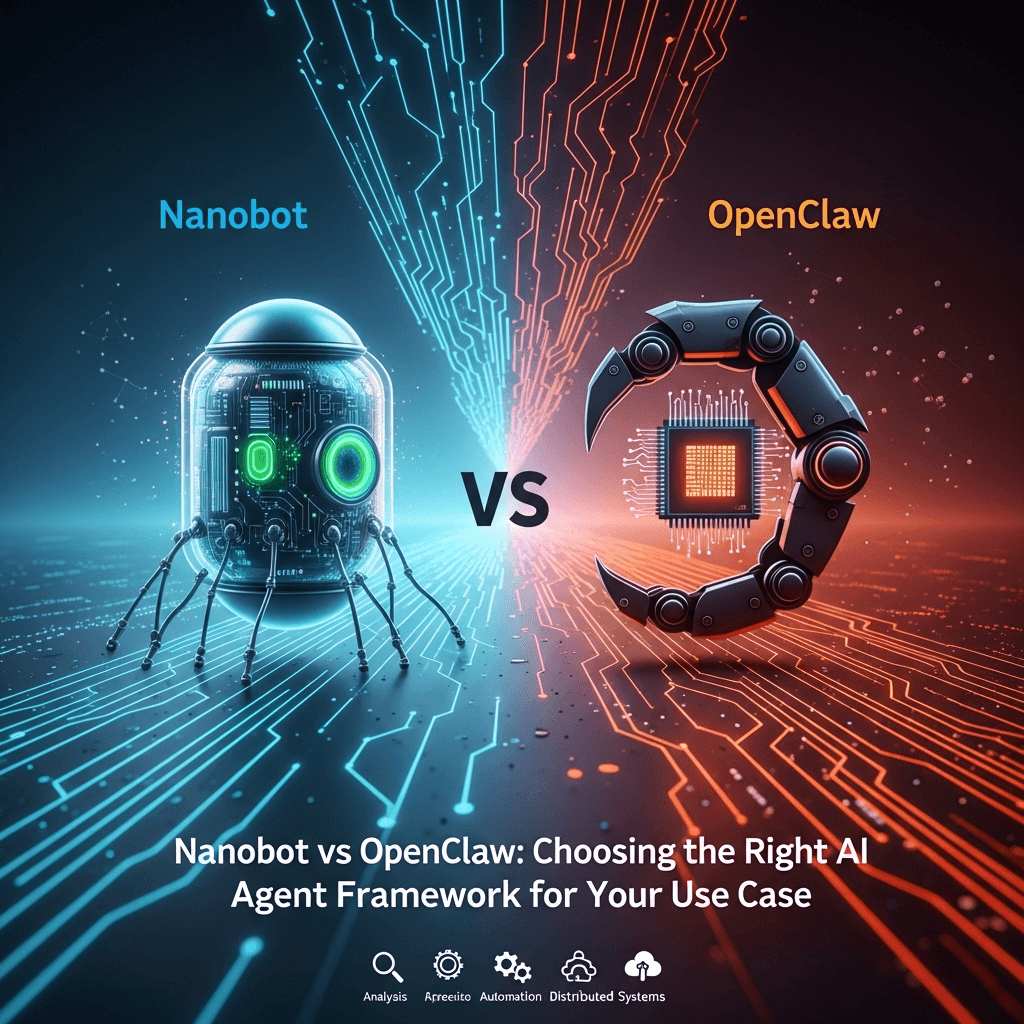
Choosing the right AI agent framework is a critical decision that can profoundly impact a project's development speed, scalability, and long-term maintainability. Two prominent (though hypothetical, for the purpose of this comparison) frameworks that represent distinct philosophical approaches to agent design are Nanobot and OpenClaw. While Nanobot champions simplicity, reactive behaviors, and resource efficiency, OpenClaw excels in complex, proactive planning, and multi-agent coordination.
This comprehensive guide will delve deep into the architectures, strengths, weaknesses, and ideal use cases for both Nanobot and OpenClaw, equipping you with the knowledge to make an informed choice for your next AI agent project.
Prerequisites
To fully grasp the concepts discussed in this article, a foundational understanding of the following is recommended:
- Basic AI concepts (e.g., perception, action, state, goal)
- Familiarity with Python programming (as examples will be in Python)
- Understanding of software architecture principles
- Exposure to event-driven programming or state machines can be beneficial
Understanding AI Agent Frameworks
AI agent frameworks provide the foundational infrastructure for building, deploying, and managing intelligent agents. They abstract away much of the boilerplate code, offering modules for perception, decision-making, action execution, memory management, and inter-agent communication. Without such frameworks, developers would spend considerable time re-implementing common agent functionalities, leading to slower development cycles and increased error potential.
Frameworks streamline the development process by:
- Providing standardized interfaces for sensors and actuators.
- Offering mechanisms for internal state management and memory.
- Facilitating decision-making logic, from simple rules to complex planning algorithms.
- Enabling communication between agents or with external systems.
- Supporting monitoring, debugging, and deployment.
Nanobot: Architecture and Philosophy
Nanobot is designed with minimalism and efficiency at its core. Its philosophy revolves around creating lightweight, reactive agents that excel in specific, well-defined tasks, often in resource-constrained environments. Nanobot agents are typically event-driven, responding quickly to changes in their environment without extensive forward planning.
Core Components of Nanobot:
- Sensors: Modules responsible for perceiving the environment. They capture data (e.g., temperature, light, user input) and often emit events.
- Actuators: Modules that enable the agent to perform actions in the environment (e.g., turn on a light, send a message, adjust a motor).
- State Machine/Rules Engine: The decision-making core. It processes sensor inputs and internal state changes, triggering appropriate actuators based on predefined rules or a simple state transition logic.
- Memory (Optional/Minimal): A lightweight store for short-term state, often just enough to inform immediate reactions.
- Event Bus: The central nervous system, facilitating communication between sensors, the state machine, and actuators via events.
Use Cases for Nanobot:
- IoT Edge Devices: Smart sensors reacting to environmental changes (e.g., a thermostat adjusting based on temperature).
- Simple Automation: Basic home automation tasks (e.g., turning lights on at dusk).
- Reactive Chatbots: Rule-based conversational agents responding to keywords.
- Microservices with Agentic Behavior: Small, focused services that react to API calls or message queue events.
- Quick Prototyping: Rapid development of agents for specific, well-understood tasks.
Nanobot Code Example: A Simple Temperature Monitoring Agent
This Nanobot agent monitors temperature and turns on a fan if it exceeds a threshold.
import time

class NanobotSensor:
    def __init__(self, name):
        self.name = name
        self.listeners = []

    def add_listener(self, listener):
        self.listeners.append(listener)

    def emit_event(self, event_type, payload):
        for listener in self.listeners:
            listener.handle_event(event_type, payload)

class NanobotActuator:
    def __init__(self, name):
        self.name = name

    def perform_action(self, action_type, payload=None):
        print(f"[{self.name} Actuator] Performing action: {action_type} with payload: {payload}")

class NanobotAgent:
    def __init__(self, agent_id):
        self.agent_id = agent_id
        self.sensors = {}
        self.actuators = {}
        self.state = {"temperature": 20, "fan_on": False}

    def add_sensor(self, sensor):
        self.sensors[sensor.name] = sensor
        sensor.add_listener(self)

    def add_actuator(self, actuator):
        self.actuators[actuator.name] = actuator

    def handle_event(self, event_type, payload):
        print(f"[{self.agent_id} Agent] Received event: {event_type}, payload: {payload}")
        if event_type == "temperature_update":
            self.state["temperature"] = payload["value"]
            self._evaluate_rules()

    def _evaluate_rules(self):
        current_temp = self.state["temperature"]
        fan_status = self.state["fan_on"]

        if current_temp > 25 and not fan_status:
            print(f"[{self.agent_id} Agent] Temperature {current_temp}°C is high. Turning fan ON.")
            self.actuators["fan"].perform_action("turn_on", {"speed": "medium"})
            self.state["fan_on"] = True
        elif current_temp <= 22 and fan_status:
            print(f"[{self.agent_id} Agent] Temperature {current_temp}°C is normal. Turning fan OFF.")
            self.actuators["fan"].perform_action("turn_off")
            self.state["fan_on"] = False

# --- Simulation ---
if __name__ == "__main__":
    my_agent = NanobotAgent("ThermoBot")
    temp_sensor = NanobotSensor("room_temp_sensor")
    fan_actuator = NanobotActuator("fan")

    my_agent.add_sensor(temp_sensor)
    my_agent.add_actuator(fan_actuator)

    print("\n--- Initial State ---")
    print(f"Current Temperature: {my_agent.state['temperature']}°C, Fan On: {my_agent.state['fan_on']}")

    print("\n--- Simulating temperature increase ---")
    temp_sensor.emit_event("temperature_update", {"value": 28})
    time.sleep(1)
    print(f"Current Temperature: {my_agent.state['temperature']}°C, Fan On: {my_agent.state['fan_on']}")

    print("\n--- Simulating further temperature increase (no change expected) ---")
    temp_sensor.emit_event("temperature_update", {"value": 30})
    time.sleep(1)
    print(f"Current Temperature: {my_agent.state['temperature']}°C, Fan On: {my_agent.state['fan_on']}")

    print("\n--- Simulating temperature decrease ---")
    temp_sensor.emit_event("temperature_update", {"value": 20})
    time.sleep(1)
    print(f"Current Temperature: {my_agent.state['temperature']}°C, Fan On: {my_agent.state['fan_on']}")
OpenClaw: Architecture and Philosophy
OpenClaw is designed for complexity, robustness, and proactive behavior. It empowers agents to reason, plan, and execute sequences of actions to achieve high-level goals, often in dynamic and uncertain environments. OpenClaw is particularly well-suited for multi-agent systems where coordination and communication are paramount.
Core Components of OpenClaw:
- Knowledge Base (KB): A rich, persistent store of facts, rules, and beliefs about the agent's environment, itself, and other agents. It can be symbolic, probabilistic, or a hybrid.
- Perception System: Gathers raw data from sensors, processes it, and updates the Knowledge Base with relevant observations.
- Goal Management System: Defines and prioritizes high-level objectives for the agent.
- Planner: The intelligent core that uses the KB and current goals to generate a sequence of actions (a plan) to achieve the desired state. This can involve search algorithms, logical inference, or machine learning models.
- Executor: Takes the plan generated by the Planner and translates it into concrete actions via Actuators. It also monitors execution progress and handles deviations.
- Communication Module: Enables robust, structured communication between agents, facilitating collaboration, negotiation, and information sharing.
- Learning Module (Optional/Advanced): Allows the agent to improve its KB, planning strategies, or action execution over time through experience (e.g., reinforcement learning).
Use Cases for OpenClaw:
- Autonomous Robotics: Robots navigating complex environments, performing multi-step tasks (e.g., warehouse robots).
- Logistics and Supply Chain Optimization: Agents planning routes, managing inventory, and coordinating deliveries.
- Strategic Game AI: Agents planning moves in complex strategy games.
- Enterprise Process Automation: Automating multi-step business workflows requiring decision-making and coordination.
- Simulations: Creating sophisticated virtual environments with interacting, intelligent entities (e.g., traffic simulations, disaster response training).
- Multi-Agent Systems: Scenarios requiring complex negotiation, task allocation, and collaborative problem-solving among multiple agents.
OpenClaw Code Example: A Simple Goal-Oriented Planning Agent
This OpenClaw agent plans to fetch an item from a known location and deliver it.
class OpenClawKnowledgeBase:
    def __init__(self):
        self.facts = {
            "location_robot": "warehouse_entry",
            "location_item_A": "shelf_3",
            "item_A_held": False,
            "item_A_delivered": False
        }

    def update_fact(self, key, value):
        print(f"[KB] Updating '{key}' to '{value}'")
        self.facts[key] = value

    def get_fact(self, key):
        return self.facts.get(key)

class OpenClawPlanner:
    def __init__(self, kb):
        self.kb = kb

    def generate_plan(self, goal):
        print(f"[Planner] Generating plan for goal: {goal}")
        plan = []

        if goal == "deliver_item_A":
            if not self.kb.get_fact("item_A_held"):
                if self.kb.get_fact("location_robot") != self.kb.get_fact("location_item_A"):
                    plan.append("move_to_item_A")
                plan.append("pickup_item_A")
            if not self.kb.get_fact("item_A_delivered"):
                if self.kb.get_fact("location_robot") != "delivery_zone":
                    plan.append("move_to_delivery_zone")
                plan.append("dropoff_item_A")
        return plan

class OpenClawActuator:
    def __init__(self, name):
        self.name = name

    def execute_action(self, action, agent_kb):
        print(f"[{self.name} Actuator] Executing: {action}")
        if action == "move_to_item_A":
            agent_kb.update_fact("location_robot", agent_kb.get_fact("location_item_A"))
            print("Robot moved to item A location.")
        elif action == "pickup_item_A":
            agent_kb.update_fact("item_A_held", True)
            print("Robot picked up item A.")
        elif action == "move_to_delivery_zone":
            agent_kb.update_fact("location_robot", "delivery_zone")
            print("Robot moved to delivery zone.")
        elif action == "dropoff_item_A":
            agent_kb.update_fact("item_A_held", False)
            agent_kb.update_fact("item_A_delivered", True)
            print("Robot dropped off item A.")
        else:
            print(f"Unknown action: {action}")

class OpenClawAgent:
    def __init__(self, agent_id, goal):
        self.agent_id = agent_id
        self.kb = OpenClawKnowledgeBase()
        self.planner = OpenClawPlanner(self.kb)
        self.actuator = OpenClawActuator("robot_arm")
        self.goal = goal

    def run(self):
        print(f"\n--- {self.agent_id} Starting with goal: {self.goal} ---")
        while not self.kb.get_fact("item_A_delivered") or self.goal != "deliver_item_A": # Simplified goal check
            current_plan = self.planner.generate_plan(self.goal)
            if not current_plan:
                print("[Agent] No further plan needed or goal achieved.")
                break

            print(f"[Agent] Executing plan: {current_plan}")
            for action in current_plan:
                self.actuator.execute_action(action, self.kb)
                if self.kb.get_fact("item_A_delivered") and self.goal == "deliver_item_A":
                    print("[Agent] Goal 'deliver_item_A' achieved!")
                    return
            # This simplified loop assumes one plan execution achieves the goal,
            # in reality, perception would update KB and replanning might occur.
            break

# --- Simulation ---
if __name__ == "__main__":
    robot_agent = OpenClawAgent("LogisticsBot", "deliver_item_A")
    robot_agent.run()
    print("\n--- Final State ---")
    print(robot_agent.kb.facts)
Key Differentiators: A Side-by-Side Comparison
| Feature | Nanobot | OpenClaw |
|---|---|---|
| Philosophy | Reactive, minimalist, event-driven | Proactive, robust, goal-oriented, planning-based |
| Complexity | Low; ideal for simple, well-defined tasks | High; designed for complex, dynamic environments |
| Decision Making | Rule-based, state machines, immediate reaction | Planning algorithms, logical inference, goal-driven |
| Memory | Minimal, short-term state | Rich, persistent Knowledge Base |
| Scalability | Good for many simple, independent agents | Excellent for complex multi-agent coordination |
| Learning | Typically external or simple adaptation | Often integrated (e.g., RL, symbolic learning) |
| Resource Usage | Low; suitable for edge/IoT devices | Moderate to High; requires more computational power |
| Development Speed | Faster for simple tasks | Slower initially due to complexity, faster for complex systems |
| Error Handling | Relies on explicit rules for known states | Can include sophisticated error recovery and replanning |
Choosing Your Framework: Use Case Scenarios
When to use Nanobot:
- Resource-Constrained Environments: If your agent needs to run on microcontrollers, small IoT devices, or embedded systems with limited CPU, memory, or power.
- Reactive Tasks: When the agent's primary function is to respond immediately to specific events or stimuli without needing complex foresight.
- Simple Automation: For tasks like environmental monitoring, basic home automation, or simple sensor-actuator loops.
- Rapid Prototyping: To quickly build and test simple agent behaviors for proof-of-concept demonstrations.
- Stateless or Minimally Stateful Agents: If the agent's decision logic doesn't require maintaining a large, persistent internal model of the world.
When to use OpenClaw:
- Complex Goal-Oriented Behavior: When agents need to achieve high-level goals through a sequence of planned actions, adapting to unforeseen circumstances.
- Dynamic and Uncertain Environments: For scenarios where the environment changes unpredictably, requiring agents to replan and reason under uncertainty.
- Multi-Agent Systems: If your application involves multiple agents collaborating, negotiating, or competing, requiring robust communication and coordination mechanisms.
- Autonomous Robotics: For robots that need to navigate, manipulate objects, and perform complex tasks in real-world physical environments.
- Strategic Decision Making: In applications requiring deep reasoning, knowledge representation, and long-term planning, such as logistics, urban planning, or sophisticated game AI.
- Learning and Adaptation: When agents need to learn from experience, improve their performance over time, or acquire new knowledge.
Practical Implementation: Building a Simple Task Agent
Let's consider two practical examples to illustrate the differences in implementation.
Nanobot Example: A Smart Light Switch Agent
This agent turns a light on when it's dark and off when it's bright, with a manual override.
import time

class LightSensor:
    def __init__(self, name):
        self.name = name
        self._light_level = 500 # Initial arbitrary light level
        self.listeners = []

    def add_listener(self, listener):
        self.listeners.append(listener)

    def set_light_level(self, level):
        self._light_level = level
        self.emit_event("light_level_change", {"level": level})

    def emit_event(self, event_type, payload):
        for listener in self.listeners:
            listener.handle_event(event_type, payload)

class LightActuator:
    def __init__(self, name):
        self.name = name
        self.is_on = False

    def turn_on(self):
        if not self.is_on:
            print(f"[{self.name} Actuator] Light ON")
            self.is_on = True

    def turn_off(self):
        if self.is_on:
            print(f"[{self.name} Actuator] Light OFF")
            self.is_on = False

class SmartLightAgent:
    def __init__(self, agent_id, threshold=300):
        self.agent_id = agent_id
        self.light_sensor = None
        self.light_actuator = None
        self.light_threshold = threshold
        self.manual_override = False # True means manual control, agent won't interfere

    def connect_sensor(self, sensor):
        self.light_sensor = sensor
        sensor.add_listener(self)

    def connect_actuator(self, actuator):
        self.light_actuator = actuator

    def handle_event(self, event_type, payload):
        if self.manual_override:
            print(f"[{self.agent_id} Agent] Manual override active. Ignoring event.")
            return

        if event_type == "light_level_change":
            current_level = payload["level"]
            print(f"[{self.agent_id} Agent] Light level changed to: {current_level}")
            if current_level < self.light_threshold and not self.light_actuator.is_on:
                self.light_actuator.turn_on()
            elif current_level >= self.light_threshold and self.light_actuator.is_on:
                self.light_actuator.turn_off()

    def set_manual_override(self, status):
        self.manual_override = status
        print(f"[{self.agent_id} Agent] Manual override set to: {self.manual_override}")

# --- Simulation ---
if __name__ == "__main__":
    my_light_agent = SmartLightAgent("LivingRoomLight")
    room_sensor = LightSensor("ambient_light_sensor")
    room_light = LightActuator("ceiling_light")

    my_light_agent.connect_sensor(room_sensor)
    my_light_agent.connect_actuator(room_light)

    print("\n--- Simulating evening ---")
    room_sensor.set_light_level(100) # Dark
    time.sleep(1)

    print("\n--- Simulating daytime ---")
    room_sensor.set_light_level(800) # Bright
    time.sleep(1)

    print("\n--- Manual override ---")
    my_light_agent.set_manual_override(True)
    room_light.turn_on() # User manually turns light on
    room_sensor.set_light_level(150) # It gets dark, but agent shouldn't react
    time.sleep(1)
    room_light.turn_off() # User manually turns light off
    my_light_agent.set_manual_override(False)

    print("\n--- Back to automatic ---")
    room_sensor.set_light_level(200) # Dark again, agent should react
OpenClaw Example: A Collaborative Delivery Agent System
Imagine two agents, a CollectorBot and a DeliveryBot, coordinating to deliver an item. CollectorBot retrieves the item, and DeliveryBot picks it up from a transfer station and delivers it.
import time

class SharedKnowledgeBase:
    def __init__(self):
        self.facts = {
            "item_A_location": "warehouse_shelf",
            "transfer_station_status": "empty", # 'empty', 'item_A_at_station'
            "item_A_delivered": False,
            "collector_bot_status": "idle", # 'idle', 'collecting', 'at_transfer'
            "delivery_bot_status": "idle" # 'idle', 'picking_up', 'delivering'
        }

    def update_fact(self, key, value):
        # print(f"[Shared KB] Updating '{key}' to '{value}'")
        self.facts[key] = value

    def get_fact(self, key):
        return self.facts.get(key)

class OpenClawAgent:
    def __init__(self, agent_id, shared_kb, role):
        self.agent_id = agent_id
        self.kb = shared_kb # Using a shared KB for simplicity in this example
        self.role = role
        self.current_goal = None

    def perceive(self):
        # In a real system, this would gather data from sensors
        # For this example, we just read the shared KB directly
        pass

    def decide_and_act(self):
        if self.role == "collector":
            self._collector_logic()
        elif self.role == "delivery":
            self._delivery_logic()

    def _collector_logic(self):
        if self.kb.get_fact("item_A_delivered"):
            self.kb.update_fact("collector_bot_status", "idle")
            return

        if self.kb.get_fact("collector_bot_status") == "idle" and \
           self.kb.get_fact("transfer_station_status") == "empty":
            print(f"[{self.agent_id}] Goal: Collect Item A from {self.kb.get_fact('item_A_location')}")
            self.kb.update_fact("collector_bot_status", "collecting")
            # Simulate collection
            time.sleep(1)
            print(f"[{self.agent_id}] Item A collected. Moving to transfer station.")
            time.sleep(1)
            self.kb.update_fact("transfer_station_status", "item_A_at_station")
            self.kb.update_fact("collector_bot_status", "at_transfer")
            print(f"[{self.agent_id}] Item A placed at transfer station.")

    def _delivery_logic(self):
        if self.kb.get_fact("item_A_delivered"):
            self.kb.update_fact("delivery_bot_status", "idle")
            return

        if self.kb.get_fact("delivery_bot_status") == "idle" and \
           self.kb.get_fact("transfer_station_status") == "item_A_at_station":
            print(f"[{self.agent_id}] Goal: Pick up Item A from transfer and deliver.")
            self.kb.update_fact("delivery_bot_status", "picking_up")
            # Simulate pickup
            time.sleep(1)
            self.kb.update_fact("transfer_station_status", "empty")
            print(f"[{self.agent_id}] Item A picked up. Delivering.")
            time.sleep(2)
            self.kb.update_fact("item_A_delivered", True)
            self.kb.update_fact("delivery_bot_status", "delivered")
            print(f"[{self.agent_id}] Item A delivered successfully!")

# --- Simulation ---
if __name__ == "__main__":
    shared_kb = SharedKnowledgeBase()

    collector_bot = OpenClawAgent("CollectorBot", shared_kb, "collector")
    delivery_bot = OpenClawAgent("DeliveryBot", shared_kb, "delivery")

    print("\n--- Starting Multi-Agent Delivery Simulation ---")
    for _ in range(5): # Simulate a few cycles for interaction
        print("\n--- Cycle --- Current KB State:", shared_kb.facts)
        collector_bot.perceive()
        delivery_bot.perceive()

        # Agents decide and act based on their roles and current KB state
        collector_bot.decide_and_act()
        delivery_bot.decide_and_act()

        if shared_kb.get_fact("item_A_delivered"):
            break

        time.sleep(0.5) # Allow for some interaction time

    print("\n--- Final Shared KB State ---")
    print(shared_kb.facts)
Best Practices for AI Agent Development
Regardless of the framework chosen, adhering to best practices is crucial for successful AI agent development:
- Modularity: Design agents with clear, independent components (sensors, actuators, decision logic) to enhance testability and maintainability.
- Clear Objectives: Define precise goals and success metrics for your agents. Ambiguous objectives lead to unpredictable behavior.
- Robust Error Handling: Agents operate in dynamic environments. Implement mechanisms to detect, report, and recover from unexpected situations.
- Comprehensive Logging and Monitoring: Track agent states, decisions, actions, and environmental interactions. This is invaluable for debugging and performance analysis.
- Testing: Employ unit, integration, and simulation testing to validate agent behaviors across various scenarios.
- Security and Privacy: Especially for agents interacting with sensitive data or physical systems, implement robust security measures and ensure data privacy compliance.
- Ethical Considerations: Design agents responsibly, considering potential biases, fairness, transparency, and impact on human users.
- Documentation: Clearly document the agent's architecture, decision-making logic, and intended behavior.
Common Pitfalls to Avoid
- Over-engineering with Nanobot: Don't try to force complex planning or multi-agent coordination into a Nanobot framework. You'll end up with an unmanageable mess of rules.
- Underestimating Complexity with OpenClaw: OpenClaw's power comes with a learning curve. Don't jump into it for simple tasks; the overhead will slow you down.
- Ignoring Agent Communication: In multi-agent systems, poor communication design leads to deadlocks, redundant actions, or conflicting goals.
- Lack of Environmental Fidelity: If your agent's internal model (KB) or sensor inputs don't accurately reflect the real environment, its decisions will be flawed.
- Insufficient Testing in Simulations: Relying solely on real-world deployment for testing is risky and costly. Leverage simulations extensively.
- Hardcoding Policies: Avoid hardcoding too many specific rules, especially in OpenClaw. Design for adaptability and learning where possible.
- Ignoring Performance: Complex planning or extensive KB lookups can be computationally intensive. Optimize for performance, especially in real-time systems.
Future Trends and Evolution
The field of AI agents is continuously evolving. We can expect to see:
- Hybrid Architectures: Blending reactive (Nanobot-like) and proactive (OpenClaw-like) elements within a single agent to leverage the best of both worlds.
- More Sophisticated Learning: Deeper integration of reinforcement learning, transfer learning, and meta-learning to enable agents to adapt faster and generalize across tasks.
- Explainable AI (XAI) for Agents: Frameworks will increasingly incorporate tools to help developers and users understand why an agent made a particular decision.
- Standardization: Efforts towards standardized communication protocols and agent description languages to foster greater interoperability.
- Edge Intelligence: Continued development of lightweight, efficient frameworks like Nanobot for deployment on even more constrained edge devices.
- Human-Agent Teaming: Improved interfaces and mechanisms for humans to effectively collaborate with and oversee AI agents.
Conclusion
The choice between Nanobot and OpenClaw, or any AI agent framework, boils down to a fundamental alignment with your project's requirements. Nanobot offers a compelling solution for reactive, resource-efficient agents handling well-defined tasks, excelling in IoT and simple automation scenarios. OpenClaw, on the other hand, provides the robust foundation needed for intelligent agents to navigate complex, dynamic environments, engage in proactive planning, and coordinate within multi-agent systems.
By carefully evaluating your use case, considering the trade-offs in complexity, resource consumption, and required intelligence, you can confidently select the framework that will best empower your AI agents to achieve their objectives. Remember, the goal is not to pick the 'best' framework universally, but the 'right' framework for your specific challenge.

Written by
CodewithYohaFull-Stack Software Engineer with 7+ years of experience in Java, Spring Boot, and cloud architecture across AWS, Azure, and GCP. Writing production-grade engineering patterns for developers who ship real software.