Mastering Prompt Engineering: Integrating LLMs into Your Codebase

Introduction: The LLM Revolution and the Developer's Role
The advent of Large Language Models (LLMs) like GPT-4, Claude, and Gemini has ushered in a new era of software development. These powerful models can understand, generate, and manipulate human language with remarkable fluency, opening up unprecedented possibilities for building intelligent applications. However, simply calling an LLM API isn't enough to harness its full potential.
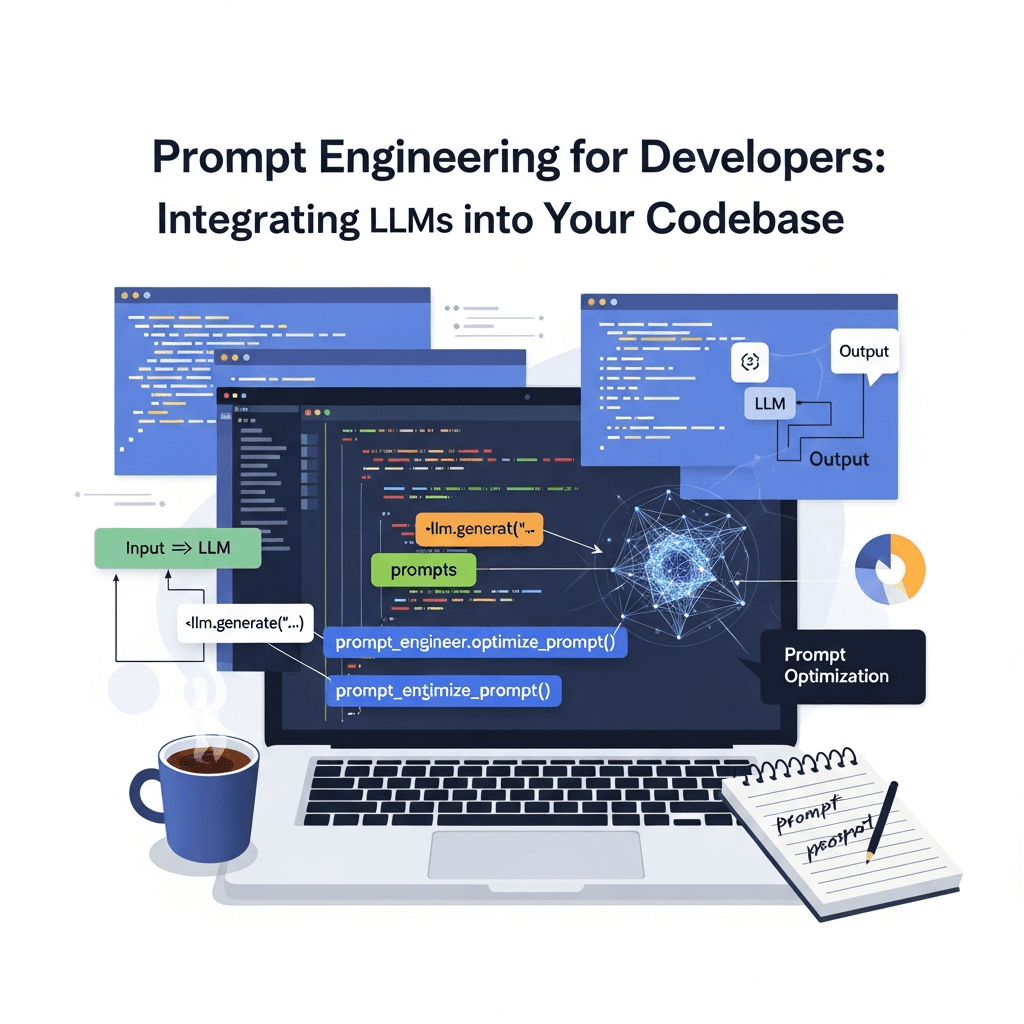
For developers, the key to unlocking consistent, reliable, and high-quality outputs from LLMs lies in Prompt Engineering. This discipline is the art and science of crafting effective inputs (prompts) to guide an LLM towards a desired response. It's the critical bridge between the raw power of an LLM and its practical application within your codebase.
This comprehensive guide will equip you with the knowledge and practical skills to integrate LLMs effectively into your applications. We'll explore core principles, practical patterns, code examples, advanced techniques, and best practices to ensure your LLM-powered features are robust, efficient, and production-ready.
Prerequisites: What You'll Need
To follow along with the examples and concepts in this guide, you should have:
- Basic Python knowledge: Our code examples will primarily be in Python.
- Familiarity with APIs: Understanding how to make HTTP requests and handle JSON responses is beneficial.
- An API key for an LLM service: We'll use OpenAI's API in our examples for simplicity, but the principles apply broadly to other LLM providers (e.g., Anthropic, Google Gemini).
- A conceptual understanding of LLMs: Knowing about tokens, temperature, and different model types (e.g., chat vs. completion) will be helpful.
Understanding Prompt Engineering: The Bridge to LLM Power
At its core, prompt engineering is about communicating your intent to an LLM in a way it can best understand and execute. Think of it as writing highly specific instructions for a very intelligent, but sometimes literal, assistant. Without proper guidance, an LLM might generate generic, irrelevant, or even incorrect information. With effective prompt engineering, you can steer it to perform complex tasks like data extraction, code generation, content summarization, and more, all within the context of your application.
Why is it so crucial for developers?
- Control and Consistency: Prompts allow you to dictate the format, tone, and content of the LLM's output, making it predictable and usable programmatically.
- Accuracy and Relevance: By providing specific context and instructions, you reduce the likelihood of hallucinations (fabricated information) and ensure the output directly addresses your application's needs.
- Efficiency: Well-engineered prompts can reduce the number of API calls needed to achieve a desired result, saving computational resources and cost.
- Scalability: Standardized prompt templates make it easier to integrate LLM capabilities across various features in your application.
- Safety and Reliability: Prompts can incorporate guardrails to prevent harmful or undesirable outputs.
Core Principles of Effective Prompt Design: Crafting Clarity
Before diving into specific patterns, let's establish fundamental principles for designing effective prompts:
1. Be Clear and Specific
Ambiguity is the enemy of good prompt engineering. Avoid vague language. Instead of "Write something about dogs," try "Write a 100-word persuasive paragraph about why Golden Retrievers make excellent family pets, focusing on their temperament and trainability."
2. Provide Sufficient Context
LLMs are stateless, meaning each API call is independent. If your LLM needs background information to complete a task, you must provide it within the prompt. This could be user input, retrieved data, or previous conversation turns.
3. Assign a Role (Persona)
Giving the LLM a persona can significantly influence its output style and content. Examples: "You are a senior Python developer...", "Act as a meticulous copy editor...", "You are a friendly customer support agent...".
4. Specify Output Format
For programmatic integration, you often need structured output (e.g., JSON, XML, Markdown lists). Explicitly request this format. "Respond only with a JSON object...", "Format your answer as a Markdown list...".
5. Use Delimiters
When providing user input or other dynamic data, use clear delimiters (e.g., triple backticks ```, XML tags <user_input>, ####) to separate it from your instructions. This helps the LLM distinguish between instructions and data.
6. Be Iterative and Experimental
Prompt engineering is rarely a one-shot process. Expect to refine your prompts through trial and error. Test with diverse inputs and measure output quality.
Basic Prompt Patterns: Instructions, Few-Shot, and Chain-of-Thought
These patterns form the building blocks of most prompt engineering strategies.
1. Instruction-Based Prompting
The most straightforward approach: tell the LLM exactly what to do.
instruction_prompt = (
    "Summarize the following article in 3 sentences, focusing on the main arguments."
    """
    Article: "The rise of AI in healthcare has led to significant advancements in diagnostics...
    """
)
2. Few-Shot Prompting
Provide examples of input-output pairs to teach the LLM the desired task. This is particularly effective for tasks requiring a specific style or format.
few_shot_prompt = (
    "Classify the sentiment of the following reviews as 'positive', 'negative', or 'neutral'.\n\n"
    "Review: 'This product is amazing!'\nSentiment: positive\n\n"
    "Review: 'It works, but it's nothing special.'\nSentiment: neutral\n\n"
    "Review: 'Absolutely terrible experience.'\nSentiment: negative\n\n"
    "Review: 'The customer service was excellent and resolved my issue quickly.'\nSentiment:"
)
3. Chain-of-Thought (CoT) Prompting
Encourage the LLM to 'think step-by-step' before providing the final answer. This is powerful for complex reasoning tasks, improving accuracy and reducing hallucinations.
cot_prompt = (
    "Calculate the total cost of 3 apples at $0.50 each and 2 oranges at $0.75 each."
    "Think step by step. First, calculate the cost of apples. Second, calculate the cost of oranges. Third, sum them up.\n"
)
Integrating LLMs into Python: A Practical Starter
Let's put these principles into practice using the OpenAI API. First, ensure you have the openai library installed (pip install openai) and your API key set as an environment variable (OPENAI_API_KEY).
import openai
import os

# Ensure your API key is set as an environment variable
# os.environ["OPENAI_API_KEY"] = "YOUR_API_KEY"

def get_completion(prompt, model="gpt-3.5-turbo"):
    messages = [{"role": "user", "content": prompt}]
    try:
        response = openai.chat.completions.create(
            model=model,
            messages=messages,
            temperature=0.7, # Controls randomness: 0.0 (deterministic) to 1.0 (very creative)
            max_tokens=200 # Max tokens for the output
        )
        return response.choices[0].message.content
    except openai.APIError as e:
        print(f"OpenAI API Error: {e}")
        return None

# Example 1: Simple Instruction
instruction_prompt = "Explain the concept of recursion in programming in simple terms."
print("\n--- Simple Instruction ---")
print(get_completion(instruction_prompt))

# Example 2: Few-Shot for sentiment
review_to_classify = "The app crashes frequently, making it unusable."
few_shot_prompt_template = (
    "Classify the sentiment of the following reviews as 'positive', 'negative', or 'neutral'.\n\n"
    "Review: 'This product is amazing!'\nSentiment: positive\n\n"
    "Review: 'It works, but it's nothing special.'\nSentiment: neutral\n\n"
    "Review: 'Absolutely terrible experience.'\nSentiment: negative\n\n"
    f"Review: '{review_to_classify}'\nSentiment:"
)
print("\n--- Few-Shot Sentiment ---")
print(get_completion(few_shot_prompt_template))

# Example 3: Chain-of-Thought for a math problem
math_problem_prompt = (
    "A baker makes 100 cookies. She sells 70% of them on Monday and then half of the remaining cookies on Tuesday. How many cookies are left?"
    "Think step by step.\n"
)
print("\n--- Chain-of-Thought Math ---")
print(get_completion(math_problem_prompt))
Managing Conversation State and Context in Your Application
LLMs, by design, are stateless. Each API call is a fresh interaction. For conversational applications or tasks requiring memory, you must manage the conversation history yourself and feed it back into subsequent prompts.
OpenAI's chat completion API uses a list of messages, allowing you to specify system, user, and assistant roles. This is ideal for maintaining context.
import openai
import os

def get_chat_completion(messages, model="gpt-3.5-turbo", temperature=0.7, max_tokens=150):
    try:
        response = openai.chat.completions.create(
            model=model,
            messages=messages,
            temperature=temperature,
            max_tokens=max_tokens
        )
        return response.choices[0].message.content
    except openai.APIError as e:
        print(f"OpenAI API Error: {e}")
        return None

# Initialize conversation history
conversation_history = [
    {"role": "system", "content": "You are a helpful assistant that answers questions about Python programming."}
]

def chat_with_llm(user_input):
    global conversation_history
    conversation_history.append({"role": "user", "content": user_input})

    response_content = get_chat_completion(conversation_history)

    if response_content:
        conversation_history.append({"role": "assistant", "content": response_content})
        return response_content
    return "Error: Could not get a response."

print("\n--- Conversation Management ---")
print(f"User: What is a decorator in Python?")
print(f"Assistant: {chat_with_llm('What is a decorator in Python?')}")

print(f"User: Can you give me a simple example?")
print(f"Assistant: {chat_with_llm('Can you give me a simple example?')}")

print(f"User: And how is it typically used?")
print(f"Assistant: {chat_with_llm('And how is it typically used?')}")

# Note: For very long conversations, you'll need strategies like summarization
# or windowing to stay within token limits.
Ensuring Structured Output: From Freeform Text to Programmatic Data
For most programmatic uses, you need LLM outputs in a machine-readable format, not just freeform text. JSON is a common and excellent choice. You can explicitly instruct the LLM to return JSON, and even provide a schema.
import openai
import json
import os

# Example: Extracting entities into a JSON object
def extract_info_to_json(text):
    prompt = (
        "Extract the following information from the text and return it as a JSON object.\n"
        "The JSON object should have keys: 'product_name', 'price', 'currency', 'quantity'.\n"
        "If a piece of information is not found, use `null` for its value.\n\n"
        "Text: """
        f"{text}"
        """
        "JSON:"
    )

    messages = [
        {"role": "system", "content": "You are an information extraction assistant that outputs valid JSON."},
        {"role": "user", "content": prompt}
    ]

    try:
        response = openai.chat.completions.create(
            model="gpt-3.5-turbo-1106", # Use a model optimized for JSON output if available (e.g., -1106 versions)
            messages=messages,
            response_format={ "type": "json_object" }, # Explicitly request JSON output
            temperature=0.0 # Make it deterministic for data extraction
        )
        return json.loads(response.choices[0].message.content)
    except (openai.APIError, json.JSONDecodeError) as e:
        print(f"Error processing JSON: {e}")
        return None

print("\n--- Structured Output (JSON) ---")
text1 = "I'd like to order 2 units of the 'ProWidget X' for $49.99 USD."
extracted_data1 = extract_info_to_json(text1)
print(json.dumps(extracted_data1, indent=2))

text2 = "Can I get the 'MegaGadget' priced at 120 Euros?"
extracted_data2 = extract_info_to_json(text2)
print(json.dumps(extracted_data2, indent=2))

# For more robust validation, consider using Pydantic to define your expected JSON schema.
# You can then ask the LLM to conform to that schema and use Pydantic for parsing and validation.
# Example Pydantic usage (conceptual):
# from pydantic import BaseModel
# class ProductOrder(BaseModel):
#     product_name: str
#     price: float
#     currency: str
#     quantity: int
#
# # Then, in your code, after getting the JSON string:
# try:
#     order = ProductOrder.parse_raw(json_string_from_llm)
#     print(order.model_dump())
# except ValidationError as e:
#     print(f"Validation error: {e}")
Advanced Integration Patterns: RAG and Function Calling
To move beyond basic text generation and leverage LLMs for more complex, knowledge-intensive, or interactive tasks, you'll often employ advanced patterns.
1. Retrieval Augmented Generation (RAG)
LLMs have a knowledge cutoff and can hallucinate. RAG addresses this by combining the LLM's generative capabilities with external, up-to-date, or proprietary knowledge bases. The process typically involves:
- User Query: User asks a question.
- Retrieval: Your system queries a vector database (containing embeddings of your documents) to find relevant document chunks.
- Augmentation: The retrieved chunks are added to the LLM's prompt as context.
- Generation: The LLM generates a response based on the provided context and its general knowledge.
This pattern significantly reduces hallucinations and grounds the LLM's responses in factual data.
2. Tool Use / Function Calling
This powerful pattern allows LLMs to interact with external tools, APIs, or functions defined in your code. Instead of just generating text, the LLM can decide when to call a specific function and what arguments to pass to it. The process is:
- User Query: User asks a question that might require external data (e.g., "What's the weather like in London?").
- LLM Decision: The LLM, given a list of available functions (with descriptions), decides if a function call is needed. If so, it generates the function name and arguments.
- Function Execution: Your application intercepts this function call and executes the actual code (e.g., an API call to a weather service).
- Observation: The result of the function call is fed back to the LLM.
- Final Response: The LLM uses the function's output to generate a natural language response to the user.
This enables LLMs to perform actions, fetch real-time data, and integrate seamlessly with your existing software ecosystem.
Real-World Applications for Developers: Beyond Chatbots
Integrating LLMs with prompt engineering opens up a vast array of possibilities:
- Content Generation & Marketing: Draft blog posts, social media updates, product descriptions, email campaigns.
- Code Generation & Refinement: Generate boilerplate code, unit tests, docstrings, refactor suggestions, translate code between languages.
- Data Extraction & Structuring: Convert unstructured text (e.g., customer reviews, legal documents, emails) into structured data (JSON, CSV) for database entry or analysis.
- Summarization: Condense long articles, reports, or conversation transcripts into concise summaries.
- Customer Support & FAQs: Power intelligent chatbots that answer user queries, escalate complex issues, or provide personalized assistance.
- Semantic Search & Q&A: Build search engines that understand the meaning of queries, not just keywords, and answer questions directly from documents.
- Personalization: Tailor user experiences, recommendations, or content based on user preferences and behavior.
- Translation & Localization: Translate text between languages while preserving context and tone.
Best Practices for Production-Ready LLM Integrations
Moving from experimentation to production requires careful consideration of several factors:
1. Version Control Your Prompts
Treat your prompts like code. Store them in your version control system (Git), allow for review, and track changes. Prompt templates should be managed alongside your application logic.
2. Implement Robust Error Handling and Fallbacks
LLM APIs can fail, return unexpected formats, or hallucinate. Your code should gracefully handle API errors, JSON parsing failures, and provide sensible fallbacks (e.g., generic responses, retries).
3. Manage Token Limits and Costs
LLM usage is often billed by tokens. Monitor token usage, especially for long conversations or RAG applications. Implement strategies like conversation summarization, truncating context, or using cheaper models for less critical tasks.
4. Evaluate and Test Systematically
Develop metrics and test suites to evaluate the quality, accuracy, and consistency of LLM outputs. This is harder than traditional unit testing but crucial. Consider human-in-the-loop review for critical outputs.
5. Implement Guardrails and Safety Measures
LLMs can generate harmful, biased, or inappropriate content. Implement content moderation, input filtering, and output validation to ensure safety. System prompts can also include instructions to refuse certain types of requests.
6. Caching and Rate Limiting
For frequently asked questions or stable outputs, implement caching to reduce API calls and latency. Respect API rate limits to avoid service interruptions.
7. Observability and Monitoring
Log prompts, responses, latency, and any errors. This data is invaluable for debugging, improving prompts, and understanding LLM behavior in production.
Common Pitfalls and Mitigation Strategies
Even with best practices, integrating LLMs presents unique challenges:
1. Ambiguity in Prompts
- Pitfall: Vague instructions lead to generic, irrelevant, or inconsistent outputs.
- Mitigation: Be hyper-specific. Use examples (few-shot), define roles, and explicitly state desired formats and constraints.
2. Hallucinations
- Pitfall: LLMs generating factually incorrect or nonsensical information, especially when asked about topics outside their training data or when pressured to answer.
- Mitigation: Use RAG for knowledge-intensive tasks. Implement CoT prompting. Instruct the LLM to state when it doesn't know an answer. Always verify critical LLM output with human review or external data sources.
3. Prompt Injection
- Pitfall: Malicious user input overriding your system prompt instructions, leading to unintended behavior (e.g., revealing system prompts, generating harmful content).
- Mitigation: Use strong delimiters for user input. Include instructions in your system prompt to prioritize its directives. Sanitize user inputs where possible. Consider dedicated prompt injection detection services.
4. Ignoring Token Limits
- Pitfall: Sending too much context, leading to truncated responses, API errors, or excessively high costs.
- Mitigation: Monitor token usage. Implement summarization for long histories. Use context windowing (e.g., keeping only the last N turns). Be judicious about what context is truly necessary.
5. Over-reliance on LLM Output Without Validation
- Pitfall: Trusting LLM output blindly, especially for critical applications, leading to errors or security vulnerabilities.
- Mitigation: Always validate LLM output, particularly when expecting structured data. Use Pydantic or similar libraries for schema validation. Incorporate human review for sensitive tasks.
Conclusion: The Evolving Landscape of LLM Development
Prompt engineering is not just a passing fad; it's a fundamental skill for any developer looking to build sophisticated applications with Large Language Models. By mastering the art of crafting clear, specific, and context-rich prompts, you gain significant control over LLM behavior, transforming them from unpredictable generators into reliable, programmable components of your software.
The field of LLM development is rapidly evolving, with new models, techniques, and tools emerging constantly. Continuous learning, experimentation, and adherence to best practices will be key to staying ahead. Start integrating LLMs into your projects today, experiment with different prompting strategies, and discover the transformative power they bring to your codebase.
Embrace the iterative nature of prompt design, learn from your experiments, and build the next generation of intelligent applications.
Written by
CodewithYohaFull-Stack Software Engineer with 7+ years of experience in Java, Spring Boot, and cloud architecture across AWS, Azure, and GCP. Writing production-grade engineering patterns for developers who ship real software.