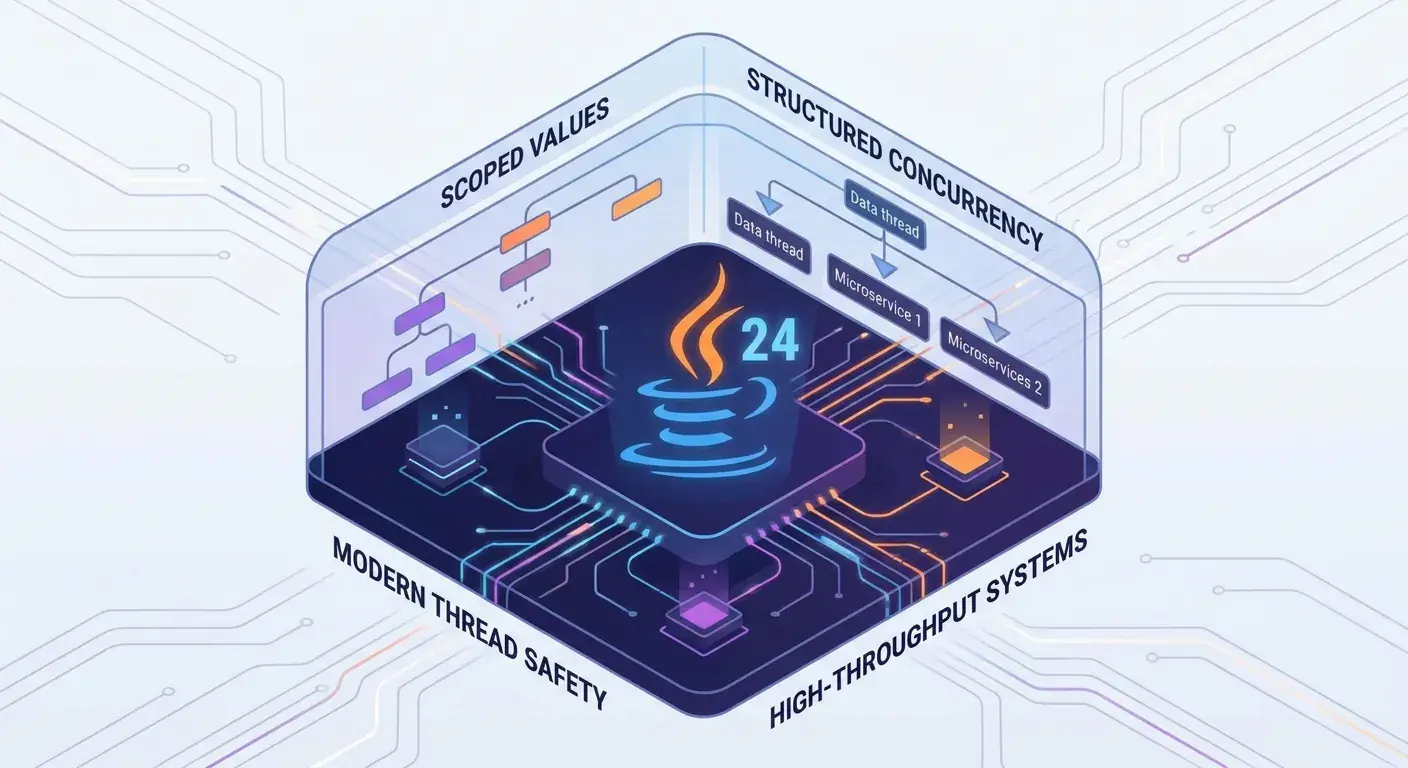
Java 24 Unleashed: Pattern Matching, Value Classes & Structured Concurrency

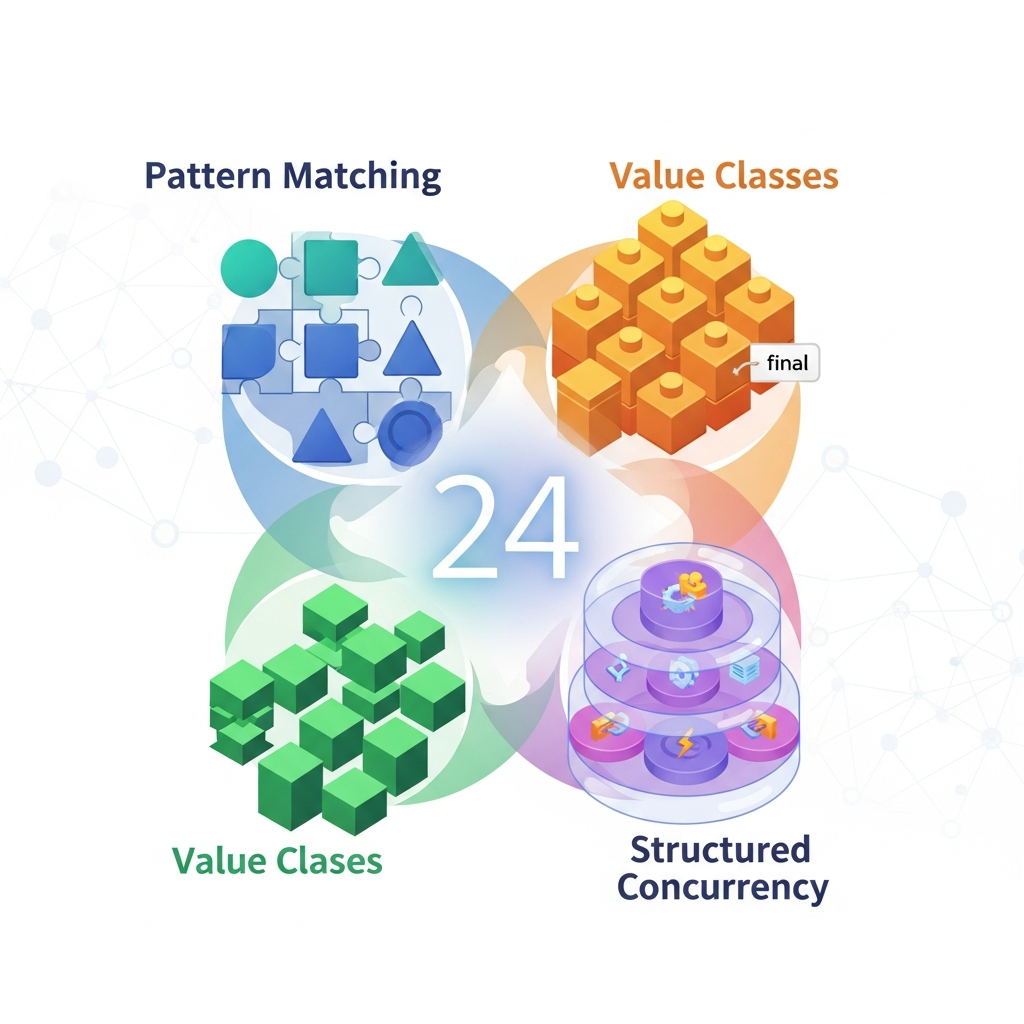
Introduction: A New Era for Java Development
Java continues its relentless evolution, and Java 24 stands as a testament to this commitment, bringing forth a suite of features that promise to significantly enhance developer productivity, code clarity, and application performance. Building on the foundation laid by previous releases, Java 24 further refines and introduces powerful paradigms from Project Amber, Project Valhalla, and Project Loom.
This comprehensive guide will deep-dive into three of the most anticipated and impactful features shaping the future of Java: enhanced Pattern Matching, the revolutionary Value Classes (from Project Valhalla), and the highly anticipated Structured Concurrency (from Project Loom). We'll explore their motivations, mechanics, practical applications, and how they collectively empower developers to write cleaner, safer, and more performant code.
Prerequisites
To fully grasp the concepts discussed in this article, a basic understanding of Java syntax and object-oriented programming is recommended. Familiarity with newer Java features introduced in versions like Java 17+ (e.g., records, sealed classes, basic instanceof pattern matching) will be beneficial but not strictly required, as we will cover the foundational aspects where necessary.
1. The Evolution of Java: A Quick Look at Java 24's Themes
Java's accelerated release cadence of every six months ensures that new features and improvements are delivered to developers more frequently. Java 24, while not a Long-Term Support (LTS) release, represents a significant milestone in bringing several long-term projects closer to full realization. The themes driving these features are clear: reducing boilerplate, improving data-centric programming, enhancing concurrency safety, and boosting performance.
Project Amber focuses on language enhancements like pattern matching, making Java more expressive and concise. Project Valhalla aims to fundamentally change how objects are represented in memory, introducing value types for better performance and memory efficiency. Project Loom tackles the complexities of concurrent programming, providing a simpler, more robust model through virtual threads and structured concurrency. Java 24 brings these ambitions closer to mainstream adoption.
2. Deeper Dive into Pattern Matching: A Story of Simplicity and Safety
Pattern Matching has been a gradual introduction into Java, starting with instanceof in Java 16, followed by switch expressions and record patterns in subsequent releases. Java 24 continues to refine and expand these capabilities, making code that deals with different types of data or varying object states significantly more readable and robust. The core idea is to allow conditional logic to extract components from an object in a single, atomic operation, avoiding explicit casts and reducing errors.
Benefits of Enhanced Pattern Matching:
- Readability: Makes complex conditional logic much easier to understand.
- Safety: Eliminates the need for explicit, potentially unsafe, type casts.
- Conciseness: Reduces boilerplate code, especially when dealing with nested data structures.
- Exhaustiveness: With sealed types, the compiler can often guarantee that all possible cases are handled, preventing runtime errors.
3. Enhancing switch Statements with Type Patterns and when Clauses
Prior to pattern matching, switch statements could only operate on primitive types, enums, and Strings. With type patterns, switch can now elegantly handle different object types, making it a powerful tool for polymorphism. Java 24 further refines this by allowing when clauses to add secondary conditions to a case label, providing incredibly granular control.
Consider a scenario where you're processing various shapes:
// Define some record types for shapes
record Circle(double radius) {}
record Rectangle(double length, double width) {}
record Triangle(double side1, double side2, double side3) {}
record Square(double side) {}

public class ShapeProcessor {
    public static double getArea(Object shape) {
        // Java 24's enhanced switch with type patterns and when clauses
        return switch (shape) {
            case Circle c       -> Math.PI * c.radius() * c.radius();
            case Rectangle r    -> r.length() * r.width();
            // Using a when clause to handle a specific condition for Triangle
            case Triangle t when t.side1() == t.side2() && t.side2() == t.side3() -> {
                // Equilateral triangle
                double s = (t.side1() + t.side2() + t.side3()) / 2.0;
                yield Math.sqrt(s * (s - t.side1()) * (s - t.side2()) * (s - t.side3()));
            }
            case Triangle t     -> { // Generic triangle using Heron's formula
                double s = (t.side1() + t.side2() + t.side3()) / 2.0;
                yield Math.sqrt(s * (s - t.side1()) * (s - t.side2()) * (s - t.side3()));
            }
            case Square s       -> s.side() * s.side();
            case null           -> throw new IllegalArgumentException("Shape cannot be null");
            default             -> throw new IllegalArgumentException("Unknown shape type: " + shape.getClass().getName());
        };
    }

    public static void main(String[] args) {
        System.out.println("Circle Area: " + getArea(new Circle(5.0))); // Circle Area: 78.53981633974483
        System.out.println("Rectangle Area: " + getArea(new Rectangle(4.0, 6.0))); // Rectangle Area: 24.0
        System.out.println("Equilateral Triangle Area: " + getArea(new Triangle(5.0, 5.0, 5.0))); // Equilateral Triangle Area: 10.825317547305483
        System.out.println("Scalene Triangle Area: " + getArea(new Triangle(3.0, 4.0, 5.0))); // Scalene Triangle Area: 6.0
        System.out.println("Square Area: " + getArea(new Square(7.0))); // Square Area: 49.0
    }
}
Notice how the when clause for Triangle allows us to handle specific cases (like equilateral triangles) before falling back to a more general Triangle case. The null pattern also provides a clean way to handle null inputs directly within the switch expression, preventing NullPointerExceptions.
4. Record Patterns: Deconstructing Data with Elegance
Records, introduced in Java 16, provide a concise syntax for immutable data carriers. Record patterns take this a step further by allowing you to deconstruct a record's components directly within a pattern match. This is particularly powerful when combined with nested records, enabling elegant navigation and extraction of data from complex, hierarchical structures.
Consider an API response representing a user's order:
// Define nested records for order data
record Address(String street, String city, String zip) {}
record Customer(String name, Address address) {}
record Product(String name, double price, int quantity) {}
record Order(String orderId, Customer customer, Product... products) {}

public class OrderProcessor {
    public static void processOrder(Object obj) {
        if (obj instanceof Order(
            String orderId,
            Customer(String customerName, Address(var street, String city, String zip)),
            Product[] products
        )) {
            System.out.println("\n--- Processing Order: " + orderId + " ---");
            System.out.println("Customer: " + customerName);
            System.out.println("Shipping to: " + street + ", " + city + ", " + zip);
            System.out.println("Products:");
            for (Product p : products) {
                System.out.println("  - " + p.name() + " (Qty: " + p.quantity() + ", Price: $" + p.price() + ")");
            }
        } else {
            System.out.println("Not a valid order object.");
        }
    }

    public static void main(String[] args) {
        Address customerAddress = new Address("123 Main St", "Anytown", "12345");
        Customer customer = new Customer("Alice Smith", customerAddress);
        Product laptop = new Product("Laptop", 1200.00, 1);
        Product mouse = new Product("Wireless Mouse", 25.00, 2);
        Order order1 = new Order("ORD-001", customer, laptop, mouse);

        processOrder(order1);
        processOrder("Just a string");

        // Example with switch expression and record patterns
        Object anotherOrder = new Order("ORD-002", new Customer("Bob", new Address("456 Oak Ave", "Otherville", "67890")), new Product("Keyboard", 75.00, 1));

        switch (anotherOrder) {
            case Order(var id, Customer(var name, Address(_, var city, _)), var prods) -> {
                System.out.println("\n--- Processing Order (Switch): " + id + " ---");
                System.out.println("Customer: " + name + " in " + city);
                System.out.println("Total products: " + prods.length);
            }
            default -> System.out.println("Not an order in switch.");
        }
    }
}
This example demonstrates how instanceof and switch can use nested record patterns to deconstruct the Order object, accessing orderId, customerName, street, city, and zip directly. The var keyword can be used to infer the type of the extracted component, and _ can be used as a wildcard for components you don't need.
5. The Promise of Value Classes (Project Valhalla): Bridging Primitives and Objects
Project Valhalla aims to fundamentally change how objects are stored and accessed in Java, bridging the performance gap between primitive types and traditional reference-based objects. The core concept here is Value Classes (also known as inline types), which are identity-less, immutable data carriers whose instances can be stored directly "inline" within other objects or arrays, much like primitive types.
The Problem Valhalla Solves:
Traditional Java objects carry overhead:
- Object Header: Each object on the heap has a header (for GC, locking, etc.), consuming memory.
- Indirection: Objects are accessed via references, leading to cache misses and slower memory access.
- Identity: Every object has a unique identity, which is often unnecessary for simple data aggregates, leading to wasted comparisons and memory.
Value Classes address these by allowing instances to be stored directly in memory, eliminating headers and indirection when possible. They behave like objects but have the memory characteristics of primitives.
Key Characteristics of Value Classes (Conceptual):
- Identity-less: Two value class instances are considered equal if their components are equal. There's no concept of
==for identity comparison. - Immutable: To ensure predictable behavior when copied or stored inline, value classes are inherently immutable.
- Inline Storage: Instances can be directly embedded in other data structures or on the stack, reducing heap pressure and improving cache locality.
inline classKeyword: While the exact syntax might evolve, a conceptualinline classkeyword is expected to declare them.
// NOTE: Value Classes are still in preview/incubator and the exact syntax
// and behavior might change. This example is illustrative of the concept.

// Conceptual definition of an inline class for Money
// This is NOT runnable Java 24 code, but demonstrates the intent.
/*
inline class Money {
    private final long amountCents;
    private final String currency;

    public Money(long amountCents, String currency) {
        if (amountCents < 0) throw new IllegalArgumentException("Amount cannot be negative");
        if (currency == null || currency.isBlank()) throw new IllegalArgumentException("Currency cannot be empty");
        this.amountCents = amountCents;
        this.currency = currency;
    }

    public long amountCents() { return amountCents; }
    public String currency() { return currency; }

    public Money add(Money other) {
        if (!this.currency.equals(other.currency)) {
            throw new IllegalArgumentException("Cannot add different currencies");
        }
        return new Money(this.amountCents + other.amountCents, this.currency);
    }

    // toString, equals, hashCode are implicitly handled based on components
    // for inline classes, similar to records.
}

public class FinancialApp {
    public static void main(String[] args) {
        // Instances of Money could be stored inline, reducing heap allocations
        Money price = new Money(19999, "USD"); // $199.99
        Money tax = new Money(1500, "USD");    // $15.00
        Money total = price.add(tax);

        System.out.println("Price: " + price.amountCents() / 100.0 + " " + price.currency());
        System.out.println("Tax: " + tax.amountCents() / 100.0 + " " + tax.currency());
        System.out.println("Total: " + total.amountCents() / 100.0 + " " + total.currency());

        // Identity comparison (==) would be meaningless for value types.
        // Equality (equals()) would be based on component values.
        Money anotherPrice = new Money(19999, "USD");
        System.out.println("Price == anotherPrice: " + (price == anotherPrice)); // Expected false (reference comparison)
        System.out.println("Price.equals(anotherPrice): " + price.equals(anotherPrice)); // Expected true (value comparison)
    }
}
*/
System.out.println("// Value Classes (Project Valhalla) are still in preview/incubator. The above is a conceptual example.");
System.out.println("// The exact syntax and behavior are subject to change before final release.");
6. Practical Implications and Use Cases of Value Classes
The impact of Value Classes will be profound, particularly in performance-critical applications and scenarios dealing with large amounts of data. Here are some key implications and use cases:
- Performance Boost: By eliminating object headers and indirection, Value Classes can significantly reduce memory footprint and improve CPU cache utilization. This means less garbage collection overhead and faster data access.
- Data-Intensive Applications: Databases, scientific simulations, financial modeling, and big data processing can benefit immensely from the ability to store complex data types efficiently.
- Domain-Specific Primitives: Imagine
Money,Duration,Coordinates, orComplexNumberbehaving like primitives. They would offer type safety and domain semantics without the performance penalty of traditional objects. - Collections of Values:
List<Money>orMap<Point, String>would become much more memory-efficient, potentially storing theMoneyorPointinstances directly in the array or hash table backing the collection, rather than just references. - Interoperability: Value classes are designed to be compatible with existing JVM features and potentially simplify interoperability with native code or other languages that use value semantics.
Value Classes represent a paradigm shift, allowing developers to model rich domain concepts with the performance characteristics traditionally reserved for primitives. This will lead to more robust, performant, and memory-efficient Java applications.
7. Structured Concurrency (Project Loom): Taming Concurrent Chaos
Concurrent programming has historically been one of the most challenging aspects of software development, often leading to hard-to-debug issues like deadlocks, race conditions, and resource leaks. Traditional thread management (using java.lang.Thread or ExecutorService) treats tasks as independent entities, making error handling, cancellation, and observability complex, especially in fan-out scenarios where a main task dispatches work to several subtasks.
Structured Concurrency, introduced as part of Project Loom (alongside Virtual Threads), aims to simplify concurrent programming by establishing a clear parent-child relationship between tasks. It enforces that a parent task cannot complete until all its child tasks have completed, failed, or been cancelled. This brings the benefits of structured programming (like structured control flow in if/else or for loops) to concurrency.
Key Principles:
- Task Hierarchy: Tasks are organized in a tree-like structure, with a parent task supervising its children.
- Lifetime Management: The lifetime of child tasks is bound to the parent task's scope.
- Error Propagation: Errors in child tasks are automatically propagated to the parent.
- Cancellation: Cancelling the parent task automatically cancels its children.
- Observability: Easier to reason about and debug concurrent code by understanding task relationships.
8. StructuredTaskScope: The Heart of Structured Concurrency
The java.util.concurrent.StructuredTaskScope API is the primary mechanism for implementing structured concurrency. It allows you to create a scope within which multiple subtasks can be forked (started) and then joined (waited upon). The StructuredTaskScope ensures that the main thread (parent) cannot exit its try-with-resources block until all tasks within the scope have completed.
StructuredTaskScope comes with two main subclasses for common patterns:
StructuredTaskScope.ShutdownOnFailure: If any subtask fails, the scope shuts down, and all other running subtasks are cancelled. The parent receives the exception from the first failing task.StructuredTaskScope.ShutdownOnSuccess: If any subtask completes successfully, the scope shuts down, and all other running subtasks are cancelled. The parent receives the result of the first successful task.
import java.util.concurrent.ExecutionException;
import java.util.concurrent.Future;
import java.util.concurrent.StructuredTaskScope;
import java.util.concurrent.ThreadLocalRandom;

public class WebServiceAggregator {

    // Imagine these are calls to external microservices
    private static String fetchUserPreferences() throws InterruptedException {
        Thread.sleep(ThreadLocalRandom.current().nextInt(500, 1500)); // Simulate network latency
        if (ThreadLocalRandom.current().nextBoolean()) {
             throw new RuntimeException("Failed to fetch user preferences");
        }
        return "Theme: Dark, Lang: EN";
    }

    private static String fetchProductRecommendations() throws InterruptedException {
        Thread.sleep(ThreadLocalRandom.current().nextInt(700, 2000));
        return "Recommended: Laptop, Mouse";
    }

    private static String fetchAdvertisement() throws InterruptedException {
        Thread.sleep(ThreadLocalRandom.current().nextInt(300, 1000));
        return "Ad: Buy now!";
    }

    public static void main(String[] args) throws InterruptedException, ExecutionException {
        System.out.println("Starting aggregation...");
        long startTime = System.currentTimeMillis();

        try (var scope = new StructuredTaskScope.ShutdownOnFailure()) {
            Future<String> userPrefs = scope.fork(WebServiceAggregator::fetchUserPreferences);
            Future<String> productRecs = scope.fork(WebServiceAggregator::fetchProductRecommendations);
            Future<String> ads = scope.fork(WebServiceAggregator::fetchAdvertisement);

            scope.join(); // Wait for all tasks to complete or one to fail
            scope.throwIfFailed(); // Re-throws any exception from a failed task

            String preferences = userPrefs.resultNow();
            String recommendations = productRecs.resultNow();
            String advertisement = ads.resultNow();

            System.out.println("\n--- Aggregated Results ---");
            System.out.println("Preferences: " + preferences);
            System.out.println("Recommendations: " + recommendations);
            System.out.println("Advertisement: " + advertisement);
        } catch (InterruptedException e) {
            System.err.println("Aggregation interrupted: " + e.getMessage());
            Thread.currentThread().interrupt();
        } catch (ExecutionException e) {
            System.err.println("Aggregation failed due to a subtask error: " + e.getCause().getMessage());
        } finally {
            long endTime = System.currentTimeMillis();
            System.out.println("Total time: " + (endTime - startTime) + " ms");
        }

        // Example of ShutdownOnSuccess (e.g., fetch result from fastest source)
        System.out.println("\n--- Fetching from fastest source (ShutdownOnSuccess) ---");
        startTime = System.currentTimeMillis();
        try (var scope = new StructuredTaskScope.ShutdownOnSuccess<String>()) {
            Future<String> sourceA = scope.fork(() -> { Thread.sleep(800); return "Data from Source A"; });
            Future<String> sourceB = scope.fork(() -> { Thread.sleep(300); return "Data from Source B (fastest)"; });
            Future<String> sourceC = scope.fork(() -> { Thread.sleep(1200); return "Data from Source C"; });

            scope.join(); // Wait for the first task to succeed
            String fastestResult = scope.result(); // Get the result of the successful task

            System.out.println("Fastest result: " + fastestResult);
        } catch (InterruptedException e) {
            System.err.println("Fastest fetch interrupted: " + e.getMessage());
            Thread.currentThread().interrupt();
        } catch (ExecutionException e) {
            System.err.println("All sources failed: " + e.getCause().getMessage());
        } finally {
            long endTime = System.currentTimeMillis();
            System.out.println("Total time (fastest source): " + (endTime - startTime) + " ms");
        }
    }
}
The try-with-resources block ensures that the StructuredTaskScope is properly closed, and its join() method implicitly waits for all forked tasks to complete. throwIfFailed() conveniently re-throws the exception from the first failing child task, making error handling straightforward. The ShutdownOnSuccess example shows how to get the result from the first successful task and automatically cancel others.
9. Real-World Applications of Structured Concurrency
Structured Concurrency is not just an academic concept; it directly addresses common patterns in modern distributed systems and applications:
- Fan-Out/Fan-In Microservices: When a single request to a gateway API needs to call multiple backend microservices in parallel and aggregate their results (as shown in the example above).
StructuredTaskScopemakes error handling and partial failures much more manageable. - Robust Timeout Handling: If one of the subtasks takes too long, the parent can cancel the scope, effectively implementing a timeout for the entire operation. This is crucial for maintaining responsiveness.
- Batch Processing: Processing a batch of items where each item can be processed concurrently. If any item processing fails, the entire batch operation can be aborted or handled gracefully.
- Complex UI Rendering: In desktop or mobile applications, rendering a complex UI might involve fetching different data components in parallel. Structured concurrency ensures that all components are ready before the UI is fully displayed, or gracefully handles failures.
- Resource Cleanup: By binding task lifetimes to a scope, resources allocated for child tasks can be more easily managed and cleaned up when the scope exits, regardless of how it exits (success, failure, cancellation).
Structured Concurrency, especially when combined with Virtual Threads (also from Project Loom), dramatically simplifies writing high-throughput, resilient concurrent applications by making the flow of execution and error handling explicit and intuitive.
10. Best Practices for Adopting Java 24 Features
To maximize the benefits of these new features, consider the following best practices:
For Pattern Matching:
- Embrace Exhaustiveness: Leverage sealed types with
switchexpressions to ensure compile-time checks for all possible cases, preventingIncompatibleClassChangeErrorat runtime. - Keep Patterns Readable: While powerful, overly complex or deeply nested patterns can become hard to read. Break down complex logic into smaller, named methods or intermediate records.
- Handle
nullExplicitly: Use thecase nullpattern inswitchexpressions to explicitly handlenullvalues, preventingNullPointerExceptions and making your code safer. - Use
varJudiciously:varin record patterns can improve conciseness, but ensure the type is still clear from context for maintainability.
For Value Classes (Once Stable):
- Immutability is Key: Design your value classes to be inherently immutable. This aligns with their identity-less nature and simplifies reasoning about state.
- No Side Effects: Methods on value classes should not have side effects. They should return new instances if a modification is needed (e.g.,
Money.add()returns a newMoneyobject). - Consider Identity: Only use value classes when object identity is not a concern. If you need to distinguish between two instances that have the same component values (e.g., two different
Personobjects with the same name), a traditional class is more appropriate. - Profile Performance: While value classes promise performance benefits, always profile your application to confirm the actual impact in your specific use case.
For Structured Concurrency:
- Define Clear Task Boundaries: Each
fork()should represent a logical, independent subtask. Avoid overly granular or interdependent tasks within a single scope. - Use
try-with-resources: Always wrapStructuredTaskScopein atry-with-resourcesstatement to ensure proper cleanup and thatjoin()is called. - Handle Exceptions Gracefully: Be prepared to catch
InterruptedExceptionandExecutionExceptionfromjoin()andthrowIfFailed(). Implement appropriate error logging and fallback mechanisms. - Choose the Right Scope: Select
ShutdownOnFailurefor operations where all tasks must succeed, andShutdownOnSuccessfor scenarios where the first successful result is sufficient (e.g., fetching data from multiple redundant sources). - Combine with Virtual Threads: Structured Concurrency shines brightest when tasks are executed on Virtual Threads, as it allows for a vast number of concurrent operations without the overhead of platform threads.
11. Common Pitfalls and How to Avoid Them
Even with these powerful new features, there are common mistakes to watch out for:
Pattern Matching Pitfalls:
- Forgetting
defaultornull: In non-exhaustiveswitchexpressions (i.e., not using sealed types), omitting adefaultcase or acase nullcan lead toMatchExceptionorNullPointerExceptionat runtime. The compiler will warn you, but it's easy to overlook. - Over-nesting Patterns: While powerful, excessively deep or complex nested patterns can become unreadable. Refactor complex patterns into helper methods or intermediate data structures.
- Type Erasure Misunderstanding: Remember that type patterns operate on the runtime type, which is available. However, generic type arguments are erased at runtime, so you cannot pattern match on
List<String>vsList<Integer>directly.
Value Classes Pitfalls (Conceptual, for future consideration):
- Assuming Identity: Treating value class instances as having unique identity (e.g., using
==for comparison) will lead to incorrect logic. Always useequals()for value comparison. - Mutable State: Attempting to create mutable value classes defeats their purpose and can lead to unexpected behavior and performance issues. Stick to immutability.
- Misapplying to Reference Types: Don't try to force value class semantics onto types that inherently require identity (e.g., entities in a database that need unique IDs).
Structured Concurrency Pitfalls:
- Not Calling
join(): Forgettingscope.join()means the parent task might proceed before its children are complete, leading to race conditions or incomplete results. - Ignoring Exceptions: Failing to call
scope.throwIfFailed()or properly handlingExecutionExceptionmeans errors in child tasks might be silently swallowed, making debugging difficult. - Mismanaging
InterruptedException: Concurrency APIs often throwInterruptedException. It's crucial to handle this by either re-throwing it, restoring the interrupt status (Thread.currentThread().interrupt()), or gracefully shutting down. - Over-reliance on
ShutdownOnSuccess: While useful,ShutdownOnSuccesscan mask issues if other tasks are consistently failing. Ensure proper logging for all tasks, even those cancelled by the scope. - Mixing with Unstructured Concurrency: Combining
StructuredTaskScopewith traditionalExecutorServicepatterns without careful consideration can reintroduce the very complexities structured concurrency aims to solve.
12. Conclusion: A Leap Forward for Java Development
Java 24's features, particularly the advancements in Pattern Matching, the conceptual introduction of Value Classes, and the robust framework of Structured Concurrency, represent a significant leap forward for the platform. These innovations are not just incremental improvements; they are paradigm shifts designed to tackle the challenges of modern software development head-on.
- Pattern Matching makes Java more expressive, safer, and less verbose, especially when dealing with complex data structures and polymorphic operations.
- Value Classes (from Project Valhalla) promise a fundamental performance boost by bridging the gap between primitives and objects, enabling richer, more efficient data modeling.
- Structured Concurrency (from Project Loom) simplifies the development of concurrent applications, making them more resilient, observable, and easier to debug.
As these features mature and become widely adopted, Java developers will find themselves equipped with powerful tools to write cleaner, more performant, and more reliable applications. Embracing these new paradigms will be key to unlocking the full potential of modern Java. The future of Java is bright, and Java 24 is a clear indicator of its continued evolution as a leading platform for enterprise and high-performance computing.
Written by
CodewithYohaFull-Stack Software Engineer with 7+ years of experience in Java, Spring Boot, and cloud architecture across AWS, Azure, and GCP. Writing production-grade engineering patterns for developers who ship real software.