Introduction: The Enterprise API Landscape in 2026
In the rapidly evolving digital landscape of 2026, enterprises face an unprecedented challenge: managing an ever-growing constellation of microservices while providing a unified, performant, and consistent data experience to their diverse clients. Traditional REST APIs, while foundational, often lead to over-fetching, under-fetching, and complex client-side orchestration as the number of underlying services explodes. GraphQL emerged as a powerful solution, offering clients precisely what they need, nothing more, nothing less. However, even a single monolithic GraphQL server quickly becomes a bottleneck for large organizations with dozens or hundreds of independent teams.
This is where GraphQL Federation, particularly the Supergraph architecture, steps in. By 2026, it has matured into the de facto standard for building scalable, resilient, and maintainable enterprise-grade APIs. It allows multiple independent GraphQL services (subgraphs) to be composed into a single, unified data graph, providing a seamless experience for consumers while empowering development teams with autonomy. This article will dive deep into GraphQL Federation, exploring its core concepts, architecture, practical implementation, and best practices for scaling your APIs at the enterprise level.
Prerequisites
To get the most out of this guide, a basic understanding of the following concepts is recommended:
- GraphQL Fundamentals: Queries, mutations, schemas, types, resolvers.
- Microservices Architecture: Concepts of distributed systems, service boundaries, and inter-service communication.
- API Design Principles: Familiarity with designing robust and maintainable APIs.
1. The Evolution of API Management: From Monoliths to Supergraphs
The journey of API management in the enterprise has seen significant shifts. Initially, monolithic applications exposed their data via a single API, often RESTful. As businesses grew, these monoliths fractured into microservices, each managing specific domains (e.g., Users, Products, Orders). While microservices offered scalability and team autonomy, they introduced client-side complexity. Clients often had to make multiple requests to different services and stitch the data together.
GraphQL provided a significant leap forward by allowing clients to request all necessary data in a single query. However, if a single GraphQL server had to integrate directly with all microservices, it became a new bottleneck – a "GraphQL monolith." This led to the need for a further abstraction: GraphQL Federation.
Federation allows each microservice team to own and expose its own GraphQL schema (a "subgraph"). These subgraphs are then combined by a central "gateway" or "router" into a single, cohesive "supergraph." This approach marries the benefits of microservices (autonomy, scalability) with the unified data access of GraphQL.
2. What is GraphQL Federation? The Supergraph Concept
At its core, GraphQL Federation is a design pattern and a set of tools that enable the composition of multiple independent GraphQL APIs into a single, unified data graph, known as a Supergraph. Unlike traditional schema stitching, which often involves manual merging and can lead to tight coupling, Federation provides a more robust and scalable approach, primarily driven by special schema directives.
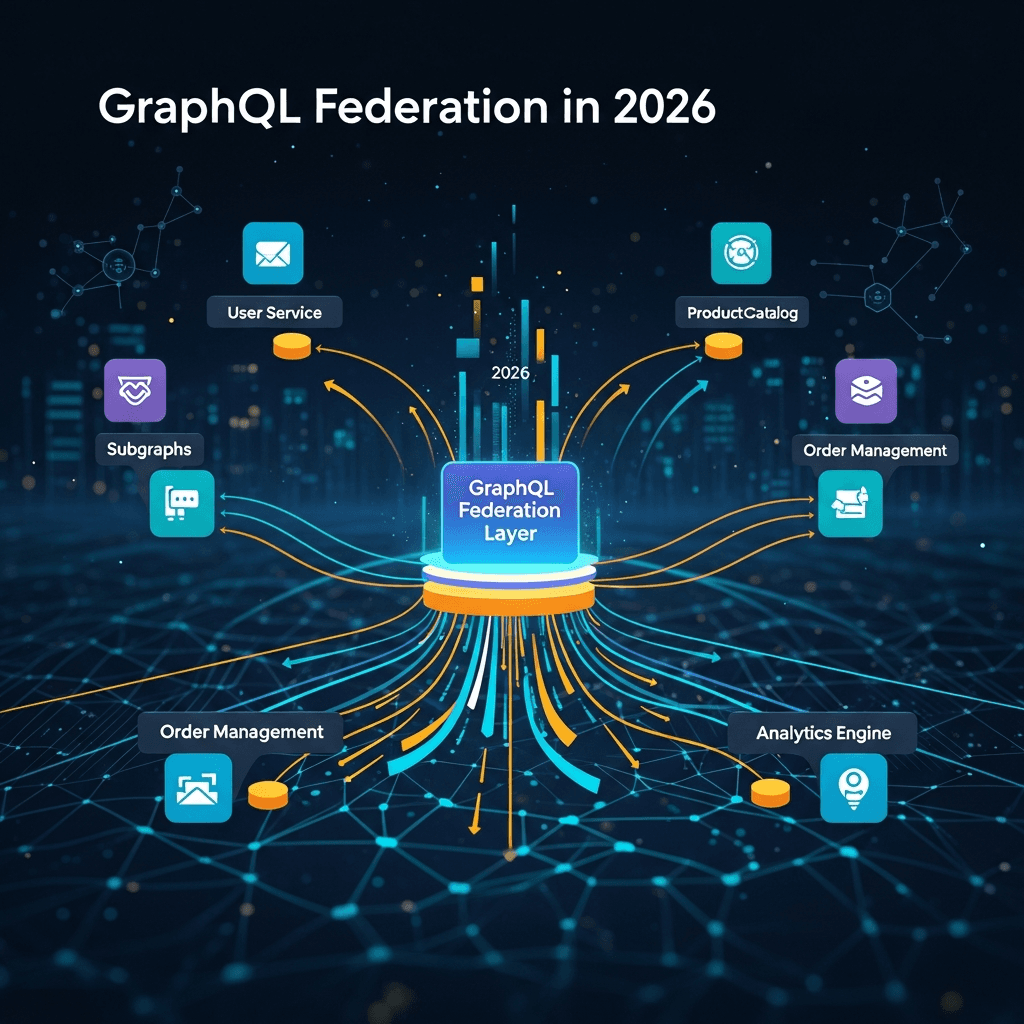
Imagine an enterprise with separate teams for Products, Users, and Reviews. Each team develops and deploys its own GraphQL service. With Federation, these services become subgraphs. A client sends a single GraphQL query to a central Router (or Gateway). The Router, using the supergraph schema, intelligently breaks down the query, sends parts of it to the relevant subgraphs, gathers the results, and stitches them back together before returning a single, unified response to the client.
This architecture empowers teams to develop and deploy their services independently, fostering true microservice autonomy, while presenting a single, coherent API to consumers.
3. Core Components of a Federated GraphQL Architecture
Understanding the key components is crucial for successful implementation:
3.1. Subgraphs (Federated Services)
These are independent GraphQL servers, each responsible for a specific domain (e.g., ProductService, UserService). They expose their own GraphQL schema, which includes special federation directives to inform the Router how to link types across subgraphs. Subgraphs are typically owned and operated by individual microservice teams.
3.2. The Router (or Gateway)
The Router is the central entry point for all client requests. It's a lightweight, high-performance service that:
- Receives incoming GraphQL queries from clients.
- Parses and validates queries against the supergraph schema.
- Breaks down complex queries into sub-queries for individual subgraphs.
- Orchestrates data fetching by sending sub-queries to the appropriate subgraphs.
- Aggregates the results from multiple subgraphs.
- Composes the final response and sends it back to the client.
Modern routers, like Apollo Router, are often written in performant languages like Rust for optimal speed and resource efficiency.
3.3. The Schema Registry
This is a critical component for managing the supergraph schema. Subgraphs register their individual schemas with the registry. The registry then validates these schemas, checks for conflicts, and composes them into the unified supergraph schema. This supergraph schema is then provided to the Router, allowing it to understand the complete data graph. The registry also plays a vital role in schema evolution and versioning.
4. Designing Subgraphs for Scalability and Autonomy
Effective subgraph design is paramount for realizing the benefits of federation. Adhere to domain-driven design principles:
- Bounded Contexts: Each subgraph should represent a clear, independent business domain. For example, a
Productsubgraph should manage product-related data and logic, not user profiles or order history. - Data Ownership: A subgraph should be the single source of truth for the data it exposes. If the
Productsubgraph defines aProducttype, it owns that data. Other subgraphs can extendProductwith their own fields but should not duplicate core product data. - Autonomy: Teams owning subgraphs should be able to develop, test, and deploy their services independently, without requiring changes or redeployments from other teams. Federation directives facilitate this by allowing types to be extended.
- Clear Boundaries: Avoid creating subgraphs that are too granular (leading to excessive inter-service communication) or too broad (recreating a monolith).
5. Schema Definition Language (SDL) Extensions: The Federation Directives
Federation introduces several key SDL directives that enable the composition of the supergraph. These directives are fundamental to how the Router understands type relationships and data fetching across subgraphs.
@key(fields: "...")
This directive marks an object type as an "entity" and specifies the unique identifier fields that the Router can use to fetch instances of this type across different subgraphs. Every entity must have a @key directive.
# products-subgraph/schema.graphql
type Product @key(fields: "id") {
  id: ID!
  name: String!
  price: Float!
}
@extends
Used when a subgraph is extending a type that is owned by another subgraph. It signifies that this type is an entity and its @key fields are defined elsewhere.
# reviews-subgraph/schema.graphql
extend type Product @key(fields: "id") {
  id: ID! @external
  reviews: [Review!]!
}

type Review {
  id: ID!
  comment: String!
  rating: Int!
  product: Product! # Link back to the Product entity
}
@external
Marks a field as being defined and resolved by another subgraph. It's used on fields of an @extends type that are part of the @key or are required by a @requires directive.
# reviews-subgraph/schema.graphql (continued)
extend type Product @key(fields: "id") {
  id: ID! @external # 'id' is defined and owned by the products-subgraph
  reviews: [Review!]!
}
@requires(fields: "...")
Used on a field of an @extends type to indicate that the subgraph resolving this field needs access to other fields on that type, which are owned by a different subgraph. The Router will ensure these required fields are fetched before calling the resolver in the current subgraph.
# pricing-subgraph/schema.graphql
extend type Product @key(fields: "id") {
  id: ID! @external
  price: Float! @external # Required for calculating discounted price
  discountedPrice: Float! @requires(fields: "price")
}
@provides(fields: "...")
Used on a field that returns an entity to declare that this subgraph can resolve certain fields on that entity, even if those fields are primarily owned by another subgraph. This optimizes queries by preventing extra round-trips to the owning subgraph if the data is already available.
# order-subgraph/schema.graphql
type OrderItem {
  product: Product! @provides(fields: "name")
  quantity: Int!
}

extend type Product @key(fields: "id") {
  id: ID! @external
  name: String! @external # 'name' is provided by OrderItem resolver
}
6. Building Your First Federated GraphQL Supergraph (Practical Example)
Let's walk through setting up a simple federated supergraph with Products and Reviews subgraphs.
6.1. Product Subgraph
First, create a products-subgraph service. This service will own the Product type.
products-subgraph/schema.graphql
# products-subgraph/schema.graphql
extend schema @link(url: "https://specs.apollo.dev/federation/v2.3", import: ["@key", "@shareable"])

type Product @key(fields: "id") {
  id: ID!
  name: String!
  price: Float!
  description: String
}

type Query {
  product(id: ID!): Product
  products: [Product!]
}
products-subgraph/index.js (Example using Apollo Server)
// products-subgraph/index.js
const { ApolloServer } = require('@apollo/server');
const { buildSubgraphSchema } = require('@apollo/subgraph');
const { readFileSync } = require('fs');
const gql = require('graphql-tag');

const products = [
  { id: '1', name: 'Laptop', price: 1200.00, description: 'Powerful computing' },
  { id: '2', name: 'Mouse', price: 25.00, description: 'Ergonomic design' },
];

const typeDefs = gql(readFileSync('./schema.graphql', { encoding: 'utf8' }));

const resolvers = {
  Query: {
    product: (parent, { id }) => products.find(p => p.id === id),
    products: () => products,
  },
  Product: {
    __resolveReference(obj) {
      // This resolver is called by the Router when fetching an entity by its key
      return products.find(p => p.id === obj.id);
    },
  },
};

async function startApolloServer() {
  const server = new ApolloServer({
    schema: buildSubgraphSchema({ typeDefs, resolvers }),
  });

  const { url } = await server.listen({ port: 4001 });
  console.log(`🚀 Product subgraph ready at ${url}`);
}

startApolloServer();
6.2. Reviews Subgraph
Next, create a reviews-subgraph service. It will extend the Product type with reviews.
reviews-subgraph/schema.graphql
# reviews-subgraph/schema.graphql
extend schema @link(url: "https://specs.apollo.dev/federation/v2.3", import: ["@key", "@external"])

extend type Product @key(fields: "id") {
  id: ID! @external # 'id' is owned by the Product subgraph
  reviews: [Review!]
}

type Review {
  id: ID!
  productId: ID!
  author: String!
  rating: Int!
  comment: String
}

type Query {
  reviewsForProduct(productId: ID!): [Review!]
}
reviews-subgraph/index.js (Example using Apollo Server)
// reviews-subgraph/index.js
const { ApolloServer } = require('@apollo/server');
const { buildSubgraphSchema } = require('@apollo/subgraph');
const { readFileSync } = require('fs');
const gql = require('graphql-tag');

const reviews = [
  { id: 'r1', productId: '1', author: 'Alice', rating: 5, comment: 'Great laptop!' },
  { id: 'r2', productId: '1', author: 'Bob', rating: 4, comment: 'Good value.' },
  { id: 'r3', productId: '2', author: 'Charlie', rating: 5, comment: 'Very precise.' },
];

const typeDefs = gql(readFileSync('./schema.graphql', { encoding: 'utf8' }));

const resolvers = {
  Product: {
    reviews(product) {
      // When the Router requests reviews for a product, it provides the product object
      // with its key fields (in this case, 'id').
      return reviews.filter(review => review.productId === product.id);
    },
  },
  Query: {
    reviewsForProduct: (parent, { productId }) => reviews.filter(r => r.productId === productId),
  },
};

async function startApolloServer() {
  const server = new ApolloServer({
    schema: buildSubgraphSchema({ typeDefs, resolvers }),
  });

  const { url } = await server.listen({ port: 4002 });
  console.log(`🚀 Review subgraph ready at ${url}`);
}

startApolloServer();
6.3. The Router (Gateway)
Finally, set up the Router to combine these subgraphs. For production, you'd use Apollo Router (written in Rust), but for demonstration, apollo/gateway with ApolloServer can be used.
gateway/index.js
// gateway/index.js
const { ApolloServer } = require('@apollo/server');
const { ApolloGateway, IntrospectAndCompose } = require('@apollo/gateway');

async function startGateway() {
  const gateway = new ApolloGateway({
    supergraphSdl: new IntrospectAndCompose({
      subgraphs: [
        { name: 'products', url: 'http://localhost:4001/graphql' },
        { name: 'reviews', url: 'http://localhost:4002/graphql' },
      ],
    }),
  });

  // Pass the ApolloGateway instance to ApolloServer
  const server = new ApolloServer({
    gateway,
  });

  const { url } = await server.listen({ port: 4000 });
  console.log(`🚀 Gateway ready at ${url}`);
}

startGateway();
Now, run all three services (products-subgraph/index.js, reviews-subgraph/index.js, gateway/index.js). You can then send a query to http://localhost:4000/graphql:
query GetProductWithReviews {
  product(id: "1") {
    id
    name
    price
    description
    reviews {
      id
      author
      rating
      comment
    }
  }
}
The Router will first query the products-subgraph for product(id: "1") and its fields. Then, using the id of the fetched product, it will query the reviews-subgraph for the reviews associated with that product ID, finally composing the result.
7. Advanced Federation Features: Interfaces, Unions, and Custom Directives
GraphQL Federation supports advanced schema features, allowing for rich and expressive supergraphs:
- Interfaces: Subgraphs can implement shared interfaces. The Router understands polymorphism and can resolve concrete types across subgraphs. For example, a
Searchableinterface could be implemented byProductin one subgraph andArticlein another. - Unions: Similar to interfaces, unions allow a field to return one of several types. Federation handles the resolution of the concrete type at runtime, potentially across different subgraphs.
- Custom Directives: While federation provides its own directives, you can define and use custom directives within your subgraphs. These directives are often for internal logic or metadata and are generally ignored by the Router unless they are specifically designed for supergraph-level concerns (e.g.,
@tagfor schema metadata).
Effective use of these features allows for highly flexible and maintainable supergraphs, particularly when dealing with diverse data models and evolving business requirements.
8. Managing Data Consistency and Transactions in a Distributed Supergraph
One of the most significant challenges in any microservices architecture, and by extension, a federated supergraph, is maintaining data consistency and managing transactions across service boundaries. Since subgraphs are autonomous, they operate on their own data stores, making traditional ACID transactions difficult or impossible.
Common strategies include:
- Eventual Consistency: This is the most common approach. Changes in one subgraph (e.g.,
Productprice update) are eventually propagated to other subgraphs that might depend on that data (e.g.,Ordersubgraph might cache product prices). This often involves event-driven architectures (e.g., Kafka, RabbitMQ) where subgraphs publish events about data changes. - Saga Pattern: For complex, multi-step operations that span several subgraphs, the saga pattern can be used. A saga is a sequence of local transactions, where each transaction updates data within a single subgraph and publishes an event that triggers the next step in the saga. If a step fails, compensating transactions are executed to undo previous changes.
- Idempotency: Ensure that operations can be safely retried without causing unintended side effects. This is crucial for resilience in distributed systems.
- Data Duplication/Caching: For performance, some data might be denormalized or cached across subgraphs, requiring careful synchronization strategies.
By 2026, robust tooling and patterns for distributed transactions and eventual consistency are well-established, often integrating with cloud-native messaging services and serverless functions to orchestrate complex workflows.
9. Deployment, Monitoring, and Observability for Federated Graphs
Deploying and operating a federated supergraph requires a robust approach to CI/CD, monitoring, and observability.
9.1. Deployment
- Independent Subgraph Deployment: Each subgraph should have its own CI/CD pipeline, allowing teams to deploy changes independently. Schema changes should be validated against the supergraph schema in the registry before deployment to prevent breaking changes.
- Router Deployment: The Router itself is a separate service. Its deployment is often tied to updates in the supergraph schema, which it fetches from the Schema Registry.
- Schema Governance: Automated tools should continuously monitor subgraph schemas, detect breaking changes, and prevent deployments that would cause supergraph instability.
9.2. Monitoring and Observability
- Distributed Tracing: Tools like OpenTelemetry, Jaeger, or Zipkin are essential. The Router should propagate trace IDs to subgraphs, allowing you to trace a single GraphQL query's journey across multiple services and identify performance bottlenecks.
- Logging: Centralized logging (e.g., ELK stack, Splunk) is crucial. Subgraphs and the Router should log relevant information, including request details, errors, and performance metrics, with correlation IDs.
- Metrics: Collect metrics from both the Router (query volume, latency, error rates) and individual subgraphs (resolver execution times, database query times, service health). Prometheus and Grafana are common choices for this.
- Schema Change Tracking: The Schema Registry should provide a history of schema changes, allowing teams to understand how the supergraph has evolved and to pinpoint issues related to schema updates.
10. Security in a Federated GraphQL Environment
Securing a federated GraphQL API involves multiple layers of defense:
- Authentication: Typically handled at the Router level. Clients send authentication tokens (e.g., JWTs) to the Router, which validates them and extracts user identity/roles. This information is then propagated to subgraphs, often via HTTP headers or context objects.
- Authorization: Can occur at two levels:
- Router-level Authorization: For coarse-grained access control (e.g., "only authenticated users can query
Product"). - Subgraph-level Authorization: For fine-grained, domain-specific access control (e.g., "only users with
ADMINrole can update product prices"). Subgraphs should never implicitly trust authorization decisions made by the Router but should re-verify based on the propagated identity.
- Router-level Authorization: For coarse-grained access control (e.g., "only authenticated users can query
- Rate Limiting: Implemented at the Router to prevent abuse and protect backend services. This limits the number of queries a client can make within a certain timeframe.
- Query Depth/Complexity Limiting: Also at the Router, these measures prevent overly complex or deeply nested queries that could exhaust server resources.
- Input Validation: Both the Router and individual subgraphs should rigorously validate all input arguments to prevent injection attacks and ensure data integrity.
- Network Security: Subgraphs and the Router should communicate over secure channels (HTTPS/TLS) and ideally reside within a private network segment, accessible only via the Router.
11. Real-World Use Cases and Success Stories (Enterprise Focus)
GraphQL Federation shines in complex enterprise environments:
- E-commerce Platforms: Unifying product catalogs, user profiles, order history, payment gateways, and review systems from disparate backend services into a single customer-facing API. This provides a consistent experience across web, mobile, and partner integrations.
- Financial Services: Consolidating customer account information, transaction history, investment portfolios, and compliance data from legacy systems and modern microservices. Federation enables a 360-degree view of the customer while maintaining strict data isolation and security.
- Internal Tooling and Data Portals: Providing a unified API for internal dashboards, analytics tools, and operational applications that pull data from various departmental systems (HR, CRM, ERP). This drastically reduces the effort required for internal integration.
- Media and Content Platforms: Aggregating content from different sources (articles, videos, user-generated content), user subscriptions, and personalization engines into a seamless content delivery API.
By 2026, many Fortune 500 companies have adopted GraphQL Federation to untangle their microservice spaghetti, accelerate development cycles, and deliver superior API experiences.
12. Federation vs. Other Approaches (e.g., Schema Stitching, API Gateways)
While GraphQL Federation is a powerful solution, it's important to understand how it compares to other API management strategies:
- Schema Stitching: An older technique to combine multiple GraphQL schemas. It often involves manual merging of schemas and can lead to tight coupling between services. When a type is extended, the stitching gateway needs to know exactly how to resolve it, often requiring custom code. Federation, with its directives, offers a more declarative and robust way to compose schemas, making it more scalable for large enterprises.
- Traditional API Gateways (REST/HTTP): These gateways typically provide routing, authentication, and rate limiting for RESTful microservices. While they aggregate HTTP endpoints, they don't offer the unified query language or declarative data fetching capabilities of GraphQL. Clients still need to understand the different REST endpoints and compose data themselves.
- BFF (Backend for Frontend): A BFF pattern involves creating a separate backend service tailored for a specific client (e.g., web, mobile). While useful for optimizing client-specific payloads, a BFF can lead to duplication of logic and increased operational overhead if not carefully managed. Federation can complement BFFs by providing a robust underlying supergraph that BFFs can consume, simplifying their implementation.
Federation stands out by providing a unified data graph that respects microservice autonomy through a declarative composition model, making it uniquely suited for large-scale, distributed API environments.
Best Practices for Enterprise GraphQL Federation
- Domain-Driven Subgraph Design: Ensure each subgraph aligns with a clear business domain and owns its data.
- Iterative Schema Evolution: Use the Schema Registry's validation capabilities to manage non-breaking changes and plan for breaking changes carefully.
- Robust Observability: Implement comprehensive distributed tracing, logging, and metrics across the entire supergraph.
- Layered Security: Apply authentication and authorization at both the Router and subgraph levels.
- Automated Testing: Implement unit, integration, and end-to-end tests for subgraphs and the supergraph. Schema integrity tests are crucial.
- Clear Ownership and Communication: Foster strong communication between subgraph teams, especially when designing shared entities or interfaces.
- Performance Optimization: Profile queries, optimize resolvers, and implement caching strategies where appropriate.
Common Pitfalls to Avoid
- Ignoring Schema Governance: Failing to properly manage schema changes can lead to breaking changes and instability.
- Over-Federating: Creating too many tiny subgraphs can introduce unnecessary overhead and complexity.
- Underestimating Data Consistency Challenges: Not planning for eventual consistency or distributed transactions can lead to data integrity issues.
- Inadequate Observability: Operating a distributed system without proper tracing and logging is a recipe for disaster.
- Weak Security Posture: Relying solely on gateway-level security and not implementing fine-grained authorization in subgraphs.
- Resolver Performance Bottlenecks: Inefficient resolvers in subgraphs can quickly degrade supergraph performance.
- Ignoring Network Latency: Excessive round trips between the Router and subgraphs, or between subgraphs, can impact performance. Design queries to minimize these.
Conclusion: The Future is Federated
By 2026, GraphQL Federation has solidified its position as the premier architecture for scaling APIs in the enterprise. It elegantly solves the tension between microservice autonomy and the need for a unified client experience, enabling organizations to build complex, resilient, and performant data graphs.
Adopting GraphQL Federation is more than just a technical decision; it's an organizational shift that empowers teams, streamlines development, and ultimately delivers a superior developer and user experience. As the complexity of enterprise systems continues to grow, the supergraph model will only become more indispensable, paving the way for even more intelligent query planning, AI-driven schema optimization, and seamless integration with emerging technologies.
The journey to a fully federated supergraph is an investment, but one that yields significant returns in scalability, maintainability, and developer velocity. Embrace the supergraph, and unlock the full potential of your enterprise APIs.

Written by
CodewithYohaFull-Stack Software Engineer with 7+ years of experience in Java, Spring Boot, and cloud architecture across AWS, Azure, and GCP. Writing production-grade engineering patterns for developers who ship real software.