Introduction
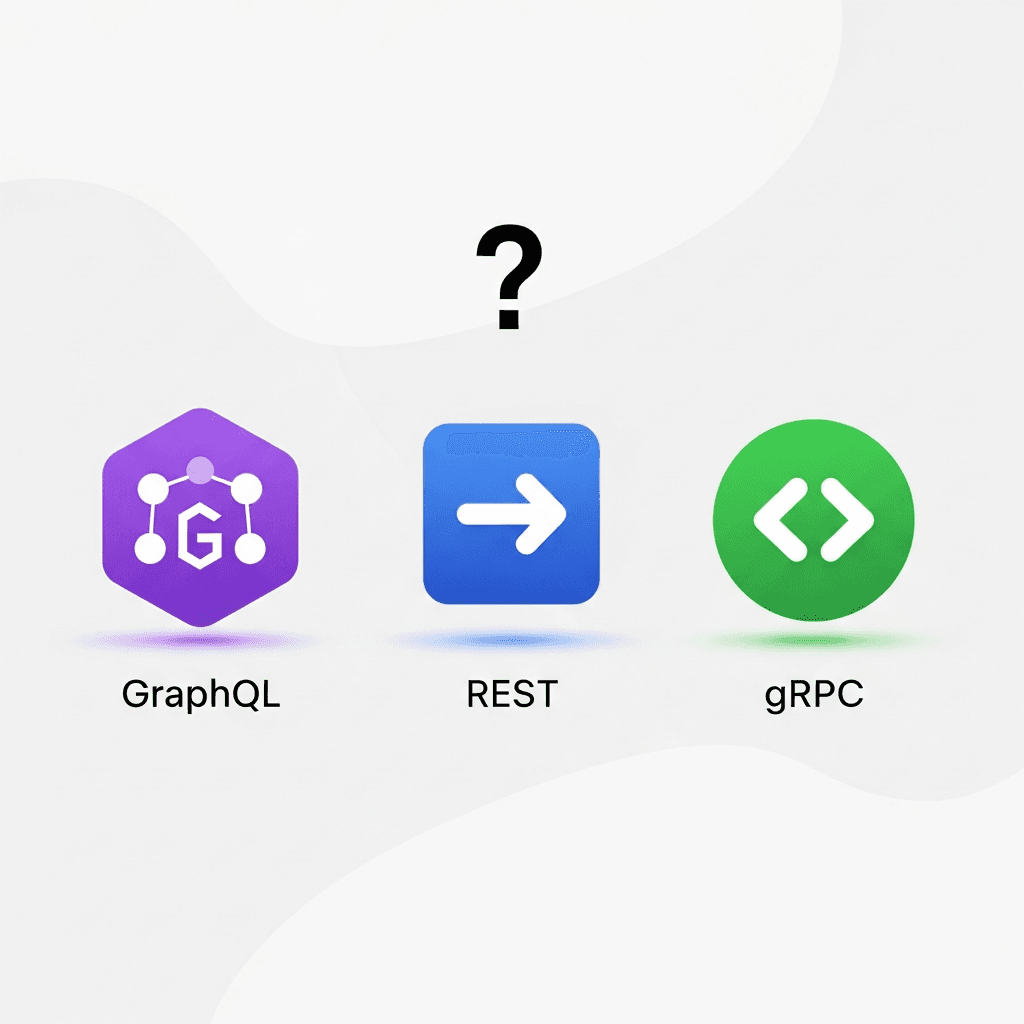
In the rapidly evolving landscape of software development, choosing the right API (Application Programming Interface) paradigm is a foundational decision that impacts everything from development speed and application performance to scalability and maintainability. For years, REST (Representational State Transfer) has been the dominant standard, known for its simplicity and ubiquity. However, as applications grow more complex and client-side data needs become more dynamic, newer paradigms like GraphQL and gRPC have emerged, each offering distinct advantages.
This comprehensive guide will dissect GraphQL, REST, and gRPC, exploring their core principles, strengths, weaknesses, and ideal use cases. By the end, you'll have a clear framework for evaluating which API paradigm best fits your project's specific requirements.
Prerequisites
To fully grasp the concepts discussed, a basic understanding of:
- HTTP protocols (GET, POST, PUT, DELETE)
- JSON and XML data formats
- Client-server architecture
- General programming concepts
Understanding REST (Representational State Transfer)
REST, introduced by Roy Fielding in 2000, is an architectural style for networked applications. It leverages standard HTTP methods and is built around resources, which are identified by URLs. The core idea is that resources can be manipulated using a uniform, stateless interface.
Core Principles of REST
- Client-Server: Separation of concerns between the client and the server.
- Stateless: Each request from client to server must contain all the information needed to understand the request. The server should not store any client context between requests.
- Cacheable: Responses must explicitly or implicitly define themselves as cacheable to prevent clients from reusing stale data.
- Layered System: A client cannot ordinarily tell whether it is connected directly to the end server, or to an intermediary.
- Uniform Interface: Simplifies and decouples the architecture, allowing independent evolution of parts.
- Resource Identification: Resources are identified by URIs.
- Resource Manipulation through Representations: Clients interact with resources using representations (e.g., JSON, XML).
- Self-descriptive Messages: Each message includes enough information to describe how to process the message.
- HATEOAS (Hypermedia As The Engine Of Application State): The client interacts with the application entirely through hypermedia provided dynamically by server-side applications.
Pros of REST
- Simplicity and Ubiquity: Easy to understand and widely adopted, making it a low barrier to entry.
- Browser Compatibility: Works seamlessly with web browsers and standard HTTP clients.
- Caching: Leverages standard HTTP caching mechanisms (ETags, Last-Modified) for improved performance.
- Statelessness: Simplifies server design and improves scalability.
- Tooling: Rich ecosystem of tools, libraries, and frameworks.
Cons of REST
- Over-fetching/Under-fetching: Clients often receive more data than needed (over-fetching) or need to make multiple requests to get all necessary data (under-fetching).
- Multiple Round Trips: Complex UIs often require fetching data from several endpoints, leading to increased latency.
- Versioning Challenges: Evolving APIs can be tricky, often requiring URI versioning (e.g.,
/v1/users,/v2/users). - Lack of Strong Typing: No inherent type system, leading to potential runtime errors if contract isn't strictly followed.
REST Code Example (Node.js/Express)
Let's imagine a simple API for managing users.
// server.js
const express = require('express');
const app = express();
const PORT = 3000;

app.use(express.json()); // For parsing application/json

let users = [
  { id: '1', name: 'Alice', email: 'alice@example.com' },
  { id: '2', name: 'Bob', email: 'bob@example.com' }
];

// GET all users
app.get('/api/users', (req, res) => {
  res.json(users);
});

// GET a single user by ID
app.get('/api/users/:id', (req, res) => {
  const user = users.find(u => u.id === req.params.id);
  if (user) {
    res.json(user);
  } else {
    res.status(404).send('User not found');
  }
});

// POST a new user
app.post('/api/users', (req, res) => {
  const newUser = { id: String(users.length + 1), ...req.body };
  users.push(newUser);
  res.status(201).json(newUser);
});

// PUT (update) a user
app.put('/api/users/:id', (req, res) => {
  const index = users.findIndex(u => u.id === req.params.id);
  if (index !== -1) {
    users[index] = { ...users[index], ...req.body };
    res.json(users[index]);
  } else {
    res.status(404).send('User not found');
  }
});

// DELETE a user
app.delete('/api/users/:id', (req, res) => {
  const initialLength = users.length;
  users = users.filter(u => u.id !== req.params.id);
  if (users.length < initialLength) {
    res.status(204).send(); // No Content
  } else {
    res.status(404).send('User not found');
  }
});

app.listen(PORT, () => {
  console.log(`REST API running on http://localhost:${PORT}`);
});
Understanding GraphQL
GraphQL, developed by Facebook in 2012 and open-sourced in 2015, is a query language for APIs and a runtime for fulfilling those queries with your existing data. It allows clients to request exactly the data they need, nothing more and nothing less, solving the over-fetching and under-fetching problems prevalent in REST.
Core Concepts of GraphQL
- Schema Definition Language (SDL): Defines the API's data structure, types, and operations (queries, mutations, subscriptions).
- Types: Strong type system ensures clients and servers agree on data shapes.
- Queries: For fetching data. Clients specify fields, and the server responds with a JSON object matching the query's shape.
- Mutations: For modifying data (create, update, delete).
- Subscriptions: For real-time data updates, typically implemented over WebSockets.
- Resolvers: Functions that fetch the actual data for each field in the schema.
- Single Endpoint: Unlike REST, GraphQL typically exposes a single HTTP endpoint (e.g.,
/graphql) for all operations.
Pros of GraphQL
- Efficient Data Fetching: Clients request precisely what they need, eliminating over-fetching and under-fetching.
- Fewer Round Trips: A single query can fetch data from multiple resources, reducing network overhead.
- Strongly Typed Schema: Provides clear contract between client and server, enabling auto-completion, validation, and improved developer experience.
- API Evolution: Adding new fields to types doesn't break existing queries, making API evolution easier.
- Real-time Capabilities: Subscriptions provide a powerful way to implement real-time features.
- Client-driven Development: Empowers frontend teams to iterate faster without waiting for backend changes.
Cons of GraphQL
- Complexity: Can have a steeper learning curve for both backend and frontend developers.
- N+1 Problem: Without proper optimization (e.g., DataLoader), fetching related data can lead to many database calls.
- Caching Challenges: Traditional HTTP caching is less effective due to the single endpoint and dynamic queries. Caching often needs to be implemented at the application level.
- File Uploads: Not natively supported by the GraphQL specification; typically handled via multipart HTTP requests or separate REST endpoints.
- Rate Limiting: More complex to implement than in REST, where each endpoint can be limited individually.
GraphQL Code Example (Node.js/Apollo Server)
// server.js
const { ApolloServer, gql } = require('apollo-server');

// 1. Define your schema using GraphQL SDL
const typeDefs = gql`
  type User {
    id: ID!
    name: String!
    email: String
    posts: [Post]
  }

  type Post {
    id: ID!
    title: String!
    content: String
    author: User
  }

  type Query {
    users: [User]
    user(id: ID!): User
    posts: [Post]
  }

  type Mutation {
    createUser(name: String!, email: String): User
    updateUser(id: ID!, name: String, email: String): User
  }
`;

// Mock data
let users = [
  { id: '1', name: 'Alice', email: 'alice@example.com' },
  { id: '2', name: 'Bob', email: 'bob@example.com' }
];
let posts = [
  { id: '101', title: 'GraphQL Basics', content: '...', authorId: '1' },
  { id: '102', title: 'REST vs GraphQL', content: '...', authorId: '2' }
];

// 2. Implement resolvers to fetch data for the schema fields
const resolvers = {
  Query: {
    users: () => users,
    user: (parent, { id }) => users.find(user => user.id === id),
    posts: () => posts
  },
  Mutation: {
    createUser: (parent, { name, email }) => {
      const newUser = { id: String(users.length + 1), name, email };
      users.push(newUser);
      return newUser;
    },
    updateUser: (parent, { id, name, email }) => {
      const userIndex = users.findIndex(user => user.id === id);
      if (userIndex === -1) return null;
      users[userIndex] = { ...users[userIndex], ...(name && { name }), ...(email && { email }) };
      return users[userIndex];
    }
  },
  User: {
    // Resolver for 'posts' field on 'User' type
    posts: (parent) => posts.filter(post => post.authorId === parent.id)
  },
  Post: {
    // Resolver for 'author' field on 'Post' type
    author: (parent) => users.find(user => user.id === parent.authorId)
  }
};

// 3. Create an Apollo Server instance
const server = new ApolloServer({ typeDefs, resolvers });

// 4. Start the server
server.listen().then(({ url }) => {
  console.log(`GraphQL Server ready at ${url}`);
});
Example GraphQL Query:
query GetUserAndPosts {
  user(id: "1") {
    id
    name
    email
    posts {
      id
      title
    }
  }
}
Understanding gRPC
gRPC (Google Remote Procedure Call) is a modern, high-performance, open-source RPC framework developed by Google. It uses Protocol Buffers as its Interface Definition Language (IDL) and HTTP/2 for transport. gRPC is designed for efficient communication between services, especially in microservices architectures.
Core Concepts of gRPC
- Protocol Buffers (Protobuf): A language-agnostic, platform-agnostic, extensible mechanism for serializing structured data. It's much more efficient than JSON or XML for data serialization.
- HTTP/2: Provides multiplexing (multiple concurrent requests over a single connection), header compression, and server push, leading to significant performance improvements over HTTP/1.1.
- Service Definition: Defined in
.protofiles, specifying RPC methods, their request, and response message types. - Client/Server Stubs: Protobuf compilers generate client-side stubs (proxies) and server-side interfaces (skeletons) in various languages, simplifying communication.
- Streaming: Supports four types of service methods:
- Unary RPC: A single request and a single response (like a traditional function call).
- Server Streaming RPC: Client sends a request, server sends back a sequence of responses.
- Client Streaming RPC: Client sends a sequence of messages, server sends back a single response.
- Bidirectional Streaming RPC: Both client and server send a sequence of messages independently.
Pros of gRPC
- High Performance: Leverages HTTP/2 and Protobuf for efficient serialization and transport, resulting in lower latency and higher throughput.
- Efficient Payload: Protobuf's binary serialization is significantly smaller than JSON or XML.
- Strongly Typed: Protobuf definitions enforce strict contracts between services, preventing runtime errors and aiding code generation.
- Multi-language Support: Code generation for numerous languages ensures seamless integration across polyglot microservices.
- Streaming Capabilities: Excellent for real-time applications requiring continuous data flow.
- Built-in Features: Supports authentication, load balancing, health checks, and more.
Cons of gRPC
- Browser Incompatibility: Browsers do not directly support HTTP/2 features required by gRPC. A proxy (e.g., gRPC-Web) is needed for browser-based clients.
- Steeper Learning Curve: Requires understanding Protobuf, HTTP/2, and RPC concepts.
- Human Readability: Protobuf's binary format is not human-readable, making debugging more challenging without specialized tools.
- Tooling Maturity: While growing, the ecosystem and tooling might not be as mature or widespread as REST's.
- Limited for Public APIs: Less suitable for public-facing APIs due to browser limitations and the need for client-side code generation.
gRPC Code Example (Go)
First, define the service and messages in a .proto file:
// user.proto
syntax = "proto3";

package user;

option go_package = ".;user";

// The User service definition.
service UserService {
  // Sends a greeting
  rpc GetUser (GetUserRequest) returns (UserResponse) {}
  rpc CreateUser (CreateUserRequest) returns (UserResponse) {}
}

// The request message containing the user's ID.
message GetUserRequest {
  string id = 1;
}

// The request message containing user details for creation.
message CreateUserRequest {
  string name = 1;
  string email = 2;
}

// The response message containing user details.
message UserResponse {
  string id = 1;
  string name = 2;
  string email = 3;
}
Next, generate Go code from the .proto file using protoc:
protoc --go_out=. --go_opt=paths=source_relative --go-grpc_out=. --go-grpc_opt=paths=source_relative user.proto
Then, implement the server and client:
// server.go
package main

import (
	"context"
	"log"
	"net"

	"google.golang.org/grpc"
	pb "./user" // Generated protobuf package
)

type server struct {
	pbs.UnimplementedUserServiceServer
	users map[string]*pb.UserResponse
	nextID int
}

func (s *server) GetUser(ctx context.Context, in *pb.GetUserRequest) (*pb.UserResponse, error) {
	log.Printf("Received: %v", in.GetId())
	if user, ok := s.users[in.GetId()]; ok {
		return user, nil
	}
	return nil, grpc.Errorf(grpc.CodeNotFound, "User not found")
}

func (s *server) CreateUser(ctx context.Context, in *pb.CreateUserRequest) (*pb.UserResponse, error) {
	log.Printf("Received CreateUser request for name: %s, email: %s", in.GetName(), in.GetEmail())
	s.nextID++
	id := strconv.Itoa(s.nextID)
	newUser := &pb.UserResponse{Id: id, Name: in.GetName(), Email: in.GetEmail()}
	s.users[id] = newUser
	return newUser, nil
}

func main() {
	lis, err := net.Listen("tcp", ":50051")
	if err != nil {
		log.Fatalf("failed to listen: %v", err)
	}
	s := grpc.NewServer()
	pbs.RegisterUserServiceServer(s, &server{users: make(map[string]*pb.UserResponse), nextID: 0})
	log.Printf("server listening at %v", lis.Addr())
	if err := s.Serve(lis); err != nil {
		log.Fatalf("failed to serve: %v", err)
	}
}// client.go
package main
import (
"context"
"log"
"time"
"google.golang.org/grpc"
"google.golang.org/grpc/credentials/insecure"
pb "./user" // Generated protobuf package
)
func main() {
conn, err := grpc.Dial("localhost:50051", grpc.WithTransportCredentials(insecure.NewCredentials()))
if err != nil {
log.Fatalf("did not connect: %v", err)
}
defer conn.Close()
c := pbs.NewUserServiceClient(conn)
ctx, cancel := context.WithTimeout(context.Background(), time.Second)
defer cancel()
// Create a user
createUserResp, err := c.CreateUser(ctx, &pb.CreateUserRequest{Name: "Charlie", Email: "charlie@example.com"})
if err != nil {
log.Fatalf("could not create user: %v", err)
}
log.Printf("Created User: %s", createUserResp.GetId())
// Get the created user
r, err := c.GetUser(ctx, &pb.GetUserRequest{Id: createUserResp.GetId()})
if err != nil {
log.Fatalf("could not get user: %v", err)
}
log.Printf("User: %s %s %s", r.GetId(), r.GetName(), r.GetEmail())
}Key Comparison Criteria
When deciding between these three paradigms, consider the following aspects:
1. Data Fetching Efficiency
- REST: Prone to over-fetching (getting more data than needed) or under-fetching (requiring multiple requests).
- GraphQL: Highly efficient. Clients explicitly define the data structure and fields they need, eliminating unnecessary data transfer.
- gRPC: Efficient due to binary Protobuf serialization, but the entire predefined message structure is sent, not a subset.
2. Performance & Latency
- REST: Uses HTTP/1.1 (typically), which can suffer from head-of-line blocking. JSON payloads can be verbose.
- GraphQL: Uses HTTP/1.1 or HTTP/2. JSON payloads can be smaller than REST due to precise fetching, but still text-based.
- gRPC: Built on HTTP/2 for multiplexing and binary Protobuf for serialization, leading to superior performance, lower latency, and reduced bandwidth usage, especially in high-throughput scenarios.
3. Developer Experience
- REST: Very mature, extensive tooling, easy to get started. Manual documentation can be a pain.
- GraphQL: Strong type system and introspection capabilities enable excellent tooling (e.g., GraphiQL, Apollo Client). Steeper initial learning curve.
- gRPC: Requires learning Protocol Buffers and specific tooling for code generation. Debugging binary payloads can be challenging. Good for polyglot environments with generated client/server stubs.
4. Schema & Type Safety
- REST: No inherent schema or type safety. Relies on external documentation (e.g., OpenAPI/Swagger) and developer discipline.
- GraphQL: Strong, explicit schema definition (SDL) provides a clear contract and compile-time validation.
- gRPC: Strongly typed via Protocol Buffers, ensuring strict data contracts and enabling code generation in multiple languages.
5. Caching
- REST: Leverages standard HTTP caching mechanisms (ETags, Last-Modified, Cache-Control headers) effectively at the network level.
- GraphQL: Due to the single endpoint and dynamic queries, traditional HTTP caching is less effective. Requires application-level caching solutions (e.g., Apollo Client's normalized cache).
- gRPC: Caching is typically handled at the application or proxy layer, as HTTP/2 streams are persistent and less suited for traditional HTTP caching.
6. Real-time Capabilities
- REST: Not inherently real-time. Typically achieved through polling or WebSockets as a separate mechanism.
- GraphQL: Built-in subscriptions provide robust real-time capabilities over WebSockets.
- gRPC: Excellent support for various streaming patterns (server, client, bidirectional streaming) over HTTP/2, making it ideal for real-time communication.
7. Browser Compatibility
- REST: Fully compatible with all web browsers, no special clients needed.
- GraphQL: Fully compatible with web browsers, standard HTTP POST requests.
- gRPC: Not directly compatible with browsers. Requires a proxy (e.g., gRPC-Web) to translate browser HTTP/1.1 requests into gRPC calls.
8. Ecosystem & Community
- REST: Largest and most mature ecosystem, abundant resources, tools, and community support.
- GraphQL: Rapidly growing ecosystem, strong community, and robust tools (Apollo, Relay).
- gRPC: Growing, particularly strong in microservices and cloud-native environments, supported by Google and a strong open-source community.
Use Cases: When to Choose REST
REST remains an excellent choice for many scenarios:
- Simple CRUD Operations: When your API primarily deals with standard create, read, update, delete operations on well-defined resources.
- Public APIs: Its simplicity, ubiquity, and browser compatibility make it ideal for public-facing APIs where ease of consumption is paramount.
- Resource-Oriented Data: When your data model naturally maps to resources (e.g.,
/users,/products,/orders). - Existing Infrastructure: If your team and infrastructure are already heavily invested in REST, it's often more practical to continue using it.
- Loose Coupling: When you need maximum decoupling between client and server, and the client's data needs are relatively stable.
Use Cases: When to Choose GraphQL
GraphQL shines in situations demanding flexibility and efficiency:
- Complex and Evolving UIs: Ideal for applications with diverse client needs (web, mobile, IoT) or rapidly changing UI requirements, as clients can adapt their data requests dynamically.
- Aggregating Data from Multiple Sources: When building a gateway that unifies data from various microservices or legacy systems into a single, cohesive API.
- Mobile Applications: Minimizes data transfer and network requests, crucial for mobile clients operating on limited bandwidth or battery.
- Frontend-Driven Development: Empowers frontend teams to develop features faster by giving them control over data fetching without backend changes.
- Real-time Dashboards/Feeds: With subscriptions, it's a strong contender for applications requiring live updates.
Use Cases: When to Choose gRPC
gRPC excels in high-performance, internal communication scenarios:
- High-Performance Microservices Communication: The primary use case. For inter-service communication where low latency, high throughput, and efficient serialization are critical.
- Polyglot Environments: When you have services written in different programming languages, gRPC's code generation simplifies cross-language communication.
- Real-time Streaming Services: Ideal for applications requiring continuous data streams, such as live data feeds, chat applications, or IoT device communication.
- Low-Latency, High-Throughput APIs: For internal APIs that demand maximum performance and minimal overhead.
- Strict Contracts: When you need strong type enforcement and compile-time validation between services.
Best Practices & Anti-Patterns
REST Best Practices
- Use Standard HTTP Methods:
GETfor retrieval,POSTfor creation,PUT/PATCHfor updates,DELETEfor removal. - Resource-Oriented URLs: Nouns, not verbs (e.g.,
/users, not/getUsers). - Proper Status Codes: Use appropriate HTTP status codes (2xx for success, 4xx for client errors, 5xx for server errors).
- HATEOAS: Include links in responses to guide clients through the API, though often overlooked in practice.
- Versioning: Implement a clear versioning strategy (e.g.,
/v1/users).
REST Anti-Pattern: Treating REST as "RPC over HTTP" by using only POST requests to a single endpoint or creating action-oriented endpoints like /calculatePrice instead of resource-oriented ones.
GraphQL Best Practices
- Schema First Development: Design your schema carefully before implementing resolvers.
- Use DataLoader: Mitigate the N+1 problem by batching and caching database requests.
- Authentication & Authorization: Implement robust security at the resolver level.
- Persistent Queries: For production, consider using persistent queries to improve caching and security.
- Error Handling: Define custom error types in your schema for clearer client-side error handling.
GraphQL Anti-Pattern: Exposing your database schema directly without proper abstraction, leading to tight coupling and potential security vulnerabilities.
gRPC Best Practices
- Clear Protobuf Definitions: Keep
.protofiles well-organized and clearly define messages and services. - Idempotent RPCs: Design RPCs to be idempotent where possible, especially for mutations, to handle retries gracefully.
- Error Handling: Use gRPC status codes for consistent error reporting.
- Connection Pooling: For clients, manage connections efficiently using connection pools.
- Monitoring & Tracing: Implement robust logging, monitoring, and distributed tracing for gRPC services.
gRPC Anti-Pattern: Over-complicating .proto files with excessive nesting or overly generic messages, making them hard to understand and maintain.
Common Pitfalls to Avoid
- Choosing a Paradigm Based on Hype: Don't pick a technology just because it's new or popular. Evaluate its fit for your project.
- Ignoring Security: Regardless of the paradigm, robust authentication, authorization, and input validation are critical.
- Poor Documentation: An API without clear, up-to-date documentation is unusable. Use tools like OpenAPI (for REST), GraphQL Playground (for GraphQL), or generated docs (for gRPC).
- Premature Optimization: Don't jump to gRPC for a simple internal service if REST or GraphQL would suffice and be quicker to implement.
- Lack of Monitoring: Without proper monitoring, you won't know how your API is performing or when issues arise.
- Ignoring Client Needs: Always consider who will be consuming your API and what their development experience will be like.
Hybrid Approaches
It's important to note that these paradigms are not mutually exclusive. Many organizations successfully employ a hybrid approach:
- REST for Public APIs, gRPC for Internal Microservices: A common pattern where external clients use the easy-to-consume REST API, while internal services benefit from gRPC's performance.
- GraphQL as an API Gateway over REST/gRPC Backends: A GraphQL layer can sit in front of existing REST or gRPC services, providing a unified, flexible API for frontend clients.
- Dedicated REST for File Uploads/Downloads: For specific resource-intensive tasks like large file transfers, a dedicated REST endpoint might be more straightforward than trying to shoehorn it into GraphQL or gRPC.
Conclusion
The choice between GraphQL, REST, and gRPC is not about identifying a single "best" solution, but rather about selecting the most appropriate tool for your specific architectural needs and project constraints. Each paradigm offers a unique set of trade-offs.
- Choose REST for simplicity, broad compatibility, and when your data model aligns well with resource-oriented access, especially for public-facing APIs or simple CRUD applications.
- Opt for GraphQL when you need maximum data fetching flexibility, efficient data transfer for diverse clients (especially mobile), and rapid UI development, often serving as an API gateway.
- Select gRPC for high-performance, low-latency inter-service communication in microservices architectures, polyglot environments, and applications requiring real-time streaming.
Carefully evaluate your project's requirements, team's expertise, performance goals, and future scalability needs. A well-informed decision at this stage will lay a strong foundation for your application's success.

Written by
CodewithYohaFull-Stack Software Engineer with 7+ years of experience in Java, Spring Boot, and cloud architecture across AWS, Azure, and GCP. Writing production-grade engineering patterns for developers who ship real software.