Introduction
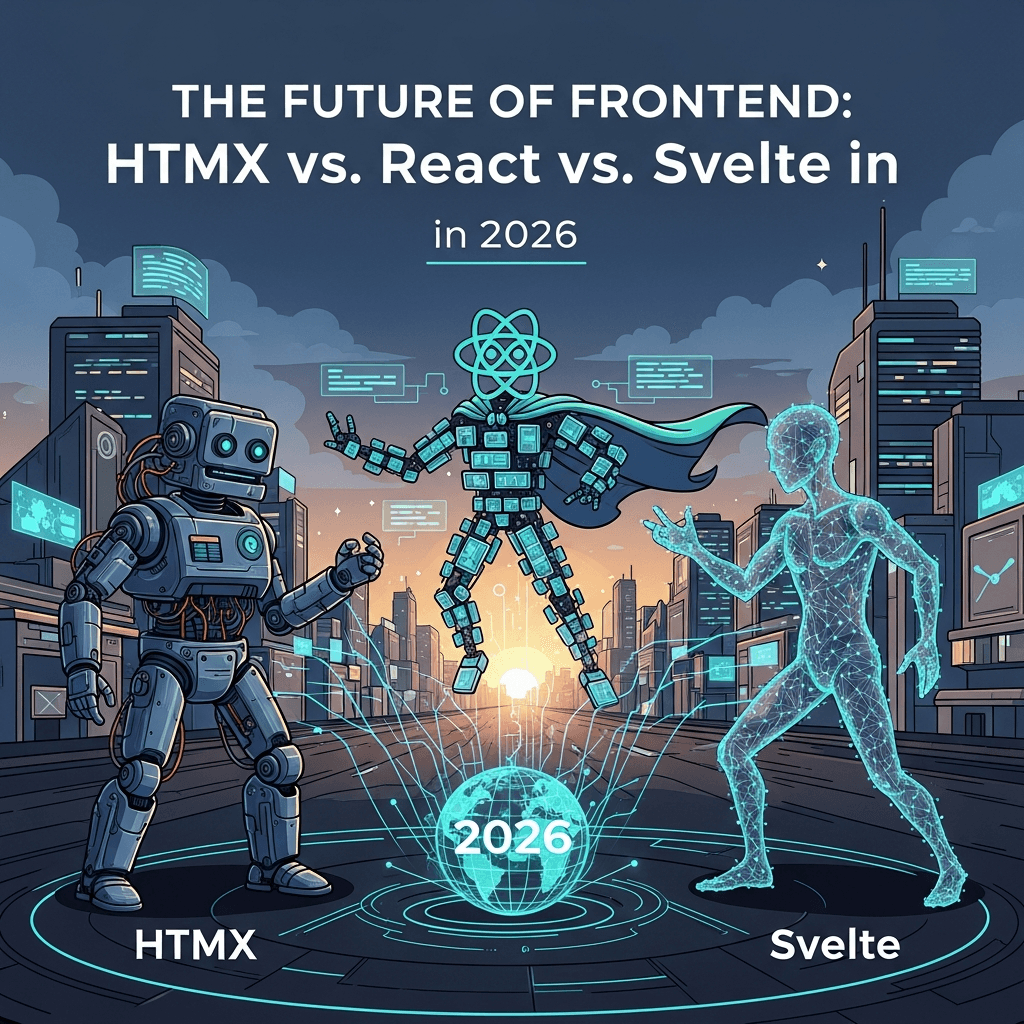
The frontend development landscape is in a perpetual state of evolution, characterized by a vibrant interplay between established giants, innovative challengers, and a renewed interest in simpler paradigms. As we peer into 2026, the choices developers make today will shape the web experiences of tomorrow. This article delves into three prominent contenders – React, Svelte, and HTMX – dissecting their current standing, projecting their future trajectories, and providing a comprehensive guide to help you navigate their strengths, weaknesses, and ideal use cases in the coming years.
For decades, the frontend world has largely gravitated towards complex JavaScript frameworks to build Single Page Applications (SPAs). React, with its vast ecosystem and Facebook backing, has dominated this era. However, the pendulum is swinging. Svelte emerged as a compiler-driven alternative, promising unparalleled performance and a delightful developer experience by shifting work from runtime to compile time. Concurrently, HTMX represents a radical re-evaluation, advocating for a hypermedia-driven approach that minimizes client-side JavaScript, leveraging the power of HTML and server-side rendering.
In 2026, the question won't be about a single victor, but rather understanding which tool is best suited for a particular problem. This guide aims to equip you with the insights needed to make informed decisions, whether you're building a complex enterprise application, a performance-critical interactive experience, or a robust content-heavy website.
Prerequisites
To fully grasp the concepts discussed in this article, a foundational understanding of the following is recommended:
- HTML, CSS, and JavaScript: The core building blocks of the web.
- Web Development Concepts: Basic knowledge of client-server architecture, HTTP requests, and rendering processes.
- Familiarity with Modern Frontend: An awareness of concepts like SPAs, component-based architecture, and build tools.
The Modern Frontend Landscape (2024 Context)
The current frontend scene is a tapestry of diverse approaches. SPAs, primarily built with frameworks like React, Angular, and Vue, offer rich, app-like experiences, often at the cost of initial load times and JavaScript bundle sizes. Server-Side Rendering (SSR) and Static Site Generation (SSG) have gained prominence to mitigate these issues, providing faster initial loads and better SEO. Meta-frameworks like Next.js (React), Nuxt.js (Vue), and SvelteKit (Svelte) encapsulate these patterns, offering full-stack capabilities.
Alongside this, there's a growing movement towards simpler, more performant web experiences, often inspired by the early web's elegance. This is where tools like HTMX find their footing, challenging the assumption that every interactive web application requires a heavy client-side JavaScript framework. The focus is shifting from "how much JavaScript can we add?" to "how little JavaScript do we actually need?".
React: The Established Giant (2026 Perspective)
React's dominance since its inception has been undeniable. Its component-based architecture, declarative syntax, and vast ecosystem have made it the go-to choice for countless developers and enterprises. In 2026, React will continue to be a powerhouse, but its evolution will be marked by a significant shift towards server-centric paradigms.
Strengths:
- Massive Ecosystem & Community: Unmatched libraries, tools, and community support.
- Developer Talent Pool: The largest pool of skilled developers, making hiring easier.
- Flexibility: Can be used for SPAs, SSR, SSG, mobile (React Native), and desktop apps.
- Maturity: Battle-tested in countless production environments.
- Server Components (RSC): A game-changer for performance and bundle size, allowing components to render on the server and stream HTML/JS to the client.
Challenges:
- Bundle Size: Can still be substantial, especially for complex applications, though RSC aims to mitigate this.
- Learning Curve: Can be steep for newcomers, especially with modern React patterns (hooks, context, state management libraries).
- Boilerplate: Can require more setup and configuration compared to simpler alternatives.
- "JavaScript Fatigue": The sheer volume of tools and approaches can be overwhelming.
Future in 2026:
By 2026, React Server Components (RSC) will likely be a mature and widely adopted pattern, fundamentally changing how developers build React applications. This will enable React to tackle performance and bundle size concerns more effectively, blurring the lines between client and server rendering. We'll see React solidify its position in complex enterprise applications, data-intensive dashboards, and highly interactive SPAs, with a strong emphasis on full-stack frameworks like Next.js.
Code Example (React Component with State):
// components/Counter.jsx
import React, { useState } from 'react';

function Counter() {
  const [count, setCount] = useState(0);

  const increment = () => {
    setCount(prevCount => prevCount + 1);
  };

  const decrement = () => {
    setCount(prevCount => prevCount - 1);
  };

  return (
    <div className="counter-widget">
      <h2>React Counter</h2>
      <p>Current count: {count}</p>
      <button onClick={decrement}>-</button>
      <button onClick={increment}>+</button>
      {/*
        In 2026, this might be a Server Component for initial render,
        then hydrate client-side for interactivity.
      */}
    </div>
  );
}

export default Counter;
Svelte: The Compiler's Edge (2026 Perspective)
Svelte distinguishes itself by being a compiler, not a runtime framework. It processes your components at build time, generating highly optimized vanilla JavaScript. This approach results in incredibly small bundle sizes and exceptional performance, as there's no virtual DOM or framework overhead to ship to the browser.
Strengths:
- True Reactivity: No need for
useStateoruseEffect; reactivity is built into the language itself with simple assignments. - No Virtual DOM: Directly updates the DOM, leading to faster runtime performance.
- Small Bundle Size: Generates minimal JavaScript, ideal for performance-critical applications and mobile.
- Developer Experience: Simple, intuitive syntax (HTML, CSS, JS in a single file), often described as "just writing HTML, CSS, and JS."
- SvelteKit: A powerful meta-framework for building full-stack applications with SSR, SSG, and API routes.
Challenges:
- Smaller Ecosystem: While growing rapidly, it's still smaller than React's, potentially requiring more custom solutions.
- Learning Curve for Paradigm Shift: While syntax is simple, understanding the compiler-driven reactivity can be different for those used to virtual DOM frameworks.
- Tooling Maturity: Tooling is excellent but might not have the same breadth or depth as React's highly mature ecosystem.
Future in 2026:
Svelte's adoption will continue to grow steadily, particularly for projects where performance and bundle size are paramount. SvelteKit will be a fully mature and highly competitive full-stack framework, challenging Next.js in many areas. We'll see Svelte become a strong contender for building embedded widgets, interactive components within existing sites, performance-sensitive SPAs, and even complex applications where development velocity and final output size are critical. Its simplicity and performance will appeal to a broader range of developers and businesses.
Code Example (Svelte Component):
<!-- src/lib/Counter.svelte -->
<script>
  let count = 0; // Reactive variable

  function increment() {
    count += 1; // Direct assignment triggers reactivity
  }

  function decrement() {
    count -= 1;
  }
</script>

<div class="counter-widget">
  <h2>Svelte Counter</h2>
  <p>Current count: {count}</p>
  <button on:click={decrement}>-</button>
  <button on:click={increment}>+</button>
  <!--
    Svelte compiles this into highly optimized vanilla JS.
    No runtime framework shipped to the browser.
  -->
</div>

<style>
  .counter-widget {
    border: 1px solid #ccc;
    padding: 1em;
    border-radius: 8px;
  }
  button {
    margin: 0.5em;
    padding: 0.5em 1em;
  }
</style>
HTMX: Back to Basics, But Better (2026 Perspective)
HTMX is not a JavaScript framework in the traditional sense. It's a small, dependency-free JavaScript library that allows you to access modern browser features (like AJAX, CSS Transitions, WebSockets, and Server Sent Events) directly from HTML, using attributes. It champions the hypermedia model, where the server dictates the UI changes by sending HTML fragments, rather than JSON data.
Strengths:
- Extreme Simplicity: Minimal client-side JavaScript, leveraging browser's native capabilities.
- Small Footprint: Tiny library size, resulting in extremely fast initial loads.
- Leverages Existing Server-Side Logic: Works seamlessly with any server-side language (Python, Ruby, PHP, Go, C#, Java, etc.).
- Developer Productivity: Focuses on server-side rendering, allowing full-stack developers to work faster with familiar patterns.
- Progressive Enhancement: Enhances existing HTML, making it robust and accessible by default.
- Reduced Complexity: Eliminates the need for client-side routing, state management, and build processes for many applications.
Challenges:
- Server-Side Coupling: Requires a tight coupling with the server for all interactive updates.
- Complex Client-Side State: Not designed for highly interactive, client-side heavy UIs (e.g., drag-and-drop editors, complex animations) where a full JS framework excels.
- Paradigm Shift: Requires frontend developers used to SPAs to think in a hypermedia-driven way.
- Less Client-Side Control: Less direct programmatic control over the DOM compared to JS frameworks.
Future in 2026:
HTMX will continue its impressive growth, becoming a default choice for a specific, yet broad, category of web applications. It will be the preferred tool for content-heavy sites, CRUD applications, forms, dashboards that primarily display data, and micro-frontends where isolated components need to interact with the server. Its adoption will be driven by teams prioritizing simplicity, performance, and leveraging existing server-side expertise. We'll see more advanced server-side frameworks offering first-class HTMX integration, and a clearer understanding of when to use HTMX as the primary interaction layer versus when to use it alongside a small amount of Alpine.js or a full-blown framework for specific, complex widgets.
Code Example (HTMX Interaction):
<!-- index.html (or a server-rendered template) -->
<!DOCTYPE html>
<html lang="en">
<head>
    <meta charset="UTF-8">
    <meta name="viewport" content="width=device-width, initial-scale=1.0">
    <title>HTMX Example</title>
    <script src="https://unpkg.com/htmx.org@1.9.10"></script>
    <style>
        body { font-family: sans-serif; margin: 2em; }
        .content-area { border: 1px solid #ddd; padding: 1em; min-height: 100px; margin-top: 1em; }
    </style>
</head>
<body>
    <h1>HTMX Content Loader</h1>

    <button
        hx-get="/api/message"
        hx-target=".content-area"
        hx-swap="innerHTML"
    >
        Load Message from Server
    </button>

    <button
        hx-post="/api/counter/increment"
        hx-target="#counter-display"
        hx-swap="innerHTML"
    >
        Increment Server Counter
    </button>

    <div class="content-area">Click a button to load content.</div>

    <p>Server-side Counter: <span id="counter-display">0</span></p>

    <!--
        Server-side endpoints (/api/message, /api/counter/increment)
        would return plain HTML fragments.
        e.g., /api/message might return: "<p>Hello from the server at {timestamp}!</p>"
        e.g., /api/counter/increment might return: "<span>1</span>"
    -->
</body>
</html>
Architectural Paradigms Compared
Understanding the fundamental architectural differences is key to choosing the right tool.
- React (and other traditional SPAs): Primarily client-side rendering (CSR). The server sends a minimal HTML shell and a large JavaScript bundle. The JavaScript then takes over, fetches data (often JSON), renders components, and manages the UI. SSR/SSG are layers on top to pre-render the initial HTML for performance and SEO, which is then 'hydrated' by client-side JavaScript.
- Svelte: Compile-time optimized. Svelte components are compiled into highly efficient vanilla JavaScript that directly manipulates the DOM. With SvelteKit, it offers a robust full-stack solution with SSR, SSG, and client-side routing, aiming for the best of both worlds without the runtime overhead.
- HTMX: Hypermedia-driven. The server remains the primary source of truth for UI state. Client-side JavaScript is minimal, acting mainly as a mechanism to trigger HTTP requests (GET, POST, PUT, DELETE) and swap HTML fragments returned by the server into the DOM. This reduces the need for complex client-side state management and routing.
Performance & Bundle Size
Performance is a critical metric for user experience and SEO. Here's how they stack up:
- React: Can be performant but requires careful optimization. Initial bundle sizes can be large, impacting Time To Interactive (TTI). React Server Components aim to significantly reduce client-side JS. Hydration costs can still be a factor.
- Svelte: Generally excellent performance due to its compilation approach. Smallest bundle sizes among the full-featured frameworks, leading to faster initial loads and TTI. No virtual DOM diffing overhead at runtime.
- HTMX: Exceptional performance for initial load and subsequent interactions. The library itself is tiny (around 14KB gzipped). Since most of the rendering happens on the server, the client only downloads small HTML fragments, resulting in very low JavaScript overhead. This is often the fastest choice for typical web interactions.
Developer Experience & Learning Curve
- React: Has a moderate to steep learning curve, especially for mastering hooks, context, and the vast ecosystem. However, once proficient, it offers immense power and flexibility. The declarative nature and JSX are generally well-liked.
- Svelte: Often praised for its excellent developer experience. The single-file component structure (HTML, CSS, JS) is intuitive, and its true reactivity simplifies state management. The learning curve is generally considered gentler for those familiar with web fundamentals.
- HTMX: Very low barrier to entry for developers comfortable with HTML and server-side logic. It feels like extending HTML. The challenge is less about learning syntax and more about adopting a different architectural mindset, moving away from client-side state management and API calls to a hypermedia-driven approach. For traditional frontend developers, this can be a significant shift.
Use Cases & Ideal Scenarios (2026)
React (with Next.js/RSC):
- Large-scale Enterprise SPAs: Complex, data-intensive applications requiring extensive client-side logic and real-time updates (e.g., SaaS platforms, internal tools).
- Highly Interactive Dashboards: Where rich data visualization and complex user interactions are central.
- Cross-platform Applications: Leveraging React Native for mobile apps alongside web.
- Applications with a large existing React codebase: Continued evolution and maintenance.
Svelte (with SvelteKit):
- Performance-critical Applications: Where every millisecond and byte counts (e.g., high-traffic marketing sites, embedded widgets, mobile-first experiences).
- Smaller to Medium-sized SPAs: Where a full-featured framework is needed but with minimal overhead.
- Interactive Components for Existing Sites: Easily drop-in Svelte components into any web page.
- Static Sites with Rich Interactivity: Leveraging SvelteKit's SSG capabilities.
HTMX:
- Content-heavy Websites: Blogs, news sites, e-commerce product pages that need dynamic updates without a full SPA.
- CRUD Applications: Forms, tables, and data entry systems where most interactions involve server updates.
- Micro-frontends: For isolated sections of a larger application that can be independently developed and deployed, leveraging server-side rendering.
- Progressive Enhancement of Traditional Web Apps: Adding dynamic capabilities to existing server-rendered applications with minimal effort.
- "Boring" Web Apps: Applications that don't require complex client-side state, prioritizing simplicity and maintainability.
Best Practices for Each (Looking to 2026)
React:
- Embrace Server Components (RSC): Prioritize rendering as much as possible on the server to reduce client-side bundle size and improve performance.
- Optimize Bundle Size: Use code splitting, lazy loading, and analyze your bundles regularly.
- Effective State Management: Choose appropriate solutions (Context API, Zustand, Jotai, Recoil) based on complexity, avoiding prop drilling.
- Strong Testing: Implement unit, integration, and end-to-end tests for stability in complex applications.
- Accessibility First: Ensure all interactive components are accessible.
Svelte:
- Leverage SvelteKit: Utilize its full-stack capabilities for routing, SSR, SSG, and API endpoints.
- Proper Store Management: Use Svelte stores (
writable,readable,derived) for global or shared state. - Component Composition: Break down complex UIs into smaller, reusable components.
- Animations and Transitions: Utilize Svelte's built-in animation system for smooth UI feedback.
- Accessibility: Svelte's simplicity makes it easier to build accessible components from the start.
HTMX:
- Design for Hypermedia: Think about server responses as HTML fragments, not JSON. The server should return exactly what the client needs to swap.
- Server-Side Validation: Perform all input validation on the server; HTMX can easily swap in validation messages.
- Security: Be mindful of XSS when injecting server-returned HTML. Always sanitize user-generated content.
- Progressive Enhancement: Ensure the application is functional even without JavaScript (or HTMX) for core functionalities.
- Minimal Client-Side JS: Use Alpine.js or vanilla JS sparingly for truly client-side-only interactions that HTMX can't handle.
Common Pitfalls & Anti-Patterns
React:
- Over-engineering Simple Features: Using complex state management or patterns for trivial components.
- Prop Drilling: Passing props through many layers of components; use Context or a state management library instead.
- Neglecting Performance: Not optimizing for bundle size, hydration, or unnecessary re-renders.
- "JavaScript Fatigue": Constantly chasing the latest library or pattern, leading to inconsistent codebases.
Svelte:
- Over-reliance on Reactivity for Complex State: While powerful, complex global state might still benefit from dedicated store patterns rather than relying solely on reactive statements.
- Ignoring SvelteKit Benefits: Building a pure Svelte SPA when SvelteKit's SSR/SSG capabilities could offer significant advantages.
- Not Understanding Component Lifecycle: Misusing
onMount,onDestroy, etc., leading to memory leaks or incorrect behavior.
HTMX:
- Trying to Build a Full SPA: HTMX is not designed for complex, client-side-heavy application logic. Trying to force it into this role will lead to frustration.
- Poor Server Response Design: Returning entire pages or malformed HTML fragments, defeating the purpose of partial updates.
- Neglecting Accessibility: Just because it's simple doesn't mean accessibility is automatic. Ensure dynamic updates are announced to screen readers.
- Security Vulnerabilities: Improperly handling server-returned HTML can introduce XSS risks.
- Over-using
hx-swap="outerHTML": While powerful, can lead to unexpected UI shifts or loss of focus if not used carefully.
The Hybrid Future (2026) – When to Mix and Match
One of the most exciting aspects of 2026 will be the increasing adoption of hybrid architectures. It's not always an "either/or" choice. For instance:
- HTMX for Core Navigation and Forms, React/Svelte for Isolated Widgets: Imagine an e-commerce site where product listings and search are handled efficiently by HTMX, but the shopping cart or a complex product configurator is a standalone React or Svelte component embedded on the page.
- SvelteKit for the Main Application, HTMX for Micro-frontends: A large application built with SvelteKit might integrate smaller, self-contained HTMX-driven modules for specific functionalities, allowing different teams to work independently with their preferred tools.
- React Server Components for Initial Render, HTMX for Subsequent Interactions: A React app could serve its initial page with RSC for maximum performance, and then use HTMX for certain localized, simple interactions (e.g., filtering a table) to reduce the client-side JavaScript needed for those specific actions.
The key is to identify the boundaries of complexity. If an interaction can be described by simple HTML attributes and a server response, HTMX is an excellent choice. If it requires complex client-side state, animations, or deep integration with browser APIs, React or Svelte are better suited.
Conclusion
The frontend landscape of 2026 will be more diverse and nuanced than ever before. The era of a single dominant framework for all use cases is fading, replaced by a sophisticated understanding of tool-to-task fit.
- React will remain the enterprise standard for complex, large-scale SPAs, with React Server Components being a transformative force for performance.
- Svelte will continue its ascent, becoming the go-to for performance-critical applications, embedded widgets, and developers who prioritize a delightful, compiler-driven experience.
- HTMX will carve out a significant niche for content-heavy sites, CRUD applications, and progressive enhancement, appealing to developers who want to leverage server-side logic and minimize client-side complexity.
The most successful teams will be those who embrace this diversity, understanding the unique strengths and weaknesses of each approach. They will build hybrid applications, meticulously selecting the right tool for each part of their system, ultimately delivering faster, more robust, and more maintainable web experiences. As you plan your frontend strategy for 2026 and beyond, remember that the best tool is the one that solves your specific problem most efficiently and elegantly, not necessarily the one with the most hype.

Written by
CodewithYohaFull-Stack Software Engineer with 7+ years of experience in Java, Spring Boot, and cloud architecture across AWS, Azure, and GCP. Writing production-grade engineering patterns for developers who ship real software.