
OT vs CRDTs: Architecting Collaborative Web Editors for Real-time

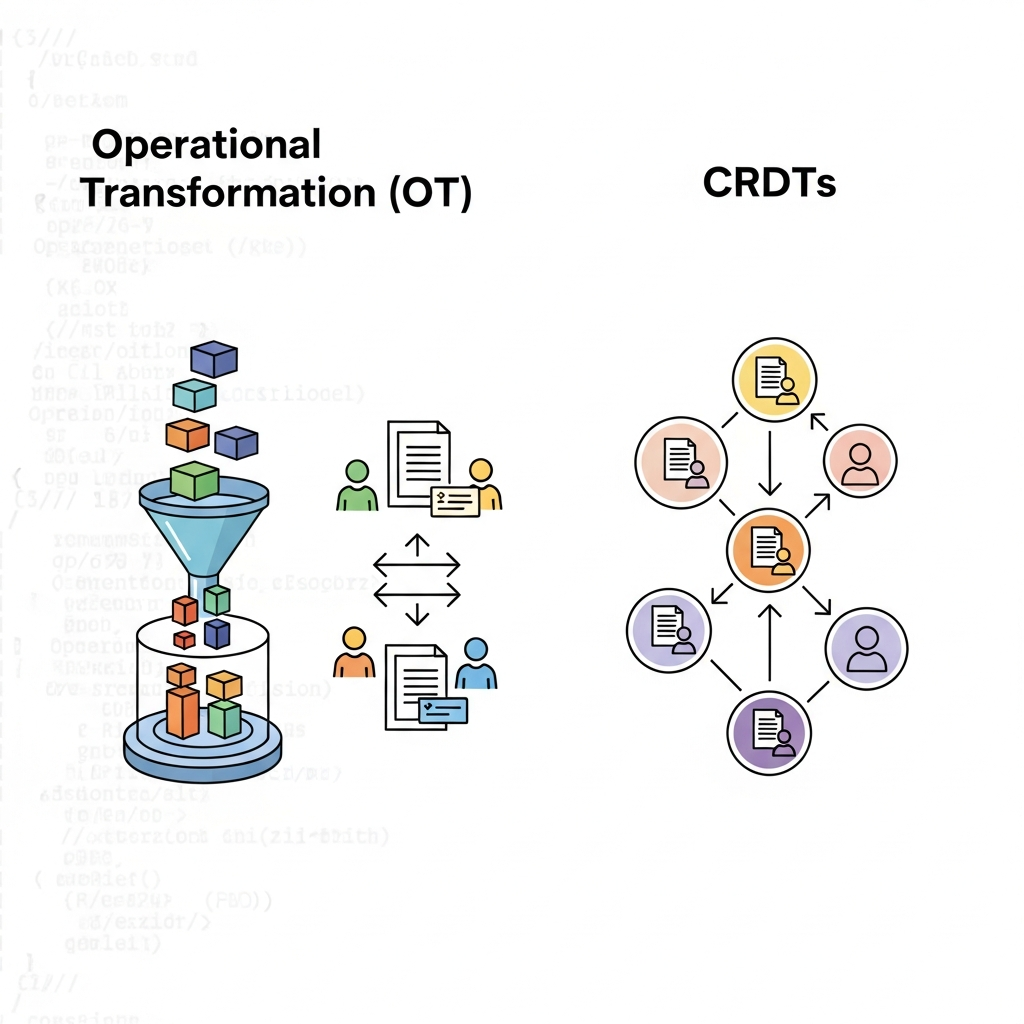
Introduction: The Quest for Seamless Collaborative Editing
In today's interconnected world, real-time collaboration is no longer a luxury but a fundamental expectation. From document editing in Google Docs to design collaboration in Figma, users demand seamless, concurrent interaction with shared content. Building such systems, however, presents a formidable challenge: how do you ensure that multiple users editing the same document simultaneously don't overwrite each other's changes, and that everyone sees a consistent, up-to-date version of the truth?
This article dives deep into the two dominant paradigms for tackling this problem in web editors: Operational Transformation (OT) and Conflict-free Replicated Data Types (CRDTs). We'll explore their underlying principles, architectural implications, practical implementations, and the trade-offs involved, equipping you with the knowledge to choose the right approach for your next collaborative project.
Prerequisites
To get the most out of this guide, a basic understanding of:
- Web development concepts: HTML, CSS, JavaScript.
- Client-server architecture: How web applications communicate.
- Distributed systems fundamentals: Concepts like concurrency, consistency, and latency.
- Data structures: Arrays, lists, and basic operations on them.
The Challenge of Real-time Collaboration: Why It's Hard
Imagine two users, Alice and Bob, editing the same sentence: "Hello world." simultaneously.
- Alice: Deletes " world."
- Bob: Inserts " awesome" after "Hello"
Without a robust mechanism, their changes could lead to inconsistent states. If Alice's deletion arrives first, Bob's insertion might happen at an invalid index. If Bob's insertion arrives first, Alice's deletion might remove the wrong characters. This is the core problem: concurrent operations arriving out of order or with stale context.
Traditional approaches like locking (preventing concurrent edits) or last-writer-wins (simply overwriting) are unacceptable for real-time collaboration. We need solutions that allow concurrent edits, resolve conflicts gracefully, and maintain a consistent document state across all participants.
Operational Transformation (OT) Explained
Operational Transformation is a set of techniques for synchronizing shared data by transforming operations. It was pioneered in the late 1980s for systems like the adams text editor and gained widespread recognition with Google Docs.
Core Concepts of OT
- Operations: Atomic changes applied to the document (e.g.,
insert(index, text),delete(index, length)). - Transformation Functions: The heart of OT. These functions adjust operations based on concurrent operations that have already been applied.
transform(op1, op2): Given two operationsop1andop2that were generated concurrently against the same document state, this function returnsop1'andop2'such that applyingop1'afterop2yields the same state as applyingop2'afterop1. This ensures commutativity.transform_against(op_to_transform, applied_op): A more common practical implementation. It transformsop_to_transformso that it can be applied correctly afterapplied_ophas already been applied to the document.
How OT Works (Server-centric Model)
In a typical OT setup, a central server is responsible for maintaining the canonical document state and coordinating operations.
- Client sends operation: When a user makes a change, the client generates an operation and sends it to the server.
- Server receives operation: The server receives the operation. It maintains a log of all operations that have been applied to the document.
- Server transforms operation: Before applying the new operation, the server transforms it against any concurrent operations that have already been applied to its canonical state but were not yet known to the originating client when it generated its operation.
- Server applies and broadcasts: After transformation, the server applies the operation to its document state and broadcasts the transformed operation to all other connected clients.
- Client applies operation: Clients receive operations from the server (either their own transformed operations or others'). They apply these operations to their local document state, typically after transforming them against any pending local operations.
This dance of transformations ensures that all clients eventually converge to the same document state, even if operations arrive out of order due to network latency.
Pros and Cons of OT
Pros:
- High-fidelity consistency: Achieves strong consistency, ensuring all users see the exact same document state in the same order.
- Precise conflict resolution: Conflicts are resolved deterministically by the transformation functions, often resulting in intuitive outcomes (e.g., insertions pushing other text).
- Established technology: Proven in large-scale applications like Google Docs.
Cons:
- Extreme complexity: Implementing correct transformation functions for rich text, cursors, and other features is notoriously difficult and error-prone. The number of transformation cases grows exponentially with operation types.
- Server dependency: Typically requires a powerful, centralized server to coordinate and transform operations, creating a single point of failure and potential latency bottleneck.
- Offline limitations: Handling offline editing is complex, as operations need to be queued and correctly transformed upon re-connection, potentially against a large backlog of server-side changes.
Simplified OT Transformation Example (Text Insertion)
Consider a simple insert(pos, text) operation. If two inserts happen concurrently:
// Simplified example, real OT is much more complex.
// This shows the concept of adjusting an operation's index.

function transformInsert(op1, op2) {
  let op1Prime = { ...op1 };
  let op2Prime = { ...op2 };

  // Scenario 1: op1 and op2 are concurrent inserts
  // If op1's position is after op2's, op1's position needs to shift.
  // If op2's position is after op1's, op2's position needs to shift.

  // If op1 inserts before or at the same position as op2, op2's position shifts
  if (op1.pos <= op2.pos) {
    op2Prime.pos += op1.text.length;
  } else { // If op1 inserts after op2, op1's position shifts
    op1Prime.pos += op2.text.length;
  }

  return { op1Prime, op2Prime };
}

// Example usage:
const opA = { type: 'insert', pos: 5, text: 'World' }; // Insert 'World' at index 5
const opB = { type: 'insert', pos: 3, text: 'Hello' }; // Insert 'Hello' at index 3

// Imagine both generated against an empty string.
// After transformation, opA's position should be adjusted if opB is applied first.
const { opAPrime, opBPrime } = transformInsert(opA, opB);

console.log('Original opA:', opA);
console.log('Original opB:', opB);
console.log('Transformed opA (if opB applied first):', opAPrime); // opAPrime.pos would be 5 + 5 = 10
console.log('Transformed opB (if opA applied first):', opBPrime); // opBPrime.pos would be 3

/*
Output:
Original opA: { type: 'insert', pos: 5, text: 'World' }
Original opB: { type: 'insert', pos: 3, text: 'Hello' }
Transformed opA (if opB applied first): { type: 'insert', pos: 10, text: 'World' }
Transformed opB (if opA applied first): { type: 'insert', pos: 3, text: 'Hello' }
*/
Conflict-free Replicated Data Types (CRDTs) Explained
CRDTs are data structures that can be replicated across multiple machines, allowing concurrent updates without coordination, and guaranteeing that all replicas eventually converge to the same state. They achieve this by ensuring that all operations are commutative, associative, and idempotent.
Core Concepts of CRDTs
- Strong Eventual Consistency (SEC): All replicas will eventually converge to the same state, and this state is deterministically reached regardless of the order of operations.
- Commutativity: The order in which operations are applied does not affect the final state.
- Associativity: The grouping of operations does not affect the final state.
- Idempotence: Applying an operation multiple times has the same effect as applying it once.
- Merge Function: CRDTs define a merge function that combines two states of the data structure. Because of the properties above,
merge(stateA, stateB)will always produce a consistent result, regardless of howstateAandstateBwere derived from a common ancestor.
Types of CRDTs
CRDTs come in various forms, each designed for specific data types:
- Counter:
G-Counter(Grow-only Counter),PN-Counter(Positive-Negative Counter). - Set:
G-Set(Grow-only Set),2P-Set(Two-Phase Set),OR-Set(Observed-Remove Set). - Register:
LWW-Register(Last-Write-Wins Register). - List/Text:
RGA(Replicated Growable Array),Yjs/Automerge(specialized CRDTs for text documents).
For collaborative text editing, RGA or similar list-based CRDTs are most relevant. They allow insertions and deletions of characters, ensuring that concurrent edits are resolved by preserving all content, often with a deterministic ordering rule (e.g., based on insertion timestamp or replica ID).
How CRDTs Work
- Client generates operation: A client makes a local change, which is immediately applied to its local CRDT state.
- Client broadcasts operation: The client broadcasts the operation (or the updated CRDT state) to other replicas.
- Client receives operation: When a client receives an operation or a state from another replica, it applies the operation or merges the incoming state with its local CRDT state using the predefined merge function.
Crucially, there's no central server required for conflict resolution. Each client can independently apply operations or merge states and guarantee convergence.
Pros and Cons of CRDTs
Pros:
- Decentralization: Can operate without a central server for consistency, enabling peer-to-peer collaboration and better fault tolerance.
- Offline-first: Operations can be applied locally and then synchronized later, making them ideal for offline editing.
- Simpler consistency model: The mathematical guarantees simplify reasoning about convergence. No complex transformation logic required.
- Scalability: Scales well as each client can process operations independently.
Cons:
- Data bloat: Some CRDTs can accumulate metadata (e.g., tombstones for deleted elements), leading to larger data sizes over time. This can be mitigated with garbage collection strategies.
- Conflict resolution semantics: While conflicts are resolved, the outcome might not always be what a human user intuitively expects (e.g., concurrent insertions at the same spot might be ordered by timestamp). This may require UI affordances.
- Limited expressiveness: Not all data types are easily modeled as CRDTs, and complex operations might need to be broken down.
Simplified CRDT Merge Example (Grow-only Set)
// A simple Grow-only Set (G-Set) CRDT
// Elements can only be added, never removed.
// Merge operation is simply a union.

class GSet {
  constructor(elements = new Set()) {
    this.elements = elements;
  }

  add(element) {
    this.elements.add(element);
  }

  // The merge function: union of two sets
  merge(otherSet) {
    const newElements = new Set([...this.elements, ...otherSet.elements]);
    return new GSet(newElements);
  }

  has(element) {
    return this.elements.has(element);
  }

  toArray() {
    return Array.from(this.elements).sort(); // Sort for consistent output
  }
}

// Example usage:
let replicaA = new GSet();
replicaA.add('apple');
replicaA.add('banana');

let replicaB = new GSet();
replicaB.add('banana');
replicaB.add('cherry');

// Simulate concurrent updates and then merge
console.log('Replica A before merge:', replicaA.toArray()); // [ 'apple', 'banana' ]
console.log('Replica B before merge:', replicaB.toArray()); // [ 'banana', 'cherry' ]

let mergedState = replicaA.merge(replicaB);

console.log('Merged State:', mergedState.toArray()); // [ 'apple', 'banana', 'cherry' ]

// The order of merge doesn't matter:
let mergedState2 = replicaB.merge(replicaA);
console.log('Merged State (B then A):', mergedState2.toArray()); // [ 'apple', 'banana', 'cherry' ]

/*
Output:
Replica A before merge: [ 'apple', 'banana' ]
Replica B before merge: [ 'banana', 'cherry' ]
Merged State: [ 'apple', 'banana', 'cherry' ]
Merged State (B then A): [ 'apple', 'banana', 'cherry' ]
*/
Key Differences and Trade-offs
| Feature | Operational Transformation (OT) | Conflict-free Replicated Data Types (CRDTs) |
|---|---|---|
| Consistency Model | Strong consistency (all replicas are always identical) | Strong eventual consistency (all replicas eventually converge) |
| Architecture | Typically server-centric; server coordinates transformations. | Decentralized; replicas converge via merge functions. |
| Complexity | High; complex transformation functions are hard to implement. | Moderate; CRDT definition can be complex, but merge is simpler. |
| Latency Tolerance | Less tolerant; requires server round-trips for definitive state. | Highly tolerant; operations can be applied locally immediately. |
| Offline Support | Challenging; requires complex queueing and re-transformation. | Excellent; naturally supports offline-first synchronization. |
| Conflict Resolution | Deterministic and often semantically intuitive due to transformations. | Deterministic but might be less intuitive (e.g., timestamp-based). |
| Data Overhead | Low, as operations are small and transformed. | Can be higher due to metadata (e.g., tombstones, version vectors). |
| Scalability | Can be a bottleneck due to central server processing. | Highly scalable, as computation is distributed. |
Architecting with OT: A Practical Approach
Implementing an OT-based collaborative editor typically involves a server-client model with a robust communication layer (e.g., WebSockets).
Server-Side Responsibilities:
- Canonical Document State: Maintains the single source of truth for the document.
- Operation Queue: Buffers incoming operations from clients.
- Transformation Engine: Applies transformation logic to incoming operations against the server's current state and its history of committed operations.
- Broadcast Mechanism: Sends transformed operations to all connected clients.
- Client State Tracking: Keeps track of the last operation each client has acknowledged, crucial for determining which operations need to be transformed against.
Client-Side Responsibilities:
- Local Document State: The user's current view of the document.
- Pending Operations Queue: Stores operations generated by the local user that haven't yet been acknowledged by the server.
- Shadow Document: A copy of the document state as the client believes the server has it. Used to generate operations against a consistent baseline.
- Transformation Logic: Applies incoming operations from the server (which are already transformed against other concurrent operations) to the local document, transforming them against any local pending operations.
OT Server Logic Sketch
// Simplified server-side logic for OT (pseudocode)
class OTServer {
  constructor(initialDoc) {
    this.document = initialDoc;
    this.operationsHistory = []; // Log of committed operations
    this.clients = new Map(); // Map clientID -> { lastAcknowledgedOpIndex, pendingOps }
  }

  // Called when a client connects
  addClient(clientId, socket) {
    this.clients.set(clientId, { lastAcknowledgedOpIndex: -1, pendingOps: [] });
    socket.send(JSON.stringify({ type: 'init', doc: this.document }));
  }

  // Called when an operation arrives from a client
  receiveOperation(clientId, clientOp) {
    let transformedOp = { ...clientOp };
    const clientState = this.clients.get(clientId);

    // Transform clientOp against all operations in history that the client hasn't seen
    for (let i = clientState.lastAcknowledgedOpIndex + 1; i < this.operationsHistory.length; i++) {
      const serverCommittedOp = this.operationsHistory[i];
      // This is the core OT logic: transform clientOp against serverCommittedOp
      // The actual 'transform' function is highly complex and depends on op types
      transformedOp = this.applyTransformation(transformedOp, serverCommittedOp);
    }

    // Apply the transformed operation to the server's canonical document
    this.document = this.applyOperation(this.document, transformedOp);
    this.operationsHistory.push(transformedOp);

    // Update client's last acknowledged index
    clientState.lastAcknowledgedOpIndex = this.operationsHistory.length - 1;

    // Broadcast the transformed operation to all other clients
    this.clients.forEach((otherClientState, otherClientId) => {
      if (otherClientId !== clientId) {
        // Transform the operation again for each client, considering their pending ops
        // This part is also extremely complex in real systems
        let opToSend = transformedOp;
        // ... (complex client-specific transformation logic)
        this.sendToClient(otherClientId, { type: 'op', op: opToSend });
      }
    });

    // Acknowledge the operation back to the originating client
    this.sendToClient(clientId, { type: 'ack', opId: clientOp.id });
  }

  // Placeholder for actual transformation logic (highly complex)
  applyTransformation(op1, op2) {
    // In real OT, this returns op1' transformed against op2
    // For text, it adjusts indices for inserts/deletes.
    return op1; // Simplistic: no transformation
  }

  // Placeholder for applying operation to document
  applyOperation(doc, op) {
    // Modify doc based on op.type, op.pos, op.text/length
    return doc; // Simplistic: no change
  }

  // Placeholder for sending data over WebSocket
  sendToClient(clientId, data) {
    // this.clients.get(clientId).socket.send(JSON.stringify(data));
    console.log(`Sending to ${clientId}:`, data);
  }
}

// Example: new OTServer('Initial document content');
Architecting with CRDTs: A Practical Approach
CRDT-based editors can be more flexible in their architecture, supporting both client-server and peer-to-peer models. Libraries like Yjs and Automerge provide robust CRDT implementations for text editing.
Client-Side Responsibilities:
- CRDT Data Structure: The core document is represented as a CRDT (e.g., a Y.Doc in Yjs).
- Local Application: User edits are immediately applied to the local CRDT instance.
- Change Tracking: The CRDT library tracks the changes (delta) or the full state difference.
- Synchronization Logic: Periodically or on every change, the client sends its changes (or full state) to other replicas.
- Merge Function: Upon receiving changes from another replica, the client uses the CRDT's merge function to combine the incoming changes with its local state.
Server/Network Responsibilities (Optional):
- Broadcast Hub: A simple server can act as a broadcast hub, forwarding changes from one client to all others without needing to understand or transform the data.
- Persistence: Store the latest CRDT state for new clients or recovery.
- Offline Synchronization: When a client comes online, it fetches the latest state and merges its local changes.
CRDT Client-Side Integration Sketch (using a conceptual CRDT library)
// Simplified client-side logic for CRDT (pseudocode, inspired by Yjs/Automerge)
class CRDTClient {
  constructor(initialDoc) {
    // Initialize our CRDT document (e.g., a collaborative text type)
    this.doc = new CollaborativeTextCRDT(initialDoc);
    this.network = new WebSocket('ws://localhost:8080/crdt'); // Assume WebSocket connection

    this.network.onmessage = (event) => {
      const message = JSON.parse(event.data);
      if (message.type === 'update') {
        // Apply the received update (delta) to our local CRDT
        // The CRDT library handles the merge logic internally
        this.doc.applyUpdate(message.update);
        this.renderEditor(this.doc.toString()); // Update UI
      } else if (message.type === 'full_state') {
        // For initial sync or after re-connection
        this.doc.mergeState(message.state);
        this.renderEditor(this.doc.toString()); // Update UI
      }
    };

    this.doc.on('change', (update) => {
      // When local changes occur, send them to other clients via the network
      this.network.send(JSON.stringify({ type: 'update', update }));
      this.renderEditor(this.doc.toString()); // Update UI immediately
    });
  }

  // Simulate user editing the document
  userEdit(index, length, text) {
    // The CRDT library provides methods to modify the document
    // These operations are immediately applied locally and trigger 'change' event
    if (length > 0) {
      this.doc.delete(index, length);
    }
    if (text) {
      this.doc.insert(index, text);
    }
  }

  renderEditor(content) {
    // Update the actual text editor UI element
    console.log('Editor content:', content);
  }
}

// Placeholder for a conceptual CollaborativeTextCRDT
class CollaborativeTextCRDT {
  constructor(initialText) {
    this.text = initialText;
    this.listeners = new Map();
  }

  // Simulate CRDT operations (real CRDTs are more complex)
  insert(index, content) {
    this.text = this.text.slice(0, index) + content + this.text.slice(index);
    this.emitChange('insert_op_data'); // Emit a delta for network
  }

  delete(index, length) {
    this.text = this.text.slice(0, index) + this.text.slice(index + length);
    this.emitChange('delete_op_data'); // Emit a delta for network
  }

  // This is where the CRDT merge magic happens (simplified)
  applyUpdate(update) {
    // In a real CRDT, this would parse the update (e.g., a Yjs Y.Update) and merge it
    // into the local CRDT state, resolving conflicts automatically.
    console.log('Applying update:', update);
    // For simplicity, let's just assume a simple string replacement for demo
    // A real CRDT handles character-level merges.
    // this.text = new_text_after_merge;
    // Example: apply simple insert/delete if update specifies it
    if (update.type === 'insert_op_data') { /* ... */ }
    if (update.type === 'delete_op_data') { /* ... */ }
    // For demonstration, let's just update the string directly (NOT how CRDTs work)
    // This is just to show UI update after *some* change.
    if (Math.random() > 0.5) {
      this.text = "Merged: " + this.text; // Simulate a merge effect
    }
  }

  mergeState(fullState) {
    // In a real CRDT, this merges a full state object, handling element IDs and causality.
    console.log('Merging full state:', fullState);
    this.text = fullState.toString(); // For demo, just replace
  }

  toString() {
    return this.text;
  }

  on(eventName, callback) {
    if (!this.listeners.has(eventName)) {
      this.listeners.set(eventName, []);
    }
    this.listeners.get(eventName).push(callback);
  }

  emitChange(updateData) {
    if (this.listeners.has('change')) {
      this.listeners.get('change').forEach(cb => cb(updateData));
    }
  }
}

// const editor = new CRDTClient('Initial text');
// editor.userEdit(0, 0, 'Hello ');
Real-world Use Cases and Scenarios
When to Choose OT:
- High-fidelity requirement: When the exact positioning and ordering of characters and rich text attributes are paramount, and the application demands a single, authoritative source of truth (e.g., legal documents, code editors where syntax matters).
- Existing infrastructure: If you're building on top of a system that already has a strong server component and can handle complex state management.
- Google Docs-like experience: For applications where the user expects the absolute minimum deviation in document state across collaborators, and is willing to accept a slight delay for server-mediated consistency.
When to Choose CRDTs:
- Offline-first capabilities: For applications that need to function robustly even when disconnected, and synchronize seamlessly upon reconnection (e.g., mobile apps, field-work applications).
- Decentralized or peer-to-peer collaboration: When a central server is undesirable or introduces too much latency (e.g., local network collaboration, end-to-end encrypted tools).
- Simpler consistency model desired: If you prefer a more mathematically sound approach to eventual consistency, even if the conflict resolution might sometimes appear less "natural" than OT.
- Scalability for many concurrent users/documents: CRDTs distribute the computational load more evenly.
- Modern web applications: With libraries like Yjs and Automerge, implementing CRDTs has become significantly easier than bespoke OT implementations.
Best Practices for Collaborative Editors
Regardless of whether you choose OT or CRDTs, certain best practices are universal for building robust collaborative editors:
- Robust Network Handling: Implement retry mechanisms, backoff strategies, and clear error reporting for network disruptions. WebSockets are generally preferred for real-time communication.
- Presence and Cursors: Displaying other users' cursors and selections in real-time is crucial for a good UX. This often involves sending separate, lightweight cursor position updates, which are easier to implement than document operations.
- Undo/Redo: This is complex in collaborative environments. For OT, undoing an operation often means transforming its inverse. For CRDTs, it might involve reverting to a previous state or applying an inverse operation that is itself a CRDT operation.
- Performance Optimization: For large documents, consider sending only deltas (changes) rather than the full document state. Efficient rendering of changes is also vital.
- Clear User Feedback: Inform users about connection status, who else is online, and if conflicts occurred (especially in CRDTs where resolution might be less obvious).
- Security: Authenticate and authorize users, ensuring only permitted individuals can modify documents.
- Schema Validation: Ensure that operations or states conform to expected structures to prevent corruption.
Common Pitfalls and How to Avoid Them
OT Pitfalls:
- Incorrect Transformation Functions: This is the most common and hardest pitfall. Subtle bugs can lead to document divergence that is extremely difficult to debug. Avoid: Use well-tested OT libraries if possible, meticulously test all transformation cases, and consider formal verification.
- Server Bottlenecks: A single server processing all transformations can become a bottleneck under heavy load. Avoid: Optimize server-side logic, consider horizontal scaling if possible, or offload some transformation tasks to trusted clients (with careful validation).
- State Management Complexity: Keeping track of client-acknowledged operations and shadow documents can be intricate. Avoid: Design clear state machines for client and server, and leverage existing OT frameworks.
CRDT Pitfalls:
- Data Bloat: Some CRDT implementations can lead to an ever-growing amount of metadata (e.g., tombstones for deleted characters). Avoid: Choose CRDT libraries with efficient garbage collection strategies. Periodically "compact" the CRDT state by serializing and deserializing it.
- Unintuitive Conflict Resolution: While CRDTs guarantee convergence, the resulting state might not always be what a user expects. For example, two concurrent inserts at the same index might be ordered alphabetically or by timestamp, which isn't always "natural." Avoid: Design UI elements to highlight or explain conflict resolutions. Educate users on the system's behavior.
- Performance with Large Documents: While CRDTs scale well horizontally, a single large CRDT document might still have performance challenges on a single client if not optimized for rendering and delta application. Avoid: Use efficient CRDT implementations (like Yjs which uses RLE and other optimizations), virtualized rendering for large documents.
- Choosing the Right CRDT: Not all CRDTs are suitable for all data types. Using a simple set CRDT for text editing is incorrect. Avoid: Research and select specialized CRDTs designed for text or list operations (e.g., RGA, Yjs, Automerge).
Conclusion: Navigating the Collaborative Frontier
Both Operational Transformation and Conflict-free Replicated Data Types offer powerful solutions for building real-time collaborative web editors. OT, with its server-centric strong consistency, provides a highly predictable and often semantically intuitive user experience, but at the cost of significant implementation complexity and server dependency. CRDTs, on the other hand, embrace eventual consistency and decentralization, offering superior offline support and scalability, with the trade-off of potentially less intuitive conflict resolution and data bloat.
The choice between OT and CRDTs is not trivial and depends heavily on your project's specific requirements, such as consistency guarantees, offline capabilities, scalability needs, and development resources. Modern frameworks like Yjs (CRDT) and ShareDB (OT-inspired) have significantly lowered the barrier to entry for both approaches, making it easier than ever to bring real-time collaboration to your applications.
As the demand for collaborative tools continues to grow, understanding these fundamental paradigms will be crucial for any developer venturing into the exciting and challenging world of real-time distributed systems. Experiment with both, understand their nuances, and choose the path that best aligns with your vision for a truly seamless collaborative experience.
Written by
CodewithYohaFull-Stack Software Engineer with 7+ years of experience in Java, Spring Boot, and cloud architecture across AWS, Azure, and GCP. Writing production-grade engineering patterns for developers who ship real software.