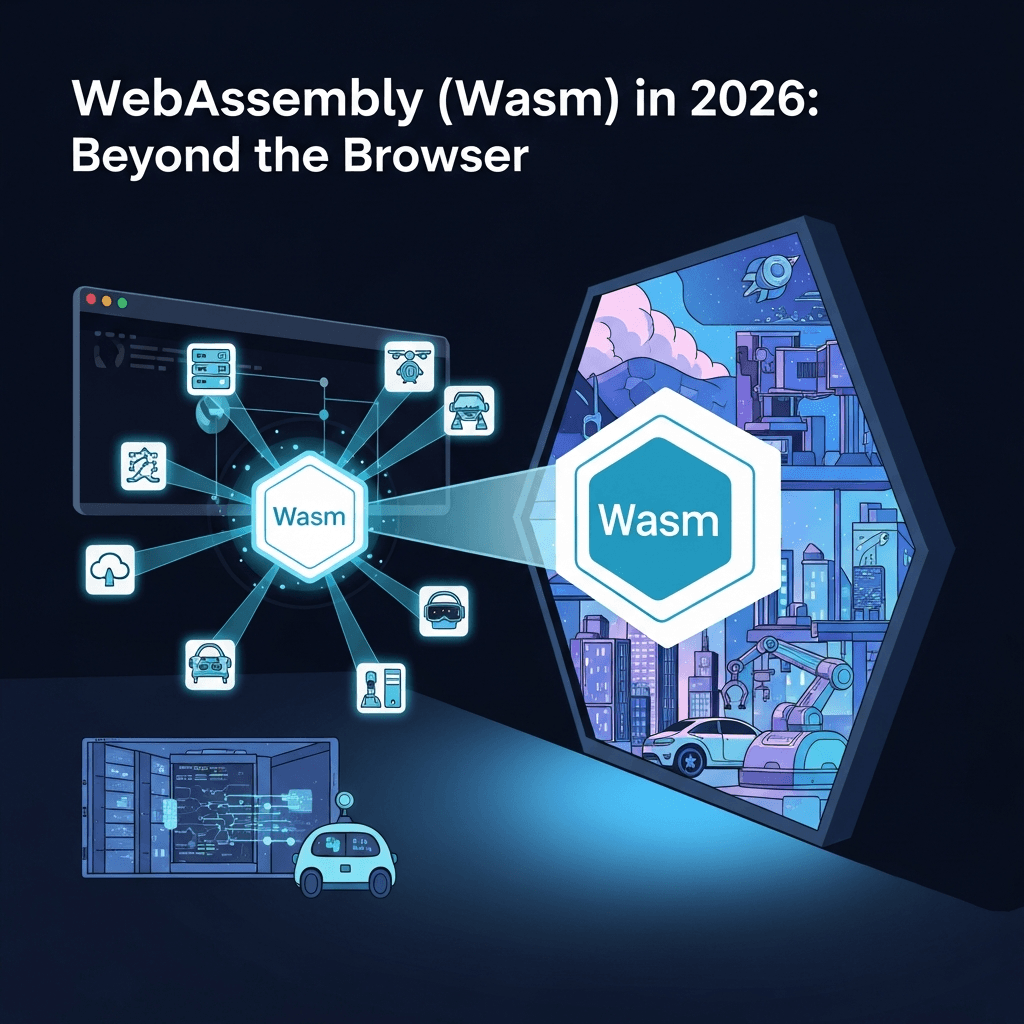
WebAssembly (Wasm) in 2026: Powering the Future Beyond the Browser

Introduction
In its nascent years, WebAssembly (Wasm) captured the imagination primarily as a performance-boosting technology for web browsers. It promised near-native speed for web applications, enabling rich, complex experiences previously confined to native desktop environments. Fast forward to 2026, and Wasm has not only delivered on that promise but has profoundly expanded its horizons, becoming a foundational technology for an entirely new generation of applications and infrastructure far beyond the confines of the browser tab.
This article delves into the mature landscape of WebAssembly in 2026, exploring its pervasive influence across diverse domains. We'll uncover how Wasm, empowered by standards like WASI (WebAssembly System Interface), has emerged as a lightweight, secure, and highly portable universal runtime, challenging traditional paradigms in serverless, edge computing, IoT, microservices, and even desktop applications. Join us as we journey into the future of computing, where Wasm is a cornerstone of efficiency, security, and developer agility.
Prerequisites
To fully grasp the concepts discussed in this article, a basic understanding of the following is recommended:
- Programming Fundamentals: Familiarity with general programming concepts and paradigms.
- WebAssembly Basics: A general idea of what WebAssembly is and its core benefits (performance, safety, portability).
- Cloud Computing Concepts: Exposure to ideas like serverless functions, microservices, and containerization.
- Operating Systems: A conceptual understanding of how applications interact with the underlying operating system.
The Wasm Revolution: A Quick Recap & Why it Matters Off-Browser
WebAssembly is a binary instruction format for a stack-based virtual machine. It's designed as a portable compilation target for high-level languages like C/C++, Rust, Go, and many others, enabling deployment on the web for client-side applications. Its core tenets — near-native performance, small binary sizes, language independence, and a robust security sandbox — were initially revolutionary for web development.
By 2026, these same attributes have proven even more transformative outside the browser. Off-browser, Wasm modules can execute directly on a host runtime, offering several compelling advantages:
- Unparalleled Portability: Compile once, run anywhere, without the overhead of heavy virtual machines or bulky containers. Wasm modules are truly architecture-agnostic.
- Extreme Security: The inherent sandboxing of Wasm provides strong isolation, mitigating supply chain attacks and ensuring that modules can only access resources explicitly granted by the host.
- Blazing Fast Startup: Wasm modules initialize in microseconds, making them ideal for ephemeral workloads, cold starts in serverless functions, and event-driven architectures.
- Minimal Resource Footprint: Small binary sizes and low memory usage make Wasm perfect for resource-constrained environments like edge devices and IoT.
- Language Agnostic: Developers can write logic in their preferred language and compile it to Wasm, fostering diverse ecosystems and leveraging existing skill sets.
This potent combination of features positions Wasm as a fundamental runtime for the next wave of distributed and cloud-native applications.
Wasm System Interface (WASI): The OS for Wasm
While Wasm provided the execution engine, its initial design was browser-centric, lacking direct access to system resources like files, network sockets, or environment variables. This limitation severely hampered its utility outside the browser. Enter WASI (WebAssembly System Interface).
By 2026, WASI has matured into a stable, widely adopted modular standard, effectively acting as a POSIX-like system interface for Wasm. It defines a set of standardized APIs that Wasm modules can use to interact with the host operating system in a secure, capability-based manner. Instead of giving a Wasm module full access to the host, WASI allows the host to grant specific "capabilities" (e.g., read a specific directory, make outgoing HTTP requests) to the module. This fine-grained control is a cornerstone of Wasm's security model.
WASI's evolution includes support for networking, file systems, clocks, environment variables, and even threading, making Wasm modules truly capable of running standalone applications. Its modular design allows runtimes to implement only the necessary capabilities, further reducing overhead and enhancing security for specific use cases.
Serverless Computing with Wasm
Serverless computing has been revolutionized by Wasm's unique properties. The traditional container-based serverless model, while powerful, often struggles with cold start times due to the need to spin up entire container images. Wasm, with its microsecond startup times and tiny memory footprint, virtually eliminates this problem.
In 2026, major cloud providers and specialized serverless platforms widely offer Wasm-native function execution. Developers can deploy Wasm modules that respond to events, process data streams, or serve APIs with unprecedented efficiency and cost-effectiveness. The "pay-per-execution" model becomes even more economical when the execution environment itself is so lightweight.
Practical Example: A Serverless Wasm Function in Rust
Let's imagine a simple Rust function that takes a JSON payload, processes it, and returns a modified JSON. This could be an event handler for a message queue or an API endpoint.
First, the Rust code (src/lib.rs):
// src/lib.rs

use serde::{Deserialize, Serialize};
use std::io::{self, Read, Write};

// Define input and output structures
#[derive(Deserialize, Debug)]
struct InputPayload {
    name: String,
    value: i32,
}

#[derive(Serialize, Debug)]
struct OutputPayload {
    message: String,
    processed_value: i32,
}

// The main entry point for our Wasm function
#[no_mangle]
pub extern "C" fn handle_request() -> i32 {
    // Read input from stdin (WASI-compliant)
    let mut buffer = String::new();
    io::stdin().read_to_string(&mut buffer).unwrap();

    // Parse the input JSON
    let input: InputPayload = serde_json::from_str(&buffer).unwrap();

    // Process the data
    let processed_value = input.value * 2;
    let message = format!("Hello, {}. Your value was doubled!", input.name);

    // Create the output payload
    let output = OutputPayload {
        message,
        processed_value,
    };

    // Serialize output to JSON and write to stdout (WASI-compliant)
    let output_json = serde_json::to_string(&output).unwrap();
    io::stdout().write_all(output_json.as_bytes()).unwrap();

    0 // Indicate success
}

// Add a panic handler for better error reporting in Wasm
#[cfg(target_arch = "wasm32")]
#[panic_handler]
fn panic(_info: &std::panic::PanicInfo) -> ! {
    // Log the panic message to stderr (or a logging service)
    eprintln!("Wasm function panicked!");
    std::process::abort();
}
Cargo.toml dependencies:
# Cargo.toml

[package]
name = "wasm-serverless-example"
version = "0.1.0"
edition = "2021"

[dependencies]
serde = { version = "1.0", features = ["derive"] }
serde_json = "1.0"

[lib]
crate-type = ["cdylib"]

[profile.release]
opt-level = "s"  # Optimize for size
lto = true       # Link Time Optimization
codegen-units = 1
To compile this, you'd use the wasm32-wasi target:
rustup target add wasm32-wasi
cargo build --target wasm32-wasi --release
This produces a .wasm file (e.g., target/wasm32-wasi/release/wasm_serverless_example.wasm) that can be deployed to any WASI-compatible Wasm runtime. When invoked, the runtime feeds the HTTP request body into stdin and captures stdout as the response body.
Edge Computing & IoT
Edge computing, characterized by processing data closer to its source, and IoT, with its vast network of often resource-constrained devices, are natural fits for WebAssembly. The need for low-latency processing, minimal power consumption, and secure execution environments on devices ranging from smart sensors to industrial gateways makes Wasm an ideal candidate.
By 2026, Wasm runtimes are embedded in a wide array of edge devices, performing real-time data filtering, aggregation, and localized AI inference. This reduces bandwidth requirements, enhances privacy (by processing sensitive data locally), and ensures application responsiveness even with intermittent cloud connectivity. Wasm's small footprint means more complex logic can run on cheaper hardware, democratizing advanced edge capabilities.
Practical Example: Wasm on an Edge Device (Conceptual)
Imagine a sensor network where each node needs to perform a simple data validation or aggregation before sending it upstream. A small Wasm module can handle this efficiently.
// src/lib.rs (for an edge device sensor)

#[no_mangle]
pub extern "C" fn validate_sensor_reading(value: i32) -> i32 {
    // Simulate a simple validation: value must be between 0 and 100
    if value >= 0 && value <= 100 {
        value // Return the valid value
    } else {
        -1 // Indicate an invalid reading
    }
}

// More complex logic could involve averaging, thresholding, or simple anomaly detection.
// For example, an exported function to calculate average of N readings:

#[no_mangle]
pub extern "C" fn calculate_average(ptr: *const i32, len: usize) -> i32 {
    let slice = unsafe { std::slice::from_raw_parts(ptr, len) };
    if slice.is_empty() { return 0; }
    let sum: i32 = slice.iter().sum();
    sum / (len as i32)
}

// Note: For actual embedded systems, memory management and host interactions
// (e.g., reading from an ADC, sending via UART) would be done via WASI extensions
// or custom host functions provided by the embedded Wasm runtime.
This Wasm module, once compiled, can be loaded and executed by a minimal Wasm runtime on an embedded Linux device or even a microcontroller with sufficient resources, providing flexible, updateable logic without needing to reflash the entire firmware.
Plugin Systems & Extensibility
One of Wasm's most compelling use cases beyond the browser is enabling highly secure and flexible plugin systems. Applications, from databases to content management systems, can leverage Wasm to allow users or third-party developers to extend functionality without compromising the host application's stability or security.
The inherent sandboxing of Wasm ensures that plugins cannot escape their allocated memory or perform unauthorized system calls. This eliminates many security headaches associated with traditional plugin architectures (e.g., dynamic linking, scripting languages with full system access). Furthermore, Wasm's language neutrality means plugins can be written in any language that compiles to Wasm, greatly expanding the developer pool.
By 2026, Wasm-based plugin architectures are standard in many enterprise applications, enabling custom business logic, data transformations, and integration connectors to be deployed and updated dynamically and safely.
Practical Example: A Wasm-powered Data Transformation Plugin
Consider an application that processes user data and needs a customizable filter. The host application provides data to the Wasm module, which then returns the transformed data.
Host Application (Conceptual pseudocode):
// Host application (e.g., Node.js with 'wazero' or 'wasmtime-js')

const fs = require('fs');
const { WASI } = require('wasi');
const { createWorker } = require('@wasmtime/wasi'); // Example using wasmtime-js

async function loadAndRunWasmPlugin(wasmPath, inputData) {
    const wasi = new WASI({
        args: process.argv,
        env: process.env,
        preopens: { '.': '.' }, // Grant access to current directory for file operations if needed
    });

    const moduleBytes = fs.readFileSync(wasmPath);
    const worker = await createWorker(moduleBytes, {
        wasi: wasi,
        // Define custom host functions if the plugin needs specific host capabilities
        // e.g., 'host_log': (messagePtr, messageLen) => console.log(getMessage(messagePtr, messageLen))
    });

    // Assume the Wasm module exports a function like `transform_data`
    // and communicates via stdin/stdout or shared memory

    // For stdin/stdout communication (WASI-style):
    const { instance } = worker;
    const memory = instance.exports.memory; // Assuming memory is exported
    const transform_data = instance.exports.transform_data; // Assuming transform_data is exported

    // Write inputData to Wasm's stdin
    wasi.setStdin(Buffer.from(JSON.stringify(inputData)));
    wasi.setStdout(new Buffer.alloc(0)); // Prepare stdout buffer

    transform_data(); // Execute the Wasm function

    // Read output from Wasm's stdout
    const outputBuffer = wasi.getStdout();
    return JSON.parse(outputBuffer.toString());
}

const input = { users: [{ name: "Alice", age: 30 }, { name: "Bob", age: 25 }] };
loadAndRunWasmPlugin('./target/wasm32-wasi/release/data_filter_plugin.wasm', input)
    .then(result => console.log('Transformed data:', result))
    .catch(err => console.error('Plugin error:', err));
Wasm Plugin (Rust src/lib.rs):
// src/lib.rs (for data transformation plugin)

use serde::{Deserialize, Serialize};
use std::io::{self, Read, Write};

#[derive(Deserialize, Debug)]
struct User {
    name: String,
    age: i32,
}

#[derive(Deserialize, Debug)]
struct InputData {
    users: Vec<User>,
}

#[derive(Serialize, Debug)]
struct OutputData {
    filtered_users: Vec<User>,
    processed_count: usize,
}

#[no_mangle]
pub extern "C" fn transform_data() -> i32 {
    let mut buffer = String::new();
    io::stdin().read_to_string(&mut buffer).unwrap();

    let input: InputData = serde_json::from_str(&buffer).unwrap();

    let filtered_users: Vec<User> = input.users.into_iter()
        .filter(|user| user.age > 28) // Example filter: only users older than 28
        .collect();

    let output = OutputData {
        filtered_users,
        processed_count: input.users.len(),
    };

    let output_json = serde_json::to_string(&output).unwrap();
    io::stdout().write_all(output_json.as_bytes()).unwrap();

    0 // Success
}
Microservices & Sidecars
In the realm of cloud-native architectures, Wasm offers a compelling alternative or complement to traditional container-based microservices. For specific types of services—especially those requiring high performance, low latency, and a minimal footprint—Wasm modules excel.
By 2026, Wasm-based microservices are prevalent for tasks such as data validation, real-time analytics, protocol translation, and authorization logic within service meshes. They can run as ultra-lightweight services or as sidecar proxies (e.g., within Envoy) to perform custom filtering, routing, and policy enforcement without the overhead of a full container runtime. This leads to significant reductions in infrastructure costs, improved performance, and enhanced security due to the Wasm sandbox.
Desktop Applications & Cross-Platform Development
While Electron has long dominated the cross-platform desktop application space, its significant resource footprint (shipping a full Chromium browser) has always been a point of contention. Wasm, coupled with projects like Tauri or even custom native Wasm runtimes, offers a more efficient paradigm.
In 2026, developers are increasingly leveraging Wasm to build truly lightweight, performant cross-platform desktop applications. Frameworks now exist that allow compiling UI logic (e.g., written in Rust with Yew or Dioxus) to Wasm, which then interacts with a minimal native WebView or a custom rendering engine. This approach drastically reduces binary sizes, memory consumption, and startup times compared to Electron, providing a near-native user experience with the portability benefits of Wasm. This also opens doors for game development, where Wasm can power game logic that runs efficiently across various desktop OSes.
Blockchain & Smart Contracts
WebAssembly's deterministic execution, security, and performance characteristics make it exceptionally well-suited for blockchain environments and smart contract execution. The ability to compile various languages to Wasm means developers aren't limited to domain-specific languages (DSLs) like Solidity, fostering broader adoption and leveraging existing developer expertise.
By 2026, many leading blockchain platforms have adopted Wasm as their primary or a supported smart contract execution engine. Its sandboxed nature ensures that smart contracts execute predictably and safely, while its efficiency helps scale transaction throughput. The standardization offered by Wasm also promotes interoperability between different blockchain ecosystems, paving the way for more robust and interconnected decentralized applications.
Best Practices for Off-Browser Wasm Development
Developing effectively with Wasm outside the browser requires adherence to specific best practices to maximize its benefits:
- Choose the Right Language: While many languages compile to Wasm, Rust and Go often provide the best balance of performance, safety, and Wasm-specific tooling (especially for WASI). C/C++ is also excellent for performance-critical libraries.
- Optimize for Size: Smaller Wasm modules lead to faster downloads, lower memory usage, and quicker cold starts. Use compiler optimizations (
opt-level="s"for Rust), link-time optimization (LTO), and strip debug symbols. Consider tools likewasm-optfrom Binaryen. - Modular Design: Design your Wasm modules to be self-contained units of logic with clear, minimal interfaces. This enhances reusability, testability, and security.
- Leverage WASI Wisely: Understand the capabilities WASI provides and only request what your module genuinely needs. This adheres to the principle of least privilege, enhancing security.
- Host-Guest Communication: For complex interactions, understand the various methods: shared memory, stdin/stdout (WASI), custom host functions (imports), and the Component Model. The Component Model, emerging as a standard by 2026, greatly simplifies interoperability between Wasm modules and host environments.
- Toolchain Integration: Integrate Wasm compilation into your CI/CD pipelines. Automate testing of Wasm modules against different runtimes.
- Profiling and Benchmarking: Even Wasm code can have performance bottlenecks. Use profiling tools (where available for your runtime) and benchmark critical paths to ensure optimal performance.
Common Pitfalls & How to Avoid Them
While Wasm offers significant advantages, developers should be aware of common pitfalls:
- Over-reliance on Host Features: Expecting full OS access within a Wasm module without explicit WASI capabilities or custom host functions will lead to errors. Design modules to be as self-contained as possible, explicitly defining necessary host interactions.
- Debugging Challenges: Debugging Wasm can be less mature than native code. Utilize logging (via WASI
eprintln!or custom host functions), source maps, and runtime-specific debuggers. The Wasm DWARF standard is improving this by 2026. - Module Size Bloat: Without careful optimization, Wasm modules can become larger than necessary, especially when including large standard libraries. Aggressive tree-shaking, dead code elimination, and optimizing for size during compilation are crucial.
- Choosing the Wrong Language/Toolchain: While many languages compile to Wasm, not all offer the same level of maturity, performance, or WASI integration. Rust and Go are generally excellent choices for off-browser Wasm due to their robust tooling and control over binary size.
- Ignoring the Component Model: Early Wasm modules often struggled with complex data types and cross-language communication. By 2026, the WebAssembly Component Model addresses these issues by providing a standardized way for Wasm modules to communicate with each other and with host environments using rich types. Ignoring this standard can lead to brittle and less interoperable solutions.
- Security Misconceptions: While Wasm is inherently sandboxed, it's not a silver bullet. Vulnerabilities can still arise from insecure host function implementations, misconfigured capabilities, or flaws in the Wasm module's own logic. Always follow secure coding practices and conduct security audits.
Conclusion
WebAssembly in 2026 is no longer just a browser technology; it is a fundamental shift in how we build and deploy software across the entire computing spectrum. Empowered by WASI and a maturing ecosystem, Wasm has transcended its origins to become a universal, secure, high-performance runtime for serverless functions, edge devices, IoT, robust plugin systems, and even lightweight desktop applications.
The promise of "write once, run anywhere" is finally being realized with unprecedented efficiency and security. Developers who embrace Wasm's capabilities and best practices will be at the forefront of building the next generation of cloud-native, distributed, and highly efficient applications. The journey beyond the browser is well underway, and Wasm is unequivocally leading the charge into a more portable, secure, and performant future.
Written by
CodewithYohaFull-Stack Software Engineer with 7+ years of experience in Java, Spring Boot, and cloud architecture across AWS, Azure, and GCP. Writing production-grade engineering patterns for developers who ship real software.