Introduction
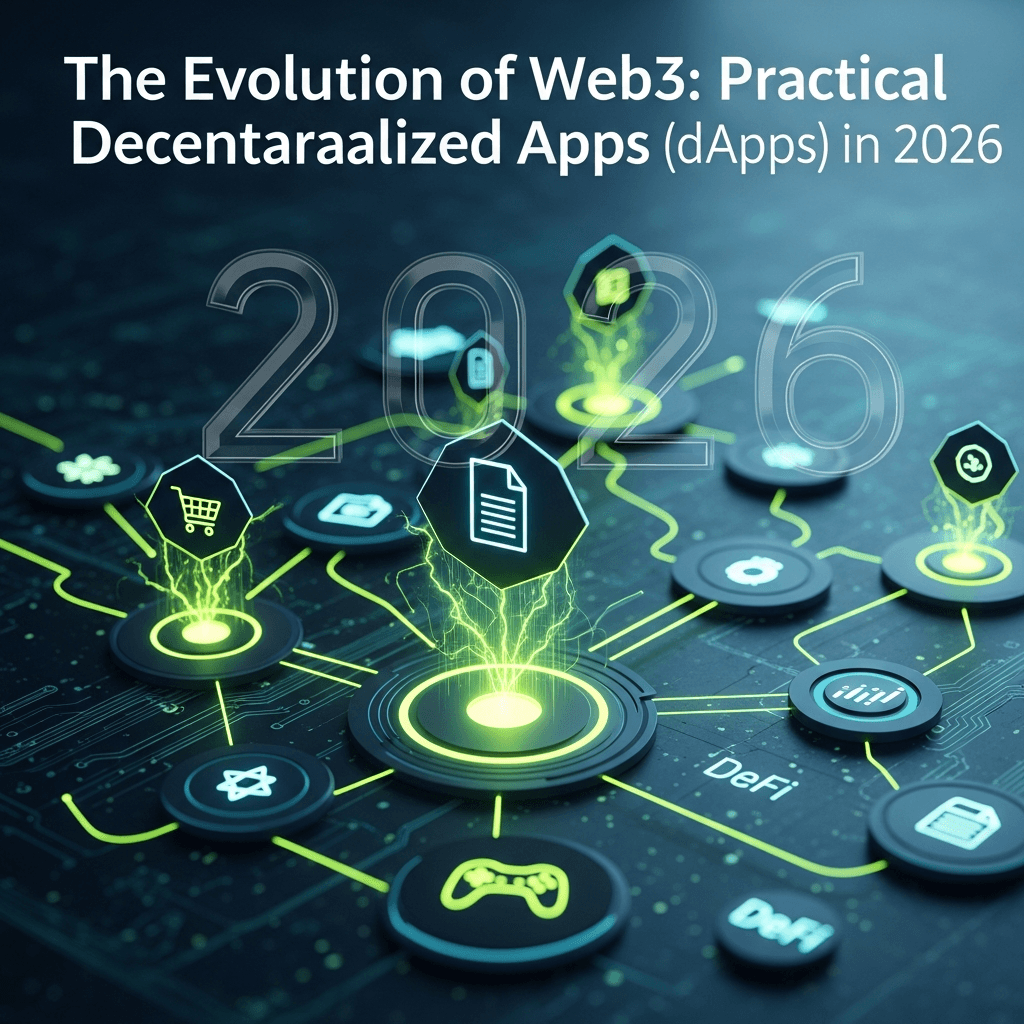
The internet has undergone two major shifts: Web1, the read-only static web, and Web2, the interactive, platform-dominated web. We are now in the midst of the Web3 revolution—a paradigm shift promising decentralization, user ownership, and censorship resistance. While early Web3 applications (dApps) faced challenges like scalability, poor user experience, and high transaction costs, the landscape by 2026 is rapidly maturing. This article explores the practical evolution of dApps, showcasing how they are transcending niche use cases to become viable, robust, and user-friendly solutions across various industries.
We'll delve into the foundational technologies, advanced development practices, real-world applications, and the strategic considerations necessary to navigate this exciting decentralized future.
Prerequisites
To fully grasp the concepts discussed in this article, a basic understanding of:
- Blockchain fundamentals: What a blockchain is, basic cryptography, and how transactions work.
- Smart contracts: Their role and execution on a blockchain.
- Web development basics: HTML, CSS, JavaScript, and familiarity with frontend frameworks (e.g., React, Vue).
- Command-line interface (CLI): For interacting with development tools.
1. The Web3 Paradigm Shift: From Vision to Reality
Web3's core promise is to return control to users, enabling a truly permissionless and trustless internet. This vision, once abstract, is materializing through innovations that address early limitations. By 2026, the focus has shifted from theoretical decentralization to practical, scalable implementations that offer tangible benefits over their Web2 counterparts.
The evolution involves moving past simple token transfers and speculative DeFi to robust ecosystems where users own their data, assets, and identity, participating actively in network governance. This transition is powered by a confluence of technological advancements and a growing understanding of user needs.
2. Core Technologies Powering 2026 dApps
The backbone of modern dApps relies on a sophisticated stack of decentralized technologies:
2.1. Blockchain Platforms and Layer 2 Solutions
While Ethereum remains a dominant force, its scalability challenges led to the proliferation of Layer 2 (L2) solutions (Optimistic Rollups like Optimism and Arbitrum, and ZK-Rollups like zkSync and StarkNet) and alternative Layer 1 (L1) blockchains (Solana, Avalanche, Polkadot, Near Protocol). By 2026, L2s are the default for high-throughput dApps, offering near-instant transactions and significantly reduced gas fees while inheriting the security of their underlying L1s. New modular blockchain architectures also allow for highly specialized and efficient application-specific chains.
2.2. Decentralized Storage
IPFS (InterPlanetary File System) and Arweave have become standard for storing dApp frontend assets, user-generated content, and large datasets in a decentralized, censorship-resistant, and persistent manner. This ensures that dApps remain fully decentralized, from backend logic to user interface.
2.3. Oracles
Chainlink continues to be the industry standard for securely connecting smart contracts with real-world data (e.g., price feeds, weather data, sports results), enabling complex dApp logic that reacts to off-chain events.
2.4. Decentralized Identity (DID)
Self-Sovereign Identity (SSI) solutions built on DIDs empower users with full control over their digital identities, enabling privacy-preserving authentication and credential management across various dApps without relying on centralized identity providers.
3. Smart Contracts: The Engine of Decentralization
Smart contracts are the immutable, self-executing agreements at the heart of every dApp. By 2026, smart contract development has matured significantly, with a strong emphasis on security, upgradability, and gas efficiency. Developers now leverage advanced patterns like proxy contracts for upgradability and libraries for common functionalities.
Here's a basic Solidity example of an upgradable contract using the OpenZeppelin UUPS proxy pattern:
// SPDX-License-Identifier: MIT
pragma solidity ^0.8.20;

import "@openzeppelin/contracts-upgradeable/proxy/utils/Initializable.sol";
import "@openzeppelin/contracts-upgradeable/access/OwnableUpgradeable.sol";

contract MyUpgradableDApp is Initializable, OwnableUpgradeable {
    uint256 private _value;

    /// @custom:oz-upgrades-from MyUpgradableDAppV1
    function initialize(uint256 initialValue) public virtual initializer {
        __Ownable_init(msg.sender);
        _value = initialValue;
    }

    function setValue(uint256 newValue) public onlyOwner {
        _value = newValue;
    }

    function getValue() public view returns (uint256) {
        return _value;
    }

    // The following functions are required for UUPS proxy pattern
    function _authorizeUpgrade(address newImplementation) internal override onlyOwner {}
}
This contract can be deployed behind a proxy, allowing its logic to be updated in the future without changing the contract's address, crucial for long-lived dApps.
4. The Rise of Layer 2 Solutions and Scalability
Scalability was the Achilles' heel of early dApps. L2 solutions have effectively addressed this by processing transactions off-chain and periodically submitting a summary or proof to the L1. This drastically reduces transaction costs and increases throughput, making dApps practical for mainstream adoption.
- Optimistic Rollups: Assume transactions are valid but allow a dispute period. Examples: Arbitrum, Optimism.
- ZK-Rollups: Use cryptographic proofs (zero-knowledge proofs) to instantly verify off-chain transactions, offering stronger security and faster finality. Examples: zkSync, StarkNet.
Developers now strategically deploy dApps or specific components (e.g., high-frequency trading, gaming actions) on L2s, only using the L1 for final settlement or critical state changes. Interacting with L2s involves using their specific RPC endpoints and bridges to move assets between L1 and L2.
5. User Experience (UX) in dApps: Bridging the Gap
Early dApps were notorious for their steep learning curve, requiring users to manage seed phrases, understand gas fees, and navigate complex wallet interfaces. By 2026, UX has become a top priority.
- Account Abstraction (ERC-4337): This breakthrough allows smart contract wallets to function like traditional accounts, enabling features like gasless transactions (paid by a relayer), multi-factor authentication, social recovery, and batch transactions. This significantly lowers the barrier to entry.
- Improved Wallets: Wallets like MetaMask, WalletConnect, and hardware wallets have evolved to be more intuitive, secure, and integrated with dApp ecosystems.
- Familiar Interfaces: dApp frontends increasingly mimic Web2 designs, abstracting away blockchain complexities and focusing on usability.
6. Real-World dApp Categories and Use Cases in 2026
Practical dApps are now impacting diverse sectors:
6.1. Decentralized Finance (DeFi) 2.0/3.0
Beyond basic lending and borrowing, DeFi in 2026 includes sophisticated structured products, real-world asset (RWA) tokenization (e.g., real estate, commodities), decentralized insurance, and advanced derivatives. DeFi protocols are becoming more capital-efficient and integrated with traditional finance (TradFi).
6.2. Gaming (GameFi) and Metaverses
GameFi has evolved from simple Play-to-Earn (P2E) models to complex, immersive games where true ownership of in-game assets (NFTs) is central. Interoperable metaverses allow assets and identities to traverse different virtual worlds, fostering vibrant digital economies.
6.3. SocialFi and Creator Economies
Decentralized social networks empower users to own their data, control their content, and directly monetize their creations without intermediaries. Token-gated communities and decentralized content platforms are thriving, fostering more equitable creator economies.
6.4. Decentralized Autonomous Organizations (DAOs)
DAOs have matured beyond simple voting mechanisms, becoming sophisticated structures for collective ownership and governance. Operational DAOs manage significant treasuries, fund projects, and even govern entire protocols, demonstrating true decentralized coordination.
6.5. Supply Chain and Enterprise Solutions
Blockchain's immutability and transparency are leveraged for supply chain traceability, ensuring authenticity and ethical sourcing. Enterprise dApps facilitate secure data sharing, identity verification, and cross-organizational workflows without central points of control.
7. Building a Practical dApp: A Simplified Architecture
A typical practical dApp architecture in 2026 combines decentralized and optimized components:
- Frontend: React, Vue, or Angular, often hosted on IPFS/Arweave.
- Web3 Libraries: Ethers.js or Web3.js for interacting with smart contracts.
- Smart Contracts: Deployed on an L2 (e.g., Arbitrum) for efficiency, with critical logic potentially anchored on L1 (e.g., Ethereum).
- Decentralized Storage: IPFS/Arweave for media, user files, or static assets.
- Oracles: Chainlink for external data feeds.
- Subgraph/Indexer: The Graph for efficient querying of blockchain data.
Here's a simplified React component interacting with a smart contract using Ethers.js:
// src/components/DAppInteraction.js
import React, { useState, useEffect } from 'react';
import { ethers } from 'ethers';

// Replace with your contract address and ABI
const CONTRACT_ADDRESS = "0xYourContractAddressHere";
const CONTRACT_ABI = [
  "function getValue() view returns (uint256)",
  "function setValue(uint256 newValue)"
];

function DAppInteraction() {
  const [currentValue, setCurrentValue] = useState(null);
  const [inputValue, setInputValue] = useState('');
  const [loading, setLoading] = useState(false);
  const [error, setError] = useState(null);

  useEffect(() => {
    fetchValue();
  }, []);

  const getProvider = () => {
    if (window.ethereum) {
      return new ethers.BrowserProvider(window.ethereum); // MetaMask provider
    } else {
      // Fallback to a read-only provider if MetaMask is not available
      console.warn("MetaMask not detected. Using a public RPC for read-only.");
      return new ethers.JsonRpcProvider("https://rpc.ankr.com/eth"); // Example public RPC
    }
  };

  const getSigner = async () => {
    const provider = getProvider();
    if (window.ethereum) {
      await provider.send("eth_requestAccounts", []);
      return provider.getSigner();
    } else {
      throw new Error("No wallet detected. Cannot sign transactions.");
    }
  };

  const fetchValue = async () => {
    setLoading(true);
    setError(null);
    try {
      const provider = getProvider();
      const contract = new ethers.Contract(CONTRACT_ADDRESS, CONTRACT_ABI, provider);
      const value = await contract.getValue();
      setCurrentValue(value.toString());
    } catch (err) {
      console.error("Error fetching value:", err);
      setError("Failed to fetch value.");
    } finally {
      setLoading(false);
    }
  };

  const updateValue = async () => {
    setLoading(true);
    setError(null);
    try {
      const signer = await getSigner();
      const contract = new ethers.Contract(CONTRACT_ADDRESS, CONTRACT_ABI, signer);
      const tx = await contract.setValue(inputValue);
      await tx.wait(); // Wait for the transaction to be mined
      alert("Transaction successful!");
      setInputValue('');
      fetchValue(); // Refresh value after update
    } catch (err) {
      console.error("Error updating value:", err);
      setError("Failed to update value. Check console for details.");
    } finally {
      setLoading(false);
    }
  };

  return (
    <div>
      <h2>dApp Interaction</h2>
      {loading && <p>Loading...</p>}
      {error && <p style={{ color: 'red' }}>Error: {error}</p>}
      <p>Current Value: {currentValue !== null ? currentValue : 'N/A'}</p>
      <div>
        <input
          type="number"
          value={inputValue}
          onChange={(e) => setInputValue(e.target.value)}
          placeholder="Enter new value"
        />
        <button onClick={updateValue} disabled={loading || !inputValue}>
          Set New Value
        </button>
      </div>
      <button onClick={fetchValue} disabled={loading}>
        Refresh Value
      </button>
    </div>
  );
}

export default DAppInteraction;
8. Security and Audit Best Practices
Security is paramount in Web3, where bugs can lead to irreversible loss of funds. By 2026, rigorous security practices are non-negotiable:
- Formal Audits: Regular, independent security audits by reputable firms are essential for all production-grade smart contracts.
- Static Analysis Tools: Tools like Slither, MythX, and Certora are integrated into CI/CD pipelines to catch vulnerabilities early.
- Bug Bounty Programs: Incentivizing white-hat hackers to find vulnerabilities before malicious actors.
- Multi-sig Wallets: For treasury management and critical contract upgrades.
- Time-locks: Introducing delays for critical operations to allow for community review or emergency halts.
- Decentralized Security Networks: Platforms like Immunefi provide a marketplace for bug bounties.
9. Interoperability and Cross-Chain Communication
The multichain future is here. dApps often need to interact across different blockchains or L2s. Interoperability is achieved through:
- Bridges: For transferring assets and data between chains. While some bridges have been vulnerable, new designs focus on enhanced security (e.g., ZK-proofs for bridge integrity).
- Cross-Chain Communication Protocols: Protocols like LayerZero and Wormhole enable secure message passing between disparate chains, allowing for complex dApp logic to span multiple networks.
- Standardization: Continued adoption and evolution of token standards (ERC-20, ERC-721, ERC-1155) and new standards for composable NFTs or soulbound tokens facilitate seamless interaction.
10. Governance and Decentralized Autonomous Organizations (DAOs)
DAOs have evolved from experimental concepts to robust organizational structures. By 2026, they are central to the governance of many dApps and protocols, ensuring community-driven development and decision-making.
- Advanced Voting Mechanisms: Beyond simple token-weighted voting, DAOs use quadratic voting, conviction voting, and delegative democracy to improve participation and fairness.
- Tooling and Infrastructure: Platforms like Tally, Snapshot, and Aragon provide comprehensive tools for DAO creation, treasury management, and proposal execution.
- Legal Wrappers: Efforts are underway to provide legal recognition and frameworks for DAOs, bridging the gap between decentralized and traditional legal systems.
11. Best Practices for dApp Development in 2026
To build successful and resilient dApps:
- Progressive Decentralization: Start with a semi-decentralized approach for faster iteration, then gradually decentralize components as the dApp matures and security is proven.
- Modular and Upgradable Contracts: Design smart contracts with upgradability in mind (e.g., UUPS proxies) and break down complex logic into modular components.
- Gas Optimization: Write efficient Solidity code, minimize storage operations, and leverage L2s to keep transaction costs low for users.
- Robust Error Handling and Logging: Implement comprehensive error handling in both smart contracts and frontend code. Utilize decentralized logging solutions where appropriate.
- Focus on User Experience (UX): Prioritize intuitive interfaces, clear messaging, and abstract away blockchain complexities through account abstraction and user-friendly wallets.
- Community Engagement: Build a strong community from the outset, involving users in governance and feedback loops.
- Security First Mindset: Integrate security audits, bug bounties, and formal verification into every stage of the development lifecycle.
12. Common Pitfalls to Avoid
Despite advancements, dApp development still presents challenges:
- Ignoring Scalability: Building directly on L1 for high-frequency applications without a clear L2 strategy will lead to poor UX and high costs.
- Poor Security Practices: Rushing development without proper audits, testing, and security considerations is a recipe for disaster.
- Complex User Experience: Overlooking UX can alienate mainstream users, hindering adoption. Don't make users think about gas, private keys, or complex blockchain concepts unless absolutely necessary.
- Centralization Risks: Introducing centralized components (e.g., centralized off-chain servers, single points of failure for oracles or storage) undermines the core value proposition of decentralization.
- Regulatory Uncertainty: The regulatory landscape for crypto and dApps is still evolving. Neglecting legal advice or failing to adapt can lead to significant issues.
- Over-Reliance on Speculation: Focusing solely on tokenomics and speculative value rather than tangible utility and sustainable business models can lead to short-lived projects.
Conclusion
The evolution of Web3 dApps by 2026 marks a significant milestone. We've moved beyond the experimental phase into an era of practical, scalable, and user-friendly decentralized applications. Layer 2 solutions, account abstraction, refined smart contract development, and a strong focus on UX have transformed the landscape, enabling dApps to tackle real-world problems across finance, gaming, social media, and enterprise.
Developers and entrepreneurs entering this space must embrace a security-first mindset, prioritize user experience, leverage the power of L2s and interoperability, and foster strong community governance. The journey towards a fully decentralized internet is ongoing, but the foundation for a truly practical and impactful Web3 is firmly in place. The future of the internet is being built, and it is decentralized.
Are you ready to build the next generation of practical dApps?

Written by
CodewithYohaFull-Stack Software Engineer with 7+ years of experience in Java, Spring Boot, and cloud architecture across AWS, Azure, and GCP. Writing production-grade engineering patterns for developers who ship real software.