
Introduction
The serverless revolution, often dubbed "Serverless 1.0," brought us the power of Functions-as-a-Service (FaaS) – ephemeral, stateless compute that scaled effortlessly with event-driven architectures. It was a game-changer for many, abstracting away infrastructure and reducing operational overhead. However, its stateless nature inherently presented limitations, particularly for applications requiring persistent state, real-time interactivity, or ultra-low latency for globally distributed users.
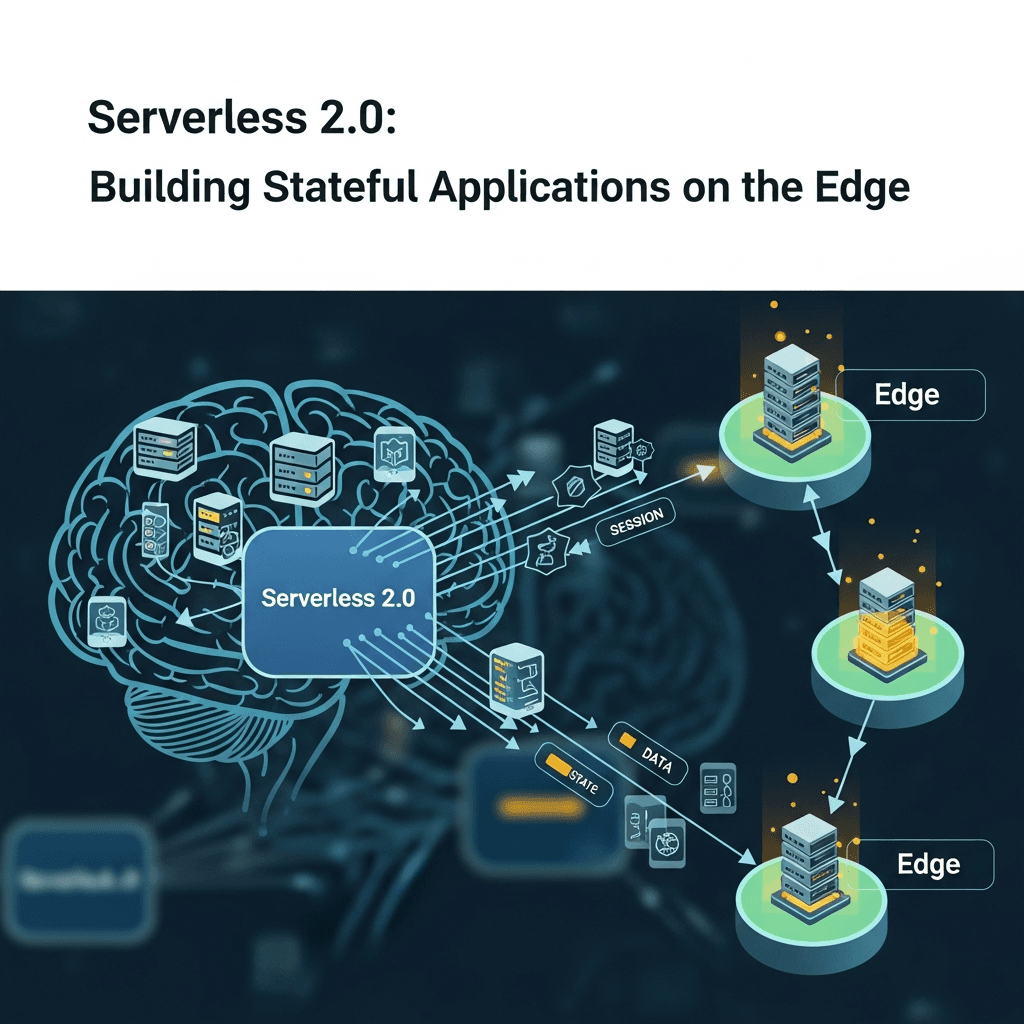
Enter Serverless 2.0, a paradigm shift that marries the benefits of serverless (no servers to manage, pay-per-execution) with the critical ability to manage state and execute compute directly at the network's edge. This evolution isn't just about faster functions; it's about enabling a new class of applications that were previously difficult or impossible to build efficiently with traditional serverless models. Imagine real-time collaborative docs, multiplayer games, personalized IoT dashboards, or global session management, all running milliseconds away from your users.
This comprehensive guide will explore the why and how of building stateful applications at the edge. We'll dive into the underlying technologies, practical patterns, code examples, and best practices to help you harness the full potential of Serverless 2.0.
Prerequisites
To get the most out of this guide, a basic understanding of the following concepts will be beneficial:
- Serverless FaaS: Familiarity with concepts like functions, event triggers, and cold starts.
- JavaScript/TypeScript: Our code examples will primarily use these languages, common in edge environments.
- Distributed Systems: An awareness of challenges like data consistency and latency in distributed environments.
- Web Technologies: Basic knowledge of HTTP, WebSockets, and APIs.
1. The Evolution to Serverless 2.0
Serverless 1.0, primarily FaaS offerings like AWS Lambda, Azure Functions, and Google Cloud Functions, excelled at stateless, event-driven tasks. A function would execute, perform its duty, and then disappear, discarding any in-memory state. While powerful for many workloads (e.g., image processing, API backends, cron jobs), this model struggled with:
- Stateful interactions: Maintaining user sessions, real-time collaboration, or long-running processes required external databases, often leading to latency bottlenecks.
- Cold Starts: The spin-up time for a new function instance could introduce noticeable delays.
- Latency for global users: Even with regional deployments, users far from a data center would experience higher latency.
Serverless 2.0 addresses these challenges by extending the serverless promise to include persistent state and ultra-low latency execution at the network's edge. This new wave is characterized by:
- Edge Compute Platforms: Run functions closer to users (e.g., Cloudflare Workers, Vercel Edge Functions, Deno Deploy).
- Edge-Native State: Providing mechanisms to store and manage state directly at the edge, often with strong consistency guarantees across global replicas.
- Longer-Lived Processes: Support for WebSockets and other persistent connections.
- WebAssembly (Wasm): Enabling polyglot development and near-native performance for critical workloads.
2. Understanding the Edge Paradigm
What exactly is "the Edge" in this context? It refers to the geographically distributed network of data centers, often co-located with Content Delivery Network (CDN) Points of Presence (PoPs), that are physically closer to end-users than traditional centralized cloud regions. When you hear "Edge Computing," think about moving compute and data resources away from a central origin server and closer to where users interact with your application.
Key benefits of the Edge paradigm include:
- Ultra-Low Latency: Requests travel shorter distances, significantly reducing round-trip times (RTT) and improving user experience.
- Improved User Experience: Faster page loads, snappier interactions, and real-time responsiveness.
- Reduced Origin Load: Edge functions can handle a significant portion of traffic, offloading your main backend and databases.
- Enhanced Resilience: Distributing logic across many edge locations can improve fault tolerance.
- Data Locality: Processing data closer to its source (e.g., IoT devices) can reduce bandwidth costs and improve privacy.
However, the edge also introduces complexities, primarily around managing distributed state and ensuring data consistency across potentially hundreds of locations.
3. Why Stateful Applications on the Edge?
The ability to manage state at the edge unlocks a new realm of application possibilities and dramatically improves existing ones. Here are compelling reasons and use cases:
- Real-time Collaboration: Think Google Docs or Figma. Users need to see updates instantly, and state needs to be synchronized seamlessly. Running this logic at the edge minimizes latency between collaborators.
- Online Gaming: Fast-paced multiplayer games demand millisecond-level responsiveness. Edge compute can host game logic, state, and even matchmaking, reducing lag and improving fair play.
- IoT Data Processing: Ingesting, filtering, and acting on data from millions of IoT devices close to their physical location can reduce network congestion and enable immediate local responses.
- Personalized User Experiences: Storing user preferences, session data, or A/B test variations at the edge allows for instantaneous, highly personalized content delivery without round-trips to a central database.
- Global Session Management: Maintaining user sessions for authentication across distributed applications with minimal latency.
- Edge Caching with Dynamic Logic: Beyond static content caching, edge functions can dynamically cache API responses, apply business logic before hitting an origin, or even serve personalized content directly from the edge.
4. State Management Patterns at the Edge
Managing state in a globally distributed environment requires careful consideration. Here are common patterns emerging in Serverless 2.0:
Edge-Native Key-Value Stores
Platforms like Cloudflare offer specialized key-value stores (e.g., Cloudflare KV) that are globally distributed and accessible from edge functions. These are excellent for simple data storage, configuration, or caching, but typically offer eventual consistency.
Edge-Native Distributed Objects (e.g., Cloudflare Durable Objects)
This is a game-changer for stateful logic. Durable Objects provide a single-writer, globally consistent primitive. Each object is essentially a unique instance of a class that can hold state and process requests. Despite being distributed, a specific Durable Object instance always runs in a single data center at any given time, ensuring strong consistency for its internal state while still being accessible from any edge location with minimal latency.
Global Distributed Databases
For more complex data models, transactional guarantees, or existing relational/NoSQL needs, connecting edge functions to globally distributed databases remains a viable option. Services like FaunaDB, PlanetScale, CockroachDB, or YugabyteDB are designed for global distribution and low-latency access, often leveraging intelligent routing or edge proxies to connect clients to the nearest replica.
CRDTs (Conflict-free Replicated Data Types)
For applications requiring strong eventual consistency and multi-master writes (like collaborative editors), CRDTs are a powerful academic concept now seeing practical implementation. They are data structures that can be concurrently updated by multiple replicas without coordination, and their merge operations are commutative, associative, and idempotent, guaranteeing convergence to the same state.
5. Deep Dive: Cloudflare Durable Objects for Stateful Logic
Cloudflare Durable Objects are a prime example of a Serverless 2.0 primitive for stateful applications. They represent a unique approach to managing state at the edge by providing:
- Single-Writer Consistency: Despite being globally accessible, each Durable Object instance exists and executes on a single Worker in a single data center at any given moment. All requests for that specific object are routed to its current location, ensuring strong consistency for its internal state.
- Global Access: Any Cloudflare Worker, anywhere in the world, can interact with a Durable Object instance by its unique ID. Cloudflare's network handles the routing to the correct instance.
- Persistence: Durable Objects can persistently store data, much like a tiny, single-tenant database.
- Concurrency Control: Requests to a Durable Object are processed serially, simplifying concurrency management within the object itself.
This makes Durable Objects ideal for managing state for individual entities like a chat room, a specific user session, a game board, or a unique IoT device.
6. Building a Real-time Chat Application with Durable Objects
Let's illustrate Durable Objects with a simple real-time chat application. Each chat room will be a Durable Object, managing its list of connected users and message history.
Project Setup (Conceptual)
You'll typically use wrangler, Cloudflare's CLI, to set up and deploy Workers and Durable Objects.
// worker.js - The main Worker script that routes requests to Durable Objects

export interface Env {
  CHAT_ROOM: DurableObjectNamespace;
}

export default {
  async fetch(
    request: Request,
    env: Env,
    ctx: ExecutionContext
  ): Promise<Response> {
    const url = new URL(request.url);
    const roomId = url.pathname.slice(1) || "default"; // Use path as room ID

    // Get a Durable Object ID for the room
    const id = env.CHAT_ROOM.idFromName(roomId);
    // Get a stub for the Durable Object (a proxy to interact with it)
    const room = env.CHAT_ROOM.get(id);

    // Forward the request to the Durable Object
    // The DO will handle WebSocket upgrades and HTTP requests
    return room.fetch(request);
  },
};

// chat-room.ts - The Durable Object class

interface ChatMessage {
  user: string;
  message: string;
  timestamp: number;
}

export class ChatRoom {
  private state: DurableObjectState;
  private websockets: WebSocket[];
  private messageHistory: ChatMessage[];

  constructor(state: DurableObjectState, env: Env) {
    this.state = state;
    this.websockets = [];
    this.messageHistory = [];

    // Restore message history from storage if available
    this.state.storage.get<ChatMessage[]>("messageHistory").then(history => {
      if (history) {
        this.messageHistory = history;
      }
    });
  }

  // Handle HTTP requests (including WebSocket upgrades)
  async fetch(request: Request): Promise<Response> {
    const url = new URL(request.url);

    switch (url.pathname) {
      case "/websocket":
        if (request.headers.get("Upgrade") === "websocket") {
          const { 0: client, 1: server } = new WebSocketPair();

          this.state.acceptWebSocket(server);
          this.websockets.push(server);

          server.addEventListener("message", async (event) => {
            const parsedMessage = JSON.parse(event.data.toString());
            const user = parsedMessage.user || "Anonymous";
            const message = parsedMessage.message;
            const chatMessage: ChatMessage = {
              user,
              message,
              timestamp: Date.now(),
            };
            this.messageHistory.push(chatMessage);
            // Persist history (debounce or batch for performance)
            await this.state.storage.put("messageHistory", this.messageHistory);

            // Broadcast message to all connected clients
            this.broadcast(JSON.stringify(chatMessage));
          });

          server.addEventListener("close", () => {
            this.websockets = this.websockets.filter((ws) => ws !== server);
            this.broadcast(`User left. Total users: ${this.websockets.length}`);
          });

          server.addEventListener("error", (err) => {
            console.error("WebSocket error", err);
            this.websockets = this.websockets.filter((ws) => ws !== server);
          });

          // Send past messages to the new client
          if (this.messageHistory.length > 0) {
            client.send(JSON.stringify({ type: "history", messages: this.messageHistory }));
          }
          this.broadcast(`User joined. Total users: ${this.websockets.length}`);

          return new Response(null, { status: 101, webSocket: client });
        }
        return new Response("Expected WebSocket upgrade", { status: 426 });

      case "/history":
        return new Response(JSON.stringify(this.messageHistory), {
          headers: { "Content-Type": "application/json" },
        });

      default:
        return new Response("Not Found", { status: 404 });
    }
  }

  private broadcast(message: string) {
    this.websockets.forEach((ws) => {
      try {
        ws.send(message);
      } catch (err) {
        console.error("Failed to send to WebSocket", err);
        // Handle broken connections (will be caught by 'close' event eventually)
      }
    });
  }
}
In this example:
- The
worker.jsscript receives an HTTP request, extracts aroomIdfrom the URL, and uses it to get a uniqueDurableObjectId. - It then obtains a
DurableObjectStuband forwards the incoming request to theChatRoomDurable Object. - The
ChatRoomclass acts as the stateful logic for a single chat room. - When a WebSocket upgrade request comes in (
/websocket), theChatRoomaccepts it, adds the newWebSocketto its internal list, and sets up event listeners. - Incoming messages are added to
messageHistory(persisted tostate.storage) and then broadcast to all connected clients in that specific room. - The
state.storageAPI allows the Durable Object to persistently store its internal state across restarts or migrations.
7. Edge Functions with External Global Databases
While Durable Objects provide an excellent primitive for entity-specific state, sometimes you need the full power of a globally distributed database. For example, if you have complex queries, transactions across multiple entities, or an existing relational data model.
Integrating edge functions with databases like FaunaDB, PlanetScale, or CockroachDB involves:
- Connection Pooling: Edge functions are short-lived. Efficient connection pooling (often handled by the database client library or a proxy) is crucial to avoid connection overhead.
- Closest Replica Routing: These databases are designed to route requests to the nearest data replica, minimizing latency from the edge function to the database.
- Security: Securely manage database credentials (e.g., using environment variables or secret management services).
// worker-with-fauna.js - Edge function interacting with FaunaDB

import { Client, fql } from 'fauna';

export interface Env {
  FAUNA_SECRET: string;
}

export default {
  async fetch(
    request: Request,
    env: Env,
    ctx: ExecutionContext
  ): Promise<Response> {
    const client = new Client({
      secret: env.FAUNA_SECRET,
      // FaunaDB automatically routes to the closest replica
    });

    const url = new URL(request.url);

    if (url.pathname === "/users") {
      if (request.method === "POST") {
        const { name, email } = await request.json();
        try {
          const result = await client.query(fql`
            User.create({
              name: ${name},
              email: ${email}
            })
          `);
          return new Response(JSON.stringify(result.data), { status: 201, headers: { 'Content-Type': 'application/json' } });
        } catch (error) {
          console.error("Error creating user:", error);
          return new Response("Error creating user", { status: 500 });
        }
      } else if (request.method === "GET") {
        try {
          const result = await client.query(fql`
            User.all()
          `);
          return new Response(JSON.stringify(result.data), { status: 200, headers: { 'Content-Type': 'application/json' } });
        } catch (error) {
          console.error("Error fetching users:", error);
          return new Response("Error fetching users", { status: 500 });
        }
      }
    }

    return new Response("Not Found", { status: 404 });
  },
};
This example shows an edge function handling user creation and retrieval using FaunaDB. The FaunaDB client automatically routes requests to the nearest database replica, ensuring low latency access from the edge.
8. WebSockets and Long-Lived Connections at the Edge
WebSockets are fundamental for real-time, stateful applications. They provide a full-duplex communication channel over a single, long-lived TCP connection, eliminating the overhead of repeated HTTP requests.
Edge platforms like Cloudflare Workers offer native support for WebSockets, allowing edge functions and Durable Objects to act as WebSocket servers. This is crucial for applications like:
- Chat applications: As demonstrated with Durable Objects.
- Live dashboards: Pushing real-time updates to connected clients.
- Multiplayer game lobbies: Managing player connections and game state.
- IoT command and control: Sending commands to devices and receiving telemetry.
The key advantage is that the WebSocket connection terminates at the closest edge location, rather than traversing a long path to a central origin server. This significantly reduces latency for real-time interactions.
9. Best Practices for Stateful Edge Applications
Building robust stateful applications at the edge requires adherence to specific best practices:
Minimize State at the Edge
While Serverless 2.0 enables state, don't store everything at the edge. Prioritize what truly benefits from edge proximity (e.g., user sessions, real-time collaboration data). Offload less frequently accessed or large datasets to a centralized, globally distributed database.
Embrace Eventual Consistency (Where Appropriate)
Strong consistency across a globally distributed system comes with a performance cost. For many applications (e.g., social media feeds, chat history), eventual consistency is perfectly acceptable and allows for higher availability and lower latency. Understand the consistency models of your chosen edge state solutions (e.g., Cloudflare KV is eventually consistent, Durable Objects offer strong consistency for their internal state).
Design for Idempotency
In distributed systems, retries are common. Design your operations to be idempotent, meaning applying them multiple times has the same effect as applying them once. This prevents unintended side effects from network retries or transient failures.
Robust Observability
Distributed systems are inherently harder to debug. Implement comprehensive logging, tracing, and monitoring across your edge functions and state stores. Tools that provide distributed tracing (e.g., OpenTelemetry) are invaluable for understanding request flows and identifying bottlenecks.
Security First
Edge functions are often exposed directly to the internet. Implement strong authentication and authorization mechanisms at the edge. Use environment variables or secret management services for API keys and sensitive credentials. Be mindful of potential DDoS attacks, leveraging your edge platform's security features.
Smart Caching Strategies
Leverage the CDN capabilities of your edge platform. Cache static assets aggressively. For dynamic content, use edge functions to implement intelligent caching logic, invalidating caches based on data changes or time-to-live (TTL) policies.
Handle Disconnects and Failures Gracefully
Network partitions, client disconnects, and transient errors are inevitable. Design your applications to handle these gracefully, especially for WebSockets. Implement retry logic, exponential backoff, and state reconciliation mechanisms.
10. Common Pitfalls and How to Avoid Them
Navigating the new landscape of Serverless 2.0 comes with its own set of challenges:
Data Consistency Issues
Pitfall: Assuming strong consistency everywhere. Forgetting that edge-native KV stores or CRDTs might operate on an eventual consistency model, leading to stale data or unexpected states. Avoid: Clearly understand the consistency model of each state primitive you use. Design your application logic to tolerate eventual consistency where possible, and use strongly consistent solutions (like Durable Objects for specific entities or global distributed databases) when strict consistency is non-negotiable.
Cold Starts (Still a Factor)
Pitfall: While edge platforms significantly reduce cold starts compared to traditional FaaS, they can still occur, especially for infrequently accessed functions or objects. Avoid: Design your architecture to minimize cold start impact. For critical paths, consider pre-warming strategies or choose platforms with extremely fast startup times (e.g., Cloudflare Workers' V8 Isolates). For Durable Objects, the first request might incur a cold start, but subsequent requests to the same object are warm.
Complex Debugging and Testing
Pitfall: The distributed nature of edge applications makes traditional debugging challenging. Replicating global state issues locally is hard.
Avoid: Invest heavily in observability (logging, tracing, metrics). Use local development environments that mimic the edge runtime as closely as possible (e.g., wrangler dev). Implement robust unit and integration tests. Utilize distributed tracing IDs to correlate logs across different edge functions and state stores.
Vendor Lock-in
Pitfall: Relying too heavily on platform-specific features (e.g., Cloudflare Durable Objects, specific Vercel APIs) can make migration difficult. Avoid: Balance the benefits of powerful platform features with the desire for portability. Abstract core business logic where possible. For state management, consider patterns that could be adapted to different underlying technologies if necessary, or accept the lock-in for the significant benefits it provides.
Cost Management
Pitfall: Edge egress fees, compute duration, and state storage costs can accumulate rapidly, especially with high traffic volumes or inefficient state management. Avoid: Monitor your usage closely. Optimize your code for efficiency (faster execution means less compute time). Minimize data transfer between regions. Prune unnecessary state. Understand the pricing models of your chosen edge and state providers.
Conclusion
Serverless 2.0 represents a pivotal moment in cloud computing, moving beyond the limitations of stateless functions to embrace stateful applications directly at the network's edge. This evolution empowers developers to build incredibly fast, resilient, and globally distributed applications that were once the exclusive domain of complex, custom-built infrastructure.
By leveraging edge compute platforms, edge-native state management primitives like Durable Objects, and globally distributed databases, you can deliver unparalleled user experiences with millisecond latency. The future of application development is distributed, real-time, and stateful, and it's happening at the edge.
Start experimenting with these powerful new capabilities today. The tools and platforms are maturing rapidly, and the potential for innovation is immense. Dive in, build something amazing, and bring your applications closer to your users than ever before.

Written by
CodewithYohaFull-Stack Software Engineer with 7+ years of experience in Java, Spring Boot, and cloud architecture across AWS, Azure, and GCP. Writing production-grade engineering patterns for developers who ship real software.