
Self-Healing Infrastructure with AI: Monitor, Predict, and Fix Production Incidents

Introduction
In the fast-paced world of modern software development and operations, the reliability and availability of production systems are paramount. Yet, despite best efforts, incidents are an inevitable part of managing complex distributed systems. Traditional incident management often involves a reactive cycle: an alert fires, an on-call engineer is paged, they diagnose the issue, and then manually apply a fix. This process is time-consuming, prone to human error, and leads to increased Mean Time To Resolution (MTTR), impacting user experience and business bottom lines.
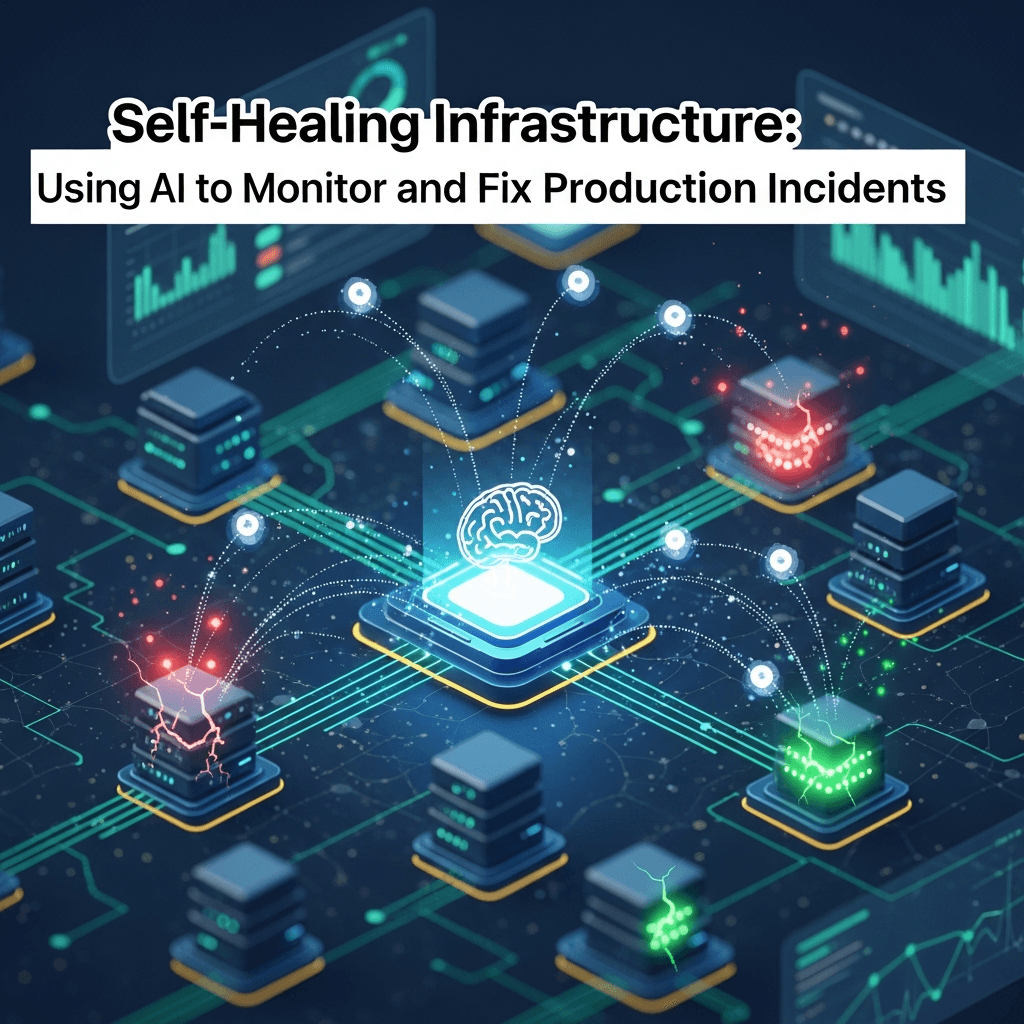
Enter Self-Healing Infrastructure, a paradigm shift that leverages Artificial Intelligence (AI) and Machine Learning (ML) to transform reactive incident response into a proactive, automated capability. Imagine a system that not only detects anomalies but also predicts potential failures, diagnoses root causes, and automatically remediates issues, often before they impact users. This isn't science fiction; it's the promise of AI-powered AIOps (Artificial Intelligence for IT Operations).
This comprehensive guide will delve deep into the principles, technologies, and practical implementation of self-healing infrastructure using AI. We'll explore how AI can monitor vast streams of operational data, identify subtle patterns indicative of impending problems, and trigger automated actions to maintain system health and stability. By the end, you'll have a clear understanding of how to embark on your journey towards more resilient, autonomous production environments.
Prerequisites
To get the most out of this guide, a basic understanding of the following concepts and technologies will be beneficial:
- Cloud Infrastructure: Familiarity with concepts from major cloud providers (AWS, Azure, GCP).
- Monitoring & Observability: Knowledge of tools like Prometheus, Grafana, ELK Stack (Elasticsearch, Logstash, Kibana), or similar systems.
- DevOps & SRE Principles: Understanding of continuous integration/delivery, site reliability engineering, and incident management.
- Basic Programming/Scripting: Familiarity with Python or a similar scripting language for understanding code examples.
- Machine Learning Concepts: A high-level grasp of supervised and unsupervised learning will be helpful, though not strictly required.
1. What is Self-Healing Infrastructure?
Self-healing infrastructure refers to systems designed to detect, diagnose, and automatically resolve operational issues without human intervention. The core idea is to build resilience directly into the infrastructure, enabling it to recover from failures autonomously. This capability moves beyond simple alerting and monitoring to active, intelligent remediation.
At its heart, a self-healing system operates on a feedback loop:
- Monitor: Continuously collect metrics, logs, traces, and events.
- Detect: Identify deviations from normal behavior (anomalies) or predict future issues.
- Diagnose: Determine the root cause of the detected problem.
- Remediate: Execute pre-defined or dynamically generated actions to resolve the issue.
- Verify: Confirm that the remediation was successful and the system is stable.
While rule-based automation can handle simple, known scenarios, the complexity and dynamic nature of modern microservices architectures make purely rule-based approaches insufficient. This is where AI and ML become indispensable, providing the intelligence needed to handle novel situations, learn from past incidents, and operate at scale.
2. The Role of AI/ML in AIOps
AIOps is the application of AI and ML to IT operations data to automate and enhance operational tasks. For self-healing infrastructure, AI/ML provides the intelligence layer that transforms raw operational data into actionable insights and automated responses.
Key AI capabilities in this context include:
- Anomaly Detection: Identifying unusual patterns in metrics, logs, or traces that signify a problem.
- Predictive Analytics: Forecasting future system states or potential failures based on historical data and trends.
- Root Cause Analysis (RCA): Correlating diverse data points to pinpoint the underlying cause of an incident, rather than just its symptoms.
- Automated Remediation: Triggering scripts, runbooks, or API calls to fix issues, often with a feedback loop for learning.
- Noise Reduction: Filtering out alert storms and identifying truly critical signals from a deluge of data.
ML algorithms, both supervised (e.g., classification for incident categorization) and unsupervised (e.g., clustering for anomaly detection), are crucial. They enable systems to learn "normal" behavior, identify deviations, and infer relationships between different operational components without explicit programming for every possible scenario.
3. Data Collection and Ingestion for AI
The effectiveness of any AI/ML system heavily relies on the quality, quantity, and diversity of its input data. For self-healing infrastructure, this means comprehensive collection of operational data.
Types of Data:
- Metrics: Numerical data points over time (CPU utilization, memory usage, network I/O, request latency, error rates).
- Logs: Timestamps events and messages generated by applications and infrastructure components (application logs, system logs, access logs).
- Traces: End-to-end requests flowing through distributed systems, showing latency and dependencies between services.
- Events: Discrete occurrences like deployments, configuration changes, scaling events, or security alerts.
- Topology Data: Information about how services and infrastructure components are interconnected.
Tools and Pipelines:
- Metrics: Prometheus, Grafana, Datadog, New Relic, CloudWatch.
- Logs: ELK Stack (Elasticsearch, Logstash, Kibana), Splunk, Sumo Logic, Loki.
- Traces: Jaeger, Zipkin, OpenTelemetry.
- Data Ingestion: Apache Kafka, AWS Kinesis, Google Cloud Pub/Sub, Fluentd, Logstash agents.
Data Preparation:
Before feeding data to AI models, it often needs to be pre-processed:
- Normalization: Standardizing data formats and units.
- Enrichment: Adding context (e.g., host metadata, application tags).
- Feature Engineering: Creating new features from raw data that might be more informative for ML models (e.g., rate of change, moving averages).
- Cleaning: Handling missing values, removing duplicates, and filtering noise.
This robust data pipeline forms the foundation upon which intelligent self-healing capabilities are built.
4. Anomaly Detection with Machine Learning
Anomaly detection is the cornerstone of self-healing systems. It involves identifying data points, events, or observations that deviate significantly from the majority of the data, indicating a potential problem. Unlike threshold-based alerts, ML-driven anomaly detection can identify subtle, multivariate anomalies and adapt to changing baselines.
Types of Anomalies:
- Point Anomalies: A single data point is abnormal (e.g., a sudden spike in error rate).
- Contextual Anomalies: A data point is abnormal in a specific context but normal otherwise (e.g., high CPU usage during peak hours is normal, but at 3 AM is anomalous).
- Collective Anomalies: A collection of related data points is anomalous, even if individual points aren't (e.g., a slow, steady increase in latency across multiple services).
Common ML Algorithms:
- Statistical Methods: Z-score, EWMA (Exponentially Weighted Moving Average) for time series.
- Clustering-based: K-Means, DBSCAN to identify outliers that don't belong to any cluster.
- Tree-based: Isolation Forest, which isolates anomalies by randomly selecting a feature and then a split value.
- Support Vector Machines (SVM): One-Class SVM for identifying data points that fall outside a learned boundary of normal data.
- Deep Learning: Autoencoders for learning normal data representation and flagging high reconstruction errors as anomalies.
Code Example: Simple Anomaly Detection using Isolation Forest (Python)
This example demonstrates how to detect anomalies in a synthetic dataset representing a metric over time. We'll use scikit-learn's IsolationForest.
import pandas as pd
import numpy as np
from sklearn.ensemble import IsolationForest
import matplotlib.pyplot as plt

# 1. Generate synthetic data: Normal behavior with some anomalies
np.random.seed(42)
# Normal data (e.g., CPU utilization between 30-60%)
normal_data = np.random.normal(loc=45, scale=5, size=200)

# Introduce some anomalies (e.g., sudden spikes or drops)
anomalies = np.concatenate([
    np.random.normal(loc=90, scale=5, size=5),  # High spike
    np.random.normal(loc=10, scale=3, size=3),  # Low drop
    np.random.normal(loc=70, scale=3, size=2)   # Moderate spike
])

# Combine and shuffle data
data = np.concatenate([normal_data, anomalies])
np.random.shuffle(data)

df = pd.DataFrame(data, columns=['metric_value'])

# 2. Train the Isolation Forest model
# contamination: The proportion of outliers in the data set.
# This is an estimate used to define the decision function threshold.
model = IsolationForest(contamination=0.05, random_state=42)
model.fit(df[['metric_value']])

# 3. Predict anomalies (-1 for anomaly, 1 for normal)
df['anomaly'] = model.predict(df[['metric_value']])

# 4. Visualize the results
plt.figure(figsize=(12, 6))
plt.plot(df.index, df['metric_value'], label='Metric Value', color='blue')

anomalies_df = df[df['anomaly'] == -1]
plt.scatter(anomalies_df.index, anomalies_df['metric_value'], color='red', label='Anomaly')

plt.title('Anomaly Detection using Isolation Forest')
plt.xlabel('Time/Index')
plt.ylabel('Metric Value')
plt.legend()
plt.grid(True)
plt.show()

print("Detected anomalies:\n", anomalies_df)
This code snippet demonstrates how easily an ML model can identify unusual data points that might signify an incident. In a real-world scenario, these detected anomalies would trigger further diagnosis or automated remediation.
5. Predictive Analytics for Proactive Healing
Beyond detecting current anomalies, AI can predict future incidents before they manifest, enabling truly proactive self-healing. Predictive analytics involves analyzing historical data to forecast future trends and identify leading indicators of potential problems.
How it works:
- Time Series Forecasting: Models analyze historical patterns in metrics (e.g., CPU usage, disk space, connection pool saturation) to predict their values in the near future.
- Thresholding on Forecasts: If a forecasted value crosses a critical threshold (e.g., disk usage predicted to hit 90% in the next hour), an alert or remediation action can be triggered.
- Pattern Recognition: Identifying sequences of events or metric behaviors that historically precede an incident.
Common Algorithms:
- ARIMA/SARIMA: Traditional statistical models for time series forecasting.
- Prophet: A forecasting procedure developed by Facebook, particularly good for business time series data with strong seasonal effects and missing data.
- LSTM (Long Short-Term Memory) Networks: A type of recurrent neural network (RNN) well-suited for complex time series patterns.
Code Example: Basic Time Series Forecasting with Prophet (Python)
This example shows how to use Facebook's Prophet library to forecast a metric, which can then be used to predict future resource exhaustion.
import pandas as pd
from prophet import Prophet
import matplotlib.pyplot as plt

# 1. Generate synthetic time series data (e.g., increasing disk usage)
# Simulate daily data for 100 days with a trend and some noise
dates = pd.to_datetime(pd.date_range(start='2023-01-01', periods=100, freq='D'))
disk_usage = np.linspace(50, 80, 100) + np.random.normal(loc=0, scale=2, size=100)

# Introduce a sudden increase towards the end to simulate an issue
disk_usage[80:] += np.random.normal(loc=10, scale=3, size=20)

df = pd.DataFrame({'ds': dates, 'y': disk_usage})

# 2. Initialize and fit the Prophet model
# Prophet expects columns 'ds' (datestamp) and 'y' (metric value)
model = Prophet()
model.fit(df)

# 3. Create a future dataframe for predictions (e.g., next 10 days)
future = model.make_future_dataframe(periods=10)

# 4. Make predictions
forecast = model.predict(future)

# 5. Visualize the forecast
fig = model.plot(forecast)
plt.title('Disk Usage Forecast with Prophet')
plt.xlabel('Date')
plt.ylabel('Disk Usage (%)')
plt.show()

# You can also plot components (trend, seasonality, etc.)
fig2 = model.plot_components(forecast)
plt.show()

# Identify when the forecast crosses a critical threshold (e.g., 90%)
critical_threshold = 90
predicted_breach = forecast[forecast['yhat'] >= critical_threshold]

if not predicted_breach.empty:
    print(f"Predicted to breach {critical_threshold}% disk usage on: ")
    print(predicted_breach[['ds', 'yhat']].head())
else:
    print(f"No breach of {critical_threshold}% disk usage predicted in the forecast period.")
By predicting future states, systems can take preventative actions like increasing disk space, scaling resources, or optimizing database queries before an actual incident occurs, significantly reducing downtime.
6. Automated Root Cause Analysis (RCA)
Identifying the true root cause of an incident, especially in complex distributed systems, is often the most challenging part of incident management. AI can significantly accelerate and automate this process by correlating disparate data points.
AI-driven RCA techniques:
- Log Anomaly & Clustering: AI can cluster similar log messages, identify rare log patterns, and detect sudden changes in log volume or error rates, pointing to specific service issues.
- Topology Mapping: Understanding service dependencies and infrastructure topology (e.g., using graph databases like Neo4j) allows AI to trace an issue from a symptom back to its origin.
- Event Correlation: Connecting alerts from different sources (e.g., a CPU spike on a host, high latency on a dependent service, and increased error logs from an application) to build a coherent incident narrative.
- Change Detection: Correlating incidents with recent deployments, configuration changes, or infrastructure modifications can quickly identify the culprit.
- Historical Learning: AI models can learn from past incidents, associating specific patterns of metrics/logs with known root causes.
For example, if an application's latency increases, an AI system might analyze:
- Recent code deployments to that application.
- Database query performance for its dependencies.
- CPU/memory usage of the underlying hosts/containers.
- Network latency between the application and its dependencies.
- Error rates in logs from upstream and downstream services.
By weighing these factors and leveraging learned relationships, the AI can propose the most probable root cause, reducing diagnostic time from hours to minutes or even seconds.
7. Automated Remediation Strategies
Once an anomaly is detected and a root cause (or at least a high-confidence symptom) is identified, the self-healing system can trigger automated remediation actions. These actions are defined in playbooks or runbooks, which are essentially pre-approved sequences of steps to resolve common issues.
Common Remediation Actions:
- Restarting Services/Pods: For hung processes or memory leaks.
- Scaling Up/Out: Adding more instances or increasing resource allocation for CPU/memory bottlenecks.
- Rolling Back Deployments: If a recent deployment is identified as the cause of an issue.
- Isolating Faulty Nodes: Removing a misbehaving server or container from the load balancer.
- Clearing Cache/Queue: For issues related to stale data or backlog.
- Executing Custom Scripts: Running specific commands to fix a known problem (e.g., clearing a
/tmpdirectory). - Notifying Human Operators: For complex or critical issues requiring human oversight, the system can provide a rich context for faster manual resolution.
Integration with Orchestration Tools:
Automated remediation heavily relies on integration with existing infrastructure orchestration and configuration management tools:
- Kubernetes: For scaling pods, rolling restarts, self-healing deployments.
- Ansible, Chef, Puppet: For configuration management and executing scripts on VMs.
- Terraform, CloudFormation: For infrastructure provisioning and adjustments.
- Service Mesh (e.g., Istio): For traffic management, circuit breaking, and fault injection to test resilience.
Code Example: Pseudo-code for an Automated Remediation Workflow
This abstract example illustrates a simple remediation script that might be triggered by an anomaly detection system. It focuses on a high_cpu_service scenario.
# This is pseudo-code to illustrate a concept, not runnable directly.

def trigger_remediation(incident_details):
    service_name = incident_details.get("service_name")
    incident_type = incident_details.get("incident_type")
    severity = incident_details.get("severity")

    print(f"\n--- Remediation Triggered ---")
    print(f"Incident Type: {incident_type} for {service_name} (Severity: {severity})")

    if incident_type == "high_cpu_service":
        print(f"Diagnosing high CPU for service: {service_name}")
        # Check current pod/instance count
        current_replicas = get_kubernetes_replicas(service_name)
        print(f"Current replicas for {service_name}: {current_replicas}")

        if current_replicas < MAX_REPLICAS:
            print(f"Scaling up {service_name} by 1 replica...")
            success = scale_kubernetes_service(service_name, current_replicas + 1)
            if success:
                print(f"Successfully scaled up {service_name}. Verifying health...")
                if verify_service_health(service_name):
                    print(f"Service {service_name} is healthy after scale-up.")
                    send_notification("SUCCESS", f"Scaled up {service_name} due to high CPU.")
                else:
                    print(f"Service {service_name} still unhealthy after scale-up. Attempting restart...")
                    restart_kubernetes_service(service_name)
                    if verify_service_health(service_name):
                        print(f"Service {service_name} healthy after restart.")
                        send_notification("SUCCESS", f"Restarted {service_name} after scale-up failed to resolve high CPU.")
                    else:
                        print(f"Restart failed. Escalating to human.")
                        send_notification("ESCALATE", f"Automated remediation for {service_name} failed. High CPU persists.")
            else:
                print(f"Failed to scale up {service_name}. Escalating.")
                send_notification("ESCALATE", f"Failed to scale up {service_name} due to high CPU.")
        else:
            print(f"Service {service_name} already at max replicas. Attempting restart...")
            restart_kubernetes_service(service_name)
            if verify_service_health(service_name):
                print(f"Service {service_name} healthy after restart.")
                send_notification("SUCCESS", f"Restarted {service_name} due to high CPU at max replicas.")
            else:
                print(f"Restart failed. Escalating to human.")
                send_notification("ESCALATE", f"Automated remediation for {service_name} failed. High CPU persists.")

    elif incident_type == "database_connection_error":
        print(f"Attempting to clear database connection pool for {service_name}...")
        # Call an API endpoint or execute a script to clear connections
        success = clear_db_connection_pool(service_name)
        if success:
            print(f"Successfully cleared DB connection pool. Verifying health...")
            if verify_service_health(service_name):
                send_notification("SUCCESS", f"Cleared DB connection pool for {service_name}.")
            else:
                send_notification("ESCALATE", f"Cleared DB connection pool but {service_name} still unhealthy.")
        else:
            send_notification("ESCALATE", f"Failed to clear DB connection pool for {service_name}.")

    else:
        print(f"Unknown incident type '{incident_type}'. Escalating to human.")
        send_notification("ESCALATE", f"Unknown incident type for {service_name}. Manual intervention required.")

# --- Mock functions for illustration ---
MAX_REPLICAS = 5

def get_kubernetes_replicas(service):
    # Simulate fetching current replicas
    return 2

def scale_kubernetes_service(service, new_replicas):
    # Simulate Kubernetes API call
    print(f"[K8s API] Scaling {service} to {new_replicas} replicas...")
    return True

def restart_kubernetes_service(service):
    # Simulate Kubernetes API call
    print(f"[K8s API] Restarting {service}...")
    return True

def verify_service_health(service):
    # Simulate health check API call
    print(f"[Health Check] Verifying health of {service}...")
    return True

def clear_db_connection_pool(service):
    # Simulate clearing DB pool
    print(f"[DB Ops] Clearing connection pool for {service}...")
    return True

def send_notification(status, message):
    # Simulate sending a Slack/PagerDuty notification
    print(f"[Notification] {status}: {message}")

# Example usage:
incident_payload_cpu = {
    "service_name": "my-api-service",
    "incident_type": "high_cpu_service",
    "severity": "P2",
    "metric_value": 85.5
}

incident_payload_db = {
    "service_name": "user-auth-service",
    "incident_type": "database_connection_error",
    "severity": "P1",
    "error_message": "Too many connections"
}

trigger_remediation(incident_payload_cpu)
trigger_remediation(incident_payload_db)
This pseudo-code illustrates a common pattern: detect, diagnose, then execute a series of pre-defined actions, with verification steps and escalation pathways. The real power comes from integrating this with actual cloud APIs and orchestration tools.
8. Implementing a Self-Healing System - A Practical Workflow
Building a self-healing infrastructure involves integrating several components into a cohesive workflow:
-
Comprehensive Observability: Ensure all critical components (applications, infrastructure, network, databases) are emitting metrics, logs, and traces. Use agents, sidecars, or native cloud integrations.
-
Centralized Data Platform: Ingest all operational data into a scalable data lake or stream processing platform (e.g., Kafka + S3/Elasticsearch).
-
AI/ML Processing Layer: Apply ML models for:
- Anomaly Detection: Real-time analysis of incoming data streams.
- Predictive Analytics: Batch or near-real-time forecasting.
- Correlation & RCA: Linking anomalies to potential root causes using dependency graphs and historical incident data.
-
Decision Engine: Based on AI insights, this engine decides if an automatic remediation is warranted, considering severity, confidence level of diagnosis, and impact. It might follow a decision tree or a more complex reinforcement learning model.
-
Automated Action Execution: Invoke pre-defined runbooks or API calls to orchestration tools (Kubernetes API, cloud provider APIs, Ansible playbooks) to perform remediation actions.
-
Verification & Feedback Loop: After remediation, continuously monitor the system to ensure the issue is resolved. This feedback is crucial for retraining and improving AI models and refining remediation strategies.
-
Human-in-the-Loop: For high-severity or novel incidents, the system should escalate to human operators, providing rich context and proposed solutions. Over time, as confidence grows, more actions can become fully automated.
Example Scenario: High CPU on a Microservice
- Monitor: Prometheus scrapes CPU metrics from
OrderServicepods. - Detect (AI): Anomaly Detection model (e.g., Isolation Forest) identifies a sudden, sustained spike in
OrderServiceCPU beyond the learned normal range. - Predict (AI): Predictive model (e.g., Prophet) shows that the CPU is trending towards 95% saturation within the next 15 minutes.
- Diagnose (AI): RCA engine correlates the CPU spike with recent log entries showing increased
OutOfMemoryErrorwarnings and a new deployment ofOrderServicethat occurred 30 minutes prior. It suggests "Recent deployment introduced a memory leak causing high CPU due to garbage collection." - Remediate (Automated):
- Step 1: The Decision Engine triggers a Kubernetes scale-out action, increasing
OrderServicereplicas by 20%. - Step 2: If CPU remains high after 5 minutes, it triggers a rollback to the previous stable version of
OrderServiceusing Kubernetes deployment history.
- Step 1: The Decision Engine triggers a Kubernetes scale-out action, increasing
- Verify: Monitoring shows CPU returning to normal and error rates decreasing. The system marks the incident as resolved.
- Feedback: The successful rollback and resolution are recorded, feeding into future model training and playbook refinement.
- Notify: An informational message is sent to the DevOps team's Slack channel about the self-healing action.
9. Best Practices for AI-Powered Self-Healing
Implementing self-healing infrastructure with AI is a journey, not a destination. Adhering to best practices ensures a robust, reliable, and continuously improving system.
- Start Small and Iterate: Don't try to automate everything at once. Begin with well-understood, high-frequency, low-risk incidents (e.g., restarting a hung process, clearing a cache) and gradually expand.
- Define Clear Incident Boundaries: Clearly define what constitutes an "incident" and what metrics/logs indicate its presence and resolution. This helps in training accurate AI models.
- Human-in-the-Loop (Initially): For critical or complex remediations, always involve human oversight initially. Automate only when confidence in the AI's diagnosis and remediation success is very high. Provide clear dashboards and context for human intervention.
- Robust Testing of Automated Actions: Thoroughly test all automated remediation scripts and playbooks in staging and pre-production environments. Simulate failures and ensure the actions work as expected and don't introduce new problems.
- Comprehensive Observability is Key: "Garbage in, garbage out" applies strongly to AI. Ensure high-quality, diverse, and complete data collection from all layers of your stack.
- Continuous Training and Evaluation: AI models degrade over time as system behavior evolves. Regularly retrain models with fresh data and evaluate their performance (precision, recall, F1-score for anomaly detection; MAE, RMSE for forecasting).
- Explainability (XAI): Strive for models that can explain why they detected an anomaly or suggested a remediation. This builds trust and helps engineers understand and debug issues.
- Security Considerations: Automated systems have elevated privileges. Implement strong access controls, audit trails, and ensure remediation actions cannot be exploited.
- Version Control for Runbooks: Treat automated runbooks and remediation scripts as code. Store them in version control (Git), review changes, and test them rigorously.
- Focus on Business Impact: Prioritize automating incidents that have the highest business impact (e.g., customer-facing service downtime) or consume significant engineering time.
10. Common Pitfalls and Challenges
While the benefits of AI-powered self-healing are immense, organizations must be aware of potential pitfalls:
- Alert Fatigue and False Positives: Overly sensitive anomaly detection models can generate too many false alarms, leading to engineers ignoring alerts and losing trust in the system.
- "Black Box" AI: If AI models are too complex or lack explainability, engineers may struggle to understand why a remediation was triggered or why an anomaly was detected, hindering debugging and trust.
- Over-Automation and Cascading Failures: Automating too aggressively without proper validation can lead to an automated action inadvertently causing a larger, cascading failure. Always have safeguards and a "kill switch."
- Data Quality Issues: Incomplete, inconsistent, or noisy data will lead to poor model performance and unreliable self-healing capabilities.
- Integration Complexity: Integrating diverse monitoring tools, data platforms, AI engines, and orchestration systems can be a significant engineering challenge.
- Skill Gap: Building and maintaining AI/ML models requires specialized data science and ML engineering skills, which may not be readily available in traditional operations teams.
- Defining "Normal": What constitutes "normal" behavior can be subjective and change over time, requiring adaptive models and continuous recalibration.
- Cost: Implementing a full-fledged AIOps platform with robust AI capabilities can involve significant investment in tools, infrastructure, and personnel.
Addressing these challenges requires a strategic approach, a willingness to learn and adapt, and a strong collaboration between operations, development, and data science teams.
Conclusion
Self-healing infrastructure, augmented by the power of AI and Machine Learning, represents the next frontier in operational excellence. By moving beyond reactive incident response to proactive detection, prediction, and automated remediation, organizations can achieve unprecedented levels of system reliability, reduce operational costs, and free up valuable engineering time for innovation.
The journey to a fully autonomous, self-healing system is complex, requiring robust data pipelines, sophisticated AI models, and a culture of continuous improvement. However, by starting small, focusing on well-defined problems, and iteratively building confidence in automated actions, the vision of systems that can monitor, predict, and fix themselves is increasingly within reach.
Embracing AI in your operations is not just about adopting new tools; it's about fundamentally rethinking how you manage your production environment. It's about empowering your infrastructure to become more resilient, intelligent, and ultimately, more reliable for your users. The future of operations is self-healing, and AI is the engine driving this transformative change.
Start experimenting with AI-driven anomaly detection and predictive analytics today. Identify your most common, repetitive incidents and explore how intelligent automation can alleviate the burden, paving the way for a more robust and efficient operational landscape.
Written by
CodewithYohaFull-Stack Software Engineer with 7+ years of experience in Java, Spring Boot, and cloud architecture across AWS, Azure, and GCP. Writing production-grade engineering patterns for developers who ship real software.