
Introduction
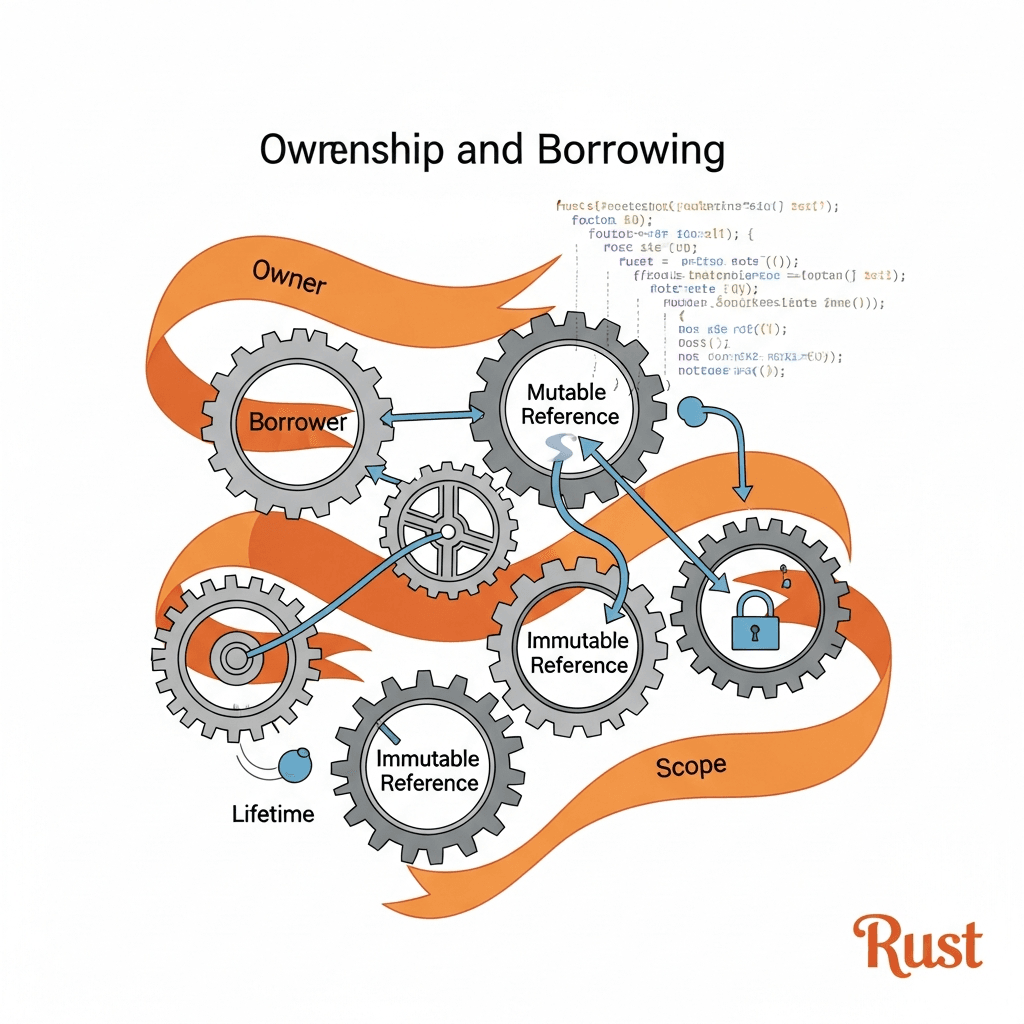
Rust, a language celebrated for its performance, reliability, and safety, achieves these feats through a unique approach to memory management: Ownership and Borrowing. Unlike languages with garbage collectors (like Java, Go, Python) or manual memory management (like C, C++), Rust's compiler, often referred to as the "borrow checker," enforces a strict set of rules at compile time.
This system eliminates entire classes of bugs, such as data races, null pointer dereferences, and use-after-free errors, without runtime overhead. It's the cornerstone of Rust's promise: memory safety without sacrificing speed. While initially challenging, mastering ownership and borrowing unlocks the full power of Rust. This guide aims to demystify these concepts, providing a clear, visual-analogy-driven path to understanding.
Prerequisites
To get the most out of this guide, a basic understanding of Rust's syntax (variables, functions, data types) is helpful. Familiarity with concepts like the stack and heap in computer memory will also be beneficial, though we'll touch upon them briefly.
1. What is Ownership? The Core Concept
At its heart, ownership is a set of rules that govern how Rust manages memory. Think of ownership like holding the deed to a house. When you own the deed, you are responsible for that house. If you transfer the deed to someone else, you no longer own it.
Rust's ownership rules are simple yet profound:
- Each value in Rust has a variable that's called its owner.
- There can only be one owner at a time.
- When the owner goes out of scope, the value will be dropped (memory freed).
Let's consider how this applies to memory. Variables in Rust store data either on the stack or the heap.
- Stack: Fast, fixed-size data. Think of it like a stack of plates; you add and remove from the top. Pushing to the stack and popping from it is very efficient.
- Heap: Slower, variable-size data. Think of it like a restaurant seating area; you request a table of a certain size, and the host finds one and gives you a pointer to it. Accessing data on the heap involves following a pointer.
Types like integers (i32), booleans (bool), and fixed-size arrays are stored on the stack. More complex, variable-sized types like String (a growable, UTF-8 encoded string) and Vec (a growable list) store their actual data on the heap, but the variable itself (which includes a pointer to the heap data, length, and capacity) lives on the stack.
When a variable goes out of scope, Rust automatically calls a function called drop on the data, freeing its memory. This is Rust's equivalent of garbage collection, but it happens deterministically at compile time or at the end of a scope, not at runtime.
fn main() {
    let s1 = String::from("hello"); // s1 owns the String data on the heap
    // ... s1 is in scope ...
} // s1 goes out of scope, 'drop' is called, memory is freed.
2. Move Semantics: Transferring Ownership
One of the most crucial aspects of ownership is how it behaves when you assign a variable to another or pass it to a function. For types that are stored on the heap (like String), Rust doesn't copy the underlying data by default; instead, it moves ownership.
Consider our house deed analogy: if you give the deed to your friend, you no longer own the house. You can't then sell the house yourself.
When s1 is assigned to s2, s1's ownership of the String data is moved to s2. s1 is then considered invalid. This prevents a common bug called a "double free" error, where two pointers might try to free the same memory, leading to corruption or crashes.
fn main() {
    let s1 = String::from("hello"); // s1 owns "hello"
    let s2 = s1;                   // Ownership of "hello" moves from s1 to s2.
                                  // s1 is now invalid and cannot be used.

    println!("{}", s2);            // This is fine: s2 now owns the data.
    // println!("{}", s1);         // ERROR! s1 was moved. This line would cause a compile-time error:
                                  // "value borrowed here after move"
}

fn takes_ownership(some_string: String) { // some_string comes into scope
    println!("{}", some_string);
} // some_string goes out of scope and 'drop' is called.

fn main() {
    let s = String::from("world"); // s owns "world"

    takes_ownership(s);            // s's ownership moves into the function's parameter 'some_string'.
                                  // s is now invalid.

    // println!("{}", s);         // ERROR! s was moved.
}
3. Clone vs. Copy Traits: Duplicating Data
Sometimes, you do want to make a complete, independent copy of the data. Rust provides two traits for this:
-
CopyTrait: For types that live entirely on the stack (e.g., integers, booleans, characters, tuples containing onlyCopytypes). When you assign aCopytype, a bit-for-bit copy is made, and the original variable remains valid. No ownership move occurs. -
CloneTrait: For types that might have data on the heap (e.g.,String,Vec). To explicitly make a deep copy of the data, you must call the.clone()method. This is an explicit, potentially expensive operation.
fn main() {
    // Example with Copy (i32)
    let x = 5; // x owns the integer 5 (on the stack)
    let y = x; // y gets a copy of 5. x is still valid.

    println!("x: {}, y: {}", x, y);

    // Example with Clone (String)
    let s1 = String::from("hello"); // s1 owns "hello" on the heap
    let s2 = s1.clone();             // s2 gets a *new, independent copy* of "hello" on the heap.
                                   // s1 is still valid.

    println!("s1: {}, s2: {}", s1, s2);

    // If we didn't clone, s1 would be moved and invalid:
    let s3 = String::from("world");
    let s4 = s3; // s3 is moved to s4, s3 is now invalid.
    // println!("s3: {}", s3); // Compile-time error!
}
4. What is Borrowing? The Reference System
Often, you want to use a value without taking ownership of it. This is where borrowing comes in. Borrowing allows you to create a reference to a value, which is like getting a library card for a book instead of buying the book. You can read the book, but you don't own it, and you must return it.
A reference is a pointer to a value that is owned by another variable. It doesn't take ownership, so the owner remains valid. References are denoted by an ampersand (&).
Rust's borrowing rules are crucial:
- At any given time, you can have either one mutable reference or any number of immutable references to a particular piece of data.
- References must always be valid. (This is enforced by lifetimes, which we'll discuss next).
An immutable reference (&T) allows you to read the data, but not modify it.
fn calculate_length(s: &String) -> usize { // s is an immutable reference to a String
    s.len()
} // s goes out of scope, but it doesn't 'drop' the data it refers to,
  // because it never owned it.

fn main() {
    let s1 = String::from("hello"); // s1 owns "hello"

    let len = calculate_length(&s1); // We pass a reference to s1. s1 remains valid.

    println!("The length of '{}' is {}.", s1, len); // s1 is still usable.
}
5. Mutable References: Modifying Borrowed Data
If you need to modify data that you've borrowed, you use a mutable reference (&mut T). This is like getting special permission to annotate or highlight a library book. Because you're modifying it, the library wants to ensure only you are making changes at that specific time to prevent conflicts.
Rust's rule for mutable references is very strict: you can only have one mutable reference to a particular piece of data in a given scope. This rule is critical for preventing data races at compile time. A data race occurs when:
- Two or more pointers access the same data at the same time.
- At least one of the pointers is writing to the data.
- There's no mechanism to synchronize access to the data.
Without mutable references, this is how data races manifest: multiple threads trying to modify the same data concurrently, leading to unpredictable results. Rust's borrow checker catches these issues before your code even runs.
fn change_string(some_string: &mut String) { // some_string is a mutable reference
    some_string.push_str(", world");
}

fn main() {
    let mut s = String::from("hello"); // s must be declared 'mut' to allow mutable borrows

    change_string(&mut s);             // Pass a mutable reference to s

    println!("{}", s);                 // s is now "hello, world"

    let r1 = &mut s; // First mutable borrow
    // let r2 = &mut s; // ERROR! Cannot borrow 's' as mutable more than once at a time.

    // This is also an error: cannot have a mutable borrow while an immutable borrow exists
    // let r3 = &s; // ERROR! Cannot borrow 's' as immutable because it is also borrowed as mutable.
}
6. The Rust Compiler (Borrow Checker): Your Static Guardian
The borrow checker is the part of the Rust compiler that enforces all the ownership and borrowing rules. It's like a vigilant librarian who ensures everyone follows the library's rules about borrowing books. It operates statically, meaning it checks your code at compile time, not at runtime.
When you get a borrow checker error, it's not a bug in your code that will crash your program at runtime; it's the compiler telling you that your code could lead to a memory safety issue if it were allowed to run. It's preventing potential bugs before they even become bugs.
Common borrow checker errors often look like:
value borrowed here after movecannot borrow 'x' as mutable more than once at a timecannot borrow 'x' as mutable because it is also borrowed as immutableborrowed value does not live long enough(related to lifetimes)
Understanding these errors is key to mastering Rust. They guide you towards writing safe and correct code.
Let's deliberately create an error and fix it:
fn main() {
    let mut s = String::from("hello");

    let r1 = &s; // Immutable borrow 1
    let r2 = &s; // Immutable borrow 2 (allowed: many readers)

    println!("r1: {}, r2: {}", r1, r2);

    // PROBLEM: We want to modify 's' here, but immutable references r1 and r2 are still active.
    // let r3 = &mut s; // ERROR! Cannot borrow 's' as mutable because it is also borrowed as immutable.
    // r3.push_str(", world");
    // println!("{}", s);

    // FIX: Ensure immutable references go out of scope before creating a mutable one.
    // The immutable references r1 and r2 are no longer used after the println! above.
    // So, we can declare r3 here.
    let r3 = &mut s; // This is now allowed because r1 and r2 are no longer 'active'.
    r3.push_str(", world");

    println!("{}", s);
}
7. Lifetimes: Ensuring References Are Valid
Lifetimes are perhaps the most abstract part of Rust's ownership system, but they are crucial for ensuring references always point to valid data. A lifetime is a named region of code for which a reference is valid. It's not about how long a value lives, but how long a reference to that value is guaranteed to be valid.
Think of a lifetime as the validity period on a library card. The card is only valid for a certain duration, and you can only borrow books during that time. If you try to use an expired card, you're out of luck.
Rust's borrow checker uses lifetimes to ensure that a reference never outlives the data it points to. This prevents "dangling references" – pointers to memory that has already been freed.
Most of the time, you don't need to explicitly annotate lifetimes because the compiler can infer them (this is called lifetime elision). However, when functions take multiple references or return a reference, and the compiler can't unambiguously determine which input reference's lifetime the output reference should match, you'll need to add explicit lifetime annotations.
Lifetime annotations start with an apostrophe (') and are usually lowercase, like 'a, 'b.
// This function takes two string slices and returns a reference to the longer one.
// The returned reference must be valid for the duration of the shorter of the two input lifetimes.
// The lifetime annotation <'a> declares a generic lifetime parameter 'a.
// The 'a on the references indicates that all these references live for at least the duration 'a.
fn longest<'a>(x: &'a str, y: &'a str) -> &'a str {
    if x.len() > y.len() {
        x
    } else {
        y
    }
}

fn main() {
    let string1 = String::from("abcd");
    let string2 = "xyz";

    let result = longest(string1.as_str(), string2);
    println!("The longest string is {}", result);

    // Example where lifetimes matter:
    let string3 = String::from("long string is long");
    {
        let string4 = String::from("xyz");
        let result2 = longest(string3.as_str(), string4.as_str());
        println!("The longest string is {}", result2);
    } // string4 goes out of scope here. result2's lifetime is tied to string4's.
      // This works because result2 is also only used within this inner scope.

    // What if we tried to use result2 outside its valid scope?
    // let result3;
    // {
    //     let string5 = String::from("short");
    //     result3 = longest(string3.as_str(), string5.as_str());
    // } // string5 goes out of scope here. result3 would be a dangling reference!
    // println!("{}", result3); // ERROR! 'string5' does not live long enough.
}
8. Structs, Enums, and Lifetimes
When a struct or enum holds references, you must also specify lifetime parameters for those references. This tells the compiler that any instance of the struct cannot outlive the data it refers to.
// This struct holds a reference to a string slice.
// The lifetime parameter 'a ensures that an instance of ImportantExcerpt
// cannot outlive the string slice it holds a reference to.
struct ImportantExcerpt<'a> {
    part: &'a str,
}

impl<'a> ImportantExcerpt<'a> {
    fn announce_and_return_part(&self, announcement: &str) -> &str {
        println!("Attention: {}", announcement);
        self.part
    }
}

fn main() {
    let novel = String::from("Call me Ishmael. Some years ago...");
    let first_sentence = novel.split('.').next().expect("Could not find a '.'");
    let i = ImportantExcerpt {
        part: first_sentence,
    };

    println!("Excerpt part: {}", i.part);

    let announcement_text = String::from("Important news!");
    let returned_part = i.announce_and_return_part(announcement_text.as_str());
    println!("Returned part from method: {}", returned_part);

    // If 'novel' went out of scope before 'i', the compiler would prevent it.
} // 'i' goes out of scope, but the data it refers to ('novel') is still valid.
9. Shared Ownership with Rc and Arc (Brief Mention)
While ownership and borrowing typically enforce a single owner or exclusive mutable access, there are scenarios where you need multiple owners or shared, thread-safe ownership. Rust provides smart pointers for these advanced cases:
Rc<T>(Reference Counting): Allows multiple owners of data on the heap. When the lastRcgoes out of scope, the data is dropped.Rcis single-threaded only.Arc<T>(Atomic Reference Counting): Similar toRc, but is thread-safe. It uses atomic operations to increment/decrement the reference count, making it suitable for sharing data across multiple threads.
These are more advanced topics, but it's important to know that Rust provides solutions for shared ownership when the strict borrowing rules don't quite fit your design.
10. Best Practices for Ownership and Borrowing
- Prefer Borrowing (
&T,&mut T) over Cloning (.clone()): Cloning can be expensive as it involves copying data. If you only need to read or temporarily modify data, borrowing is more efficient. - Design APIs for Clarity: Function signatures should clearly communicate ownership semantics. If a function takes
T, it takes ownership. If it takes&T, it borrows immutably. If&mut T, it borrows mutably. - Minimize Mutable Borrows: Keep the scope of mutable references as small as possible. This reduces the chances of conflicts with other borrows and makes your code easier to reason about.
- Understand
Copyvs.Clone: Don't accidentally clone when you meant to move, and don't get surprised when aCopytype doesn't move. - Use
StringandVecfor Owned Data: When you need data that you own and can modify,StringandVecare your go-to types. - Use
&strand&[T]for Borrowed Slices: When you need to refer to a portion of aStringorVec(or an array) without taking ownership, use string slices (&str) or slice references (&[T]). - Embrace the Borrow Checker: See compiler errors as helpful guides, not roadblocks. They are pointing you towards safer, more performant code.
11. Common Pitfalls and How to Avoid Them
-
"Value borrowed here after move": This happens when you try to use a variable after its ownership has been moved (e.g., assigned to another variable, passed to a function). Solution: Clone the data if you need an independent copy, or pass a reference (
&) if you only need to read it.rustlet s1 = String::from("hello"); let s2 = s1; // s1 moved to s2 // println!("{}", s1); // Error: s1 used after move -
"Cannot borrow
xas mutable more than once at a time": This occurs when you try to create a second mutable reference to the same data while the first one is still active. Solution: Ensure mutable references go out of scope before creating new ones. Use curly braces{}to explicitly create smaller scopes if needed.rustlet mut s = String::from("test"); let r1 = &mut s; // let r2 = &mut s; // Error // r1 and r2 cannot coexist. r1.push_str("ing"); // After r1 is no longer used, we can get another mutable reference. let r2 = &mut s; r2.push_str(" done"); println!("{}", s); -
"Cannot borrow
xas mutable because it is also borrowed as immutable": You cannot have immutable and mutable references to the same data active concurrently. Solution: Again, ensure immutable references go out of scope before attempting a mutable borrow.rustlet mut s = String::from("data"); let r_imm = &s; // Immutable borrow // let r_mut = &mut s; // Error: cannot get mutable borrow while immutable one exists. println!("Immutable: {}", r_imm); // Use r_imm here, then it's no longer 'active' let r_mut = &mut s; // This is now fine. r_mut.push_str(" changed"); println!("Mutable: {}", r_mut); -
Dangling References: The borrow checker prevents these by ensuring references do not outlive the data they point to, often leading to lifetime errors like "borrowed value does not live long enough." Solution: Adjust the scope of the owner or the reference, or return an owned value instead of a reference if the data's owner would go out of scope.
rust// fn dangle() -> &String { // This function would try to return a reference to a String it creates // let s = String::from("hello"); // s comes into scope // &s // We return a reference to s // } // s goes out of scope here, and is dropped. The returned reference would be dangling! // The compiler prevents this. // Correct way to return owned data: fn no_dangle() -> String { let s = String::from("hello"); s // Ownership of s is moved out of the function. }
Conclusion
Rust's ownership and borrowing system is a paradigm shift in how we approach memory management. It's the secret sauce that allows Rust to deliver both high performance and robust memory safety without the overhead of a garbage collector. While the initial learning curve can feel steep, the rewards are immense: code that is inherently safer, faster, and more reliable.
By understanding the core rules of ownership, the implications of moves, the distinction between Copy and Clone, and the power of references (both immutable and mutable) enforced by the vigilant borrow checker and explicit lifetimes, you gain a deep appreciation for Rust's design philosophy. Embrace the borrow checker's guidance; it's your most powerful ally in writing exceptional systems-level code.
Keep practicing, experimenting with code, and interpreting compiler messages. With each error resolved, your understanding will deepen, and you'll find yourself writing idiomatic Rust with confidence. The mastery of ownership and borrowing is the key to unlocking Rust's full potential.

Written by
CodewithYohaFull-Stack Software Engineer with 7+ years of experience in Java, Spring Boot, and cloud architecture across AWS, Azure, and GCP. Writing production-grade engineering patterns for developers who ship real software.