Introduction
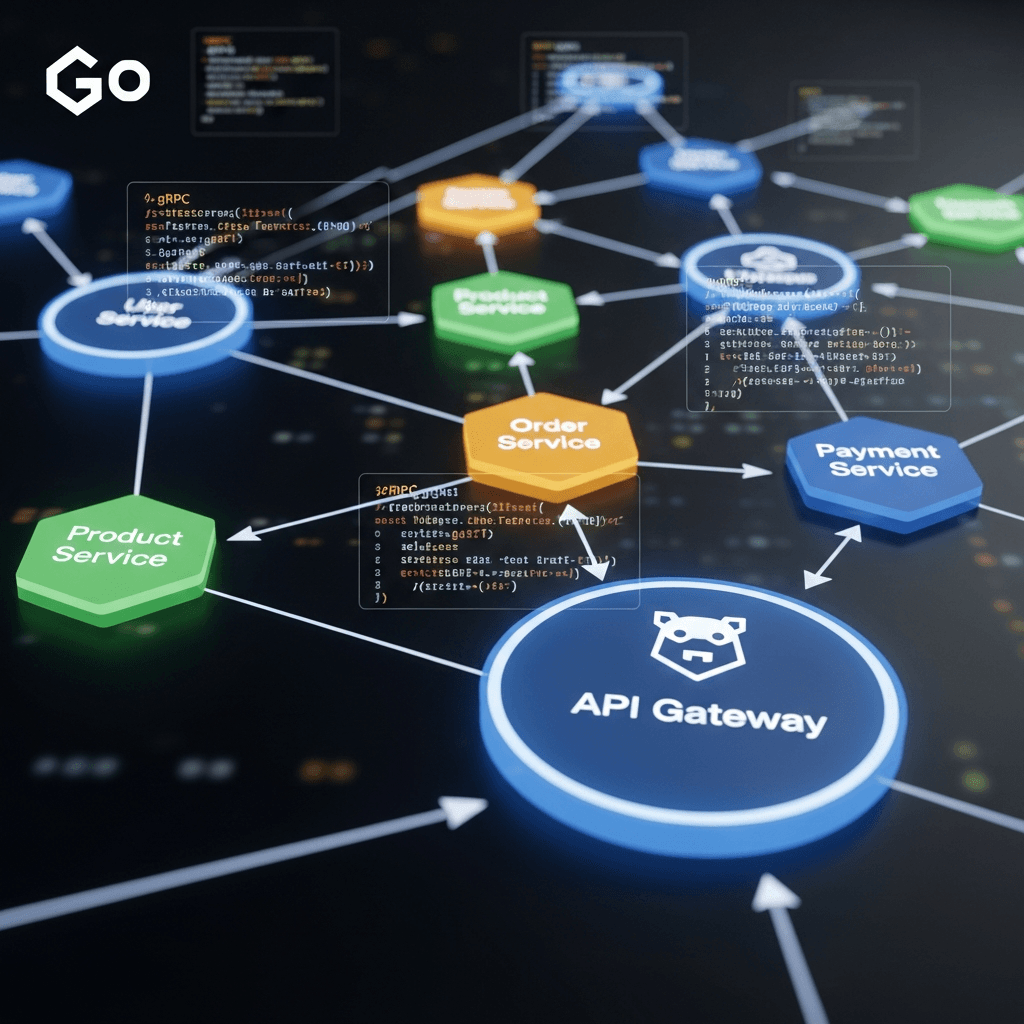
The modern software landscape demands systems that are scalable, resilient, and maintainable. Monolithic applications, while simpler to initially develop, often struggle to meet these demands as they grow. This is where microservices shine, breaking down complex systems into smaller, independently deployable, and manageable services.
However, building microservices effectively requires careful consideration of communication protocols, data serialization, and language choice. This article delves into a powerful triumvirate that has emerged as a gold standard for high-performance, strongly-typed microservices: Go, gRPC, and Protocol Buffers.
We'll explore why this combination is so effective, provide practical, step-by-step guidance on implementation, and discuss best practices to help you build robust, production-ready microservices.
Prerequisites
Before diving in, ensure you have the following:
- Go (v1.16 or higher): Installed and configured on your system.
- Protocol Buffers Compiler (
protoc): Downloaded and added to your PATH. - Go gRPC Plugins: Installed via
go install google.golang.org/protobuf/cmd/protoc-gen-go@latestandgo install google.golang.org/grpc/cmd/protoc-gen-go-grpc@latest. - Basic understanding of Go: Familiarity with Go syntax, concurrency, and module system.
- Basic understanding of microservice concepts: Knowledge of service-oriented architecture principles.
Why Go for Microservices?
Go (Golang) has rapidly become a preferred language for building backend services, particularly microservices, due to several compelling reasons:
- Concurrency Primitives: Go's goroutines and channels make concurrent programming simple and efficient, allowing services to handle many requests simultaneously without complex threading models.
- Performance: Go compiles to machine code, offering performance comparable to C/C++ while providing garbage collection and type safety. Its small memory footprint is also a significant advantage.
- Simplicity and Readability: Go's minimalist syntax and strong opinionated tooling (like
go fmt) promote consistent, readable codebases, which is crucial for team collaboration and long-term maintenance. - Fast Compilation: Quick build times enhance developer productivity, especially in large microservice ecosystems.
- Static Binaries: Go applications compile into self-contained static binaries, simplifying deployment and reducing dependency hell.
- Strong Standard Library: Go's comprehensive standard library provides robust support for networking, cryptography, and more, reducing reliance on third-party libraries.
Understanding gRPC
gRPC is an open-source, high-performance Remote Procedure Call (RPC) framework developed by Google. It enables client and server applications to communicate transparently and build connected systems. Here's why it's a game-changer for microservices:
- Performance: gRPC uses Protocol Buffers for data serialization and HTTP/2 for its transport protocol. HTTP/2 offers multiplexing, header compression, and server push, leading to significant performance improvements over traditional HTTP/1.1-based REST APIs.
- Strongly Typed Contracts: Unlike REST, where API contracts are often implicitly defined or rely on external documentation (like OpenAPI), gRPC uses Protocol Buffers to explicitly define service methods, request types, and response types. This ensures type safety across different programming languages.
- Language Agnostic: gRPC supports code generation for numerous languages (Go, Java, Python, C++, Node.js, etc.), allowing polyglot microservice architectures where services can be written in different languages but still communicate seamlessly.
- Bidirectional Streaming: Beyond the traditional unary (request/response) model, gRPC supports server-side streaming, client-side streaming, and bidirectional streaming, enabling real-time, event-driven communication patterns.
- Built-in Features: gRPC provides features like authentication, load balancing, retries, and cancellation out of the box, simplifying the development of robust distributed systems.
gRPC vs. REST
While REST is widely used, gRPC offers distinct advantages for internal microservice communication:
- Data Format: gRPC uses Protocol Buffers (binary) vs. REST's JSON/XML (text).
- Transport: gRPC uses HTTP/2 vs. REST's HTTP/1.1 (typically).
- Contract Definition: gRPC uses
.protofiles (IDL) vs. REST's OpenAPI/Swagger (documentation). - Performance: gRPC generally outperforms REST due to binary serialization and HTTP/2.
- Complexity: gRPC can have a steeper learning curve initially due to code generation and Protobufs.
Protocol Buffers Deep Dive
Protocol Buffers (Protobufs) are Google's language-neutral, platform-neutral, extensible mechanism for serializing structured data. They are smaller, faster, and simpler than XML or JSON.
How Protobufs Work:
- Define Structure: You define the structure of your data in a special
.protofile using the Protocol Buffer Interface Definition Language (IDL). - Compile: The
protoccompiler takes your.protofile and generates source code in your chosen language (Go, Java, Python, etc.) to handle serialization and deserialization of your data. - Use: Your application uses the generated code to populate data structures, serialize them to a binary format, and parse them back.
Advantages:
- Efficiency: Protobufs serialize data into a compact binary format, leading to smaller message sizes and faster transmission over the network.
- Strong Typing: The
.protodefinition acts as a contract, enforcing data types and structures, which helps prevent runtime errors and improves maintainability. - Language Agnostic: A single
.protodefinition can generate code for multiple languages, ensuring interoperability across diverse microservice stacks. - Backward and Forward Compatibility: Protobufs are designed to be extensible. You can add new fields to your message formats without breaking existing services, provided you follow specific rules (e.g., don't change field numbers, mark old fields as deprecated).
Defining Your Service with .proto
The .proto file is the heart of your gRPC service. It defines both the data structures (messages) and the service methods.
Let's create a simple ProductService that allows us to get product details.
First, create a directory for your project, e.g., product-service, and inside it, a proto directory. Then, create product.proto:
syntax = "proto3";

package product;

option go_package = "./product";

// Product represents a single product in the catalog.
message Product {
  string id = 1;
  string name = 2;
  string description = 3;
  double price = 4;
  int32 stock_quantity = 5;
}

// GetProductRequest is the request message for getting a product by ID.
message GetProductRequest {
  string id = 1;
}

// GetProductResponse is the response message for getting a product.
message GetProductResponse {
  Product product = 1;
}

// CreateProductRequest is the request message for creating a new product.
message CreateProductRequest {
  string name = 1;
  string description = 2;
  double price = 3;
  int32 stock_quantity = 4;
}

// CreateProductResponse is the response message for creating a new product.
message CreateProductResponse {
  Product product = 1;
}

// ProductService defines the gRPC service for product operations.
service ProductService {
  rpc GetProduct(GetProductRequest) returns (GetProductResponse);
  rpc CreateProduct(CreateProductRequest) returns (CreateProductResponse);
}
Explanation of the .proto file:
syntax = "proto3";: Specifies we are using Protocol Buffers version 3.package product;: Declares the package name for the Protobuf definitions.option go_package = "./product";: Tells the Go generator where to place the generated Go files.message Product { ... }: Defines a data structure namedProduct. Each field has a type (e.g.,string,double,int32) and a unique field number (e.g.,id = 1). These field numbers are crucial for backward/forward compatibility.service ProductService { ... }: Defines the gRPC service. Inside,rpcdeclares a remote procedure call method, specifying its request and response message types.
Generating Go Code from .proto
Once your .proto file is defined, you use the protoc compiler along with the Go plugins to generate the necessary Go code.
Navigate to your project's root directory (e.g., product-service) in your terminal and run:
protoc --go_out=./proto --go_opt=paths=source_relative \
       --go-grpc_out=./proto --go-grpc_opt=paths=source_relative \
       proto/product.proto
Explanation of the command:
protoc: The Protocol Buffers compiler.--go_out=./proto: Specifies the output directory for the generated Go Protobuf message code (product.pb.go).paths=source_relativeensures the generated file uses relative imports.--go-grpc_out=./proto: Specifies the output directory for the generated Go gRPC service code (product_grpc.pb.go). This file will contain the interface for our server and the client stub.proto/product.proto: The input.protofile.
After running this command, you will find product.pb.go and product_grpc.pb.go in your proto directory. These files contain the Go structs for your messages and the interfaces for the ProductService server and client.
Implementing the gRPC Server in Go
Now, let's implement the ProductService server. We'll create a simple in-memory store for products.
Create a main.go file in your project's root directory:
package main

import (
	"context"
	"fmt"
	"log"
	"net"
	"sync"

	"google.golang.org/grpc"
	"google.golang.org/grpc/codes"
	"google.golang.org/grpc/status"

	pb "product-service/proto" // Import the generated protobuf package

	"github.com/google/uuid" // For generating unique product IDs
)

// server implements the ProductServiceServer interface from the generated protobuf code.
type server struct {
	pb.UnimplementedProductServiceServer // Must be embedded for forward compatibility
	products map[string]*pb.Product // In-memory store for products
	mu       sync.RWMutex           // Mutex to protect concurrent access to products map
}

// NewServer creates a new ProductService server instance.
func NewServer() *server {
	return &server{
		products: make(map[string]*pb.Product),
	}
}

// GetProduct implements the GetProduct RPC method.
func (s *server) GetProduct(ctx context.Context, req *pb.GetProductRequest) (*pb.GetProductResponse, error) {
	log.Printf("Received GetProduct request for ID: %s", req.GetId())

	s.mu.RLock()
	product, ok := s.products[req.GetId()]
	s.mu.RUnlock()

	if !ok {
		return nil, status.Errorf(codes.NotFound, "Product with ID %s not found", req.GetId())
	}

	return &pb.GetProductResponse{Product: product}, nil
}

// CreateProduct implements the CreateProduct RPC method.
func (s *server) CreateProduct(ctx context.Context, req *pb.CreateProductRequest) (*pb.CreateProductResponse, error) {
	log.Printf("Received CreateProduct request for product name: %s", req.GetName())

	// Generate a unique ID for the new product
	id := uuid.New().String()

	newProduct := &pb.Product{
		Id:           id,
		Name:         req.GetName(),
		Description:  req.GetDescription(),
		Price:        req.GetPrice(),
		StockQuantity: req.GetStockQuantity(),
	}

	s.mu.Lock()
	s.products[id] = newProduct
	s.mu.Unlock()

	log.Printf("Created new product with ID: %s", id)

	return &pb.CreateProductResponse{Product: newProduct}, nil
}

func main() {
	// Listen on TCP port 50051
	lis, err := net.Listen("tcp", ":50051")
	if err != nil {
		log.Fatalf("Failed to listen: %v", err)
	}

	// Create a new gRPC server instance
	s := grpc.NewServer()

	// Register our ProductService implementation with the gRPC server
	productServer := NewServer()
	pb.RegisterProductServiceServer(s, productServer)

	log.Printf("gRPC ProductService server listening on %v", lis.Addr())

	// Start serving gRPC requests
	if err := s.Serve(lis); err != nil {
		log.Fatalf("Failed to serve: %v", err)
	}
}
Key parts of the server implementation:
pb.UnimplementedProductServiceServer: Embedding this struct ensures forward compatibility. If new RPC methods are added to the.protofile, your server will still compile, and calls to the unimplemented methods will returnUnimplementederrors.GetProductandCreateProductmethods: These implement the interfaces defined inproduct_grpc.pb.go. They receive thecontext.Contextand the respective request message, and return the response message or an error.status.Errorf: This helper fromgoogle.golang.org/grpc/statusis used to return gRPC-specific error codes (likecodes.NotFound).grpc.NewServer(): Creates a new gRPC server.pb.RegisterProductServiceServer(s, productServer): Registers our customserverimplementation with the gRPC server.s.Serve(lis): Starts the gRPC server, listening for incoming requests.
Remember to initialize your Go module and fetch dependencies:
go mod init product-service
go get github.com/google/uuid
go mod tidy
Then, run the server:
go run main.goYou should see gRPC ProductService server listening on [::]:50051.
Building the gRPC Client in Go
Now, let's create a client to interact with our ProductService.
Create a client/main.go file:
package main

import (
	"context"
	"log"
	"time"

	"google.golang.org/grpc"
	"google.golang.org/grpc/credentials/insecure"

	pb "product-service/proto" // Import the generated protobuf package
)

func main() {
	// Set up a connection to the gRPC server.
	// Use insecure.NewCredentials() for development; use TLS in production.
	conn, err := grpc.Dial("localhost:50051", grpc.WithTransportCredentials(insecure.NewCredentials()))
	if err != nil {
		log.Fatalf("Did not connect: %v", err)
	}
	defer conn.Close()

	// Create a new client stub for the ProductService.
	c := pb.NewProductServiceClient(conn)

	ctx, cancel := context.WithTimeout(context.Background(), time.Second)
	defer cancel()

	// --- Create a new product ---
	log.Println("\n--- Creating a product ---")
	createReq := &pb.CreateProductRequest{
		Name:         "Laptop Pro X",
		Description:  "Powerful laptop for professionals",
		Price:        1299.99,
		StockQuantity: 50,
	}
	createRes, err := c.CreateProduct(ctx, createReq)
	if err != nil {
		log.Fatalf("Could not create product: %v", err)
	}
	createdProduct := createRes.GetProduct()
	log.Printf("Created Product: %v", createdProduct)

	// --- Get the created product by ID ---
	log.Println("\n--- Getting the created product ---")
	getReq := &pb.GetProductRequest{Id: createdProduct.GetId()}
	getRes, err := c.GetProduct(ctx, getReq)
	if err != nil {
		log.Fatalf("Could not get product: %v", err)
	}
	log.Printf("Retrieved Product: %v", getRes.GetProduct())

	// --- Attempt to get a non-existent product ---
	log.Println("\n--- Getting a non-existent product ---")
	nonExistentReq := &pb.GetProductRequest{Id: "non-existent-id"}
	_, err = c.GetProduct(ctx, nonExistentReq)
	if err != nil {
		log.Printf("Error getting non-existent product (expected): %v", err)
	}
}
Key parts of the client implementation:
grpc.Dial: Establishes a connection to the gRPC server. In production, you'd usegrpc.WithTransportCredentialswith TLS certificates for secure communication.pb.NewProductServiceClient(conn): Creates a client stub that allows you to call the RPC methods defined in your service.context.WithTimeout: Sets a timeout for the RPC call, which is crucial for preventing clients from hanging indefinitely.c.CreateProduct(ctx, createReq)andc.GetProduct(ctx, getReq): These are the actual RPC calls. The client stub handles serialization of the request and deserialization of the response automatically.
Run the client from the project root:
go run client/main.goYou should see output indicating the product creation and retrieval, and an expected error for the non-existent product.
Error Handling and Interceptors
Robust error handling and cross-cutting concerns (like logging, authentication, tracing) are vital in microservices. gRPC provides excellent mechanisms for both.
Error Handling
As shown in the server example, google.golang.org/grpc/status allows you to return rich error information, including standard gRPC error codes (e.g., NotFound, InvalidArgument, Unauthenticated).
// Server side error example
return nil, status.Errorf(codes.NotFound, "Product with ID %s not found", req.GetId())
On the client side, you can extract this information:
// Client side error handling
if err != nil {
	if s, ok := status.FromError(err); ok {
		log.Printf("gRPC Error: Code=%s, Message=%s", s.Code(), s.Message())
		if s.Code() == codes.NotFound {
			// Handle not found specifically
		}
	} else {
		log.Printf("Non-gRPC Error: %v", err)
	}
	log.Fatalf("Could not get product: %v", err)
}
gRPC Interceptors
Interceptors (similar to middleware in HTTP frameworks) allow you to intercept RPC calls on both the client and server sides before or after the actual method execution. They are perfect for implementing cross-cutting concerns.
Server-side Unary Interceptor Example (for logging):
// loggingInterceptor logs details about incoming RPC calls.
func loggingInterceptor(ctx context.Context, req interface{}, info *grpc.UnaryServerInfo, handler grpc.UnaryHandler) (interface{}, error) {
	start := time.Now()

	// Call the actual RPC method
	res, err := handler(ctx, req)

	// Log after the call
	duration := time.Since(start)
	if err != nil {
		log.Printf("RPC Failed - Method: %s, Duration: %s, Error: %v", info.FullMethod, duration, err)
	} else {
		log.Printf("RPC Succeeded - Method: %s, Duration: %s", info.FullMethod, duration)
	}

	return res, err
}

func main() {
	// ... (listen setup)

	// Create a new gRPC server with the interceptor
	s := grpc.NewServer(grpc.UnaryInterceptor(loggingInterceptor))

	// ... (register service and serve)
}
Client-side Unary Interceptor Example (for adding metadata/auth token):
// authClientInterceptor adds an authorization token to the outgoing context.
func authClientInterceptor(ctx context.Context, method string, req, reply interface{}, cc *grpc.ClientConn, invoker grpc.UnaryInvoker, opts ...grpc.CallOption) error {
	// Add a dummy authorization token to the context
	md := metadata.Pairs("authorization", "Bearer my-secret-token")
	ctx = metadata.NewOutgoingContext(ctx, md)

	// Invoke the original RPC method
	err := invoker(ctx, method, req, reply, cc, opts...)

	return err
}

func main() {
	// ... (connection setup)

	// Set up a connection with the client interceptor
	conn, err := grpc.Dial("localhost:50051",
		grpc.WithTransportCredentials(insecure.NewCredentials()),
		grpc.WithUnaryInterceptor(authClientInterceptor),
	)
	// ...
}
Best Practices for Microservices with Go, gRPC, Protobufs
To build robust and maintainable microservices, consider these best practices:
1. API Design First with Protobufs
Always start by defining your service contracts in .proto files. This forces you to think about the API surface before implementation, promoting clear communication and reducing friction between service teams. Treat .proto files as your API documentation.
2. Versioning Your APIs
Microservices evolve, and breaking changes are inevitable. Plan for versioning your Protobufs from the start:
- Minor Changes (Backward Compatible): Add new fields, rename fields (but keep old field numbers for compatibility), add new RPC methods. Always assign new fields new, unique field numbers.
- Major Changes (Breaking): For truly breaking changes, consider creating a new version of the service or message (e.g.,
v2/product.proto,ProductV2). This allows old clients to continue working while new clients migrate. - Field Deprecation: Use the
deprecatedoption in Protobufs to mark fields or services that should no longer be used.
3. Observability (Logging, Tracing, Metrics)
In a distributed system, understanding what's happening is critical:
- Structured Logging: Use structured logging (e.g., JSON logs) with context (request ID, trace ID) to make logs searchable and analyzable.
- Distributed Tracing: Implement distributed tracing (e.g., OpenTelemetry, Jaeger) to visualize request flows across multiple services. gRPC has good integration points for context propagation.
- Metrics: Collect and expose metrics (e.g., Prometheus) for service health, request rates, error rates, and latency. gRPC provides built-in metrics capabilities.
4. Idempotency for RPCs
Design your RPC methods to be idempotent where possible, especially for write operations. This means that calling a method multiple times with the same input should produce the same result as calling it once. This simplifies retry logic and makes your services more resilient to network failures.
5. Service Discovery and Load Balancing
In a dynamic microservice environment, services need to find each other. Use a service discovery mechanism (e.g., Kubernetes DNS, Consul, Eureka) to register and discover services. gRPC clients can integrate with these systems for automatic load balancing across available service instances.
6. Security
Always use TLS for gRPC connections in production, even within your private network. Implement authentication (e.g., JWT via interceptors) and authorization at the service level.
Common Pitfalls and How to Avoid Them
Even with powerful tools, missteps can occur. Be aware of these common pitfalls:
- The Distributed Monolith: Breaking a monolith into microservices without addressing underlying architectural issues can lead to a "distributed monolith" where services are tightly coupled, deployment is complex, and benefits are lost. Focus on strong service boundaries and independent deployment.
- Ignoring Network Latency: Microservices introduce network hops. Excessive inter-service communication can lead to performance bottlenecks. Design APIs to minimize chatty interactions and consider data aggregation where appropriate.
- Over-engineering: Don't introduce gRPC, Protobufs, or microservices if a simpler solution (like a well-designed monolith or a REST API) suffices for your current needs. Start simple and evolve as complexity grows.
- Lack of Monitoring and Alerting: Without proper observability, debugging issues in a microservice environment becomes a nightmare. Invest in robust monitoring, logging, and alerting from day one.
- Schema Evolution Blindly: Not planning for schema evolution can lead to breaking changes and deployment headaches. Always consider backward and forward compatibility when modifying
.protofiles. - Ignoring Context Propagation: Failing to propagate
context.Contextacross RPC calls can break tracing, cancellation signals, and timeout mechanisms.
Real-World Use Cases
Go, gRPC, and Protocol Buffers are a formidable combination for a variety of real-world scenarios:
- Internal Communication: Ideal for high-performance internal APIs between microservices within a data center or cloud environment.
- High-Throughput APIs: Services requiring low latency and high data transfer rates, such as financial trading platforms, real-time analytics, or gaming backends.
- IoT Devices: The compact nature of Protobufs makes them suitable for constrained environments and efficient data exchange with IoT devices.
- Mobile Backends: gRPC can be used to build efficient mobile backends, reducing battery consumption and data usage on client devices.
- Polyglot Environments: When different teams prefer different programming languages, gRPC's language-agnostic nature ensures seamless integration.
Conclusion
Building microservices with Go, gRPC, and Protocol Buffers offers a powerful path to creating scalable, high-performance, and maintainable distributed systems. Go's concurrency and performance, combined with gRPC's efficient communication and Protobufs' strong typing and serialization, provide a robust foundation for modern applications.
By embracing API-first design, prioritizing observability, and adhering to best practices, you can leverage this stack to build sophisticated microservice architectures that meet the demands of today's complex software challenges. The journey into distributed systems is continuous, but with Go, gRPC, and Protocol Buffers, you're equipped with some of the best tools available.

Written by
CodewithYohaFull-Stack Software Engineer with 7+ years of experience in Java, Spring Boot, and cloud architecture across AWS, Azure, and GCP. Writing production-grade engineering patterns for developers who ship real software.