Mastering Database Scaling: Sharding, Replication, and Read Replicas

Introduction
In the relentless pursuit of high-performance and resilient applications, the database often emerges as the critical bottleneck. As user bases grow, data volumes explode, and query loads intensify, a single, monolithic database instance inevitably struggles to keep pace. This challenge isn't just about speed; it's also about ensuring continuous availability and the ability to recover gracefully from failures.
Scaling a database effectively is a nuanced art, requiring a deep understanding of various architectural patterns. This comprehensive guide will demystify three fundamental techniques: Replication, Read Replicas, and Sharding. We'll explore their underlying principles, practical implementations, common pitfalls, and how to combine them to build robust, scalable data infrastructures capable of handling the demands of modern applications.
Prerequisites
To get the most out of this guide, a basic understanding of relational databases (like MySQL, PostgreSQL), SQL queries, and fundamental database concepts (transactions, ACID properties) will be beneficial. Familiarity with general software architecture principles will also be helpful.
The Challenge of Database Scaling: Why It's Hard
At its core, database scaling addresses two primary issues: increasing throughput (handling more requests per second) and managing growing data volumes. A single database server has finite CPU, memory, and I/O capacity. Once these resources are exhausted, performance degrades rapidly.
Traditionally, scaling strategies are categorized into two types:
- Vertical Scaling (Scale Up): Increasing the resources (CPU, RAM, faster storage) of an existing server. This is often the simplest initial solution but has limits. Hardware costs escalate quickly, and there's an ultimate ceiling to how powerful a single machine can be.
- Horizontal Scaling (Scale Out): Distributing the workload across multiple servers. This approach offers virtually limitless scalability and improved fault tolerance but introduces significant architectural complexity. This guide focuses primarily on horizontal scaling techniques.
Replication: The Foundation of High Availability and Read Scaling
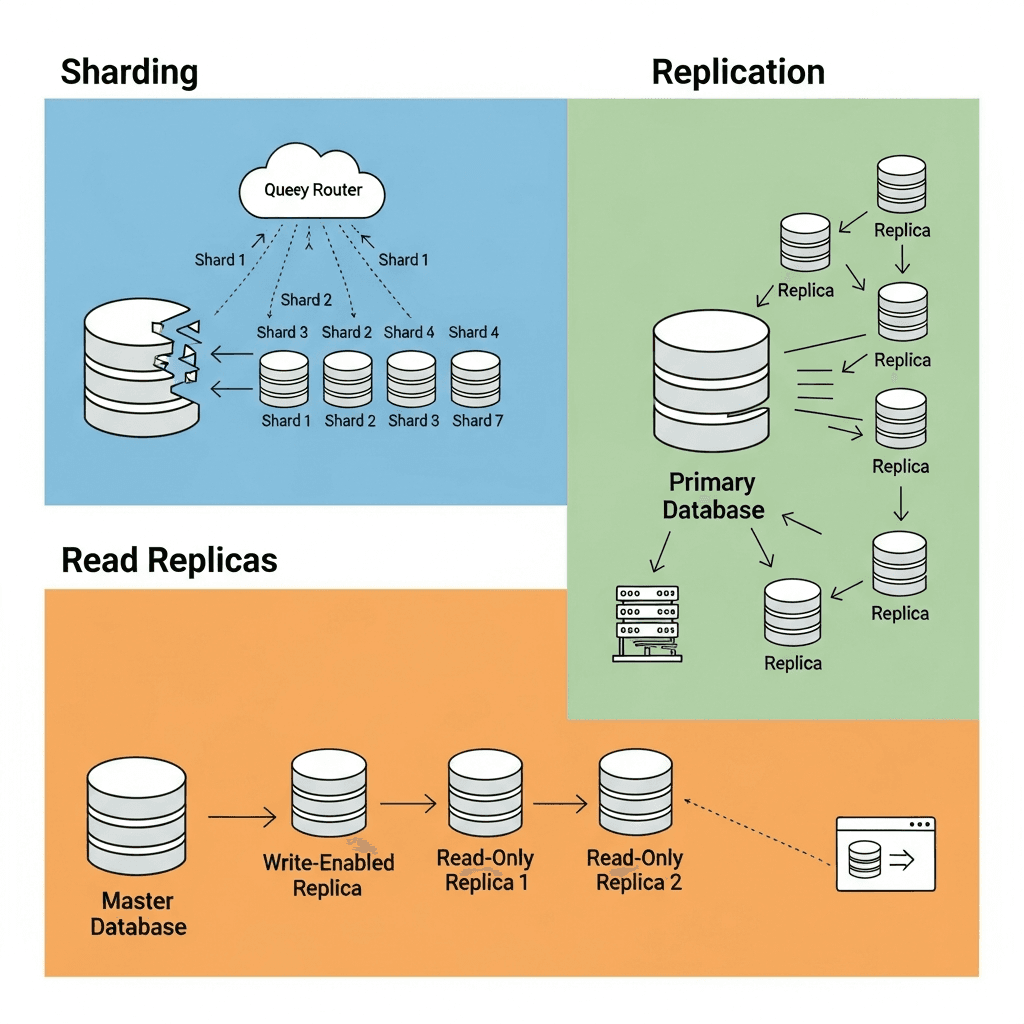
Replication is the process of creating and maintaining multiple copies of your database. It's a cornerstone for both high availability and improving read performance.
How Replication Works (Primary-Replica Architecture)
In a typical primary-replica (often called master-slave) setup:
- Primary (Master) Database: Handles all write operations (INSERT, UPDATE, DELETE) and often all read operations by default.
- Replica (Slave) Databases: Receive a continuous, real-time stream of changes (transaction logs or binary logs) from the primary and apply them to their own datasets. Replicas typically handle read operations only.
This architecture ensures that if the primary database fails, a replica can be promoted to become the new primary, minimizing downtime. Furthermore, by directing read traffic to replicas, the primary's workload is reduced, improving overall system responsiveness.
Synchronous vs. Asynchronous Replication
- Asynchronous Replication: The primary commits a transaction and acknowledges it to the client before the change has been applied to all replicas. This offers low latency for writes but means there's a small window where data on replicas might lag behind the primary. If the primary fails before changes are replicated, some data loss might occur on the replicas.
- Synchronous Replication: The primary commits a transaction and waits for confirmation from at least one (or all) replicas that they have received and applied the change before acknowledging the commit to the client. This guarantees data consistency across nodes but introduces higher write latency.
Most high-performance web applications opt for asynchronous replication due to its lower write latency, accepting the trade-off of potential eventual consistency.
Benefits of Replication
- High Availability & Disaster Recovery: If the primary fails, a replica can take over, ensuring business continuity.
- Read Scaling: Distribute read queries across multiple replicas, significantly increasing read throughput.
- Data Backups: Replicas can be used to perform backups without impacting the primary's performance.
- Reporting & Analytics: Offload complex analytical queries to a replica, preventing them from slowing down the primary.
Conceptual MySQL Replication Setup
This example outlines the basic steps for setting up MySQL primary-replica replication. The actual commands vary slightly by version and specific configuration.
-- On Primary Server:
-- 1. Enable binary logging
-- In my.cnf or my.ini:
-- log_bin = mysql-bin
-- server_id = 1
-- binlog_format = ROW

-- 2. Create a replication user
CREATE USER 'repl_user'@'%' IDENTIFIED BY 'your_password';
GRANT REPLICATION SLAVE ON *.* TO 'repl_user'@'%';
FLUSH PRIVILEGES;

-- 3. Lock tables and get primary status (for initial data dump)
FLUSH TABLES WITH READ LOCK;
SHOW MASTER STATUS; -- Note File and Position

-- (Perform a full backup of primary data here)

UNLOCK TABLES;

-- On Replica Server:
-- 1. Configure server ID
-- In my.cnf or my.ini:
-- server_id = 2

-- 2. Point replica to primary and start replication
CHANGE MASTER TO
    MASTER_HOST='primary_ip_address',
    MASTER_USER='repl_user',
    MASTER_PASSWORD='your_password',
    MASTER_LOG_FILE='noted_log_file',
    MASTER_LOG_POS=noted_log_position;

START SLAVE;

-- 3. Check replica status
SHOW SLAVE STATUS\G
Read Replicas: Offloading Read Workloads
Read replicas are a specific application of database replication primarily aimed at scaling read-heavy applications. While replication provides the underlying mechanism, read replicas refer to the architectural pattern where applications explicitly direct read queries to secondary database instances.
How Read Replicas Work with Application Logic
Applications are configured to send:
- Write operations (INSERT, UPDATE, DELETE) to the primary database.
- Read operations (SELECT) to one or more read replica databases.
This distribution significantly reduces the load on the primary, allowing it to focus on transaction processing and ensuring data integrity. It's particularly effective for applications with a high read-to-write ratio, which is common in many web services, content platforms, and e-commerce sites.
Use Cases and Considerations
- High-Traffic Websites: Serve static content, product listings, or user profiles from replicas.
- Reporting and Analytics: Run complex, long-running reports on replicas without impacting the production primary database.
- Geographical Distribution: Place read replicas closer to users in different regions to reduce latency.
Considerations: The main challenge with read replicas is eventual consistency. Due to the asynchronous nature of most replication setups, there's a delay (replication lag) between a write occurring on the primary and that change appearing on the replicas. Applications must be designed to tolerate this lag. For example, immediately after a user posts a comment, they might not see it on a page served by a replica until the change has propagated.
Application Logic for Directing Reads
Many ORMs and database drivers offer configuration options to define multiple database connections (one for writes, others for reads). Alternatively, you can implement this logic within your application layer.
# Conceptual Python/SQLAlchemy example for read/write splitting

from sqlalchemy import create_engine, text
from sqlalchemy.orm import sessionmaker

# Configure primary (write) and replica (read) engines
PRIMARY_DB_URL = "postgresql://user:pass@primary_host/dbname"
REPLICA_DB_URL = "postgresql://user:pass@replica_host/dbname"

primary_engine = create_engine(PRIMARY_DB_URL)
replica_engine = create_engine(REPLICA_DB_URL)

# Create session factories
PrimarySession = sessionmaker(bind=primary_engine)
ReplicaSession = sessionmaker(bind=replica_engine)

def get_user_data(user_id):
    # This is a read operation, use the replica
    with ReplicaSession() as session:
        # Example: Fetch user data
        result = session.execute(text("SELECT * FROM users WHERE id = :id"), {"id": user_id})
        return result.fetchone()

def update_user_email(user_id, new_email):
    # This is a write operation, use the primary
    with PrimarySession() as session:
        session.execute(text("UPDATE users SET email = :email WHERE id = :id"), {"email": new_email, "id": user_id})
        session.commit()
        print(f"User {user_id} email updated to {new_email}")

# Example Usage
# user = get_user_data(123)
# update_user_email(123, "new.email@example.com")
Sharding: Horizontal Partitioning for Write Scaling and Large Datasets
While replication primarily addresses read scaling and high availability, it doesn't solve the problem of a single database server becoming a bottleneck for write operations or when the total dataset size exceeds the capacity of a single machine. This is where sharding comes in.
What is Sharding?
Sharding is a method of horizontal partitioning, where a single logical database is divided into multiple smaller, more manageable parts called "shards." Each shard is a complete, independent database instance (or a replica set, as we'll see later) that contains a subset of the overall data.
Instead of all data residing on one server, different rows or tables are stored on different servers. This distributes both the data storage and the query/write workload across multiple machines, enabling massive scalability.
When to Use Sharding
- Massive Data Volumes: When your dataset is too large to fit on a single server or manage efficiently.
- High Write Throughput: When the primary database is overwhelmed by write operations.
- Geographical Distribution: To store data closer to users for lower latency (data locality).
The Importance of the Shard Key
Choosing an effective shard key (also known as a partition key) is the most critical decision in sharding. The shard key is the column or set of columns used to determine which shard a particular row of data belongs to. A good shard key ensures:
- Even Data Distribution: Data is spread uniformly across shards, preventing "hot spots" (one shard receiving disproportionately more traffic).
- Minimizing Cross-Shard Queries: Most queries can be routed to a single shard, avoiding complex and expensive distributed queries.
Sharding Strategies in Detail
Different strategies exist for selecting a shard key and distributing data:
1. Range-Based Sharding
Data is partitioned based on a range of values in the shard key. For example, users with IDs 1-1,000,000 go to Shard A, 1,000,001-2,000,000 to Shard B, and so on. Or, customers created in January go to Shard A, February to Shard B.
- Pros: Simple to implement for range queries (e.g., "find all users created last month"). Data for a specific range is co-located.
- Cons: Prone to hot spots if data distribution isn't uniform or if certain ranges experience higher activity. Rebalancing (moving data between shards) can be complex if ranges need to change.
2. Hash-Based Sharding
Data is distributed by applying a hash function to the shard key. The output of the hash function determines the shard. For example, hash(user_id) % number_of_shards.
- Pros: Excellent for even data distribution, reducing hot spots. Good for point queries (e.g., "find user by ID").
- Cons: Range queries become very inefficient as data is scattered. Adding or removing shards (rebalancing) can be very disruptive as the hash function logic needs to change, potentially requiring data movement for almost all rows.
3. Directory-Based Sharding
This strategy uses a lookup table (often stored in a separate, highly available database or service like ZooKeeper or Consul) that maps shard keys to specific shards. For example, a user_id maps to shard_id in the lookup table.
- Pros: Highly flexible. Allows for easy rebalancing and adding/removing shards by simply updating the lookup table. Can accommodate irregular data distribution.
- Cons: Introduces an additional hop for every query to consult the directory service, adding latency and a single point of failure (if the directory itself isn't highly available).
Conceptual Sharding Logic (Application Layer)
# Conceptual Python example for routing queries based on a shard key

SHARD_MAP = {
    0: "db_conn_string_shard_0",
    1: "db_conn_string_shard_1",
    # ... more shards
}
NUM_SHARDS = len(SHARD_MAP)

def get_shard_connection(user_id):
    # Simple hash-based sharding example
    shard_index = user_id % NUM_SHARDS
    conn_string = SHARD_MAP.get(shard_index)
    if not conn_string:
        raise ValueError(f"No connection string for shard {shard_index}")
    # In a real application, you'd manage a connection pool for each shard
    print(f"Routing user_id {user_id} to shard {shard_index} using {conn_string}")
    return create_engine(conn_string)

def insert_user_profile(user_id, data):
    engine = get_shard_connection(user_id)
    with engine.connect() as connection:
        # Execute INSERT query on the determined shard
        connection.execute(text("INSERT INTO user_profiles (id, data) VALUES (:id, :data)"), {"id": user_id, "data": data})
        connection.commit()

def get_user_profile(user_id):
    engine = get_shard_connection(user_id)
    with engine.connect() as connection:
        # Execute SELECT query on the determined shard
        result = connection.execute(text("SELECT * FROM user_profiles WHERE id = :id"), {"id": user_id})
        return result.fetchone()

# Example Usage
# insert_user_profile(1, "Profile for User 1")
# insert_user_profile(2, "Profile for User 2")
# profile_1 = get_user_profile(1)
# profile_2 = get_user_profile(2)
Challenges and Considerations with Sharding
Sharding introduces significant complexity that must be carefully managed.
- Application Complexity: The application logic needs to be aware of the sharding scheme to correctly route queries. This can be mitigated by using a sharding proxy or ORM features.
- Data Redistribution (Rebalancing): As data grows or traffic patterns change, shards can become unevenly loaded. Rebalancing involves moving data between shards, which is a complex, time-consuming, and potentially disruptive operation.
- Cross-Shard Queries: Queries that need to access data across multiple shards (e.g., joining tables that are on different shards, or aggregate queries over the entire dataset) are extremely difficult and inefficient. They often require complex fan-out/fan-in logic at the application layer or dedicated analytics systems.
- Schema Changes: Applying schema changes across many shards simultaneously can be a logistical nightmare.
- Distributed Transactions: Maintaining ACID properties for transactions that span multiple shards is notoriously hard and often requires sophisticated distributed transaction coordinators or eventual consistency models.
- Operational Overhead: Managing many independent database instances (backups, monitoring, patching) is more complex than managing a single one.
Hybrid Approaches: Combining Replication and Sharding
For truly massive-scale systems, sharding and replication are often combined. Each shard itself can be a primary-replica set. This provides the best of both worlds:
- Horizontal Scalability (Sharding): Distributes write load and data volume across multiple independent database clusters.
- High Availability & Read Scalability (Replication): Within each shard, replicas provide redundancy and allow for read scaling, ensuring that even if one primary shard fails, a replica can take over, and read traffic can be distributed.
Architectural Concept
Imagine your data is split into N shards. Each Shard_X consists of a Primary_X database and one or more Replica_X_1, Replica_X_2, etc. The application layer or a sharding proxy first determines the correct shard based on the shard key, and then within that shard, directs writes to the Primary_X and reads to Replica_X nodes.
This architecture is incredibly powerful but also significantly more complex to design, implement, and operate.
Best Practices for Database Scaling
- Start Simple (Vertical Scaling First): Don't jump to sharding prematurely. Maximize a single server's capacity and use read replicas first. Complexity has a cost.
- Monitor Everything: Implement robust monitoring for database performance (CPU, I/O, memory, query latency, replication lag, shard balance). This is crucial for identifying bottlenecks and making informed scaling decisions.
- Choose the Right Shard Key: If sharding, invest significant time in selecting a shard key that distributes data evenly and minimizes cross-shard queries.
- Plan for Data Growth: Design your scaling strategy with future growth in mind. How will you add new shards? How will you rebalance data?
- Test Failovers and Recovery: Regularly test your replication failover procedures and shard recovery processes to ensure they work as expected.
- Application-Level Awareness: Design your application to be aware of your scaling strategy. Use connection pools, implement retry logic, and handle eventual consistency if using asynchronous replication.
- Optimize Queries: Before scaling out, ensure your queries are efficient, indexes are properly utilized, and your schema is well-designed. Poor queries will perform poorly regardless of your scaling efforts.
- Use Connection Pooling: Efficiently manage database connections to reduce overhead on both the application and database servers.
Common Pitfalls to Avoid
- Premature Optimization: Implementing complex sharding before it's truly necessary adds overhead without immediate benefit. Scale reads with replicas first.
- Poor Sharding Key Choice: A bad shard key leads to hot spots, inefficient queries, and difficult rebalancing, negating the benefits of sharding.
- Ignoring Eventual Consistency: If using asynchronous replication, your application must gracefully handle the potential for stale reads. Don't assume immediate consistency if you're not enforcing it.
- Lack of Monitoring and Alerting: Without visibility into your database's health and performance, you'll be reacting to problems rather than proactively preventing them.
- Over-Engineering: Don't build custom sharding solutions if off-the-shelf tools or managed services can meet your needs. Leverage existing solutions where possible.
- Forgetting Backups and Disaster Recovery for Shards: Each shard needs its own robust backup and recovery strategy.
Tools and Technologies for Database Scaling
Many technologies and services can assist in implementing these patterns:
- Managed Database Services: Cloud providers like AWS RDS, Azure SQL Database, and Google Cloud SQL offer managed primary-replica setups and read replicas with minimal configuration. Some also offer sharding features (e.g., Aurora Serverless v2, Azure Cosmos DB for PostgreSQL).
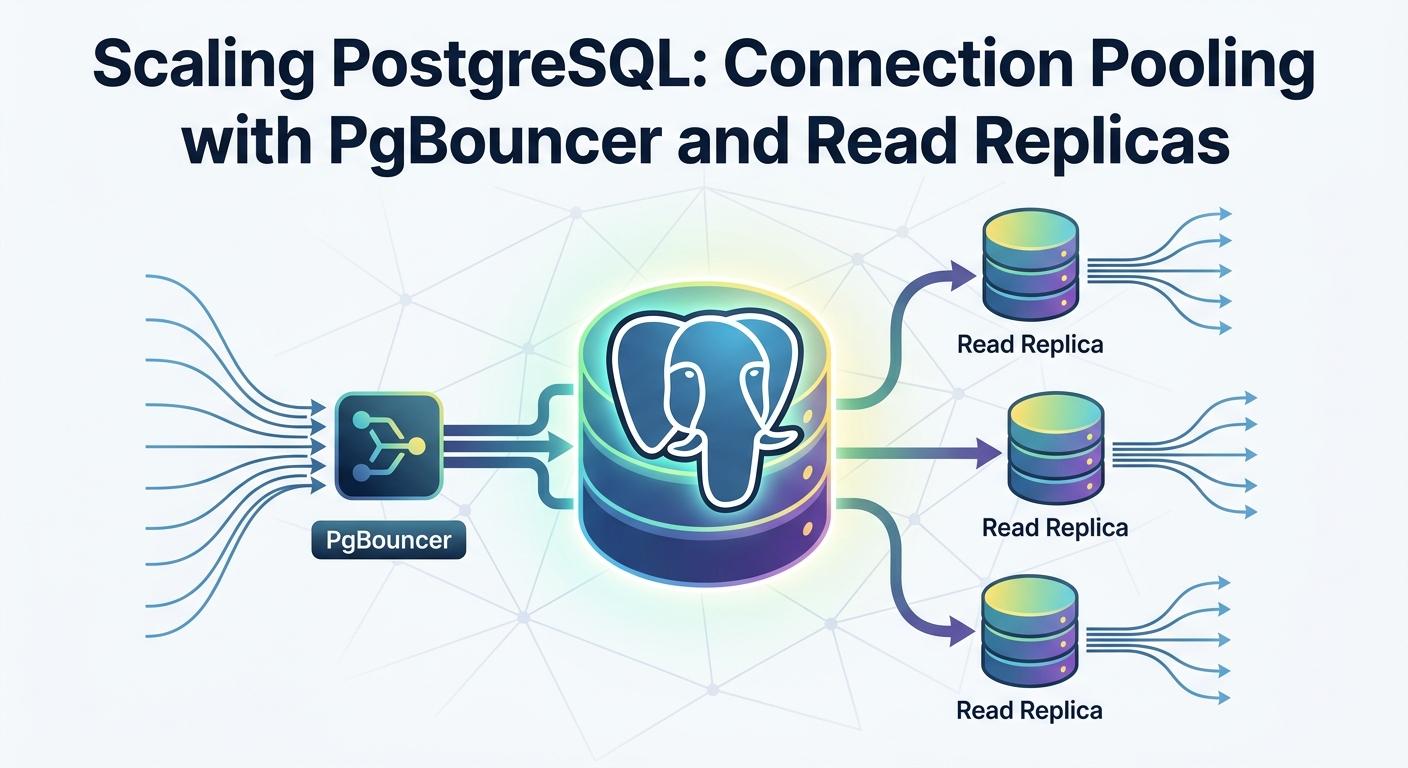
- Database Proxies: Tools like ProxySQL (for MySQL) or PgBouncer (for PostgreSQL) can sit between your application and database, handling connection pooling, query routing, and even read/write splitting automatically.
- Sharding Middleware: Projects like Vitess (for MySQL) provide a sophisticated sharding layer, handling query routing, rebalancing, and even distributed transactions across shards.
- NoSQL Databases: Many NoSQL databases (e.g., Cassandra, MongoDB, DynamoDB) are designed from the ground up for horizontal scalability and distributed data, often incorporating sharding and replication inherently into their architecture.
Conclusion
Database scaling is a journey, not a destination. Understanding and strategically applying patterns like Replication, Read Replicas, and Sharding is crucial for building high-performance, resilient, and continuously available applications. Start with simpler methods like vertical scaling and read replicas, and only introduce the complexity of sharding when your write throughput or data volume genuinely demand it.
Always prioritize robust monitoring, careful planning, and thorough testing. By mastering these techniques, you can ensure your data infrastructure can gracefully evolve with your application's success, supporting millions of users and petabytes of data without breaking a sweat.
Written by
CodewithYohaFull-Stack Software Engineer with 7+ years of experience in Java, Spring Boot, and cloud architecture across AWS, Azure, and GCP. Writing production-grade engineering patterns for developers who ship real software.