
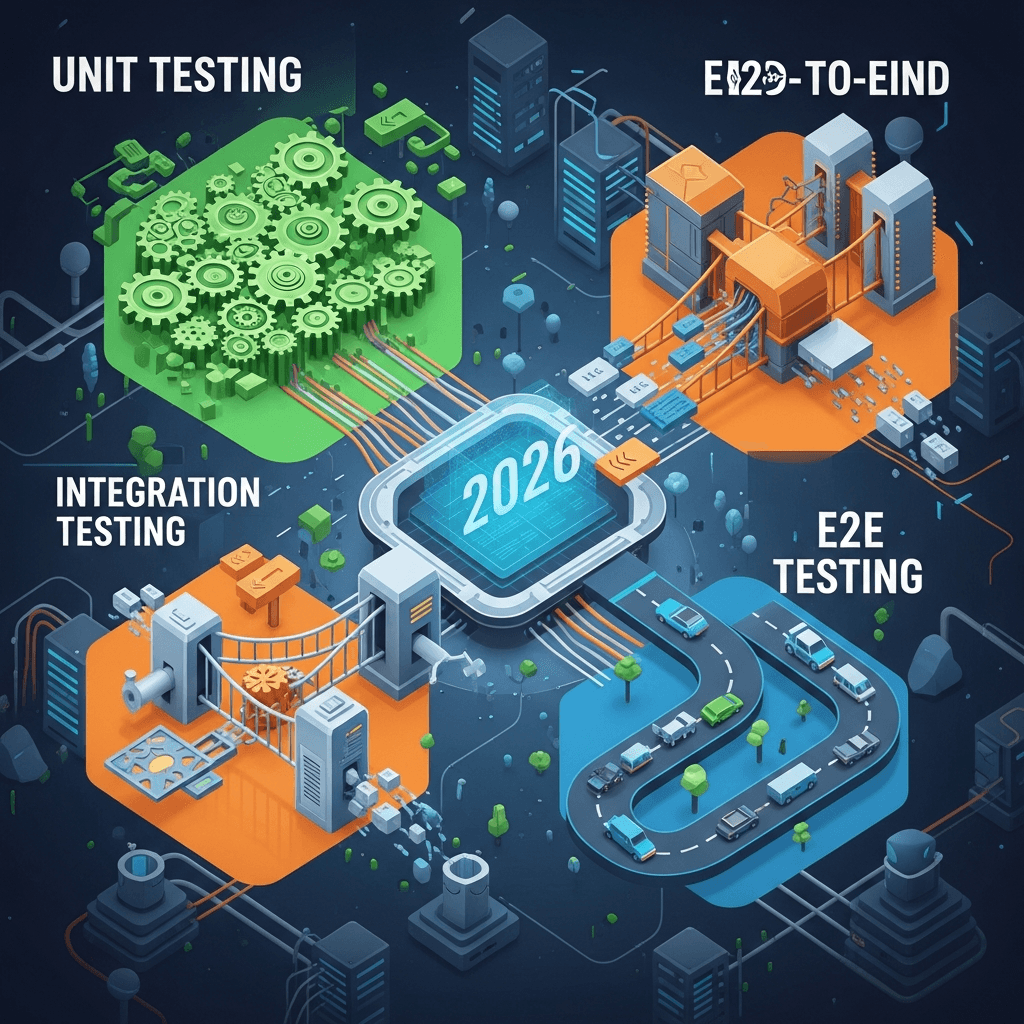
Introduction: The Imperative of Quality in 2026
In the rapidly evolving digital landscape of 2026, software isn't just a product; it's the backbone of every industry. From AI-powered autonomous systems to hyper-personalized user experiences, the demands on software quality, reliability, and performance have never been higher. Bugs aren't just inconveniences; they can lead to significant financial losses, reputational damage, or even safety hazards. This reality underscores the critical importance of a robust, modern testing strategy.
Gone are the days when testing was an afterthought, a separate phase relegated to the end of the development cycle. Today, testing is a continuous, integrated process, woven into every stage of the software development lifecycle (SDLC). This article will guide you through the essential modern testing strategies – Unit, Integration, and End-to-End (E2E) testing – exploring their roles, best practices, and how they collectively ensure your software is ready for the challenges and opportunities of 2026 and beyond.
Prerequisites
To get the most out of this guide, a basic understanding of software development principles, common programming constructs, and familiarity with concepts like Continuous Integration/Continuous Deployment (CI/CD) pipelines will be beneficial. We'll use JavaScript/TypeScript for code examples, but the principles apply universally across languages and frameworks.
The Evolving Landscape of Testing in 2026
The testing landscape is dynamic. In 2026, we see increased adoption of AI/ML in testing, a stronger emphasis on shift-left and shift-right methodologies, and the ubiquitous presence of microservices and serverless architectures. Test automation is no longer a luxury but a necessity, and observability plays a crucial role in understanding post-deployment behavior. The goal remains the same: deliver high-quality software faster and more reliably.
The Testing Pyramid Revisited: A Balanced Approach
The classic testing pyramid (coined by Mike Cohn) suggests a high volume of fast, isolated unit tests at the base, fewer integration tests in the middle, and a small number of slow, comprehensive E2E tests at the top. While still fundamentally sound, its interpretation has evolved. Some now advocate for a "testing trophy" or "ice cream cone" where the integration layer is thicker, particularly in microservices architectures where service interactions are paramount. Regardless of the exact shape, the core principle remains: prioritize faster, cheaper tests, and use slower, more expensive tests judiciously.
Unit Testing: The Foundation of Quality
Unit testing is the bedrock of any solid testing strategy. It involves testing individual, isolated units of code – typically a function, method, or class – to ensure they behave as expected in isolation. These tests are fast, cheap to write, and provide immediate feedback to developers.
Why Unit Testing is Crucial
- Early Bug Detection: Catches bugs at the source, preventing them from propagating.
- Code Quality: Encourages modular, testable code, leading to better design.
- Refactoring Confidence: Provides a safety net when making changes to existing code.
- Documentation: Tests serve as living documentation of how individual units are supposed to work.
Tools for Unit Testing
For JavaScript/TypeScript: Jest, Vitest, Mocha, Jasmine.
For Java: JUnit, TestNG.
For .NET: NUnit, XUnit.
For Go: testing package.
Code Example: Basic Unit Test (JavaScript/Jest)
Let's consider a simple utility function that calculates the sum of an array of numbers.
// src/utils/math.js
export function sum(numbers) {
  if (!Array.isArray(numbers)) {
    throw new Error('Input must be an array.');
  }
  return numbers.reduce((acc, current) => acc + current, 0);
}

// tests/unit/math.test.js
import { sum } from '../../src/utils/math';

describe('sum function', () => {
  // Test case 1: Sum of positive numbers
  test('should return the correct sum for an array of positive numbers', () => {
    expect(sum([1, 2, 3])).toBe(6);
  });

  // Test case 2: Sum with zero
  test('should return the correct sum when zero is included', () => {
    expect(sum([0, 5, 10])).toBe(15);
  });

  // Test case 3: Sum of negative numbers
  test('should return the correct sum for an array of negative numbers', () => {
    expect(sum([-1, -2, -3])).toBe(-6);
  });

  // Test case 4: Empty array
  test('should return 0 for an empty array', () => {
    expect(sum([])).toBe(0);
  });

  // Test case 5: Non-array input (error handling)
  test('should throw an error if input is not an array', () => {
    expect(() => sum(123)).toThrow('Input must be an array.');
    expect(() => sum('hello')).toThrow('Input must be an array.');
    expect(() => sum(null)).toThrow('Input must be an array.');
  });
});
Advanced Unit Testing Techniques: Mocks, Stubs, and Spies
When a unit of code has external dependencies (e.g., a database, an API call, another complex module), we use test doubles to isolate the unit under test. This ensures that the test only fails if the unit itself is broken, not its dependencies.
- Mocks: Objects that record calls made to them and can be configured to return specific values. They allow us to assert that a dependency was called in a certain way.
- Stubs: Objects that hold predefined data and return it when called. They don't have assertion capabilities for how they were called, just what they return.
- Spies: Wrappers around existing functions/methods that allow us to observe their behavior (e.g., how many times they were called, with what arguments) without altering their original implementation.
Code Example: Mocking a Dependency (JavaScript/Jest)
Imagine a UserService that fetches user data from an API.
// src/services/api.js
export const api = {
  fetchUser: async (userId) => {
    // In a real app, this would make an actual HTTP request
    console.log(`Fetching user ${userId} from actual API`);
    const response = await fetch(`https://api.example.com/users/${userId}`);
    if (!response.ok) {
      throw new Error('Failed to fetch user');
    }
    return response.json();
  },
  // ... other API methods
};

// src/services/userService.js
import { api } from './api';

export class UserService {
  async getUserProfile(userId) {
    try {
      const user = await api.fetchUser(userId);
      return { id: user.id, name: user.name, email: user.email };
    } catch (error) {
      console.error(`Error fetching user profile: ${error.message}`);
      throw new Error('Could not retrieve user profile');
    }
  }
}

// tests/unit/userService.test.js
import { UserService } from '../../src/services/userService';
import { api } from '../../src/services/api';

// Mock the entire api module
jest.mock('../../src/services/api');

describe('UserService', () => {
  let userService;

  beforeEach(() => {
    userService = new UserService();
  });

  test('should return user profile if API call is successful', async () => {
    // Configure the mock to return a specific value
    api.fetchUser.mockResolvedValueOnce({
      id: '123',
      name: 'John Doe',
      email: 'john.doe@example.com',
      // Potentially more data than the service cares about
      address: '123 Main St'
    });

    const userId = '123';
    const profile = await userService.getUserProfile(userId);

    // Assert that the API was called correctly
    expect(api.fetchUser).toHaveBeenCalledWith(userId);
    expect(profile).toEqual({
      id: '123',
      name: 'John Doe',
      email: 'john.doe@example.com',
    });
  });

  test('should throw an error if API call fails', async () => {
    // Configure the mock to reject with an error
    api.fetchUser.mockRejectedValueOnce(new Error('Network error'));

    const userId = '456';
    await expect(userService.getUserProfile(userId)).rejects.toThrow('Could not retrieve user profile');
    expect(api.fetchUser).toHaveBeenCalledWith(userId);
  });
});
Integration Testing: Connecting the Pieces
Integration testing verifies the interactions between different units or components of a system. This could involve testing the communication between a service and a database, two microservices, or a frontend component and its backend API. The goal is to ensure that these interconnected parts work correctly together.
Why Integration Testing is Vital
- Interface Validation: Confirms that components communicate correctly through their interfaces.
- System Flow: Verifies data flow and functional paths across multiple modules.
- Catching Integration Bugs: Uncovers issues that unit tests miss, such as incorrect data serialization, API contract mismatches, or database connection problems.
Challenges
- Setup Complexity: Requires setting up multiple components (e.g., database, message queues, external services).
- Data Management: Ensuring consistent and clean test data.
- Slower Execution: Generally slower than unit tests due to external dependencies.
Tools for Integration Testing
For JavaScript/TypeScript: Supertest (for API testing), Testcontainers (for containerized dependencies).
For Java: Spring Boot Test, Testcontainers.
For .NET: Microsoft.AspNetCore.Mvc.Testing package.
Code Example: API Endpoint Integration Test (JavaScript/Supertest)
Let's test an Express.js API endpoint that relies on a database.
// src/models/userRepository.js
// In a real app, this would connect to a database (e.g., PostgreSQL, MongoDB)
const usersDb = []; // In-memory mock for demonstration

export const userRepository = {
  async findById(id) {
    return usersDb.find(u => u.id === id);
  },
  async create(user) {
    usersDb.push(user);
    return user;
  },
  // ... other CRUD operations
};

// src/app.js
import express from 'express';
import { userRepository } from './models/userRepository';

const app = express();
app.use(express.json());

app.post('/users', async (req, res) => {
  try {
    const newUser = { id: String(Date.now()), name: req.body.name, email: req.body.email };
    await userRepository.create(newUser);
    res.status(201).json(newUser);
  } catch (error) {
    res.status(500).json({ message: 'Error creating user' });
  }
});

app.get('/users/:id', async (req, res) => {
  try {
    const user = await userRepository.findById(req.params.id);
    if (user) {
      res.status(200).json(user);
    } else {
      res.status(404).json({ message: 'User not found' });
    }
  } catch (error) {
    res.status(500).json({ message: 'Error fetching user' });
  }
});

export default app; // Export for testing

// tests/integration/userApi.test.js
import request from 'supertest';
import app from '../../src/app';
import { userRepository } from '../../src/models/userRepository';

// Mock the in-memory database for clean state between tests
const mockUsersDb = [];
jest.spyOn(userRepository, 'findById').mockImplementation(async (id) => {
  return mockUsersDb.find(u => u.id === id);
});
jest.spyOn(userRepository, 'create').mockImplementation(async (user) => {
  mockUsersDb.push(user);
  return user;
});

describe('User API Integration Tests', () => {
  // Clear the mock database before each test
  beforeEach(() => {
    mockUsersDb.length = 0; // Clear array
  });

  test('POST /users should create a new user', async () => {
    const newUser = { name: 'Alice', email: 'alice@example.com' };
    const response = await request(app)
      .post('/users')
      .send(newUser)
      .expect(201);

    expect(response.body).toHaveProperty('id');
    expect(response.body.name).toBe('Alice');
    expect(response.body.email).toBe('alice@example.com');
    expect(mockUsersDb.length).toBe(1);
    expect(mockUsersDb[0].name).toBe('Alice');
  });

  test('GET /users/:id should return a user if found', async () => {
    const userToCreate = { id: 'test-1', name: 'Bob', email: 'bob@example.com' };
    mockUsersDb.push(userToCreate);

    const response = await request(app)
      .get('/users/test-1')
      .expect(200);

    expect(response.body).toEqual(userToCreate);
  });

  test('GET /users/:id should return 404 if user not found', async () => {
    await request(app)
      .get('/users/non-existent-id')
      .expect(404);
  });
});
Service-Level Testing (API Testing)
Service-level testing, often considered a specialized form of integration testing, focuses specifically on the public interfaces of services, typically RESTful APIs or GraphQL endpoints. It's crucial for microservices architectures where services communicate extensively via APIs. These tests ensure the API contract is honored, handling various request/response scenarios.
Why Service-Level Testing is Important
- Decoupled Testing: Allows testing services independently of their UI.
- Contract Enforcement: Validates that API endpoints behave as documented.
- Performance Baseline: Can be extended to performance testing.
Tools for Service-Level Testing
Postman/Newman (for collections), Cypress (for API testing), Axios/Fetch (programmatic).
End-to-End (E2E) Testing: The User's Perspective
E2E testing simulates real user scenarios, interacting with the application through its user interface (UI) from start to finish. These tests cover the entire application stack, from the UI down to the database and any integrated external services. E2E tests are the final validation that the entire system works as expected for the user.
Why E2E Testing Matters
- User Experience Validation: Ensures critical user flows are functional.
- System Health Check: Verifies that all integrated components work together in a production-like environment.
- Confidence in Deployment: Provides the highest level of assurance before a release.
Challenges
- Flakiness: Highly susceptible to UI changes, network latency, and timing issues.
- Slow Execution: Involves launching browsers and traversing UI elements, making them the slowest tests.
- High Maintenance: Costly to write and maintain due to their complexity and coupling to the UI.
- Environment Dependency: Requires a fully configured, production-like environment.
Tools for E2E Testing
Cypress, Playwright, Selenium, Puppeteer.
Code Example: E2E Login Flow (JavaScript/Playwright)
Let's test a simple login page.
// tests/e2e/login.spec.js
import { test, expect } from '@playwright/test';

test.describe('Login Feature', () => {
  test.beforeEach(async ({ page }) => {
    // Navigate to the login page before each test
    await page.goto('http://localhost:3000/login'); // Assuming your app runs on port 3000
  });

  test('should allow a user to log in successfully with valid credentials', async ({ page }) => {
    // Fill in the username and password fields
    await page.fill('input[name="username"]', 'testuser');
    await page.fill('input[name="password"]', 'password123');

    // Click the login button
    await page.click('button[type="submit"]');

    // Expect to be redirected to the dashboard or see a success message
    await expect(page).toHaveURL('http://localhost:3000/dashboard');
    await expect(page.locator('h1')).toHaveText('Welcome, testuser!');
  });

  test('should display an error message with invalid credentials', async ({ page }) => {
    // Fill in invalid credentials
    await page.fill('input[name="username"]', 'invaliduser');
    await page.fill('input[name="password"]', 'wrongpass');

    // Click the login button
    await page.click('button[type="submit"]');

    // Expect to stay on the login page and see an error message
    await expect(page).toHaveURL('http://localhost:3000/login');
    await expect(page.locator('.error-message')).toHaveText('Invalid username or password');
  });

  test('should show validation errors for empty fields', async ({ page }) => {
    // Click login without filling any fields
    await page.click('button[type="submit"]');

    // Expect validation messages for both fields
    await expect(page.locator('#username-error')).toHaveText('Username is required');
    await expect(page.locator('#password-error')).toHaveText('Password is required');
  });
});
The Role of AI in Modern Testing (2026 Context)
AI and Machine Learning are no longer futuristic concepts in testing; they are becoming integral to modern strategies. In 2026, AI-powered tools assist in:
- Test Case Generation: AI can analyze code changes, user behavior, and existing tests to suggest or generate new test cases, improving coverage and reducing manual effort.
- Self-Healing Tests: AI-driven tools can automatically adapt E2E tests to minor UI changes (e.g., changed element locators), significantly reducing test maintenance and flakiness.
- Anomaly Detection: ML models can analyze test results and production logs to identify patterns indicating potential issues that human eyes might miss.
- Predictive Analytics: AI can predict which parts of the codebase are most likely to contain bugs based on commit history, code complexity, and past defect data, guiding testing efforts.
- Visual Regression Testing: AI-powered visual testing tools can detect subtle UI changes that impact user experience, beyond pixel-perfect comparisons.
Tools like MABL, Applitools, and Reflect are leading the charge, and we expect more sophisticated AI integrations into mainstream testing frameworks.
Best Practices for a Robust Testing Strategy
- Shift-Left Testing: Integrate testing activities as early as possible in the SDLC. Developers write unit tests alongside code, and QA participates in design discussions.
- Automate Everything Possible: Manual testing should be reserved for exploratory testing, usability, and edge cases that are impractical to automate. Automate unit, integration, and critical E2E flows.
- Maintainable Tests: Write clear, concise, and readable tests. Use descriptive names, follow the AAA (Arrange, Act, Assert) pattern, and avoid unnecessary complexity.
- Fast Feedback Loops: Tests should run quickly, especially unit and integration tests, to provide immediate feedback to developers. Integrate tests into your CI pipeline.
- Realistic Test Data: Use representative, anonymized production data or generate realistic synthetic data. Avoid hardcoding values; use factories or builders.
- Environment Consistency: Strive for testing environments that closely mirror production, especially for integration and E2E tests, to minimize "works on my machine" issues.
- Observability and Post-Deployment Testing (Shift-Right): Implement robust logging, monitoring, and tracing. Use canary deployments, dark launches, and A/B testing, coupled with synthetic monitoring and real user monitoring (RUM), to validate functionality and performance in production.
- Developer Ownership: Developers should be responsible for writing and maintaining their unit and integration tests.
- Test in Parallel: Leverage cloud-based testing platforms or parallel execution in CI/CD to speed up test suites, particularly for E2E tests.
Common Pitfalls and How to Avoid Them
- Over-reliance on E2E Tests: While crucial, too many E2E tests lead to slow feedback, high flakiness, and costly maintenance. Prioritize the testing pyramid; use E2E for critical user journeys only.
- Insufficient Integration Testing: Neglecting the integration layer leaves significant gaps. Components might work in isolation but fail when combined due to interface mismatches, data issues, or environmental factors.
- Poor Test Data Management: Inconsistent, outdated, or insufficient test data can lead to unreliable tests and missed bugs. Invest in robust test data generation and management strategies.
- Ignoring Test Failures: "Flaky" tests that are consistently ignored or quarantined without investigation erode confidence in the test suite. Address flakiness promptly.
- Tests as an Afterthought: Bolting on tests at the end of the development cycle is inefficient and often results in poorly written, brittle tests for un-testable code. Integrate testing from the start.
- Neglecting Performance or Security Testing: Functional correctness is not enough. Performance bottlenecks and security vulnerabilities can cripple an application. Incorporate performance, load, and security testing into your strategy.
- Testing the Obvious: Avoid writing tests that provide little value (e.g., testing simple getters/setters in trivial classes). Focus on business logic, complex interactions, and potential failure points.
Conclusion: Building for Reliability and Resilience
In 2026, a modern testing strategy is not merely a quality gate; it's an accelerator for innovation and a shield against operational failures. By embracing a balanced approach with unit, integration, and E2E tests, leveraging automation, and integrating AI-powered tools, development teams can build robust, reliable, and resilient software that meets the demands of an ever-changing world.
Remember, testing is a continuous journey of improvement. Regularly review your test coverage, analyze test results, and adapt your strategy to the evolving needs of your application and the technological landscape. Invest in your testing infrastructure, empower your developers, and foster a culture where quality is everyone's responsibility. This commitment to modern testing strategies will ensure your software not only functions today but thrives in the future.

Written by
CodewithYohaFull-Stack Software Engineer with 7+ years of experience in Java, Spring Boot, and cloud architecture across AWS, Azure, and GCP. Writing production-grade engineering patterns for developers who ship real software.