
Building Multi-Tenant SaaS: Isolation Strategies & Architecture Deep Dive

Introduction
In today's cloud-first world, Software as a Service (SaaS) has become the dominant delivery model for applications. A cornerstone of efficient SaaS development is multi-tenancy: a single instance of software running on a single server, serving multiple distinct customer organizations (tenants). This approach offers significant advantages, including lower operational costs, simplified maintenance, faster feature delivery, and efficient resource utilization.
However, building a multi-tenant application is not without its complexities. The primary challenge lies in ensuring robust isolation between tenants – preventing data leakage, guaranteeing performance, and providing customized experiences without compromising the shared infrastructure. A poorly designed multi-tenant system can lead to security vulnerabilities, 'noisy neighbor' issues where one tenant's activities impact others, and significant scaling headaches.
This comprehensive guide will deep dive into the architectural considerations and isolation strategies essential for building secure, scalable, and high-performing multi-tenant SaaS applications. We'll explore various data isolation models, application and infrastructure-level techniques, crucial security measures, and practical best practices to navigate this challenging but rewarding architectural pattern.
Prerequisites
To get the most out of this article, a basic understanding of:
- Web application development concepts (front-end, back-end, APIs)
- Relational and NoSQL database concepts
- Cloud computing fundamentals (IaaS, PaaS, SaaS)
- Basic security principles (authentication, authorization)
Understanding Multi-Tenancy Models
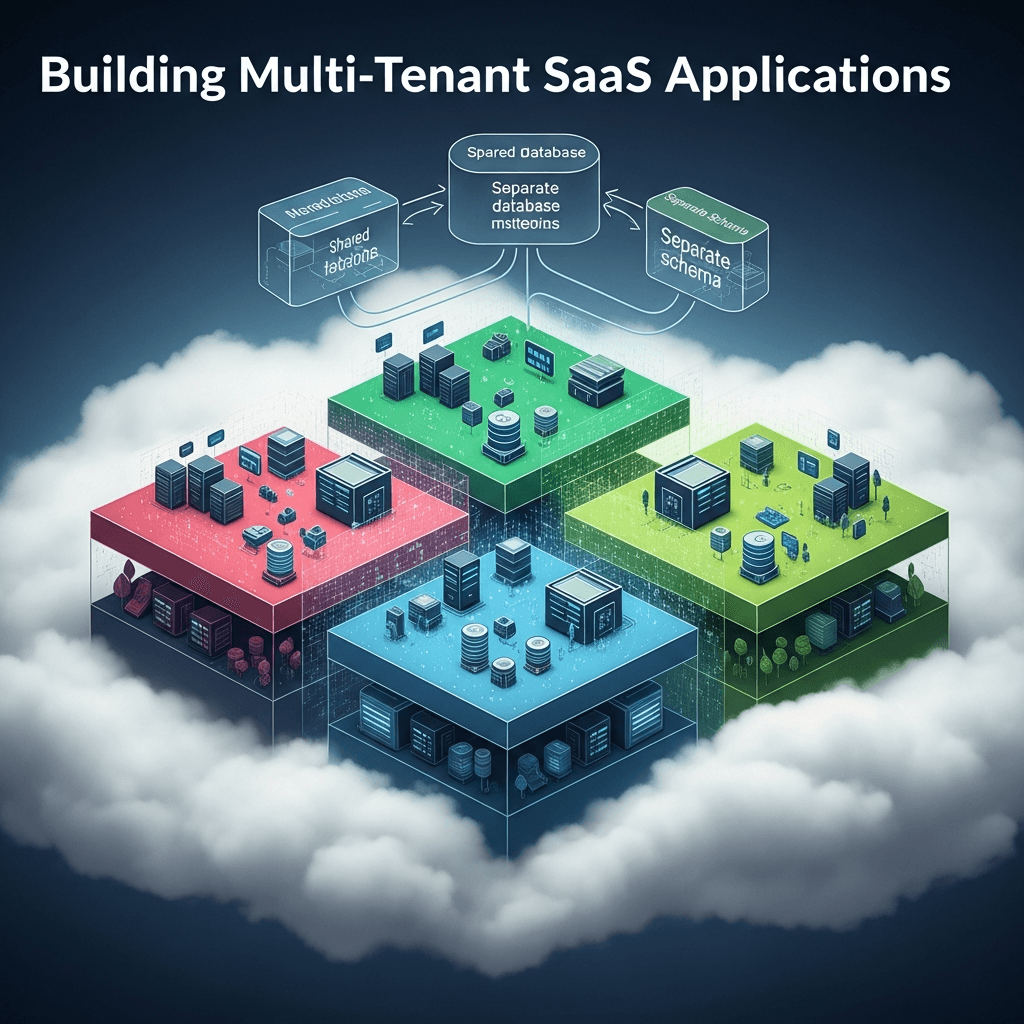
Before diving into isolation, it's crucial to understand the spectrum of multi-tenancy models, which primarily differ in how deeply tenants share resources.
Single-Tenant vs. Multi-Tenant
- Single-Tenant: Each customer gets a dedicated instance of the application and its infrastructure (database, servers). Offers maximum isolation and customization but is resource-intensive and expensive to maintain.
- Multi-Tenant: Multiple customers share a single instance of the application and its underlying infrastructure. Offers cost efficiency and easier maintenance but requires careful design for isolation.
Spectrum of Multi-Tenancy Isolation
Multi-tenancy itself can be implemented with varying degrees of isolation:
-
Shared Everything (Least Isolation):
- Description: All tenants share the same application instance, database, and even tables within that database. Tenant data is typically differentiated by a
tenant_idcolumn in every table. - Pros: Easiest to implement initially, most resource-efficient, lowest cost per tenant.
- Cons: Highest risk of data leakage if
tenant_idfilters are missed, potential 'noisy neighbor' issues, complex backups/restores per tenant, limited customization. - Use Case: Early-stage startups, low-security applications, internal tools.
- Description: All tenants share the same application instance, database, and even tables within that database. Tenant data is typically differentiated by a
-
Shared Database, Separate Schema/Tables-per-Tenant:
- Description: Tenants share the same database server, but each tenant has its own set of tables or a dedicated schema within that database. The application instance is still shared.
- Pros: Better logical isolation than 'shared everything', easier tenant-specific backups/restores (schema level), clearer data separation.
- Cons: Still shares database server resources (potential 'noisy neighbor'), schema migrations can be complex across many schemas, database size can grow rapidly.
- Use Case: Mid-tier SaaS, applications requiring moderate isolation and customization.
-
Separate Database, Shared Application:
- Description: Each tenant has its own dedicated database instance (or a separate database within a shared database server). The application instances are still shared.
- Pros: Strong data isolation, easy tenant-specific backups/restores, better performance characteristics per tenant (dedicated resources), easier to scale individual tenants.
- Cons: Higher operational overhead (more database instances to manage), increased cost, connection management complexity.
- Use Case: High-security SaaS, enterprise-grade applications, tenants with specific data residency requirements.
-
Separate Application, Separate Database (Most Isolation):
- Description: Each tenant gets a dedicated application instance and a dedicated database. Effectively, this is closer to a single-tenant model but managed under a multi-tenant umbrella (e.g., automated provisioning).
- Pros: Maximum isolation, dedicated performance, highest customization, easiest to meet regulatory compliance.
- Cons: Highest cost, most complex to operate and maintain, slowest feature delivery across all tenants.
- Use Case: Highly regulated industries, large enterprise customers with unique demands, mission-critical applications.
Data Isolation Strategies
Choosing the right data isolation strategy is paramount. It dictates security, scalability, and operational complexity.
1. Row-Level Security (RLS) / Discriminator Column
This is the most common approach for the 'Shared Everything' model. Every table that stores tenant-specific data includes a tenant_id column. All queries must filter by this tenant_id.
How it Works:
- Application-Enforced: The application code explicitly adds
WHERE tenant_id = current_tenant_idto every database query. - Database-Enforced (RLS): Modern databases like PostgreSQL, SQL Server, and Oracle offer native Row-Level Security features. Policies are defined on tables to automatically filter rows based on the current user's (or application's) context.
Pros:
- Most cost-effective due to maximum resource sharing.
- Simplified schema management (single schema).
- Easy to implement for basic multi-tenancy.
Cons:
- High Risk of Data Leakage: A single missed
WHEREclause in the application code can expose data across tenants. - 'Noisy Neighbor' problem: A single large tenant can impact others' performance.
- Complex per-tenant backup/restore.
- Limited customization.
Code Example (Application-Enforced SQL with tenant_id)
-- Schema for a shared database with tenant_id
CREATE TABLE Products (
    id SERIAL PRIMARY KEY,
    tenant_id INT NOT NULL,
    name VARCHAR(255) NOT NULL,
    price DECIMAL(10, 2) NOT NULL
);

-- Example of retrieving products for a specific tenant (application-enforced)
SELECT id, name, price
FROM Products
WHERE tenant_id = :currentTenantId;

-- Example of inserting data for a specific tenant
INSERT INTO Products (tenant_id, name, price)
VALUES (:currentTenantId, 'Laptop', 1200.00);
2. Schema-per-Tenant
In this model, each tenant has its own dedicated schema within a shared database. All tables for a tenant reside within their schema, e.g., tenant_A.products, tenant_B.products.
How it Works:
- The application dynamically switches the database schema context based on the current tenant.
- Database connection strings can remain the same, but the default schema or search path is altered.
Pros:
- Stronger logical isolation than RLS.
- Easier per-tenant backups and restores at the schema level.
- Reduced risk of accidental cross-tenant data leakage (schema-level separation).
- Can support minor schema customizations per tenant if needed.
Cons:
- Increased database management complexity (many schemas).
- Schema migrations need to be applied to all tenant schemas.
- Still susceptible to 'noisy neighbor' if not properly resource-managed at the DB level.
Code Example (PostgreSQL Schema-per-Tenant)
-- Create a new schema for Tenant A
CREATE SCHEMA tenant_A;

-- Create a products table within Tenant A's schema
CREATE TABLE tenant_A.products (
    id SERIAL PRIMARY KEY,
    name VARCHAR(255) NOT NULL,
    price DECIMAL(10, 2) NOT NULL
);

-- Create a new schema for Tenant B
CREATE SCHEMA tenant_B;

-- Create a products table within Tenant B's schema
CREATE TABLE tenant_B.products (
    id SERIAL PRIMARY KEY,
    name VARCHAR(255) NOT NULL,
    price DECIMAL(10, 2) NOT NULL
);

-- Application logic to switch schema (e.g., at the start of a request)
-- For Tenant A
SET search_path TO tenant_A, public;
SELECT id, name, price FROM products; -- Automatically queries tenant_A.products

-- For Tenant B
SET search_path TO tenant_B, public;
SELECT id, name, price FROM products; -- Automatically queries tenant_B.products
3. Database-per-Tenant
Each tenant gets its own dedicated database instance. This is often implemented using managed database services (e.g., Amazon RDS, Azure SQL Database, Google Cloud SQL) where provisioning a new database is automated.
How it Works:
- The application maintains a mapping of
tenant_idto database connection string. - Upon tenant request, the application retrieves the appropriate connection string and connects to the tenant's dedicated database.
Pros:
- Highest data isolation: No accidental data leakage across tenants.
- Excellent performance isolation: 'Noisy neighbor' problems are largely eliminated at the database level.
- Easy per-tenant backup, restore, and data migration.
- Simplified compliance and data residency requirements (data physically separated).
- Can scale individual tenants independently (e.g., give a large tenant a more powerful DB instance).
Cons:
- Higher infrastructure costs (more database instances).
- Increased operational complexity (managing many database instances).
- Connection pooling can be more complex to manage efficiently across many databases.
Code Example (Database-per-Tenant Connection Management - Pseudocode)
// In a Node.js/Express application
const tenantDbConnections = new Map(); // Map tenant_id to database client/pool

async function getTenantDbClient(tenantId) {
    if (tenantDbConnections.has(tenantId)) {
        return tenantDbConnections.get(tenantId);
    }

    // Assume a function to lookup connection string from a tenant config service
    const connectionString = await lookupTenantConnectionString(tenantId);

    // Create a new database client/pool for the tenant
    const newClient = new DatabaseClient(connectionString);
    await newClient.connect();

    tenantDbConnections.set(tenantId, newClient);
    return newClient;
}

// Example usage in an API endpoint
app.get('/api/products', async (req, res) => {
    const tenantId = req.tenantId; // Resolved from middleware
    const dbClient = await getTenantDbClient(tenantId);
    const products = await dbClient.query('SELECT * FROM products');
    res.json(products);
});
Application-Level Isolation
Beyond data storage, the application layer itself needs to be tenant-aware and ensure proper isolation.
Tenant Context Propagation
Every request entering the system must be associated with a tenant_id. This context needs to be propagated throughout the application stack.
How it Works:
- Tenant Identification: The
tenant_idcan be extracted from:- Subdomain:
tenantA.mysaas.com->tenant_id = A - Custom HTTP Header:
X-Tenant-ID: A - JWT Claims: The
tenant_idis embedded in the JSON Web Token after authentication. - URL Path:
mysaas.com/A/products
- Subdomain:
- Middleware/Interceptors: An early-stage middleware (or filter/interceptor) intercepts incoming requests, resolves the
tenant_id, and stores it in a request-scoped context (e.g., a thread-local variable, request object). - Propagation: Subsequent layers (services, repositories) access this context to perform tenant-specific operations (e.g., constructing database queries, accessing tenant-specific caches).
Code Example (Node.js/Express Middleware for Tenant Resolution)
// tenantMiddleware.js
function tenantMiddleware(req, res, next) {
    // Example: Resolve tenant from subdomain or header
    const host = req.hostname;
    let tenantId = null;

    if (host.includes('.')) {
        // Assuming subdomain like tenantA.example.com
        tenantId = host.split('.')[0];
    } else if (req.headers['x-tenant-id']) {
        // Or from a custom header
        tenantId = req.headers['x-tenant-id'];
    }

    if (!tenantId) {
        return res.status(400).send('Tenant ID not provided or resolved.');
    }

    req.tenantId = tenantId; // Attach tenantId to the request object
    next();
}

// In your main application file (e.g., app.js)
const express = require('express');
const app = express();

app.use(tenantMiddleware);

app.get('/api/data', (req, res) => {
    // Now req.tenantId is available throughout the request lifecycle
    const tenantId = req.tenantId;
    // Use tenantId to fetch data or perform actions specific to this tenant
    res.send(`Data for tenant: ${tenantId}`);
});

app.listen(3000, () => console.log('Server running on port 3000'));
Resource Pooling & Caching
- Tenant-Aware Caching: Caches must be tenant-aware to prevent data leakage. This means cache keys should incorporate the
tenant_id(e.g.,cache:tenantA:products) or use separate cache instances per tenant. - Resource Quotas: Implement application-level quotas (e.g., API rate limits, storage limits, concurrent user limits) per tenant to prevent one tenant from consuming excessive resources and impacting others.
Infrastructure and Service Isolation
Cloud infrastructure offers various ways to isolate tenants, complementing data and application-level strategies.
Shared Infrastructure with Logical Separation
- Containerization (Kubernetes): Use Kubernetes namespaces to logically separate tenant-specific deployments. Resource quotas can be applied to namespaces to limit CPU/memory usage, preventing 'noisy neighbors'.
- Serverless Functions (AWS Lambda, Azure Functions): Functions can be written to be tenant-aware, using the tenant context to access specific resources. For higher isolation, separate function deployments per tenant are possible but increase operational overhead.
Dedicated Infrastructure
- Dedicated Instances/VMs: For very large or sensitive tenants, provision entirely separate VMs or cloud instances. This is the ultimate form of isolation but comes with the highest cost.
- Virtual Private Clouds (VPCs)/Virtual Networks: Deploying tenants into separate VPCs or subnets provides network-level isolation, ensuring traffic from one tenant cannot directly access another's resources.
Security Considerations
Security is paramount in multi-tenant environments. A breach affecting one tenant can have catastrophic consequences for the entire platform.
- Tenant-Aware Authentication & Authorization: Ensure that user authentication is tenant-specific and that authorization checks always include the
tenant_idto prevent users from one tenant accessing resources of another. - Strict Access Control: Implement granular role-based access control (RBAC) that is tenant-scoped. A user's role in Tenant A should not grant them any privileges in Tenant B.
- Data Encryption: Encrypt data at rest (database, storage) and in transit (TLS/SSL for all communications). Consider tenant-specific encryption keys for highly sensitive data.
- Auditing and Logging: Implement comprehensive, tenant-aware logging and auditing. All actions, especially those related to data access and modification, should be logged with the associated
tenant_idfor compliance and forensics. - Input Validation and Sanitization: Prevent common web vulnerabilities (SQL injection, XSS) that could be exploited to bypass tenant isolation.
- Cross-Tenant Data Leakage Prevention: This is the most critical. Rigorous testing, code reviews, and automated security scans must focus on ensuring that
tenant_idfilters are always correctly applied and cannot be circumvented.
Scalability and Performance
Multi-tenant systems inherently aim for scalability and efficiency. Proper design can unlock massive potential.
- Database Sharding: For 'database-per-tenant' or even 'schema-per-tenant' models, sharding (distributing data across multiple database servers) can be implemented. Tenants can be sharded based on their ID, allowing for horizontal scaling of the database layer.
- Load Balancing: Distribute incoming requests across multiple application instances. Ensure load balancers are configured to maintain session affinity if tenant context is session-bound, or use stateless services for easier scaling.
- Tenant-Aware Monitoring: Implement monitoring solutions that can provide metrics per tenant (e.g., API calls, error rates, resource usage). This helps identify 'noisy neighbors' or tenants requiring dedicated resources.
- Asynchronous Processing: Use message queues (e.g., Kafka, RabbitMQ, SQS) for background tasks. This decouples long-running operations from user requests, improving responsiveness and preventing resource contention.
- Connection Pooling: Optimize database connection pooling. For 'database-per-tenant', managing many pools efficiently can be challenging. Consider dynamic pool sizing or connection multiplexing.
Common Pitfalls and Anti-Patterns
Building multi-tenant applications is challenging. Avoiding these common mistakes is crucial:
- Ignoring Isolation Early: Retrofitting isolation into a single-tenant application is extremely difficult and costly. Design for multi-tenancy from day one.
- Hardcoding Tenant IDs: Never hardcode tenant IDs in the application logic. Always resolve them dynamically from the request context.
- Insufficient Testing: Lack of comprehensive tenant-aware integration and security testing can lead to data leaks or functional bugs specific to certain tenants.
- Noisy Neighbor Neglect: Failing to implement resource quotas or monitoring to identify and mitigate 'noisy neighbor' issues can degrade performance for all tenants.
- Over-Engineering for Small Tenants: Don't implement the most complex isolation model (e.g., separate application/database) for every tenant if it's not justified by their size, security needs, or revenue. Start simpler and scale up isolation as needed.
- Poor Tenant Provisioning/De-provisioning: Manual processes for creating or deleting tenants are error-prone and don't scale. Automate these workflows fully.
- Inconsistent Tenant Context: Losing the
tenant_idcontext during a request (e.g., in background jobs or inter-service communication) can lead to incorrect data access.
Best Practices for Multi-Tenant SaaS
To build a successful multi-tenant SaaS application, adhere to these best practices:
- Design for Isolation First: Make tenant isolation a core architectural principle from the outset. This influences database design, API design, and infrastructure choices.
- Automate Tenant Lifecycle Management: Automate the provisioning, configuration, scaling, and de-provisioning of tenants. This reduces operational overhead and human error.
- Implement Robust Tenant Context Resolution: Ensure the
tenant_idis reliably identified and propagated throughout the entire application stack for every request. - Prioritize Security at Every Layer: Conduct regular security audits, implement strong authentication/authorization, and ensure all data access is tenant-scoped.
- Choose the Right Isolation Strategy: Select your data isolation model (RLS, schema-per-tenant, database-per-tenant) based on your target market, security requirements, scalability needs, and budget. It's often a mix, evolving as your product grows.
- Implement Comprehensive Monitoring and Alerting: Track tenant-specific metrics for performance, errors, and resource usage. Set up alerts to proactively address issues and identify 'noisy neighbors'.
- Plan for Data Management: Develop clear strategies for per-tenant data backup, restore, migration, and deletion (e.g., for compliance with GDPR, CCPA).
- Build for Scalability: Design components to be stateless where possible, leverage cloud-native services, and anticipate horizontal scaling needs for both application and database tiers.
- API Design: Ensure all public APIs are tenant-aware and enforce tenant-specific access rules.
- Customization Strategy: Define how much customization (UI, workflow, integrations) you will allow per tenant and design your architecture to support it without breaking multi-tenancy.
Real-World Use Cases & Examples
Multi-tenancy is ubiquitous in modern SaaS applications across various domains:
- Customer Relationship Management (CRM) Systems: Salesforce, HubSpot. Each customer organization has its own set of leads, contacts, and opportunities, all isolated within a shared platform.
- Project Management Tools: Jira, Asana. Teams from different companies use the same application, but their projects, tasks, and users are strictly separated.
- Analytics and Business Intelligence Platforms: Tableau Cloud, Power BI. Different organizations upload their data for analysis, expecting complete isolation and dedicated performance.
- E-commerce Platforms: Shopify. Merchants create their stores on a shared platform, benefiting from shared infrastructure while maintaining their unique storefronts and product data.
- HR and Payroll Systems: Workday, Gusto. Sensitive employee and financial data for various companies are managed securely and separately.
These platforms often employ a hybrid approach, using simpler isolation (like RLS or schema-per-tenant) for smaller tenants and offering dedicated database or even application instances for large enterprise clients with higher demands for isolation, performance, and compliance.
Conclusion
Building multi-tenant SaaS applications is a complex but highly rewarding endeavor. It offers unparalleled efficiency and scalability, enabling businesses to serve a broad customer base with a single, maintainable codebase. The key to success lies in a thoughtful architectural design that prioritizes tenant isolation, security, and performance from the very beginning.
By carefully selecting the appropriate data isolation strategy, implementing robust application-level context propagation, and leveraging cloud infrastructure for both shared and dedicated resources, developers can construct a resilient and secure multi-tenant platform. Always remember that security is not an afterthought but an integral part of the design process, especially when dealing with shared resources.
The journey to a robust multi-tenant SaaS is iterative. Start with a model that suits your initial needs and be prepared to evolve your isolation strategies as your customer base grows and their requirements become more diverse. With careful planning and adherence to best practices, you can unlock the full potential of the multi-tenant SaaS model.
Written by
CodewithYohaFull-Stack Software Engineer with 7+ years of experience in Java, Spring Boot, and cloud architecture across AWS, Azure, and GCP. Writing production-grade engineering patterns for developers who ship real software.